Today, HONOR has announced its new 200 series in Europe, which consists of the HONOR 200, HONOR 200 Lite and HONOR 200 Pro. The entire lineup focuses on AI-powered portrait photography, with the partnership that HONOR has started with Studio Harcourt.
The HONOR 200 Pro is the star of this new lineup, with a price of £699, while the HONOR 200 is priced at £499. Pre-sales will start immediately for both models. The HONOR 200 Lite will debut a bit later this Summer.
With the HONOR 200 series, the company has partnered with Studio Harcourt, which is a very popular studio in Paris that takes portraits of all of the big celebrities and politicians. During a pre-briefing last month, I was able to take a tour at Studio Harcourt in Paris and really see what the HONOR 200 Pro is capable of, and let me just say this, it’s pretty incredible. While HONOR is using AI to do portrait photography, it’s actually not needed. With AI turned off, I was still able to capture some incredible portrait shots.
HONOR is also announcing a new collaboration with renowned portrait photographer Rankin. Who is famous for his iconic shots of celebrities, including Queen Elizabeth II, David Bowie, and Kate Moss. This partnership will have further details announced in the coming weeks. HONOR is also announcing that the MagicBook 16 Pro – announced in Barcelona back at MWC – will be launching in some European countries later this Summer.
HONOR 200 Pro sports two 50-megapixel cameras
Now for the specs, the HONOR 200 Pro sports two 50-megapixel cameras on the backside, one being a f/1.9 wide camera and the other being a telephoto camera. There is also a 12-megapixel ultrawide camera, but that’s not being used for portraits. The Studio Harcourt mode uses two 50-megapixel cameras. The HONOR 200 Pro is also able to provide better light sensing capabilities, ensuring clear and true captures of distant objects with exceptional details.
Inside the HONOR 200 Pro is the Snapdragon 8s Gen 3, 12GB of RAM, and 512GB of storage. There is also a massive 5,200mAh capacity Silicon-Carbon battery – the same type of battery used in the Magic6 series earlier this year. Finally, this also uses a 6.78-inch curved 120Hz display with a peak brightness of 4,000 nits.
Onto the HONOR 200, the phone is pretty much identical, aside from the processor – which is a Snapdragon 7 Gen 3. It also has a 6.7-inch display at up to 120Hz refresh rate and 4,000 nits of peak brightness. It also has the exact same camera setup, as well as the same size battery – a 5,200mAh Silicon-Carbon battery. However, HONOR is offering 200 additional SKUs. So there will be an 8GB RAM and 256GB storage model, as well as 12GB/256GB and 12GB/512GB. Obviously, the £499 price is for the 8GB/256GB model.
Finally, the HONOR 200 Lite. With the Lite, HONOR is sticking with the same portrait photography features as the 200 and 200 Pro models. But it is using different cameras. On the HONOR 200 Lite, there is a 108-megapixel main camera with a f/1.75 aperture and High-Res mode available. It also includes a 5-megapixel wide and depth camera and a 2-megapixel macro camera. HONOR also includes a 50-megapixel front camera with a selfie light for some pretty artistic lighting effects. Similar to the other models in this lineup, the HONOR 200 Lite also sports a 6.7-inch display, with 3240Hz risk-free PWM dimming and a peak brightness of 2000 nits. There’s also 8GB of RAM and 256GB of storage. The HONOR 200 Lite is available starting today for £279.99.
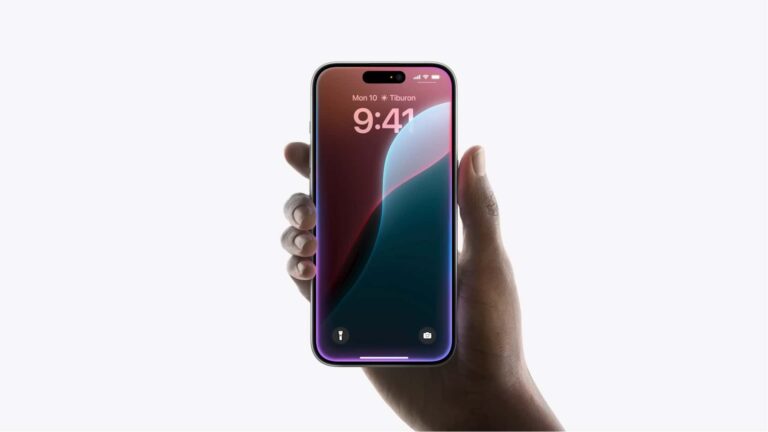
WWDC 2024 just happened, and Apple just introduced us to its take on AI called Apple Intelligence. The presentation was impressive enough, but the company didn’t hammer home just how incredible it is. So, Apple released a video showing Apple Intelligence in action.
You will be able to try out Apple Intelligence when the features eventually land on iOS 18. It’s limited to phones from the iPhone 15 Pro on, so if you’re using an older iPhone, then you’re out of luck. In any case, if you want to know how to install the iOS 18 developer beta, you can read our useful guide.
Apple shows off Apple Intelligence in a new video
In case you need any more reasons to know that Apple Intelligence is popular, the video is currently sitting at 3.1 million views, and it’s #44 on Trending. Rightfully so, as Apple Intelligence just check-mated both Gemini and Galaxy AI. Both Google’s and Apple’s on-device features don’t go much further than text generation, translation, and summarization.
However, Apple managed to massage AI into the very core of iOS and deliver an experience much more seamless and unified. Apple Intelligence has the typical slew of text generation and summarization tools as well. You can have the AI rewrite text for you like emails, create a TLDR, outline key points of what you write, etc. This is all stuff that we’ve seen before.
Another thing that we’ve seen before is image generation, but Apple took a less traditional approach to it. With Genmoji, the company allows you to artificially generate emojis to use in chat. The Image Playground is the company’s larger-scale image generation platform. You can use it to generate larger and more detailed images.
Apple Intelligence
So, those are things that we’ve seen already, but what’s new? Well, Siri just got a huge makeover. Firstly, you can speak to Siri more naturally. It will also remember the context of the conversation, so you can have a continuous conversation without needing to repeat details. In fact, Siri will learn about you from a plethora of apps on your phone so you won’t have to train it on information about you.
The AI will also surface the most important notifications to you. This still doesn’t fix the issue that people have with iOS’s notifications, but it’s a step in the right direction.
Those are just a few of the things that Apple Intelligence is bringing. We’re certain that other companies are going to up their AI game in order to compete with it.
Hackers go for Apple due to its massive user base along with rich customers, including business people and managers who use those devices with some important information.
Even with these security measures in place, Apple is a likely target since there will always be risks and the opportunity to obtain valuable information that lures the threat actors.
Recently, CertiK’s CertiKSkyfall team, one of the leading security-focused ranking platforms, discovered that a critical flaw (CVE-2024-27801) in Apple ecosystems lets threat actors gain unauthorized access.
Vulnerability Details
The vulnerability, which was tracked as CVE-2024-27801, has been identified in the low-level implementation of NSXPC, which was found to affect all Apple platforms.
This was a potential security flaw, as attackers might have laundered their applications to access limited services and personal and corporate user data.
With ANYRUN You can Analyze any URL, Files & Email for Malicious Activity : Start your Analysis
The vulnerability revealed a possible avenue of attack on third-party apps similar in architecture and structure to Telegram.
This has to be addressed since, if exploited then, it would enable cyber attackers to compromise crucial security features together with access privileged control on the impacted devices.
As a result, the attackers could have obtained extensive permissions and control over the services.
This empowers them to run code of their choice on the systems, set up undesirable configurations, or obtain the data stored locally within these services.
Moreover, from third-party applications that shared similar architectures to Telegram, the vulnerability presented a risk of data exfiltration.
The consequences of such a vulnerability are immense. It could have weakened the privacy and security assurances provided by impacted applications, which can demoralize users’ trust and result in diverse risks and dangers for users and businesses.
Besides this, the cybersecurity researchers developed a proof-of-concept exploit that demonstrated the severity of the vulnerability.
The @CertiKSkyfall team identified and collaborated with @Apple to fix a vulnerability (CVE-2024-27801) in the low-level implementation of NSXPC, affecting all Apple platforms.
This vulnerability could have potentially allowed malicious apps to gain unauthorized access to… pic.twitter.com/sjgS1SExF9
Specifically, the proof-of-concept attack was designed to surreptitiously exfiltrate sensitive data from Telegram’s local storage on the compromised device and then transfer the stolen data to a remote server.
The successful execution of this proof-of-concept attack underscored the critical nature of the vulnerability.
Looking for Full Data Breach Protection? Try Cynet's All-in-One Cybersecurity Platform for MSPs: Try Free Demo
Following days of user pushback that included allegations of forcing a “spyware-like” Terms of Service (ToS) update into its products, design software giant Adobe explained itself with several clarifications.
Apparently, the concerns raised by the community, especially among Photoshop and Substance 3D users, caused the company to reflect on the language it used in the ToS. The adjustments that Adobe announced earlier this month suggested that users give the company unlimited access to all their materials—including materials covered by company Non-Disclosure Agreements (NDAs)—for content review and similar purposes.
As Adobe included in its Terms of Service update:
“As a Business User, you may have different agreements with or obligations to a Business, which may affect your Business Profile or your Content. Adobe is not responsible for any violation by you of such agreements or obligations.
This wording immediately sparked the suspicion that the company intends to use user-generated content to train its AI models. In particular, users balked at the following language:
“[.] you grant us a non-exclusive, worldwide, royalty-free sublicensable, license, to use, reproduce, publicly display, distribute, modify, create derivative works based on, publicly perform, and translate the Content.”
To reassure these users, on June 10, Adobe explained:
“We don’t train generative AI on customer content. We are adding this statement to our Terms of Use to reassure people that is a legal obligation on Adobe. Adobe Firefly is only trained on a dataset of licensed content with permission, such as Adobe Stock, and public domain content where copyright has expired.”
Alas, several artists found images that reference their work on Adobe’s stock platform.
As we have explained many times, the length and the use of legalese in the ToS does not do either the user or the company any favors. It seems that Adobe understands this now as well.
“First, we should have modernized our Terms of Use sooner. As technology evolves, we must evolve the legal language that evolves our policies and practices not just in our daily operations, but also in ways that proactively narrow and explain our legal requirements in easy-to-understand language.”
Adobe also said in its blog post that it realized it has to earn the trust of its users and is taking the feedback very seriously and it will be grounds to discuss new changes. Most importantly it wants to stress that you own your content, you have the option to opt out of the product improvement program, and that Adobe does not scan content stored locally on your computer.
Adobe expects to roll out new terms of service on June 18th and aims to better clarify what Adobe is permitted to do with its customers’ work. This is a developing story, and we’ll keep you posted.
We don’t just report on privacy—we offer you the option to use it.
Privacy risks should never spread beyond a headline. Keep your online privacy yours by using Malwarebytes Privacy VPN.
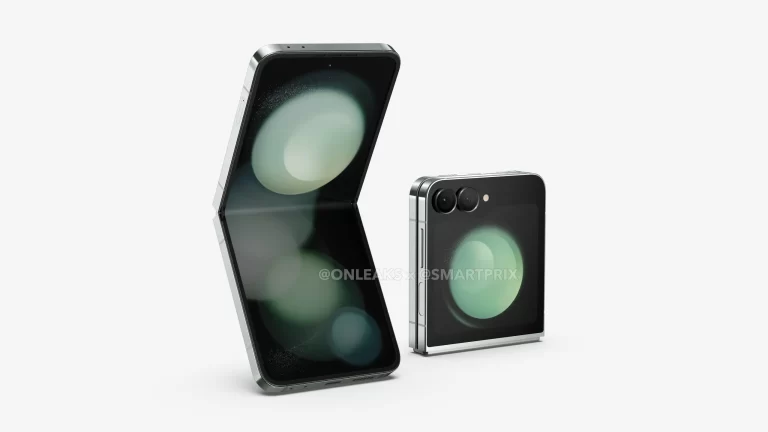
We’re all gearing up for the next Galaxy Unpacked event where we’re going to see Samsung’s latest foldable phones. Samsung has been able to keep the price of its clamshell foldable phone pretty reasonable, but that might change. According to a new report, the Galaxy Z Flip 6 could get a price increase.
The price of tech is going up, and that is unfortunate for the people looking to get their hands on it. Over the past year or so, we’ve seen some companies try to reverse this trend by bringing down the price of the foldable phone. For example, devices like the Razr 2023, Tecno Phantom Flip, and ZTE Nubia Flip all undercut the Galaxy S Flip 5. So, we’re not sure what Samsung is going to do about the prices for its phones.
However, we are following rumors that the company is going to bring a more affordable phone under its FE branding. We’re going to have to see if the company will follow through.
The Galaxy Z Flip 6 could see a price increase
This is never good news to hear, but you’ll want to take it with a grain of salt. The report states that the Galaxy Z Flip 6 could see a price increase of $100 at least. The Galaxy Z Flip 5 (Review) started at $999, which is where it’s been for a while. That’s also the price that the Motorola Razr+ launched at.
However, according to the report, it looks like the 256GB model will start at $1,099 (INR 1,09,999 in India). If you want to double the storage, you’ll need to shell out a whopping $1,219 (INR 1,19,999 in India). Samsung’s foldable phones are great, but the competition is heating up in the market. More companies are unlocking the secrets of creating great foldable phones, and they’re pricing them competitively. The question is: if Samsung raises its prices, will it be able to weather the next wave of phones from competitors? It’s the most popular foldable phone company in the world, but it can only rest on its laurels for so old.
As for the rumored specs, we are sure that it’s going to use the Snapdragon 8 Gen 3 SoC (or a specialized version for Galaxy phones). The screen could stay the same 6.7 inches, and we expect to see the same outer display at last year’s clamshell.
The major announcements to take place during the event are likely to revolve around AI. These phones will likely have additional Galaxy AI features that we didn’t see with the Galaxy S24 phones.
A critical vulnerability (CVE-2024-37051) in the JetBrains GitHub plugin for IntelliJ-based IDEs (2023.1 and later) exposed access tokens to malicious content within GitHub pull requests, allowing attackers to steal tokens and potentially compromise linked accounts, even with two-factor authentication enabled.
JetBrains has addressed the issue with a patch and collaborated with GitHub on mitigation efforts.
Users are advised to update their IDEs and consider revoking any GitHub tokens used by the plugin.
They have provided available fixed versions for JetBrains IDEs as of today, while Aqua currently has a single fixed version available, 2024.1.2.
With ANYRUN You can Analyze any URL, Files & Email for Malicious Activity : Start your Analysis
CLion offers multiple fixed versions, spanning from 2023.1.7 all the way up to the latest Early Access Program (EAP) build, 2024.2 EAP2. DataGrip and DataSpell each have a fixed version from the current year (2024.1.4 and 2024.1.2, respectively).
GoLand and IntelliJ IDEA users benefit from a wider range of fixed versions, including those from 2023 and the current EAP builds for 2024.2.
Finally, MPS offers fixed versions starting in the middle of 2023 (2023.2.1), with the latest being an EAP build from the current year (2024.1 EAP2).
A security vulnerability in the JetBrains GitHub plugin that could expose access tokens has been patched, which affects all IntelliJ-based IDEs (including PhpStorm, PyCharm, Rider, RubyMine, WebStorm, and RustRover) from version 2023.1 onwards.
The JetBrains GitHub plugin has been updated with the fix, and insecure versions have been removed from the JetBrains Marketplace.
Users are strongly recommended to update the plugin to the latest version immediately.
An external security report submitted on May 29, 2024, identified a vulnerability (CVE-2024-37051) in the JetBrains GitHub plugin for IntelliJ-based IDEs (version 2023.1 and later).
The vulnerability could expose a user’s GitHub access token to a malicious third-party if a pull request containing malicious content is handled by the IDE, while updating to the latest IDE version is strongly recommended to mitigate this vulnerability.
JetBrains identified a security vulnerability in their GitHub plugin for IntelliJ-based IDEs (versions 2023.1 and later) that could expose access tokens, and to mitigate this issue, they contacted GitHub and implemented measures that might cause the plugin to malfunction in older IDE versions.
While a permanent fix is underway, updating the plugin and IDE to the latest versions is crucial to ensuring security and full functionality.
To ensure compatibility and security when using the JetBrains IDE GitHub integration plugin, update to the latest IDE version, and if you’ve used the plugin’s pull request features, revoke any associated GitHub tokens.
The plugin might use OAuth or Personal Access Tokens (PATs). Revoke them through GitHub’s application settings or token management page.
Note that revoking tokens disables all plugin features, including Git operations, requiring reconfiguration.
Looking for Full Data Breach Protection? Try Cynet's All-in-One Cybersecurity Platform for MSPs: Try Free Demo
Google’s next smartwatch will be the Pixel Watch 3 and rumors have suggested that it may come in a larger size this year, and thanks to new leaked images obtained by Android Headlines, we now understand that that larger model will be the Pixel Watch 3 XL. Previously suspected to be called the Pixel Watch 3 Pro which would match up with Google’s flagship Pixel phone lineup, the company is instead calling it the Pixel Watch 3 XL.
This naming scheme would suggest that the larger model will come with a larger display (and potentially a larger battery), but likely no other different specs. Whereas with devices like the Pixel 8 and Pixel 8 Pro, the “Pro” model actually comes with enough different hardware and features to warrant the pro name. Google is expected to reveal the new Pixel Watch devices at its upcoming hardware event later this year. However, thanks to these leaked Pixel 3 XL images, you can catch a glimpse of it well ahead of time.
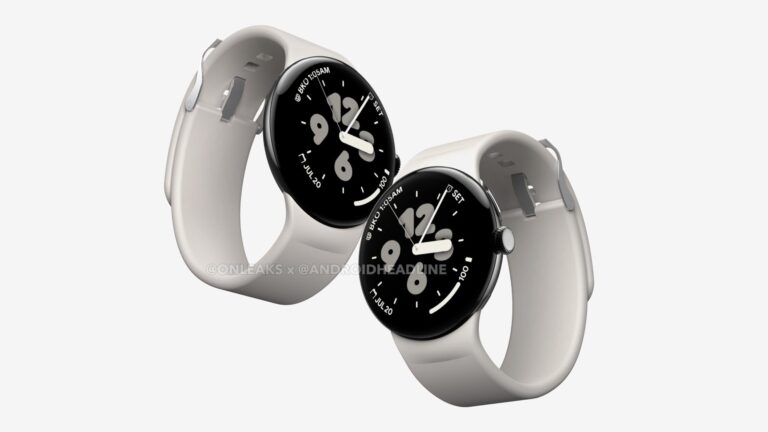
Pixel Watch 3 XL leaked images confirm no change to the design
Google’s first Pixel Watch caught people’s attention because of its elegant design. So far, Google has seen no reason to change things up. This was true with the release of the Pixel Watch 2. An earlier leak of the Pixel Watch 3 seemed to suggest Google would continue down this path. Now we have leaked images of the Pixel Watch 3 XL and, once again, nothing about the design is different.
Leaked renders (provided by OnLeaks), showcase Google’s commitment to the ongoing style of the original watch. A seamless, domed glass design inspired by the continuous surface of a water droplet. You also still have the digital crown on the right with a singular button above it. While the overall design looks to remain the same, that doesn’t mean Google hasn’t changed anything at all.
The Pixel Watch 3 XL will be thicker with a 1.45-inch display and a larger band system
Past rumors had already hinted that Google would finally be releasing a larger version of the Pixel Watch with this year’s release. That appears to be true. According to the leak, the size of the display will be 1.45 inches. This is compared to the 1.2-inch panel on the Pixel Watch 3 and both previous Pixel Watch devices.
Additionally, the Pixel Watch 3 XL will be thicker. Google is bumping up the thickness of the watch body to 13.89mm. The full dimensions of the watch body will be 45mm x 45mm x 13.89mm. This is suspected to be so that Google can pack a larger battery and more sensors into this new watch. While we don’t have any specific details on more sensors or the larger battery, we do know that Google has slightly altered the band system for the Pixel Watch 3 XL.
The XL watch has a larger band attachment system
According to the leaks, the Pixel Watch 3 XL will come with a larger band attachment system. This should be expected, but it’s worth mentioning. With the larger display and larger watch body, the attachment system is also growing in size. This means that the bands for the Pixel Watch 3 and the Pixel Watch 3 XL will not be interchangeable. Unfortunately, this also means if you upgrade from a Pixel Watch 2 to the Pixel Watch 3 XL, you won’t be able to use those old bands you may have accumulated.
Speaking of the bands, the one shown in the images looks to be a slightly updated version of the crafted leather band. Since it uses the same clasp. That being said, these are just renders. There’s no texture to the band material surface. So it’s tough to tell if this band uses a hybrid leather of some kind like on the older crafted leather band. It does seem to come in the same Porcelain color, although Google may not call it that.
Announced at MWC Barcelona back in February, HONOR is finally providing details on when you can get the MagicBook Pro 16 in Europe. And how much it’ll cost.
The MagicBook Pro 16 will be available starting today in select European markets, with a starting price of €1299. It will also be available in either white or purple colorways.
HONOR’s MagicBook Pro 16 is powerful, yet sleek
I was able to go hands-on with the MagicBook Pro 16 at MWC in February, and it really blew me away. It’s a solid laptop that feels extremely light and is incredibly powerful. It boasts a 16-inch HONOR FullView Display with a resolution of 3072 x 1920 and has a 93% screen-to-body ratio. Meaning that the bezels here are extremely small. The display also supports 100% DCI-P3, 100% sRGB wide color gamut as well as HDR 400. It also has 500 nits of peak brightness and up to 165Hz refresh rate, making it perfect for gaming on the go.
Inside the HONOR MagicBook Pro 16 is the Intel Core Ultra 5 processor 125H, which has four performance cores, eight efficiency cores, and two low-power efficiency cores to provide stellar performance and battery life. It also has a dedicated Intel Arc Graphics Laptop GPU, which isn’t as impressive as an NVIDIA GPU, but it does work well for gaming and video editing.
HONOR MagicBook Pro 16 does have two modes: a 65W high-powered mode, and a 50W Smart Mode. The Performance Mode is able to maximize the processor’s power for gaming and demanding tasks like video editing. The Smart Mode provides balanced performance for everyday work and leisure activities while optimizing power consumption.
Inside this laptop is a 75Whr battery, which HONOR says should get you through about 12 hours of usage. As always, that is going to depend on how you’re using your MagicBook Pro 16.
Finally, we cannot forget about the HONOR ecosystem. With the MagicBook Pro 16, HONOR is using AI for seamless cross-device collaboration. This will allow you to use the MagicRing, which syncs tasks and notifications across devices, providing a convenient and accessible experience. HONOR’s cross-device collaboration is truly incredible, from using it on the HONOR 200 Pro announced today, to the HONOR Pad 9 and even the MagicBook Pro 16.
Typically, the number series from HONOR are mid-range phones, but that’s not the case this year, at least for the HONOR 200 Pro. Everything about this phone screams high-end if not flagship territory. So how can HONOR set this one apart from their other very capable smartphones, like the new Magic6 Pro? Portrait Photography.
HONOR partnered with Studio Harcourt, a popular portrait studio in Paris, to improve the camera setup on the HONOR 200 Pro. While I was in Paris a few weeks ago, I was able to take part in a media pre-briefing at Studio Harcourt to learn a bit more about what they do and how the HONOR 200 Pro puts that into your pocket. I even got a portrait done that was shot on the HONOR 200 Pro. That right there blew my mind. But the important thing to remember is with the right lighting, almost any camera can take incredible pictures.
So what about the rest of the phone? Is it worth buying? Let’s find out in our full review.
HONOR 200 Pro Review: Design and Build Quality
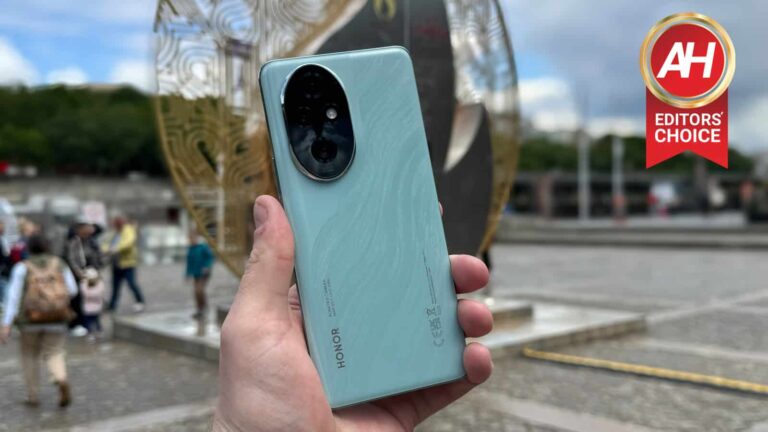
As someone that has used HONOR phones for many years, dating back to when they were simply marketed as the “millennial brand” under Huawei, the build quality of the HONOR 200 Pro does not surprise me. It’s a very solid phone with an interesting backplate. The back of the HONOR 200 Pro has a dual-texture. Most of it is a matte sort of finish, with a bit of a glossy finish near the camera module, which HONOR has made the cameras symmetrical this year. The oval camera module houses the 50-megapixel portrait main camera, a 50-megapixel telephoto camera, and a 12-megapixel ultrawide (and macro) camera, with the flash to the right of that camera.
The back of the phone is slightly curved, which does make it easier to hold in the hand. Though, I’m not a fan of the back finish. There’s just something about it touching my hand that feels weird and awkward. Of course, that is likely just a me thing and won’t bother anyone else. The other design choice I don’t particularly like here is the curved display. I’ve never really liked curved displays, and happy to see other OEMs getting away from it. Hopefully, HONOR can, too, soon.
The bottom of the phone houses the USB-C port, SIM slot, and the speaker. The top has another speaker – instead of using the earpiece – as well as an IR blaster. Both of those are things we don’t typically see on smartphones in 2024. So kudos to HONOR for adding that. The right side houses the volume rocker and power button, while the left side has nothing.
It’s a stunning phone. But then again, you expect that from HONOR. They’ve really made a name for themselves with their hardware. And that continues with the HONOR 200 Pro.
HONOR 200 Pro Review: Display
These days, it’s pretty tough to come across a phone that has a bad display. Unless you’ve popped into a Boost Mobile or are looking at the prepaid section of any other carrier. Most phones have a great OLED display, and the HONOR 200 Pro is no different. This phone sports a 6.78-inch AMOLED quad-curved display that goes up to 120Hz and has a peak brightness of 4,000 nits. That is a truly incredibly bright display, and while you won’t really ever see it hit 4,000 nits, it does get bright enough to use outdoors in direct sunlight without any problems.
I’ll admit that while I don’t like curved displays, content still looks incredible on curved displays. Especially a YouTube video in full screen. Since this is a quad-curved display, it doesn’t bother me as much as some other phones with curved displays. And I haven’t come across any issues with accidental touches, which is always good to see.
HONOR also includes its Eye Comfort Display here, which uses adaptive dimming and has 3840Hz risk-free PWM dimming. So those who are susceptible can use this phone without worrying about getting sick. It also has a low Blue Light, making it better for use in bed at night.
HONOR 200 Pro Review: Performance
The HONOR 200 Pro sports the new(ish) Snapdragon 8s Gen 3 processor. This is actually the first phone I’ve used with this new processor, and I’m quite pleased with how well it performs. It’s a slightly underperforming version of the Snapdragon 8 Gen 3; Qualcomm favored AI more with this processor versus processing speed. That did result in it getting slightly lower Geekbench scores, but not crazy low.
In day-to-day usage, the Snapdragon 8s Gen 3, paired with 12GB of RAM and 512GB of storage, keeps the phone running nice and smooth. During the two weeks that I used this phone, I did not notice any slowdowns or the phone getting hot. That includes using the camera for quite some time, which is rather impressive. Gaming has also been a joy here, playing Genshin Impact a good amount, it does get a tad warm when playing, but it’s not so hot you can’t touch the phone.
Benchmarks
Now, let’s talk about the benchmarks. As always, we put the HONOR 200 Pro through three performance-based benchmarks. This includes Geekbench, 3D Mark Wildlife Extreme Stress Test, and a Capcut benchmark, which simulates video editing and exporting. You can find out more about how we test phones here.
Starting with Geekbench 6, we are going to compare the HONOR 200 Pro to the HONOR Magic6 RSR and the Pixel 8 Pro. That means three different processors are being compared here. For Geekbench, the HONOR 200 Pro scored 1,920 on the single-core test and 4,687 on the multi-core test. At the same time, the GPU test was 8,701. For the CPU tests, the results were lower than those of a Snapdragon 8 Gen 3, but only marginally. You will really see the difference in GPU, where the score is almost half of what the Snapdragon 8 Gen 3 scored. Of course, it is still well above the Tensor G3 in the Pixel 8 Pro on all three tests.
Next up is the 3D Mark Wildlife Extreme Stress Test. Now this test is going to put your device to its absolute limit. It runs the same 60-second benchmark 20 times, giving us scores for each round, along with the best and worst loop scores and a stability score from that. The Snapdragon 8s Gen 3 did score significantly lower than the Snapdragon 8 Gen 3 – in fact, the lowest loop for the Snapdragon 8 Gen 3 was higher than the best loop for the Snapdragon 8s Gen 3. The HONOR 200 Pro hit a best loop of 3,033 and a lowest loop of 2,206. That brings it a stability score of 72.7%. That’s not bad, typically anything over 70% is pretty good, as it shows that the phone is good at managing the temperature.
The final test here is about Capcut. For this test, we load up the same 60-second video and then export it at 1080p 30fps. That’s not always the default option, so we make sure to change that if it’s not. This is the same video and export settings on every phone. For the HONOR 200 Pro, it exported it in 12.94 seconds. Not bad, but that is a good bit behind the Magic6 RSR, but still well above the Pixel 8 Pro’s finishing time of 40 seconds.
Overall, performance is right where it should be on the HONOR 200 Pro with the Snapdragon 8s Gen 3. These tests also show that the phone is pretty good at dissipating heat as well.
Thermals
Another way that we test devices to see how well they perform is with thermal testing. Now while we don’t have a thermal chamber like some other testing facilities, we do have three tests that we perform, and check the temperature after each one. These are the exact same tests for each phone we’ve reviewed in the past year.
The first test is 3D Mark Wildlife Extreme Stress Test, which is the benchmark we used earlier in this review. That typically gets the device to its hottest point, and you’ll typically never see it reach that temperature again. The HONOR 200 Pro reached a temp of 105.2 degrees. That is actually really good. That’s the exact same temperature as the Pixel 8 Pro, which had a much lower score in the benchmark itself. It’s also 6 degrees cooler than the HONOR Magic6 RSR.
The next test is running Genshin Impact at its maximum settings and screen brightness for an hour. This is another good test since Genshin Impact is quite demanding, and the game is also hugely popular. After an hour, we got a reading of 97.8 degrees. That is pretty much in line with every other phone we’ve tested. Most are between 96 and 98 degrees.
Finally, we have a camera test. Where we record video at 4K30 for 10 minutes, checking the temps at 5 minutes and again at 10 minutes. Five minutes in, the HONOR 200 Pro had a reading of 93.5 degrees, and at 10 minutes, it was 96.8 degrees. That is cooler than the Magic6 RSR, showing that not only are thermals slightly better, but the slightly slower GPU of the Snapdragon 8s Gen 3 is helping to keep the HONOR 200 Pro cooler.
HONOR 200 Pro Review: Battery Life and Charging
With the HONOR 200 Pro, the company is continuing its use of a Silicon-carbon battery versus using a lithium-ion battery, which is not only more sustainable but also safer than lithium-ion, which we can all appreciate. But it also appears to allow HONOR to put in larger batteries in its phones. With the Magic6 RSR earlier this year, we saw a 5,400mAh battery; now, in the HONOR 200 Pro, we’re seeing a 5,200mAh battery inside.
So the real question is, how does that translate to battery life? Well, it brings over some pretty great battery life to the HONOR 200 Pro. In my usage, I was able to get a full day out of the phone and still have around 40% left at the end of a 16-hour day. That’s not too shabby. Typically, I can get around 6-7 hours of screen time in that amount of time. Now unfortunately, HONOR’s battery stats page does not show you the stats for the full charge cycle, only for that day – similar to the iPhone. So, I can’t get a full picture that way. But that’s why we have benchmarks. So, let’s talk about how it performed in our battery test.
For each phone that we review, we run the same battery rundown test. Essentially, we are playing a YouTube video that is about 24 hours long, at full brightness and full screen, until the phone dies. We try to get it at 1% before it shuts off, but we can’t always do that. Only a handful of phones have lasted longer than that video, and the HONOR 200 Pro came pretty close, with a time of 22:42. That’s pretty good, but still behind the Magic6 RSR.
Charging speeds are excellent on HONOR 200 Pro
As someone who lives in the US, I know that we don’t get a lot of phones with incredible charging speeds like the HONOR 200 Pro, which is outside of OnePlus. So when I get to review a phone like the HONOR 200 Pro and see how quickly it can charge, it kind of spoils you. HONOR quotes the wired charging speed as 100W, with 66W wireless. Now I do not have an HONOR wireless charger so I could not test that wireless speed, but on wired, it definitely delivered.
When it comes to charging, we were able to get a full charge, using the included power brick from HONOR, in under 40 minutes. That’s actually kind of crazy.
HONOR 200 Pro Review: Software
Over the past few years, there’s been a lot of talk about how similar Honor’s MagicOS is to Apple’s iOS. That’s not a surprise, as many Chinese OEMs do the same thing, but in some parts of MagicOS, it looks like a carbon copy. Almost like Apple said, “You can copy our homework, but change it up a little.” Honestly, that doesn’t bother me. MagicOS works pretty well, and everything is basically where you’d expect it to be.
With HONOR 200 Pro, the company is bringing some crowd-favorite MagicOS features to the table. This includes Magic Capsule, Air Gestures, Magic Lock screen, and even some platform-level AI in the Magic Portal – which was announced at MWC earlier this year. Magic Portal is honestly one of my favorite features that HONOR has on its phones. It’s just so easy to take the address you have in WhatsApp and drag it to the left or right to open it in Google Maps, and you instantly get directions. No more long-press to copy, then switch to Google Maps, long-press to paste, and then search for directions. It’s literally half the steps. It also works with Gmail emails and much more. And I’d expect this only to expand and get better.
MagicOS 8.0, based on Android 14, is what is standard on the HONOR 200 Pro. The company has not talked about how many updates you can expect on the 200 Pro, but we do expect it to see Android 15 later this year and likely Android 16 next.
HONOR 200 Pro Review: Camera
This is the star of the show for HONOR 200 Pro, though I feel like we say that about every phone. But it feels even more true with this phone in particular. During our briefing with HONOR in Paris, we were brought to Studio Harcourt, a very prestigious photography studio in France that has done portraits for just about everyone you can think of. Studio Harcourt does some amazing things with lighting and does some incredible black-and-white portraits. Typically, you’d think that you need an expensive camera to do these types of portraits, but not anymore. The HONOR 200 Pro can do just that. And how do I know? I got my portrait taken at Studio Harcourt with a HONOR 200 Pro, and it looks incredible. It’s hard to imagine that it was taken with a camera that fits in my pocket and can watch TikTok.
Obviously, a big part of the camera story here is studio-level portraits. With that, HONOR has included a 50-megapixel portrait main camera, a 50-megapixel telephoto camera, and a 12-megapixel ultra-wide camera that also doubles as a macro camera.
Let’s start with regular, old, plain pictures taken on auto settings. Those came out as great as you’d expect. HONOR is no stranger to producing great images from their phones, and the 200 Pro is no different here. The colors looked nice and vibrant while also being completely in focus or having some bokeh if you are photographing something up close. Of course, a big part of that bokeh is due to the size of the sensor, so it’s natural bokeh and not computer-generated bokeh. Overall, no complaints with the main sensor.
Moving onto Portrait mode, you can actually use this with and without the Studio Harcourt tuning. When you tap on the Studio Harcourt icon at the top, you get three options: Harcourt Classic, Harcourt Color, and Harcourt Vibrant. The Harcourt Classic is black and white and looks truly incredible. At the same time, the others are in color, with the Vibrant option being, well, more vibrant. It’s pretty self-explanatory here. I mostly used the Harcourt Classic option in my testing, as I found it to be more aesthetically pleasing. What I really like about this, is how quickly the camera is able to adjust to the light. Typically, phone cameras can be quite slow at adjusting to the lighting and then blow out some of the background. This is mostly only in portrait mode, but it leaks out a bit in other modes, too. But it’s not nearly as fast.
With the HONOR 200 Pro, taking a new portrait or a headshot for LinkedIn is so much easier. In just a few minutes, you can take a new portrait that looks like it was professionally done, and no one would think otherwise. The only issue here is that this only works on the rear cameras. So, it’s not quite as simple as taking a selfie. But, speaking of selfies, the front camera is also a 50-megapixel portrait camera, and it takes some great photos as well.
HONOR has decided to go a bit niche with their camera setup on the 200 Pro, and I don’t see that as a bad thing. Cameras on phones were starting to get a bit stale. With so many companies doing the same old features, better zoom, better macro, larger sensors. HONOR saw that and decided to focus on portraits for the HONOR 200 series. And I think it was a good move. It made me excited about a smartphone camera, which is hard to do in 2024.
Should you buy the HONOR 200 Pro?
That’s a hard question, as always, but it’s even harder right now. Because, at the time of writing this, I do not know the price of the HONOR 200 Pro. I’d imagine it’ll be cheaper than the Magic6 Pro, which is €1299. But how much cheaper is the question? Then there’s the HONOR 100 Pro that it is replacing, that was priced at €449 last year.
Leaving the price out of it, this is a damn good phone. Especially if it comes in much cheaper than the Magic6 series. Typically, the number series are marketed as mid-range phones, but there’s nothing mid-range about this. A flagship processor, 12GB of RAM, 512GB of storage, three incredible cameras on the back, and a big juicy battery to boot. There’s not a lot to dislike about the HONOR 200 Pro.
You should buy the HONOR 200 Pro if:
You want to take stunning portraits without an expensive, dedicated camera.
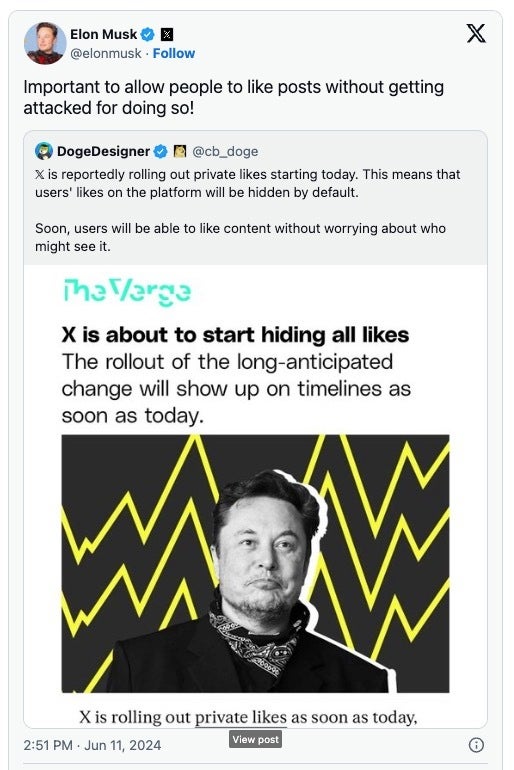
In a move to enhance user privacy and encourage authentic engagement, X, formerly known as Twitter, is rolling out private likes for all users. This feature, previously available to X Premium subscribers, hides the identity of users who like a particular post, making the act of liking more personal and less subject to public scrutiny.The decision to make likes private by default was confirmed by X owner Elon Musk after a report from The Verge that the feature was quietly rolling out. Musk, in his post, emphasized the importance of allowing users to like posts without fear of “getting attacked for doing so.” This change reflects a broader shift in social media away from public like counts, as users increasingly seek more private and less performative online experiences.X’s director of engineering, Haofei Wang, previously explained that the change is aimed at protecting users’ public image and encouraging them to engage with a wider range of content, without fear of judgment or backlash. The company believes that by making likes private, users will feel more comfortable expressing themselves authentically and engaging with content that resonates with them personally.
Elon Musk confirms the rollout of private likes by default for everyone on the platform | Credit: Elon Musk (X)
While likes will be hidden from public view, users will still be able to see who liked their own posts and the total like count for all posts. This allows users to gauge the popularity of their content while maintaining the privacy of individual likes. The Likes tab on user profiles will be removed, further emphasizing the shift away from public like counts as a measure of social validation.
The change to private likes aligns with X’s broader efforts to prioritize user privacy and create a safer and more inclusive online environment. By removing the pressure to conform to public opinion and engage in performative liking, X hopes to foster more genuine interactions and encourage users to express themselves freely.