A new change is coming to WhatsApp due to certain U.S. states passing age verification laws. The changes are aimed at protecting children online, and different laws and legislation bills are currently in progress.
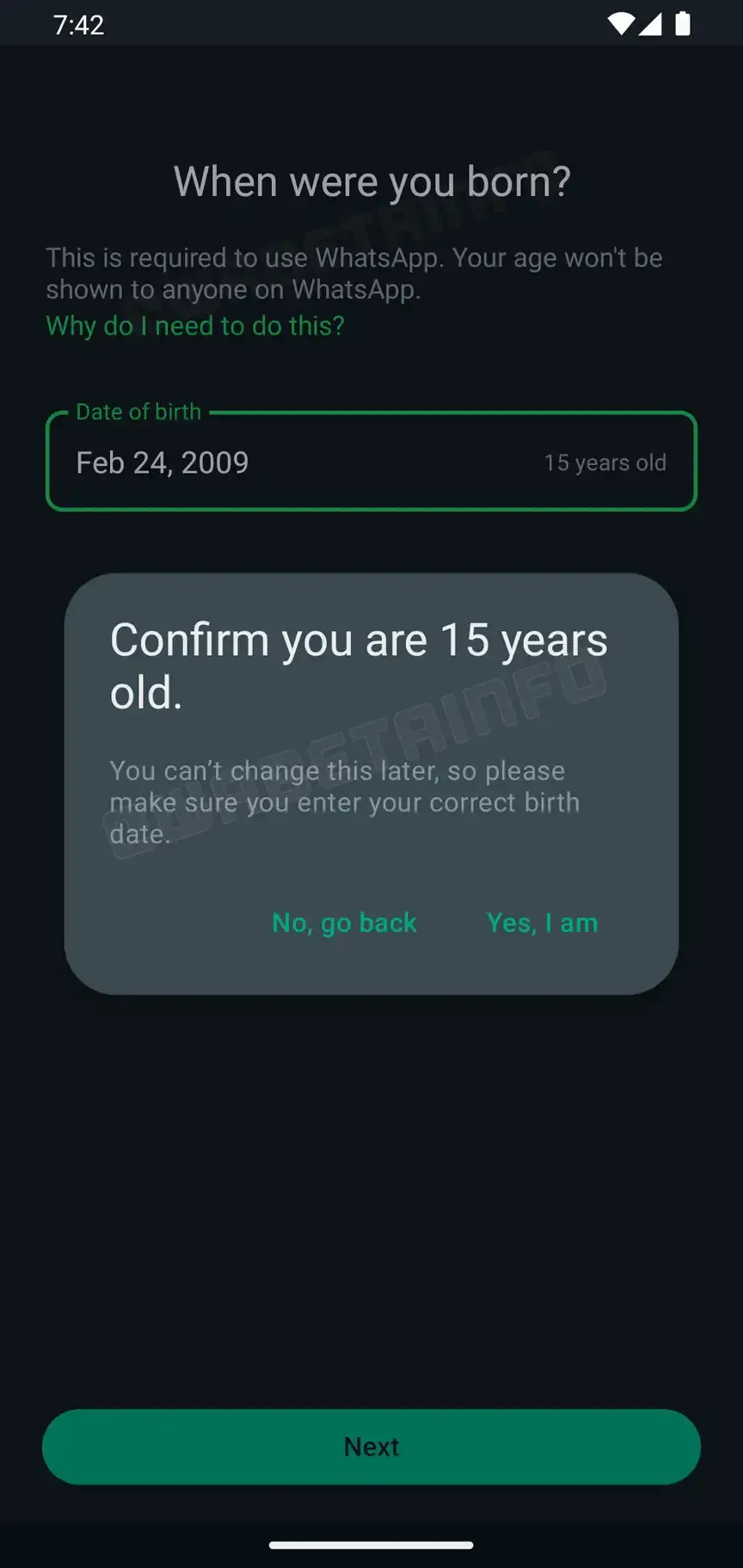
Now, Meta is getting WhatsApp ready for these changes. In a recent beta version for Android (v.2.24.12.25) of the app, WABetaInfo discovered code that is meant to make WhatsApp ask you for your birth year. The prompt warns that the year cannot be changed later, and you need to provide it to continue using WhatsApp.
Here’s how the prompt may look like when released publicly (Image Source – WABetaInfo)
For now, this feature is not available to the public. Although there’s no official reason given for this feature, it’s most likely connected to the laws that are currently in the works in the U.S.
It seems that Meta will not be showing your birth year within WhatsApp, and this prompt seems to only be for compliance with local laws.
It’s probable this prompt will appear to you if you live in a state with age verification laws (or you’re visiting).
These are currently the US states where verification laws have been passed:
Alabama
Florida
Georgia
Idaho
Indiana
Kansas
Kentucky
Nebraska
Oklahoma
South Carolina
South Dakota
Tennessee
This means when this update rolls out publicly, you’ll probably see the prompt if you live in one of them. Of course, as with anything currently in beta, we don’t know exactly when this feature will be officially released. However, it’s probably going to be sooner rather than later so that WhatsApp can be compliant with the legislation.
Izzy, a tech enthusiast and a key part of the PhoneArena team, specializes in delivering the latest mobile tech news and finding the best tech deals. Her interests extend to cybersecurity, phone design innovations, and camera capabilities. Outside her professional life, Izzy, a literature master’s degree holder, enjoys reading, painting, and learning languages. She’s also a personal growth advocate, believing in the power of experience and gratitude. Whether it’s walking her Chihuahua or singing her heart out, Izzy embraces life with passion and curiosity.
SMS scammers are using cloud storage from Google, Amazon, and IBM to trick you! Learn how they’re doing it and how to protect yourself from these sneaky cloud phishing scams.
The threat intelligence unit at Enea, a software security firm based in Stockholm, Sweden, has uncovered a concerning trend: cybercriminals are exploiting cloud systems to perpetrate SMS scams including Smishing or SMS phishing.
According to the investigation by the company’s threat intelligence team, cloud storage services like Amazon S3, Google Cloud Storage, Backblaze B2, and IBM Cloud Object Storage are being exploited to redirect users to malicious websites, stealing their information through SMS.
(Screenshot: Enea)
How Cloud Storage is Exploited?
Cloud storage allows organizations and individuals to store, access, and manage files, including static websites. However, cybercriminals have exploited this facility to host static websites with embedded spam URLs in their source code.
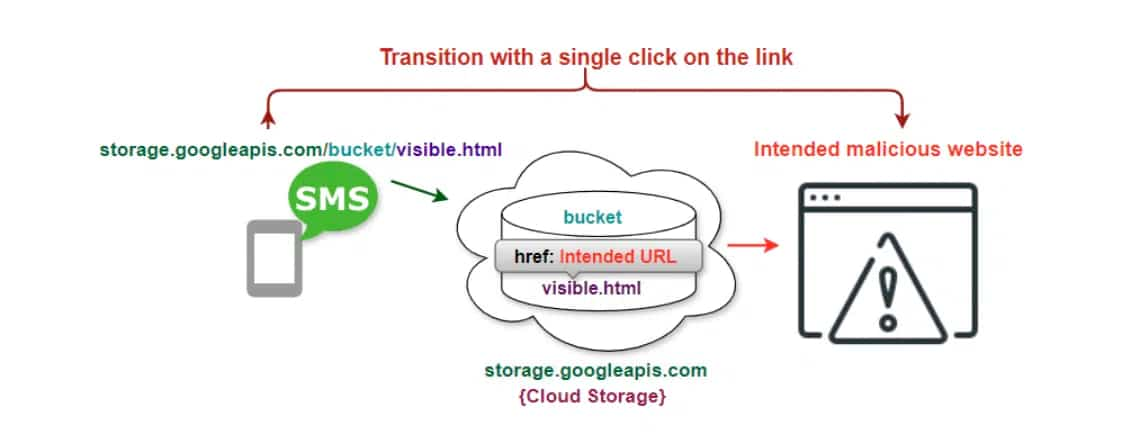
These URLs are distributed via authentic text messages, bypassing firewall restrictions. Mobile users click on links containing cloud platform domains, which direct them to the static website stored in the storage bucket, automatically forwarding or redirecting them without user awareness.
The Scam: From SMS to Fake Websites
According to Enea’s blog post that the company shared with Hackread.com ahead of publication on Thursday 23rd, 2024, the attackers prioritize two main objectives: delivering scam messages without network firewall detection and convincing end users to perceive the messages or links as trustworthy.
The scam starts with a seemingly harmless text message (SMS). These messages often contain enticing offers or create a sense of urgency, tricking recipients into clicking a link. This link redirects them to a malicious website cleverly disguised as a legitimate one.
As per the research, Google Cloud Storage’s domain, “storage.googleapis.com,” is used by attackers to link to a static webpage hosted in a bucket on the platform. The spam website is loaded from that webpage using the “HTML meta refresh” method, a technique used in web development to automatically refresh or redirect a web page after a certain time period.
These fake websites, typically hosted on cloud storage buckets with names like “dfa-b.html” on Google Cloud Storage, aim to steal personal and financial information once users enter it. Users are directed to fraudulent websites offering gift cards to trick users into revealing personal and financial information.
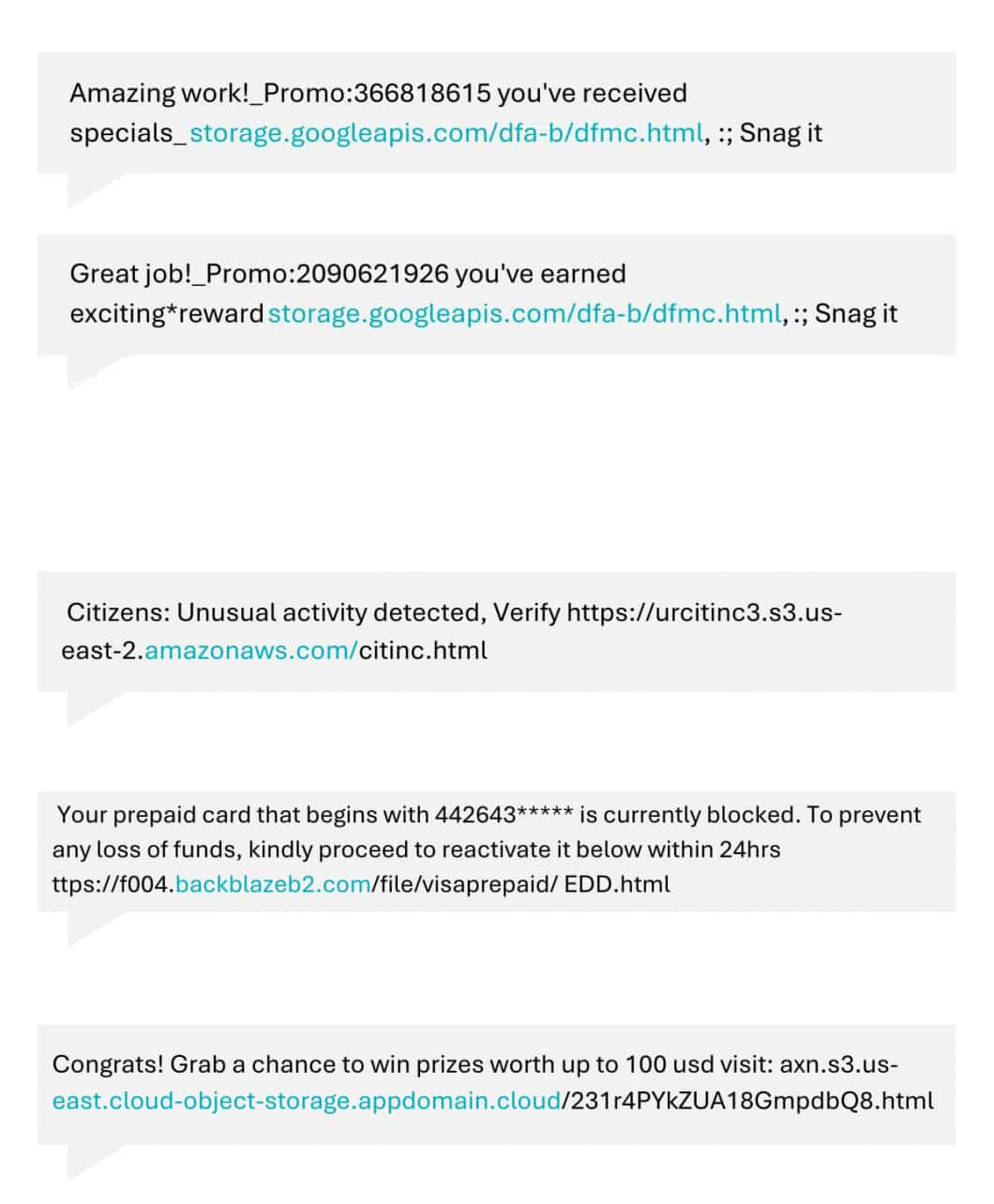
These SMS scammers have also been observed using links to static websites hosted on Amazon Web Services (AWS), IBM Cloud, and Blackblaze B2 Cloud.
Malicious text messages sent through popular cloud storage services (Screenshot: Enea)
Mitigation Strategies
Detecting and blocking URLs containing genuine Google Cloud Storage domains is challenging due to their association with legitimate domains from reputable companies. To protect yourself from cloud phishing scams, be cautious with suspicious SMS links, check website legitimacy before entering personal information, and enable multi-factor authentication (MFA) to add an extra layer of security.
Back when Xiaomi unveiled the first Poco phone, the term “Flagship Killer” was in full swing. Be that as it may, we were still surprised with the specs that the company was able to pack into that phone. More than half a decade has passed since then, and the definition of a Flagship Killer has shifted a bit. Well, does the Poco brand still live up to that title? Let’s find out in our review of the Poco F6.
Times have changed a lot since the mid-2010s, and that’s extremely evident in the affordable phone market. Flagship phones have always been the most feature-packed and expensive devices, but when we dip below the $500 line, things get a bit chaotic. We see phones that are unapologetically mid-range with all of the typical trademarks; mediocre display, choppy performance, bad speakers, the list goes on.
However, we also see phones that make us question why Samsung and Apple can get away with charging more than $1,000 for their phones. These are phones that just barely nip at the heels of $500, but they offer some insane hardware, displays, performance, speakers, and software on the market.
Enter the Poco brand! This is a brand that, like OnePlus back in the old days, is characterized by its rebellious nature of offering $800 worth of phone for under $500. Its first phone cost about $299 when it launched back in 2018, and it had some of the best specs of the day.
Fast forward to 2024, and the Poco brand is alive and well. I’ve been using the Poco F6, and I had the same response to its specs that I had back when I saw the Poco F1. While I’ve seen a ton of killer phones for under $500 in my day, phones like these still impress me. But, as we know, there’s more to a phone than its specs. So, let’s dive to see if Poco delivered a powerful experience along with its specs.
Poco F6 Review: Design
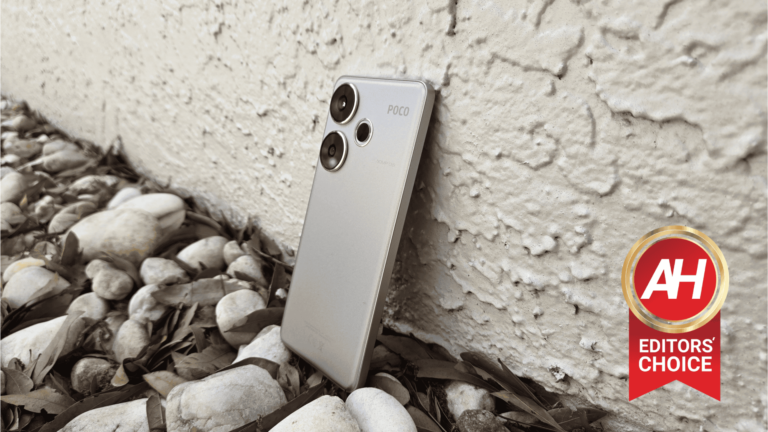
When it comes to the design, there’s a bit of a clash between two design aesthetics. Going by the overall shape and arrangement of elements, I’d say that it’s a pretty elegant-looking device. The cameras are a bit large, but they work well with the overall design, and I like how they (along with the flash) make sort of a triangle on the back.
Poco is showing a nice bit of restraint with the text on the back, opting to only show the Poco branding and the camera resolution. This gives the phone a subtle beauty that pervades minimalist phone designs. The phone itself is boxy, but it’s also rounded at the same time with the back plate curving to meet the frame. I also like how the color of the backplate and frame share the same color.
So, there’s a very straightforward and professional beauty to the Poco F6. However, that’s juxtaposed to this very pretty and flashy back plate. The back glass plays with the light in a way that almost makes it look glittery. While the phone has a boxy and elegant design, it has this “Look at me!” feeling.
This phone isn’t just a piece of tech, it’s a piece of jewelry. It’s like the phone version of a diamond-studded necklace, and I’m here for it. I love the mixed mentalities in the design. It’s bold, but it’s also very pretty. You can admire it for Poco’s masterful restraint while also liking it because it’s…. shiny! This is the beauty of the phone.
Poco F6 Review: Build Quality
The build quality is where most Flagship Killers tend to fall short. While the internals can be premium, we start to see where the company had to cut corners to keep from charging Galaxy S prices. In the case of the Poco F6, the company did a good job of delivering a solidly built device, but it’s nothing to write home about.
In terms of the overall construction, it’s put together rather nicely. The buttons are clicky, and I don’t hear any creaks or groans when I pick it up or interact with it. I did a little bit of a bend test and bent it from the front and the back. I didn’t go too far, but I bent it past the point where most people would be comfortable bending it.
The phone fared well for the most part, though I did hear a little bit of creaking when bending it from the front. I hear just a little bit coming from the backplate. It’s not bad, but it’s just a bit more than I’d typically hear from other phones I reviewed.
As for the overall feeling in the hand, the fact that this is an affordable phone becomes evident pretty quickly. It doesn’t feel bad at all, it’s just that you won’t be fooled into thinking you’re holding a flagship once you pick it up. When you buy a more expensive phone, some of the money you’re paying is for luxury. Some of that premium goes towards the glass back and metal frame.
So, when you’re dealing with a more affordable phone, there are certain materials you should expect, and one of them is plastic. When I picked up this phone for the first time, it was evident that much of it was made from plastic. It lends to an overall lighter feeling in the hand. It doesn’t take away from the overall experience, but you’ll definitely notice it if you’re used to more expensive phones.
The exterior, while beautiful, won’t give you that premier feeling in the hand. I won’t dock points for that. The main thing is that it’s a solidly built phone that will definitely last you.
Poco F6 Review: Display
Moving onto the display, it’s fair to say that affordable phones are no longer cursed to have crappy displays. OLED technology has long adorned cheaper phones, and the companies making these phones have mastered how to calibrate them (Looking at you, Tecno!). So, going into this review, I didn’t expect any surprises with the Poco F6’s display.
To be quite honest, nothing about the display particularly blew me away, but that doesn’t mean that it’s not a nice screen.
Brightness
We’re at a point with smartphone technology where affordable phones are coming with pretty bright displays. They used to be overshadowed by more expensive phones, but they’re reaching more than 1,000 nits of peak brightness.
In the case of the Poco F6, I think that the brightness is decent, but not great. When I take the phone outside, I see it boost the brightness to compensate for the sunlight, and it does a pretty good job. However, I was able to get brighter displays from the likes of Tecno and Infinix. It’s not as bad as years back when the screen would be extremely washed out in the sun; there’s definitely some improvement in that department. I just wish for a little more juice out of the display.
One thing that confused me was the fact that Poco advertises this phone’s display as peaking at 1,400 nits of brightness. I don’t think I’m getting a brightness that high.
In any case, I think that the screen does a fine job out in the sun, and you’ll be able to watch videos and play games with relative ease.
Colors
When it comes to the colors, it’s a little difficult to give a definitive answer. This is mostly because of the amount of settings that you can do to tweak the colors. Out of the box, the colors are set to the original mode. This is meant to produce the most realistic colors that the display can. As such, they’ll be pretty toned down. With the toned-down colors, you’ll get a picture that’s similar to what you would get with an LCD display.
So, judging the display by its out-of-the-box settings, the visuals aren’t too appealing. However, I set the colors to the Saturated mode. This, of course, boosted how punchy the colors were and made it a more engaging viewing experience. Even at its highest saturation setting, the colors remained overall balanced. There didn’t really seem to be any colors that stuck out among the others. I think that the saturated color setting still showed some restraint. The colors are nice, but I think they could use just a little bit more punch.
Color settings
Xiaomi gave the Poco F6 a large array of settings to adjust your display’s color. These settings surpass the likes of Samsung and other companies. Firstly, there are three color saturation modes. There is the Original Color Pro (which gives colors a more natural look), Vivid, and Saturated. These three modes allow you to adjust the color temperature throughout the interface Under that, you will have the advanced settings.
Once you go into these settings, you will be able to choose between P3 and sRGB color gamuts. Under that, you can adjust the RGB color space by adjusting the red, blue, and green levels individually. The fun doesn’t stop there, as you have a hue slider, saturation slider, value slider, contrast slider, and Gamma slider.
These settings allow you to fine-tune the colors being displayed on your screen. It has plenty more than other phones that I’ve reviewed.
Overall, you won’t find much of an issue with this phone’s display. It is a nice and Punchy OLED panel that gives you some pretty colors. I’ve definitely seen better displays from companies selling comparable devices, but the Poco F6 is no slouch. You’ll have no problem enjoying watching content using this display.
Poco F6 Review: Speakers
OEMs often have to sacrifice certain aspects of their phone in order to keep the price down, and speakers are often on the chopping block. However, some companies wind up giving their phones a nice pair of speakers regardless of their price.
In the case of the Poco F6, I didn’t really know what to expect with the speakers. Having reviewed several mid-range phones in the past, I was not expecting much.
In order to test these speakers, I listened to a set of specifically tuned audio tracks that are meant to accentuate different aspects of audio. These are volume, distortion, base, treble, vocals, and immersion.
Volume
The volume is one aspect where I feel like Poco could have pushed just a bit more. When I have the volume turned to full, I don’t get the sense that the volume is at its full setting. The highest volume is still plenty high, but it reminds me of the Galaxy S24+. It’s not terrible, but it could have been better.
I placed the sound meter about a foot away from the phone and played the first test piece. It reached about 84dB, max. Other phones I reviewed were able to peak at a few decibels higher than that.
Distortion
All speakers experience distortion and higher volumes, and this one was no different. However, I didn’t hear much distortion with this phone’s higher notes. The speakers do a good job of reducing the distortion. Overall, I will definitely say that these speakers are good when it comes to reducing distortion.
Bass
Moving on to the bass, this is one area where I was pleasantly surprised. The speakers are able to produce a fair amount of depth which was very pleasant to hear. The example I used strongly emphasized lower instruments, and I could hear all of the instruments clearly. Not only that, but I could hear a lot of detail in their sound.
Treble
Just like with the bass, I was very happy with these speakers’ performance in the treble department. When it comes to higher tones, I think that Poco did a good job. The higher-pitched notes project clearly throughout the sound, they sound Pleasant. I wouldn’t say that the treble is the best on the market, but it’s very good nonetheless.
Balance
In terms of balance, neither the treble nor the base particularly steals the show. I think that Poco gave this phone a very nice set of speakers for listening to all types of music.
Immersion
All the other aspects come together to create an overall immersive sound. The sound is punchy, with nice attention paid to both the low-end and high-end audio. Everything from music to movies to podcasts sounds great, and I was pleasantly surprised by these speakers’ performance. The speakers and the Poco F6 are some of the best that I’ve tested on a mid-ranger.
Poco F6 Review: Performance
Affordable phones have come a long way in terms of performance. While other companies give their affordable phones lower-end hardware, the Poco F6 is running the very fast Qualcomm Snapdragon 8s gen 3. At the time of writing this review, this is one of the most powerful chips on the mobile market.
This is something that defined the Poco series when the Poco F1 launched. While mid-range chips offer good performance, there’s no doubt that the Snapdragon 8s Gen 3 delivers some blazing-fast speeds.
When it comes to general use, I had no issues with this phone whatsoever. Everything from navigating the software to using apps was perfectly smooth. I didn’t run into any lag or stutters while using the phone. Everything went perfectly smoothly.
Other mid-range phones have at least some degree of lag or stutter throughout the software. However, in the case of the Poco F6, the performance was flawless.
Numbers
We all know that benchmarks don’t properly describe a phone’s user experience. However, it is still nice to see some numbers to see how this phone stacks up against the competition.
I ran this phone through Geekbench 6 and through 3D Mark. As for the Geekbench scores, this phone scored a single core score of 1,949. That score is better than most other phones on the market. It beat out other phones like the Galaxy S24+. It actually came shy of the Galaxy S24 Ultra’s 2172 score.
Moving on to the multi-core score, this phone scored a whopping 4,920. It was beat out by both a Galaxy S24 Ultra and the Galaxy S24 Plus. So, the Snapdragon 8s Gen 3 is packing some serious power.
Moving on to 3D Mark, I ran this phone through the Wildlife Extreme Stress test. It got a best Loop score of 3,109 and its lowest Loop score of 2,511. Again, those scores are definitely up there with Android flagships.
All in all, even though the numbers don’t tell us much about the real-world experience, they still show that the combination of Poco’s software optimizations and the Qualcomm Snapdragon 8s Gen 3 makes for an extremely powerful experience.
Poco F6 Review: Gaming
It came as no surprise that the Snapdragon 8s Gen 3 power came in handy when it comes to gaming. So, if you’re thinking of using the Poco F6 as a gaming device, you will not be disappointed. Using it to play Simple 2D games, there was no issue whatsoever. Even games like Survivor.io ran perfectly, even though games like those tend to have a lot of Sprites on the screen.
Loading up a couple of 3D games like Asphalt 9, Sky: Children of the Light, and Dragon Ball Legends, it was no different. This phone is a snappy performer, and I did not have any issues with them at all. Those three games are pretty graphically intensive, and the Poco F6 was able to tackle them like a champ.
However, this will not be a gaming review without reviewing games like Genshin Impact and Star Rail. Starting off with Genshin Impact, I had zero issues playing that game. It started up quickly and, from the moment I started it up, it ran perfectly smoothly. It didn’t matter if I was in closed-off areas or wide-open spaces. I was able to get a consistent 60 frames per second while playing.
The story was much the same for Star Rail. The game loaded up quickly, and everything was smooth for the most part. However, I did have the occasional dropped frame here and there. Instances of these were few and far apart.
It’s also important to mention that this phone comes with a boosted gaming mode that will push the chip to its fullest capacity. That’s What I tested these games on. So, this mode pushes the Snapdragon 8s Gen 3 to its absolute limit.
Poco F6 Review: Battery
So far, this review has been pretty positive for this phone, and I’m not going to rock the boat when it comes to the battery life. I’ve reviewed numerous devices with affordable price points, and some of them do pretty decent when it comes to battery life. They’re nowhere near what you get with a modern Galaxy S device or iPhone, but they’ll definitely get you through the day with moderate to light usage.
However, in the case of the Poco F6, this phone gets extremely close to the numbers that we get from more expensive devices. I charged the phone to 100% and played a 24-hour video until it completely died. Several phones I reviewed struggle to get past the 10-hour Mark, and some do a little bit better. The Galaxy S24 was able to get 20 hours of battery life, and the S24 Ultra was able to top 25 hours.
The Poco F6 was able to hit a sweet spot between those groups of phones. The phone lasted more than 18 hours before giving up the ghost. This means that you will comfortably be able to get more than a day and a half of moderate usage before having to plug it in. On heavier days, you should still get past the one-day mark. Also, if you’re being frugal, you should have no issues hitting the two-day mark.
When it comes to charging, I was, unfortunately, not able to test the full charging capabilities. This phone came with a bonkers 90W charger in the Box. However, it was not a charger compatible with a US Outlet. In any case, with such fast charging, you should be able to top the phone off completely within an hour.
Poco F6 Review: Camera
More affordable phones seem to falter when it comes to camera technology. It’s one of the main things that keep people from buying mid-rangers. While there are some standout phones with decent shooters in the mid-range market, they’re never quite up to par with more expensive Galaxy phones or iPhones.
In the case of the Poco F6, you get a pretty decent shooter, but this is not the kind of camera that will stand out amongst the others.
Exposure/contrast
One thing I found while using this phone was the fact that the camera tends to be a bit bright. While I did take these shots out in the bright daylight, the camera seemed to punch up the exposure just a bit. This makes for some pleasing shots that really emphasize the bright sunlight. However, there were some shadowy spots that were a bit brighter than they should have been. While the camera did expose a bit brighter, I did not get too many blown-out highlights.
In terms of contrast, I’ve definitely seen better contrast from the likes of Tecno, mainly, the Tecno Camon 30 Premier. With the Poco F6’s camera, shots were a bit washed out when they should have been more contrasty. The example below showing the rocks made it seem like it was pretty overcast. However, it was in direct sunlight.
Another example is the picture of the grass with the sun and shadows. I feel like the Shadows could have been lowered just a bit more to create a crisp contrast.
In general, the exposure and contrast can be a little bit inconsistent. This picture of the tree is rather dark. I would have liked to see the software lift the shadows just a bit. Also, the picture of the wall with the trees behind it suffers the same issue.
Colors
When it comes to the colors, I think that the pictures are similar to the phone’s display. You do get some nice juicy colors, and they’re pleasantly represented. I do feel that they’re toned down ever so slightly. They give them more of a natural look, which is welcomed. The company kept from going overboard with the colors.
I particularly like how the sky is exposed. The blue in the sky is punched up just a bit, but it keeps from being cartoonish. The color shows restraint and responsibility, and I do like that.
The picture of the yellow flower below is probably my favorite picture in terms of color. The yellow is warm and beautiful while the green has a little bit of punch to it. Overall, if you’re looking for tasty social media-ready colors, you won’t get them from this camera natively. You may want to boost them in a photo editing program. However, overall, the colors are very nice.
Details
When it comes to details, I didn’t really have an issue. I was able to find some decent details. Zooming into this picture of these flowers, I’m able to make out fine details like the little hairs at the end of the leaves and the buds. I’m also able to make out dirt granules.
So, I have no complaints about the details. Also, if you want even more details, you can simply switch to the 50MP mode.
Low light
As for low light performance, I think that the camera does a good job of retaining details even when the lights go down. Taking pictures of certain objects, I was able to get some nice crisp details like the weaving on the top of my speaker. Also, there’s not much noise in the images.
Overall
I wouldn’t say that this camera blows any other mid-range camera out of the water. However, that’s not to say that it’s bad. It’s a solid shooter that gives you some pretty nice results. The exposure and contrast can be a bit inconsistent, so that’s something you’ll need to keep in mind. However, the colors come out nicely and the camera produces some nice results in low light. You shouldn’t have any issues using this as your primary camera.
Poco F6 Review: Software
In terms of software, this phone is running Xiaomi’s hyper OS version 1.0.3.0. The software on this phone is rather beautiful with fluid animations, nice UI elements, and an overall unified experience. There are certain neat animations I love like how the clock smoothly grows as you summon the notification shade. Once you close the notification shade, the time shrinks back to its original spot on your taskbar.
It’s an incredibly fluid software, and I think that Xiaomi is going in the right direction with its Android skin.
I do have a few gripes, however. Firstly, and this is an issue that most people have when using Tecno or Infinix devices, the notification shade is split into two sections. You have to swipe down on the top right corner of your screen to access your quick settings and swipe down on the top left corner of your screen to access your notifications. We would all prefer to having notifications and quick settings in one view.
Next, there recent apps screen is a little annoying to get used to. Most people are used to swiping upwards to swipe away apps on the snap screen. However, you have to swipe either left or right. It’s a bit counterintuitive, and it takes some getting used to. It’s not a deal breaker, but it shows that the company could have just stuck with a more traditional way of swiping away apps.
You’re able to change it to a vertical swipe in the system settings. However, since this is an out-of-the-box setting, I have to mention it.
My main gripe is the monumental amount of bloatware on this phone. I had to uninstall what felt like more than 20 pre-loaded apps from this phone. Some of the apps seemed like system apps, but I found that they didn’t serve any purpose. If you get this phone, be prepared to delete a ton of apps.
Final verdict
Most of the time, when I’m reviewing an affordable device, there are certain caveats that I have to overlook. Obviously, I can’t expect a $300 phone to be perfect. So, I’ve developed a bit of a standard level of expectation with affordable phones.
However, there are those phones that deliver much more than what they should based on their price. The Poco F6 is one of them. This is a phone that overachieves in several areas. It’s an extremely powerful and smooth performer with a beautiful screen, amazing speakers, a luxurious design, a solid camera, and great software. It’s an extremely compelling offering, and I highly recommend that you get this phone.
London hospitals crippled by cyberattack! This incident highlights the growing threat of ransomware on healthcare systems worldwide.
London’s healthcare system, NHS (National Health Service), has been thrown into chaos after a crippling cyberattack disrupted operations and diverted emergency patients, affecting tens of thousands of patients.
According to reports, two London hospital trusts, Kings College Hospital Foundation Trust and Guy’s and St Thomas’ Hospitals Foundation Trusts have been forced to cancel all non-emergency operations and blood tests due to a “major” cyberattack occurring on 3rd June 2024.
The attackers targeted Synnovis, an outsourced lab service provider to NHS hospitals in South-East London, in what is believed to be a ransomware attack targeting its ICT systems. Synnovis supplies blood tests, swabs, and bowel tests for London NHS, serving patients across six London boroughs.
Additionally, impacted hospitals include Guy’s Hospital, Evelina, Harefield Hospital, King’s College Hospital, Princess Royal University Hospital, Royal Brompton Hospital, St Thomas’ Hospital, and primary care services across South-East London.
The incident has significantly impacted the delivery of services, particularly blood transfusions and test results, and left hospitals unable to connect to the servers of the private firm providing their pathology services. GPs are advised to cancel non-emergency pathology appointments, while hospital staff are instructed to request emergency blood samples only for patients requiring transfusions.
Major London hospitals experienced significant disruptions, including postponed procedures and diverted emergencies. These disruptions put patients at risk, increased stress, and added strain on already stretched healthcare resources. The National Cyber Security Center is investigating the incident whereas, NHS England has declared it a level three incident, the 2nd highest alert level.
Expert Comment
Gerasim Hovhannisyan, CEO & Co-Founder, of EasyDMARC, commented on the incident and stressed the unfortunate and vulnerable state of the healthcare industry.
“Unfortunately, attacks against healthcare facilities are continuing to increase. Today’s outage in London is yet another reminder of the challenges healthcare systems face around the globe. As critical services stall, the impact on patient care and safety is clear, underlining the necessity for robust cybersecurity measures and detailed incident response plans,” said Gerasim.
“As healthcare systems become increasingly digitised, the risk of cyber attacks escalates, and their impact can be more significant. Aside from the need for more investment, the inevitability of cyber threats requires a proactive approach. It is no longer a matter of if, but when, a cyber attack will occur. As a result, healthcare providers must be prepared to maintain operations and protect patient safety even in the absence of digital systems. This level of preparedness is essential to safeguarding patients in the case of future attacks,” he concluded.
Sophos’ State of Ransomware 2024 and Healthcare
The attack has indeed highlighted the vulnerability of hospitals to ransomware attacks, which is a growing cause of concern within the UK. According to Sophos’ State of Ransomware 2024 report, around 63% of UK healthcare organizations experienced ransomware attacks in 2023, with secure access for remote users being the top perceived cybersecurity risk.
The report revealed that the average ransom payment increased 500%, with organizations paying an average of $2 million, up from $400,000 in 2023. 63% of ransom demands were for $1 million or more, with 30% for over $5 million with exploited vulnerabilities being the most commonly identified root cause for these attacks.
The findings and the recent ransomware attack on London NHS highlight the need for robust cybersecurity measures in healthcare institutions. Hospitals should prioritize cybersecurity investments, implement advanced security solutions, and train staff on best practices to prevent such attacks.
High profile TikTok accounts, including CNN, Sony, and—er—Paris Hilton have been targeted in a recent attack.
CNN was the first account takeover that made the news, with Semafor reporting that the account was down for several days after the incident.
According to Forbes, the attack happens without the account owner needing to click on or open anything—known as a zero-click attack. All they need to do is open a DM. The account is then taken over and the user loses access.
Malwarebytes’ Pieter Arntz explained how this sort of attack could happen:
“If they don’t need to click on anything, this could well be a vulnerability in the way content is loaded when opening the DM. We’ve seen similar vulnerabilities before in Chromium browser, for example when fabricated images are loaded.”
TikTok says it has now fixed the issue and is working to get the accounts back to their rightful owners. Spokesperson Alex Haurek told Forbes:
“Our security team is aware of a potential exploit targeting a number of brand and celebrity accounts. We have taken measures to stop this attack and prevent it from happening in the future. “
Haurek didn’t say whether the attackers were still targeting accounts.
Securing your TikTok account
This attack is eye-catching because it’s technically unusual, and was used against people who naturally attract headlines. However, it’s a flash in the pan and the vulnerability was quickly patched.
Meanwhile, there’s a thriving underground market in social logins fuelled with much more successful, but much more mundane forms of attack. To reduce your risk of those, make sure you do these things:
Use a strong password to secure your account, and make sure you’ve not used it elsewhere. You can use a password manager to remember your passwords.
Check what devices are logged into your account. TikTok Device Management allows you to view what devices are logged into your account, remove them if needed, and get notified if there is suspicious activity on your account.
Be careful what you click on. If you receive a link from someone and you don’t know what it is, don’t click on it. Check via a different communication channel about what the link is. In this case, it appears that someone only had to open a DM in order to get their account taken over so watch out for DMs you’re not expecting.
Don’t feel pressure. If someone is messaging you asking you to click on or send them something, think before you do it. Putting pressure on someone to perform an action quickly is a common tactic used by scammers. Trust your instincts.
We don’t just report on threats – we help safeguard your entire digital identity
Cybersecurity risks should never spread beyond a headline. Protect your—and your family’s—personal information by using identity protection.
We’ve seen all sorts of leaks thus far. This one takes the cake, though, in a way. Here we have a pixelated look at all of Samsung’s soon-to-be-announced devices. Yes, these devices are expected at the second Unpacked event this year.
A very odd leak is here to show us Samsung’s foldables, watch & ring
This leak comes from Evan Blass, so it’s safe to say it’s spot on. He could be even teasing what he’ll leak by doing this, we could be seeing proper marketing images soon. Also, even though the images are pixelated, it’s obvious that the design of the Galaxy Z Fold 6 and Galaxy Z Flip 6 go hand-in-hand with the images Samsung shared recently.
If you take a look at the five images shared in the gallery below, you’ll know what’s what. The Galaxy Z Fold 6, Galaxy Z Flip 6, Galaxy Ring, and what seems to be the Galaxy Watch 7 Ultra.
Yes, these images are pixelated, but at least they confirm what we can expect from Samsung’s upcoming event. The second Unpacked event from the company is coming next month, allegedly.
All of these devices are expected to launch next month
Samsung still hasn’t confirmed it, but it’s rumored to happen on July 10. The company will allegedly host the event in Paris, France. Samsung is moving these Unpacked events constantly, they’re happening sooner and sooner.
August was the month for the second Unpacked event, but then Samsung decided to change things up. Last year’s event happened in July, but later on in July, not as early as this year’s is rumored to occur.
Samsung could be doing it sooner this year because of the Olympic games which are starting later in July, though. Based on the leaks, it will be a packed event once again. Not only will we get two high-end foldables, and a new flagship smartwatch, but the company’s first smart ring too. It’s also worth noting that the regular Galaxy Watch 7 is expected to launch too.
As time goes on, the chips powering our phones get more powerful. This is so that they can perform more demanding tasks and run more advanced software. However, for Qualcomm’s newest chip, it seems that the company is taking a step back. According to a new report, it seems that the new Snapdragon 6s Gen 3 is basically a recycled Snapdragon 695.
Qualcomm is going through a phase right now, and that phase is “Confusing the heck out of us with its naming convention.” We thought that the company had its releases down when it rebranded back in 2021. When it launched the Snapdragon 8 Gen 1, we thought that things were clear. However, the company launched the 8+ Gen 1 in 2022, but it didn’t release a “+” variant of the 8 Gen 2.
Then, after launching the 8 Gen 3, we got the 8s Gen 3. We would assume that the “s” took over the “+” variant’s job… nope. It’s a lite version. Now, it has an 8s Gen 3, a 7s Gen 3, and a 6s Gen 3.
The Snapdragon 6s Gen 3 is basically a recycled Snapdragon 695
This is not to say that Qualcomm dug into its back-stock of Snapdragon 695s and rebranded them. Based on the specs, there are differences between the 6s Gen 3 and the 695.
However, there are just so many similarities to the 2021 chip that it’s hard to ignore. For example, both chips are fabricated on TSMC’s 6nm process. Also, they both have 2 Cortex A78 CPUs (2.2GHz for the Snapdragon 695 and 2.3GHz for the 6s Gen 3) along with 6 Cortex A55 CPUs (1.8GHz for the Snapdragon 695 and 2GHz for the 6s Gen 3).
One thing that makes this a bit confusing is the fact that the Snapdragon 6 Gen 1 seems to be more powerful than the 6s Gen 3, and this chip was launched in 2021. This chip was fabricated on a 4nm process, and it has two more high-powered cores. Also, it has a newer Adreno GPU (Adreno 710 vs Adreno 619 in the 6s Gen 3). The 6 Gen 1 can also support 200MP photos (up to 108MP for the 6s Gen 3), it has a better modem (Snapdragon X62 5G for the 6 Gen 1 vs Snapdragon X51 5G for the 6s Gen 3), etc.
Qualcomm, why is your newest chip such a downgrade from a chip that hit the market almost three years ago? The 6s Gen 3 is so similar to the Snapdragon 695 that we can’t really call it a spiritual successor because a successor would have some sort of improvement. It almost seems like the company just recycled the older chip.
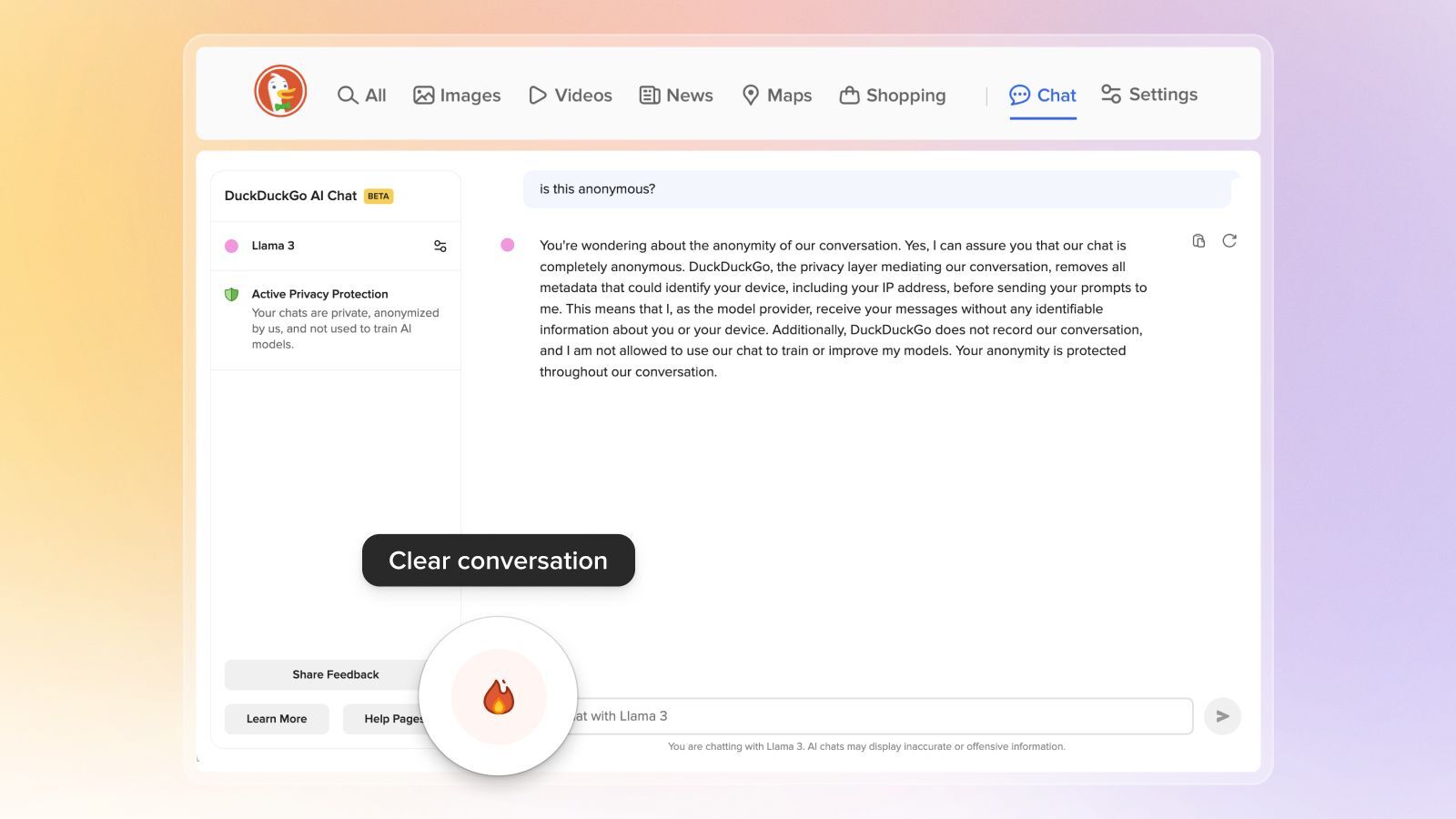
Everyone is getting into AI these days, and although the tech is now almost everywhere, if you think of it, it’s got some security concerns around it. Now, though, the internet’s favorite privacy-focused search engine, DuckDuckGo, is getting an AI chatbot. And, as you might expect, it’s here with a strong focus on respecting your privacy and keeping your data safe. DuckDuckGo’s AI chat is private and allows you to use AI models like OpenAI’s GPT 3.5 Turbo, Anthropic’s Claude 3 Haiku, and Meta’s Llama 3 anonymously. The company says everything you do with these chatbots is between you and them, and it won’t be used to train future or existing models.
In fact, DuckDuckGo’s solution isn’t perfect and it does have some caveats. DuckDuckGo warns that its supported models may store your conversations temporarily in order to deliver responses. Of course, the company underlines that all metadata is removed from the logs and that the agreements when building these AI chats ensure everything is deleted from servers in 30 days.
Image Source – DuckDuckGo
The app is now live. DuckDuckGo has a daily usage limit for the free version though, and the company has plans to introduce a paid version. The paid option will also offer more advanced models. You can try the tools at duck.ai, and it’s also available within the top bar of DuckDucGo’s search engine. Honestly, these privacy features should probably inspire other companies that use AI to take privacy more seriously. I sincerely do hope so.
Izzy, a tech enthusiast and a key part of the PhoneArena team, specializes in delivering the latest mobile tech news and finding the best tech deals. Her interests extend to cybersecurity, phone design innovations, and camera capabilities. Outside her professional life, Izzy, a literature master’s degree holder, enjoys reading, painting, and learning languages. She’s also a personal growth advocate, believing in the power of experience and gratitude. Whether it’s walking her Chihuahua or singing her heart out, Izzy embraces life with passion and curiosity.
Cybersecurity threats rise during this peak season as millions embark on the annual Hajj pilgrimage. This article offers crucial tips for pilgrims to safeguard themselves online while ensuring a safe and fulfilling Hajj experience.
Every year, millions of Muslims embark on the Hajj pilgrimage, a deeply spiritual journey, to Mecca, Saudi Arabia. However, the forever-widening scope of cybercrimes has made the event vulnerable to a range of cyber threats.
According to Resecurity’s cyber threat intelligence team’s research, shared exclusively with Hackread.com ahead of its publication, this year’s Hajj season is marred with an extensive range of frauds and scams.
The pilgrimage involves a multitude of logistical steps, from booking travel and accommodation to managing finances and staying connected with loved ones, for which pilgrims typically rely heavily on mobile apps and websites.
This reliance can expose them to frauds like fake travel agencies, online registration scams, sub-standard travel arrangements, and unlicensed travel companies created by organized crime groups, etc. The Association of British Travel Agents (ABTA) reports cases where individuals paid for sub-standard or non-existent travel arrangements, resulting in financial losses for victims.
These scams often involve fake websites or invitations, duping people into providing personal information and money. Scammers also use social media platforms to promote fake Hajj packages and entice people with attractive offers, ultimately leaving individuals without a tour and no way to recover their money.
According to Rsecurity’s blog post, researchers found that a fraudulent website Registergovcom was part of a larger identity theft campaign, which involved several fake websites disguised as free Hajj applications, tricking victims into sharing sensitive data. The information is used by threat actors for identity theft, fraud, and other cybercrime.
Moreover, Saudi Arabia’s official digital platform, Nusuk, launched to facilitate secure planning, booking, registration, and payment for Hajj and Umrah, is also exploited by cybercriminals. One of the phishing campaigns involving a fake site nusuksacom was found redirecting users to a payment interception form, stealing sensitive information.
Screengrabs of the scams targeting Hajj Pilgrimage (Credit: Resecurity)
In addition, scammers are using generative AI and Troll Factories to spread deceptive content on social media and defraud individuals. Resecurity has blocked over 630 accounts suspected of distributing fraudulent content targeting individuals preparing for Hajj season. The team also successfully blocked a resource collecting payment data.
Researchers call for stronger collaboration between platforms, law enforcement, and the private sector as Hajj approaches. Consumers are advised to be vigilant against online scams involving money exchange services, which can result in significant financial losses. To avoid falling victim to these scams, do your research on reputable services, verify their credentials, and exercise caution online.
It’s been a long time since I’ve used a Motorola phone, so when Motorola sent over the new Moto G Stylus 5G 2024 I was eager to check it out. The mid-range phones with affordable pricing aren’t usually the types of phones I tend to go for. I prefer the powerhouses with best-in-class cameras and top-notch specs. Basically the flagship phones. Unfortunately, those also come with a much higher price.
So it’s nice to see that for $399, Motorola can put together a smartphone that quite honestly, performs very well. That might not be something you expect to read about a phone that costs a mere $399. Let me tell you though, powerful, fun phones don’t have to cost an arm and a leg anymore. In fact, a fun phone that comes with tons of excellent features is more readily available at lower prices these days than you might think. Motorola didn’t exactly spearhead this movement, but it’s certainly contributing in a big way.
Enter the Moto G Stylus 5G 2024. A smartphone that puts the fun back into phones for a price that you won’t feel guilty about paying. But how does the Moto G Stylus 5G this year stack up compared to other devices in the same price range? Is it worth your $399? Let’s dive into this review and find out.
Moto G Stylus 5G 2024 Review: Hardware & Design
Motorola has been around for decades building phones. Longer than some of today’s most popular brands. So you can bet it knows a thing or two about designing a good-looking phone, not to mention building one that feels like a quality product. The Moto G Stylus 5G 2024 is exactly those things. A stylish phone that feels very well-built. My last experience with a Moto G was several years ago. It wasn’t my phone either, rather, it was the phone I bought for my parents when they were ready for upgrades.
My mom’s second Android phone, and my dad’s first smartphone. While the phone was affordable and offered plenty of features, the one thing that sticks in my mind about it was how many issues both my parents had with it. It just wasn’t a very good phone. The fingerprint sensors were finicky and didn’t work nearly half the time, and there were numerous other problems that they were always calling me about in hopes I could fix the issue. The Moto G Stylus 5G 2024 is so far removed from that experience that it’s almost like it doesn’t come from the same brand.
When I first picked up the Moto G Stylus 5G, it felt like I was holding something more premium than what the price tag is demanding for this device. The frame is a fingerprint magnet, but it looks nice. And the vegan leather back feels so good to the touch. Plus it actually looks really good. Now it’s not real leather so unfortunately it won’t develop that nice patina that happens as natural leather gets older and more worn. That’s ok though. Because the back of this phone still looks great. I ended up with the Caramel Latte color but the Scarlet Wave also looks very nice.
The one thing I don’t love about the design is the camera bump. It’s not super tall, but the narrowness of it means the phone doesn’t lay completely flat face up. So if I tap the display to wake it up and see notifications or the time, it rocks a little. And that will never not annoy me. It’s a preference thing. Aside from that, Motorola gave this phone a pretty solid design. It’s got an upgraded stylus for one.
But also a 3.5mm audio jack for wired headphones, which is a rare sight these days. It also has a USB-C port on the bottom, speakers on the bottom (the phone also has dual stereo speakers), buttons on the side, and a mic on top.
The buttons for power and volume also feel solid and they’re easy to press without being too easy if that makes sense. Overall, the hardware is good and the design is even better. It’s a phone that doesn’t look cheap, even though the price would have believe it is.
Moto G Stylus 5G 2024 Review: Display
These days you’re almost bound to get a suitable display on any phone that costs around $400 or more. That’s not to say there aren’t some stinkers out there in this price range. However, I was surprised at how good the display looks here. Not to mention the upgrades Motorola gave it to make the phone better than last year’s. For starters, this is a 6.7-inch 1080p display compared to the previous model’s 6.6-inch. It’s big and bright and lends itself well to any entertainment you want out of it.
It also comes with a 120Hz refresh rate which is excellent for anything. If you’re scrolling around menus or browsing the web or using apps, everything is nice and fluid. And of course, the main reason I like it is because the 120Hz means good things for gaming. Not all games will support 120 frames per second. But plenty of them do and you’ll be glad you have that support here. It’s just wild to see in a phone that costs $399 when some phones that cost several hundred more don’t go above 60Hz or 90Hz.
In terms of brightness, the display could be a bit better. It’s not bad but I did notice that it had a little more of an issue with glare out in the bright sunlight than devices like the Pixel 8 or ROG Phone 8 Pro Edition. Now that might not be a problem for you if you aren’t using your phone out in the Summer sun a whole bunch. But if you’re an outdoorsy person you will notice. Luckily, you can still see the display pretty well and I imagine when it gets even brighter in a month or two during the day, it’ll still do just fine.
When it comes to colors, there’s absolutely no complaints from me. The colors pop off the display and they’re nice and vibrant with some saturation. If you don’t like this there is an option in the display settings menu to change it so the colors look more natural. I feel like this takes away from how good the display looks when it’s bright outside though. And you definitely want your colors to be a little more saturated for games.
Moto G Stylus 5G 2024 Review: Performance
Ok so the phone looks good, it’s built well, and it has a decent display, but how does it perform? Honestly, pretty good. I never really noticed any hitching or jitters when using the device. it also felt perfectly fine when playing games like Genshin Impact or Wuthering Waves (another anime-style action RPG with high-fidelity graphics and fast gameplay).
I was surprised at how good games felt here given the phone is running on the Qualcomm Snapdragon 6 Gen 1 Mobile Platform. It’s not exactly a flagship CPU. But it’s certainly no slouch either. And the upgrade from 6GB of RAM to 8GB doesn’t hurt. I do think it is worth considering though that for $499, the OnePlus 12R offers better gaming performance thanks to the use of the Snapdragon 8 Gen 2 inside it, while also having more RAM. So if gaming is one of the main things you’ll be doing on your phone, you’ll want to weigh if it’s worth paying $100 more for something like that.
As I said though, gaming felt good here. By no means was it industry-leading. But I think there’s a real incentive to save that $100 and go for something like this phone instead when games didn’t feel sluggish. That being said, I didn’t try every game I usually play. But if I can run around in Genshin Impact for over an hour with the graphics settings maxed, and not have any noticeable issues, there’s probably not much you’d have problems playing. In short, the performance is pretty decent, although you wouldn’t necessarily know it from the benchmarks.
The Benchmarks
Like we’ve been doing in all our phone reviews for the past few months, we ran a series of benchmark tests on the Moto G Stylus 5G 2024. This includes 3D Mark, Geekbench 6, our own test we created called the CapCut test, and a series of thermal tests.
The results for some were less impressive than others. So on paper, it doesn’t look as good as using the phone actually feels. Let’s start with the CapCut test. For this, we take a 60-second video and upload it to CapCut. We then export it at 1080p at 30 frames per second and see how long it takes to export. The Moto G Stylus 5G 2024 did fine here, though it was noticeably slower than the more high-end devices. In the end, though, it was able to export the video in 23.79 seconds. Which is fine.
The 3D Mark Wildlife Extreme Stress test was a different story. With a best loop score of 611 and a lowest loop score of 604, it doesn’t look great. The silver lining is that it had a stability of 98.8% which is pretty good. As for Geekbench 6, we ran both the CPU and GPU tests. The CPU test resulted in a single-core score of 935 and a multi-core score of 2746. While the GPU test ended up with a GPU OpenCL score of 1341. Nothing to write home about but not terrible considering the price and the chipset. And again, real-world usage still delivered decent performance anyway.
The Thermals
You might not think about the thermals of your phone but it is a pretty important factor. When using things like video recording or watching long pieces of video content at high brightness, the phone can warm up quite a bit. This is especially true when playing more demanding games. I’m happy to say that the Moto G Stylus 5G 2024 did pretty well here. And it should, considering the Snapdragon 6 Gen 1 isn’t a powerhouse CPU and GPU combo so it’s not exactly pumping out immense heat.
For the thermals tests, we do a few different things. We play Genshin Impact for around an hour or so with the display at max brightness and the graphics settings maxed out. We also run the phone through the 3D Mark Wildlife Extreme Stress test and measure the thermal temperature directly after the test is over. Lastly, we set up a video recording on the phone with video at 4K resolution and 60 frames per second, and then check the temperature after it records for 5 minutes, and again at 10 minutes.
For the Genshin test, the phone reached 108.6 degrees Fahrenheit which is around what I was expecting. The phone didn’t feel that warm though so this was a good sign. For the 3D Mark test, it got to 99.1 degrees, and the camera test ended up at 100.4 and 102.7. So all-in-all, the thermals are good. You won’t have to worry about the phone heating up and being uncomfortable to hold.
Moto G Stylus 5G 2024 Review: Battery Life & Charging
I’ve been spoiled on battery life for the past few years because I’m used to using ASUS’ ROG Phones which have massive batteries and come with 65W chargers. So the batteries last a really long time and they charge up quickly. The Moto G Stylus 5G 2024 comes with a pretty decent-sized battery at 5000mAh, and it does appear to last a fairly long time. I typically unplug my phone around 7AM or 8AM in the morning. It then stays unplugged till about 11PM or 12AM when I go to bed.
This is how I used the Moto G Stylus 5G in my time with it and battery life was decent but not great. After about 4 hours and 25 minutes, I was typically just under 50%. I would end the day with about 40% battery life from about 6 hours of screen-on time. It’s not the best. However, it was more than suitable for my usual daily needs. Where it gets a little concerning is with the charging speeds. Motorola packages this phone with a 30W TurboCharger. Turbo is in the name. Yet it felt anything but turbo in my opinion.
It took just over an hour and a half to charge up this device using the charger that came in the box. There are certainly slower-charging phones. But one hour and thirty minutes felt slow. Motorola says you can get a day’s worth of power in just 30 minutes. And I found that to be pretty accurate. The battery would charge to around 50% in that time. But it would slow way down after that. Taking exceedingly long to reach 100% from a little over halfway.
Benchmarks
Just like with the regular benchmarks, we run a set of tests for the battery life and charging. We did this for the Moto G Stylus 5G 2024 using the same methods we do for every other phone. For the battery life rundown, we charge the phone to 100% overnight. Then we play the same 24-hour YouTube video and let it run til the battery reaches 1% so we can see how long it lasts. For this test, the Moto G Stylus 5G 2024 lasted for 19 hours, 29 minutes, and 53 seconds.
For the charging test, we simply plug it back in and see how long it takes to reach 100%. As I said earlier, it took a while for this phone. Taking a total of 1 hour, 30 minutes, and 17 seconds to charge completely. Not great. But in the grand scheme of things, it will depend on how you use the device. In my opinion, though, you’ll want the device to charge faster. So this is something to consider if you use your phone heavily throughout the day.
Moto G Stylus 5G 2024 Review: Software
The software experience can be just as important as any other factor on a phone. And I think this is where Motorola is really shining. At least with this device. There were a lot of nifty little touches that made the user experience a joy and although some might call this bloatware, I found Motorola’s little additives to be fun and useful.
Now you’re not getting stock Android 14 here, but that’s honestly fine. Because it’s “mostly” stock Android 14 with a few UI tweaks. What I think users are really going to like is all the little customization options. For instance, you can personalize things like the font, custom colors, the layout and more. These are all things that you can do with a third-party launcher app. But Motorola baked it right into the phone. You can also enhance the experience with more advanced gestures.
One that I particularly liked using was flipping the phone to put it into Do Not Disturb mode. Normally with DND, you have to toggle it on and off. But with this gesture, you simply flip the phone and it enables DND right away. You still get alarms and such, but phone calls, messages, and any other notifications are all blocked. The magic is that you only have to flip the phone back over. Then DND turns back off. You don’t have to press a single button for the whole thing. Aside from enabling this gesture of course.
There’s also a really cool game bar you can enable for while you’re in games. It’s not as advanced as what ASUS has. Then again this isn’t a gaming phone. What Motorola does give you though are some nifty tools. Like a go live button, a screenshot option, and more all from a collapsible game bar panel. Then of course there’s Moto Notes and everything you can do with the stylus. I didn’t use this much for notes. I did use it for marking up pictures of strategy game boards though. This came in handy when I needed to confer with a teammate about what our plan should be.
Overall, the software experience is great on this device and it was one of my favorite things about it.
Moto G Stylus 5G 2024 Review: Camera
Now we come to the final part of our review – the camera. For a lot of people, the camera is going to be the most-used function. The best camera is the one you have on you, and these days, that’s probably your smartphone. So if you like taking pictures, you want your phone’s camera to be good.
Motorola packs in a 50MP main camera sensor on the back with a 13MP ultrawide lens with macro functions and more. Then there’s a front camera for selfies that’s been upgraded from last year’s offering. The camera experience was pretty good and I’d say most photos came out looking nice. I wouldn’t put it on par with the likes of the Pixel 8 or Samsung’s Galaxy S flagships. However, for $399, you’re getting a pretty decent setup.
In a lot of the images I took, there was a high amount of detail and decent color. Some photos though did appear oversaturated. This was minimal though so I think overall, the color you get from the photos on this phone is nothing to worry about. I also noticed that the phone could be a little heavy-handed with the HDR in some shots. I feel like if the lighting is poor or the area is dimly lit, then the camera tries to compensate for this, and in some instances it overcorrects.
The good thing is you can tune things a bit with the camera settings to find a good balance. I don’t think it will end up making a massive difference but it should be enough to improve the images a bit. What I do love is that there are loads of camera features. Slow Motion, Portrait, Pro mode, Spot Color, and even Time Lapse.
There’s a lot for users to play around with. It might feel daunting at first, but trust me you get used to it quickly the more photos you take. The takeaway here should be that you’re getting a pretty decent camera for the price.
Should you buy the Moto G Stylus 5G 2024?
There are an awful lot of options for affordable smartphones out there. But I think Motorola has done a really good job here at separating itself apart from the competition in most cases. For $399 the Moto G Stylus 5G 2024 is a very good setup. That being said, there are other really good options that are close to its price point. The Pixel 8a is $499. The OnePlus 12R is $499, and both of these are excellent. If you’re ok with spending $399, then you might be ok with spending $499.
If that’s the case, then the Moto G Stylus 5G 2024 could be a hard sell. However, the Moto G Stylus 5G 2024 has a lot going for it, and I think this review shows that. It’s fun to use, has some great features, and it looks really good. Those are all great reasons to buy this phone. It also comes universally unlocked so it should work on essentially any carrier in the US.
While it has a few faults I’d like to see improved, I think overall it’s a solid choice in the $399 price range.
You should buy the Moto G Stylus 5G 2024 if:
You want a good phone that won’t cost a lot of money