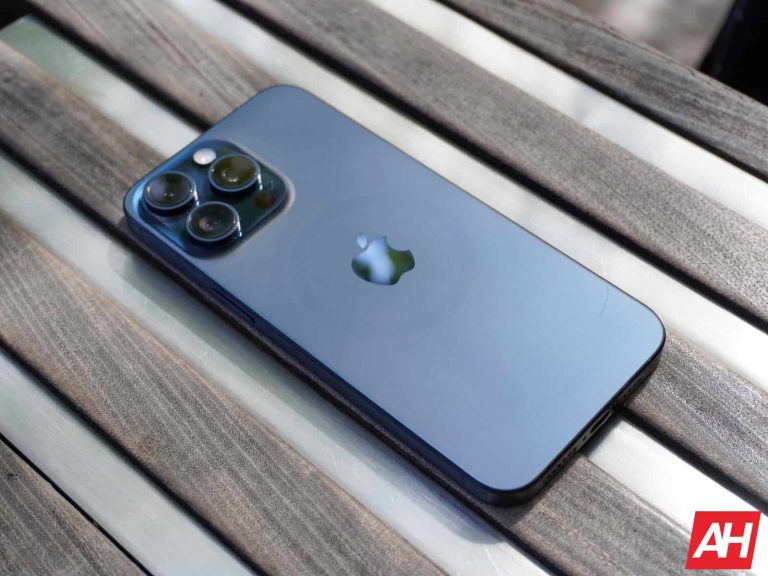
If you use WhatsApp often with family and friends, some upcoming changes to the app might make it easier to transfer files back and forth. This previously discovered feature seems to be getting some new refinements and might be able to replace OS-specific features like AirDrop on iOS and Quick Share on Android.
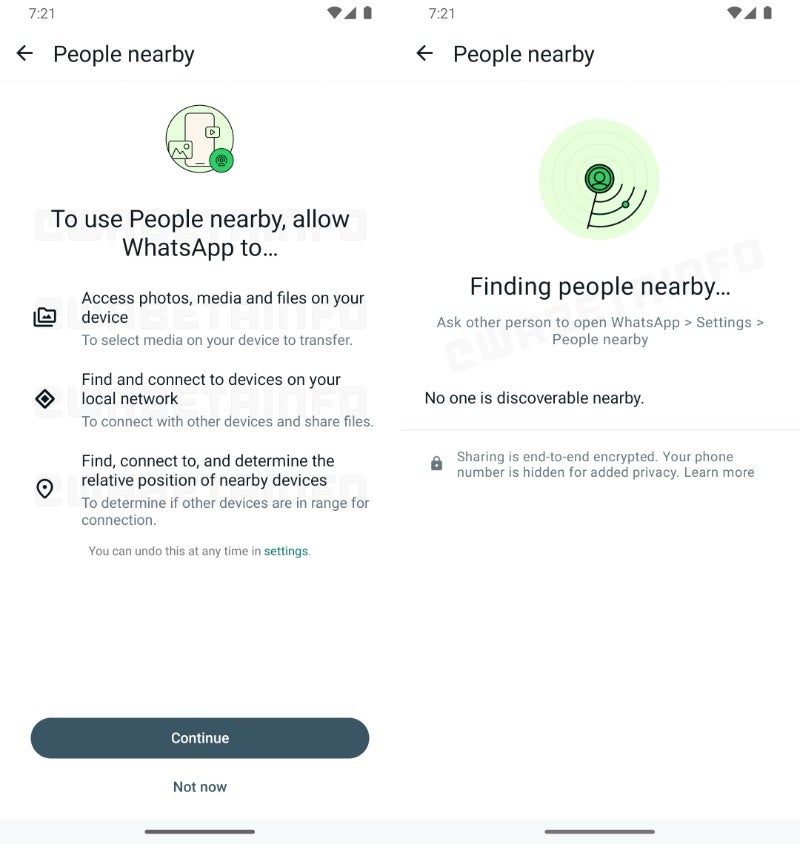
WhatsApp’s Bluetooth file-sharing feature for users nearby was first discovered back in January. Although still being tested, some new details are being added to the interface, such as a screen advising what the feature does and what permissions are needed. This was found by WaBetaInfo in version 2.24.9.22 of WhatsApp beta on the Google Play Store.
Credit: WaBetaInfo
The idea of the feature is simple: When you want to share a file, you’ll be able to find nearby WhatsApp users directly through a new section within the app. The app will then use your device’s Bluetooth and/or Wi-Fi for discovery (without requiring a data connection), and then you and the recipient will both need to open this new sharing section to connect.
This will be an “opt-in” approach, which means full privacy control. Additionally, WhatsApp assures users that all file sharing will remain end-to-end encrypted for security, and phone numbers will be hidden even when sharing. To use this feature, you’ll need to grant WhatsApp some permissions, including access to the files you want to share and permission to use your device’s location services to see which other devices are nearby.
WhatsApp’s new file-sharing option could be a game-changer, particularly for large files or when you’re in an area with a weak internet connection. However, where I see the most advantage is when using across operating systems. Right now, transferring files between an iPhone and an Android is a complicated matter, unless at least one of the users knows how to use other third party tools. Most of the time, what ends up happening is that one will send the file to the other via text (or SMS), which we know can be limited and will usually result in some awful compression.
Having this available within WhatsApp, which is used quite a bit already in my neck of the woods, will definitely make file transfer (particularly photos) practically frictionless. I envision a future where I no longer need to be the middle woman trying to educate friends and family on how to upload to Google Drive or use Snapdrop in order to send a high quality picture. Let’s hope this feature rolls out soon in an upcoming update.
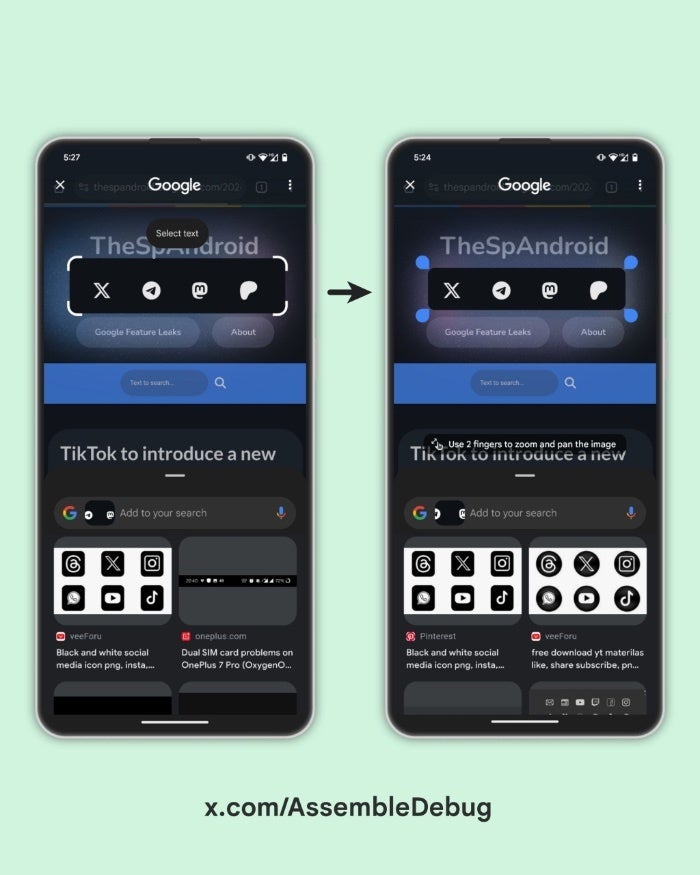
If you’ve ever wanted a quicker way to share specific parts of your phone screen with friends or colleagues, you’ll be glad to know a feature just like that may be arriving soon. Google is reportedly working on an update to Circle to Search which allows users to copy and share screenshots of a selected area of the screen.”Circle to Search,” the feature currently available on some newer Pixel and Samsung Galaxy phones, lets users draw a circle on the screen to search for information, as well as copy text. With the new update that is under development, according to findings by AssembleDebug (via PiunikaWeb), users will be able to do more than just search. They will be able to copy the circled area as an image, allowing them to edit or share it with others.
“Circle to Search” screenshot selection | Credit: PiunikaWeb
This will be particularly useful for sharing specific parts of apps, documents, and other visuals on your phone screen. Currently, to accomplish this you’d have to take a screenshot, then crop it in order to capture only a portion of what is on the display.
In addition to the new screenshot functionality, Circle to Search looks to also be getting a slight new look to it, specifically to the handles surrounding the area that is being selected. Currently, the area selected is enclosed in rounded brackets, while the new area looks more square and with less polish. It’s possible that this isn’t a final design and just a sign that development on this feature is far from finished.
Credit: PiunikaWeb
It is unknown when this new feature for Circle to Search is planned as an update for Pixel phones. However, judging by how tweaks to existing features such as this one traditionally get rolled out, it makes sense that this would make it into a future Pixel Feature Drop. It is also a possibility that Google may want to save this as an announcement for Google I/O as an Android 15 improvement.
Either way, Circle to Search and AI seem to be where Google is spending most of its energy these days. It would make sense if Google wants to spend a little more time working to refine and add polish to this feature before rolling it out to users.
With a bipartisan vote count of 360-58, the House passed a bill on Saturday that takes the banning of the popular video app TikTok in the U.S. one step closer to becoming reality. The bill is similar to one that passed the House in March by a vote count of 352-65; that bill would ban TikTok owner ByteDance from U.S. app storefronts unless the Chinese company quickly sold TikTok to a new owner.
With 170 million U.S. users, TikTok is accused of collecting personal data from its U.S. subscribers and there is concern that under Chinese Communist Party (CCP) rules, the Chinese government can force ByteDance to turn over this information to it.
The new TikTok bill is attached to a couple of requests to fund military equipment for Ukraine and to fund missiles for Israel. By submitting the bill to the Senate in this format, House Republicans put pressure on the Senate to pass the bill in a single vote. Analysts believe that the Senate will take up the bill within the next two weeks which could improve its chances of getting passed. President Joe Biden has previously said that if the bill reaches his desk, he will sign it.
The House of Representatives passes a new bill that could result in the banning of TikTok in the U.S.
The U.S. considers TikTok, with its current ownership, to be a national security threat. However, many young Americans love the app and TikTok users would prefer to see ByteDance sell the app to a U.S. company. In 2020, then President Donald Trump tried to force ByteDance to sell TikTok’s U.S. assets to an American company and in September of that year, he told reporters that he had approved “in concept” a deal that would have resulted in the acquisition of TikTok by U.S. tech firm Oracle. That deal never made it to the negotiating stage. Microsoft and Walmart were also said to be interested in TikTok.
Once signed into law by the president, the new bill would give ByteDance 270 days to find a new owner for TikTok, up from the 6-month deadline that the previous bill from last month gave the company. The new bill also would give the president the option to increase the deadline by an additional 90 days if he feels that progress is being made on a sale.
In a post on “X” this past week, TikTok wrote, “It is unfortunate that the House of Representatives is using the cover of important foreign and humanitarian assistance to once again jam through a ban bill that would trample the free speech rights of 170 million Americans, devastate 7 million businesses, and shutter a platform that contributes $24 billion to the U.S. economy, annually.”
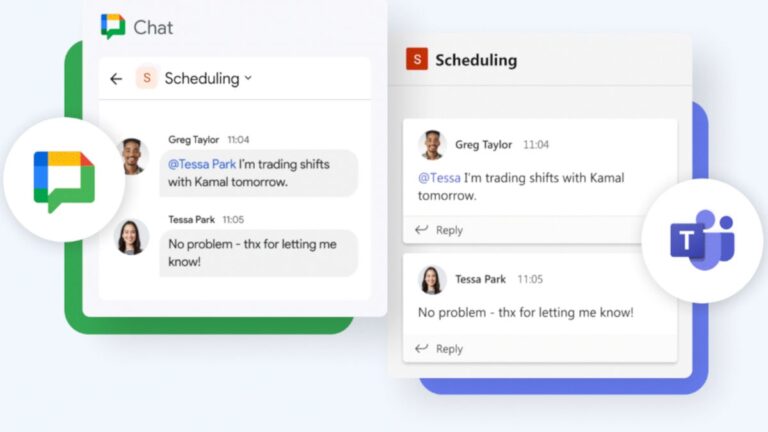
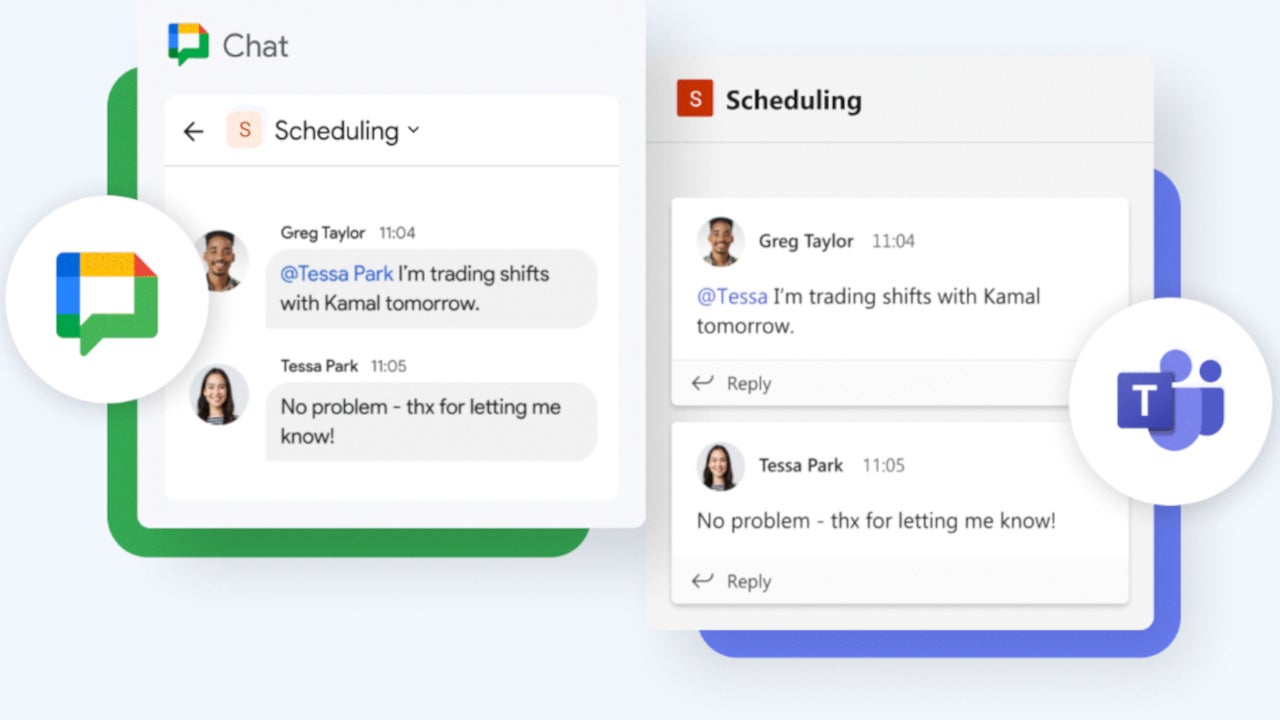
Not many might remember, but Google announced last year during its Cloud Next event plans to implement interoperability between its Chat app and Microsoft Teams and Slack.
Powered by Mio, the functionality entered beta testing right away and was available to Workspace customers through a special program that they could enroll into.
Earlier this week, Google announced that after about one year of testing, interoperability between Google Chat, Microsoft Teams, and Slack is finally generally available for Google Workspace customers.
This means that organizations will now be able to use Google Chat and other messaging platforms like Slack and Teams within their domain to offer their customers a more seamless experience for their users.
However, there’s one major requirement that Google Workspace customers must meet in order to benefit from this interoperability. According to Google, a separate Mio licensing is required to enable interoperability between Google Chat, Teams and Slack.
The functionality is already available in both Rapid Release and Scheduled Release domains and doesn’t require any end user action.
In a move that, frankly, surprises no one, TikTok appears to be working on a new feature that utilizes artificial intelligence (AI) to clone a user’s voice. This means that users may now be able to narrate their videos with a computer-generated version of their own voice, adding a new layer of personalization and creative freedom to their content.AI has been rapidly evolving in recent years, finding applications in various fields, from self-driving cars, to medical diagnosis, to just day-to-day use in your smartphones. In the realm of social media, AI is being used for a variety of purposes, such as content moderation and personalized recommendations.
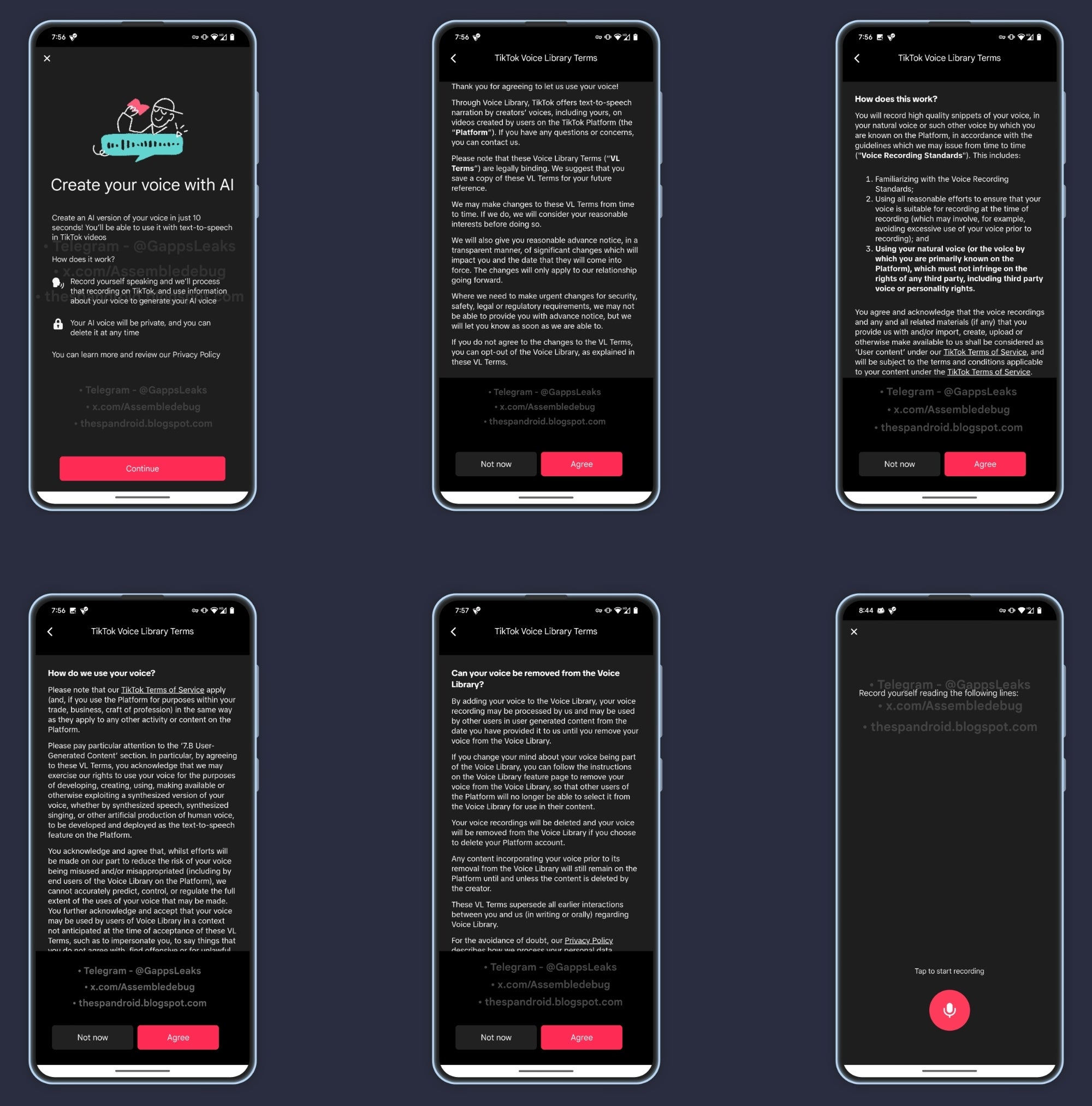
As discovered by AssembleDebug (via TheSPAndroid) after some tinkering with the code, TikTok’s new AI voice cloning feature appears similar to offerings from other companies like OpenAI. Users can record their voice saying a phrase, and the AI will then be able to generate a synthetic voice that mimics the speaker’s tone and inflection — all within 10 seconds. This synthetic voice can then be used to narrate text in videos, allowing creators to add narration without needing to record their voice directly.
The introduction of AI voice cloning on TikTok has the potential to significantly impact video creation on the platform. Creators can now leverage this feature to add a unique voice to their content, even if they are not comfortable using their natural voice in their videos. This can be particularly beneficial for users who may be shy or self-conscious about their voice, or have a particularly thick accent in the language chosen to create content in. Another possible application could be for creating content in different voices or accents for comedic effect.
Credit: TheSPAndroid
According to the UI screenshots that show the terms and conditions for using the feature, users will retain complete control over their AI voice data. They can decide to delete their AI voice at any time, ensuring privacy and control over their data. With this new feature, when it launches, TikTok would be offering creators a powerful tool to enhance their content and express themselves in new and innovative ways.
There is no official word on if or when this feature will be ready to roll out to the masses. However, whether it’s for educational purposes, comedic skits, or simply adding a personal touch to their videos, the possibilities for creative expression on TikTok will definitely expand thanks to AI voice cloning.
Google announced during Google Cloud Next 2024 that Chat apps can now subscribe to event notifications. Although Google Workspace developers enrolled in the Developer Preview Program have been able to build Chat apps that can subscribe to events using the specific API, this feature wasn’t actually functional.However, starting this week, the functionality is available to all Workspace developers, which means Chat apps can receive events about the following types of changes in Google Chat:
New memberships
New or removed reactions to a message
New, updated, or removed members in a space
Changes to a space, such as the space name or description
Thanks to the new functionality, all Chat apps that subscribe to event notifications will be able to respond to major actions in real-time. It’s also important to mention that both Rapid Release and Scheduled Release domains are getting the new functionality right away, so there’s no waiting for those who’d like to take advantage of it.
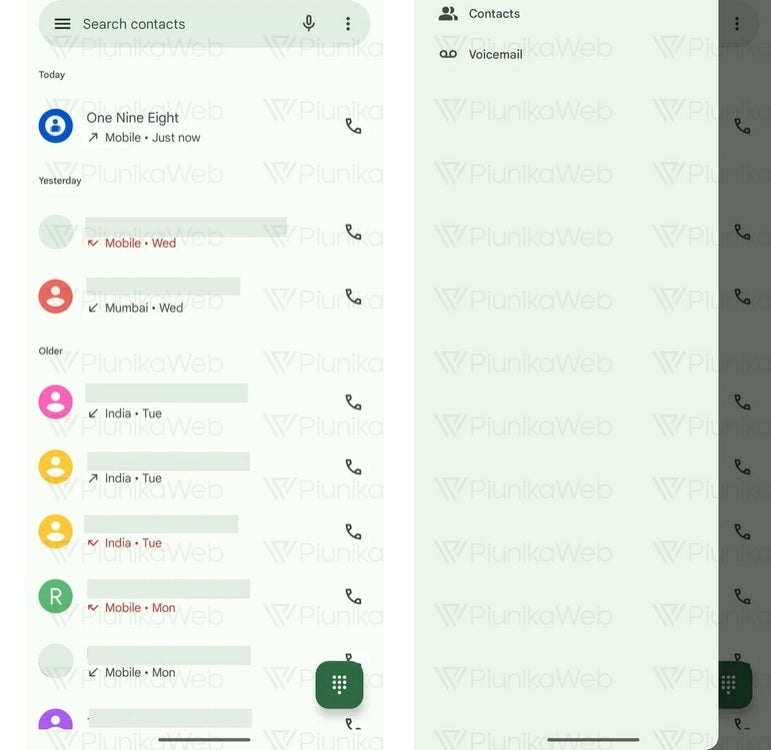
Google appears to be working on a new layout for the Google Phone app (known as the Phone by Google app) used to dial phone calls and more. That makes it probably one of the most widely used but less heralded apps on Android. The new UI is going to eliminate the bottom bar on the dialer which currently offers options such as Favorite, Recents, Contracts, and Voicemail. Instead, the dialer will feature a three-line hamburger menu icon. Tapping on the icon shows a side panel with only two options, Contacts and Voicemail.
The page does look strange as it is empty except for those two options. Google might be considering ways to fill out the side panel or this layout could merely be a test by Google that it doesn’t plan on releasing following the latest beta test of the Phone by Google app. While the Contacts and Voicemail options on the bottom bar would be replaced by the same options that appear in the hamburger menu icon, the Favorites and Recents options on the bottom bar do not appear anywhere in the new layout. Perhaps they will join Contacts and Voicemail on the side panel when the hamburger menu icon is tapped. That would make the panel look a little more full.
New layout for Phone by Google app includes three-line hamburger menu icon (L) and a new side panel
The new layout was discovered by AssembleDebug together with PiunikaWeb in the public beta version 128.0.625763929. The new layout has yet to reach my Pixel 6 Pro running Android 15 beta 1. My phone has the Phone by Google public beta version 127.0.620688474. I’m guessing that the next beta update to the Phone by Google app will give me the new layout.
AssembleDebug also discovered a string of code that gives permission to users to use the feature known as Emergency SOS which will allow Android users to connect to emergency services via satellite if no cellular connectivity is available. This feature is expected to be coming in Android 15, the final version of which will be pushed out in September or October. For those who don’t mind rolling the dice on an unstable beta update, Android 15 beta 1 is currently available for compatible Pixel handsets.
The danger is that since the beta can’t be uninstalled without wiping the phone, you might have to live with apps you use every day not working, reduced battery life, and bugs making it impossible to use the phone the way you want to until the final version of the app is released in September or October. Still, if you want to be the first on your block to run Android 15, go to google.com/android/beta or tap on this link. Press the box that reads, “View your eligible devices” and you be sent to a page showing a photo of your Pixel. Underneath the image, tap on Opt-in. A few minutes later go to Settings > System > System update and your update to the latest beta version of Android 15 will be ready.
Google has its all-in-one AI platform named Gemini. Gemini’s models are powering some of the most powerful AI tools on the internet. However, before there was Gemini, there was the PaLM API. This was a free-to-use API that developers could use to develop custom chatbots. Well, Google is shutting down the PaLM API. Adding insult to injury, the alternative that Google offered costs money.
This news comes shortly after we got rumors of Google eventually charging for search AI features. If this is true, then users will have to pay a monthly fee in order to access certain search AI tools. We believe that the SGE (Search Generative Experience) will be part of this. This is the feature that artificially generates answers to questions that you type into Google.
Google is shutting down the PaLM API
It’s always unfortunate seeing previously free products eventually gain a price tag. However, this is something that we should expect with AI tools. Right now, companies are still trying to figure out how to properly monetize AI content. For example, according to the rumors, Samsung is planning on charging for access to some Galaxy AI features in the future. So, we should rightfully expect Google to start charging for certain AI functions in the future.
The PaLM API was a free tool that people could use to create custom chatbots. Well, Google just sent out an email telling its users that it will be shutting down access to the PaLM API through Android Studio on August 15th. This gives people just about four months of access before they have to move to a different API.
However, Google is not leaving these developers without an alternative. The alternative that the company proposed was using Gemini Pro 1.0. Fortunately, you can use the same keys you used for the PaLM API to access Gemini through Google AI SDKs. The only issue is that using Gemini Pro 1.0 is not free.
The lowest plan costs $7/month, and that’s for 1 million input tokens. If you also want to have 1 million output tokens, this will cost you $21/month. Fortunately, Google will not use the responses to train its AI models.
One thing to know is that users will be able to access Palm and Gemini if they’re paying for Vertex AI.
Multi-platform emulator, Provenance, is headed to the App Store. This means an iPhone running a legitimate, non-Jailbroken iOS operating system, will be able to run old console games without sideloading any apps.
Multi-system emulator Provenance headed to iPhone officially
In an email to iMore, Joseph Mattiello, project lead of Provenance, confirmed that an app for the multi-system emulator is headed to the iOS App Store. He has, however, cautioned that the Provenance team is treading carefully, presumably because it is Apple,
“[The Provenance] team is working on a release. [However], I need to investigate these new rules before an App Store submission and to improve some quality-of-life issues. Also, I need to change some things to adhere to the App Store’s rules, such as mentioning “beta”.
Back when I had my iPhone 11, I had jailbroken it, and Provenance is a multi-system emulator with support for SEGA games. It also supports MD5 URLs for home screen shortcuts.
Delta has recently been dropped onto the App Store, and while it’s moreso Nintendo, it supports this too
What this means is that a Provenance app for iPhone could arrive this year. However, there’s no confirmed release date yet. Regardless, the presence of emulation apps like Provenance is a huge deal for the iPhone and iOS ecosystem.
Provenance might not be as big or as wide as Retroarch. However, it is a multi-system emulation package. In other words, Provenance is a single program that can emulate multiple consoles from the late 20th and early 21st century.
Some of the notable gaming consoles Provenance supports include Sony PlayStation, SEGA Saturn, Nintendo Virtual Boy, Nintendo Gamecube, and many more. The team behind the platform reportedly confirmed it is working on adding support for SEGA Dreamcast, Sony PlayStation 2, Nintendo DS, and others.
Retro gaming on iPhone is possible with multiple emulator apps
Owing to the amended rules, several multi-platform emulators should start trickling into the App Store. This is because many emulators were already working on the iPhone. Users, however, needed to sideload them. In other words, availability and compatibility weren’t stopping emulation on an iPhone.
It is important to note that emulation is a legally dicey issue. Companies like Nintendo have always taken the toughest possible approach to squash emulation. The company considers downloading a game a breach of copyright law even if users own a physical copy of the title.
Incidentally, the Apple iOS App Store has free, independently developed games. However, there’s no denying the appeal for multi-system emulation.
Pebblebee has confirmed that shipping of trackers will officially begin on May 27, 2024. This news comes after Pebblebee’s initial announcement that trackers for Android would start shipping in “late May.”
While not all pre-orders will necessarily go out on May 27th, it signifies the first day that customers can expect shipments to begin. This pebblebee tracker shipping date aligns with competitor Chipolo, who also announced May 27th as their launch date.
Pre-orders still open for Pebblebee’s diverse tracker range
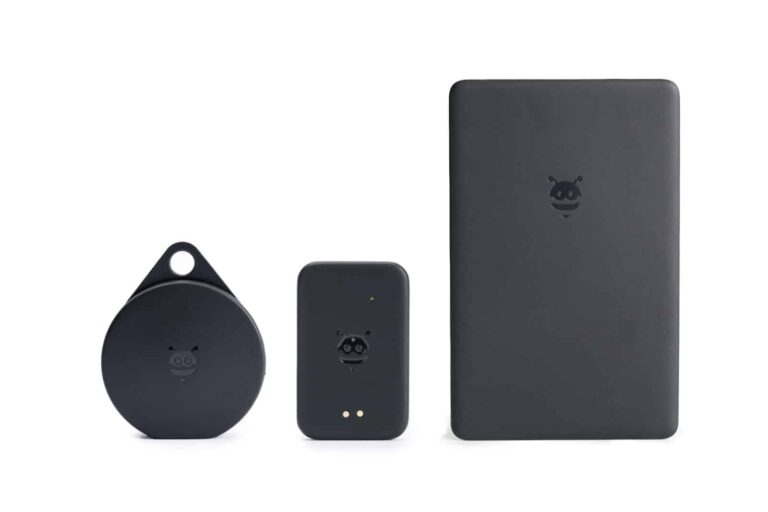
Ahead of the shipping date, Pebblebee’s diverse range of trackers is still available for pre-order. These include the Pebblebee Tag, Card, and Clip, with prices starting at $29.99.
The Pebblebee Tag is a versatile option ideal for attaching to keys, bags, or anything else you might misplace. Its compact size ensures it won’t add bulk, while still offering reliable tracking functionality. For those who prioritize keeping track of the phone itself, the Pebblebee Card is a slim and unobtrusive option designed for wallets or phone cases.
Finally, the Pebblebee Clip is a clip-on tracker ideal for attaching to larger items like bikes or backpacks. The Clip’s secure attachment method provides peace of mind for valuable possessions.
Find My Device Network expands with Pebblebee integration
Pebblebee’s trackers integrate seamlessly with Android’s Find My Device network, using Bluetooth Low Energy (BLE) to locate nearby trackers. This makes it a breeze to find misplaced items within a short range.
For situations where your lost item is farther away, the Find My Device network leverages the power of the crowd. When a Pebblebee tracker is out of range of its owner’s phone, it can still be anonymously detected by other Android devices in the network. This collective effort significantly increases the chances of finding a lost item, even at a distance.
The addition of Pebblebee trackers to the Find My Device network offers more options to Android users for keeping track of their belongings. With their variety of trackers, competitive pricing, and the tracker shipping date fast approaching, Pebblebee is poised to become a major player in the Android lost-item tracking space.