GitHub has leaped application security by introducing a new feature that promises to revolutionize how developers address code vulnerabilities.
The new tool, code scanning autofix, is now available in public beta for all GitHub Advanced Security customers, harnessing the power of GitHub Copilot and CodeQL to offer unprecedented assistance in code remediation.
Found Means Fixed: A Vision for Application Security
GitHub’s vision for application security is encapsulated in the principle that “found means fixed.”
Alert Fatigue that helps no one as security teams need to triage 100s of vulnerabilities.:
The problem of vulnerability fatigue today
Difference between CVSS-specific vulnerability vs risk-based vulnerability
Evaluating vulnerabilities based on the business impact/risk
Automation to reduce alert fatigue and enhance security posture significantly
AcuRisQ, that helps you to quantify risk accurately:
With the introduction of code scanning autofix, GitHub is making strides towards an environment where the discovery of a vulnerability is immediately followed by its resolution.
This tool is not just a theoretical advancement; it is a practical solution that has been shown to help teams remediate issues up to seven times faster than traditional security tools.
Github Advanced Security (source:GitHub)
How Code Scanning Autofix Works
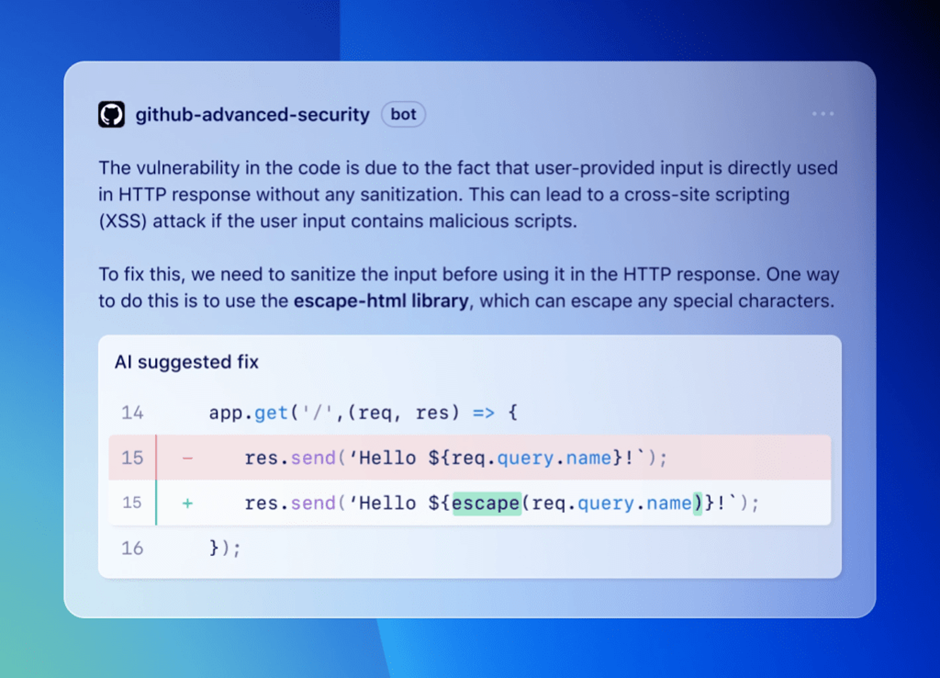
Code scanning auto-fix is designed to provide developers with an explanation and code suggestions to remediate a vulnerability.
This feature covers over 90% of alert types in popular programming languages such as JavaScript, TypeScript, Java, and Python.
It can deliver code suggestions that can remediate more than two-thirds of found vulnerabilities with minimal editing required by the developer.
Github Advanced Security
Addressing Application Security Debt
Applications are a leading attack vector, and many organizations acknowledge the challenge of managing an increasing number of unremediated vulnerabilities in production repositories.
Code scanning autofix aims to curb the growth of this “application security debt” by simplifying the process for developers to fix vulnerabilities as they arise during coding.
Just as GitHub Copilot has been assisting developers by automating tedious and repetitive tasks, code scanning auto-fix is set to help development teams save valuable time previously spent on remediation.
Security teams also benefit from this tool as it reduces the volume of everyday vulnerabilities, allowing them to concentrate on higher-level strategies to safeguard the business in a fast-paced development environment.
The Technology Behind Autofix
The magic behind code scanning auto-fix lies in the CodeQL engine, which, in combination with heuristics and GitHub Copilot APIs, generates code suggestions.
When a vulnerability is detected in a supported language, the tool provides a natural-language explanation of the fix and a preview of the code suggestion.
Developers can then choose to accept, edit, or dismiss the suggestion. These suggestions can span multiple files and include necessary changes to project dependencies.
Stay updated on Cybersecurity news, Whitepapers, and Infographics. Follow us on LinkedIn & Twitter.
We are knee-deep into Q1 2024, so we are starting to see numbers trickling in from Q4 2023. We’re able to get a glimpse at how smartphone companies performed during the final three months of the year. Well, it looks like Google has caused to celebrate because Pixel phones are nearing 5% of the US market in terms of market share.
Right now, the global smartphone market is facing some challenges with stagnated growth due to the poor economic situation. However, several companies are seeing varying degrees of success in the smartphone market. For example, the Galaxy S24 series of phones seems to be doing pretty well for Samsung. These phones are breaking sales records for the company.
Pixel phones are nearing 5% market share in the US
The top three spots in the US smartphone market are pretty much set in stone. Apple (51.9%) is in first place by a large margin, Samsung (22.4%) is in second place, and Motorola (8%) is in third. It will take an act of cosmic proportions to move any of these three heavy hitters from their spots. However, the lower spots fluctuate much more frequently. According to a new report from IDC, the Google Pixel phone is starting to near the 5% mark in terms of market share for the US. The number might not seem significant in the grand scheme of things, but it shows that Pixel phones are rising at a steady rate in the US. Sure, Pixel phones are extremely popular in Japan, but the US is Google’s home.
Looking at the numbers, Google was able to tackle 4.6% of the US smartphone market in Q4 2023. All of this is despite a heavy 13.6% decline in YoY shipments for the same quarter. Pixels were able to secure fourth place in the US in terms of market share, just beating out TCL’s 4.2%.
Below TCL, we have the rest of the riffraff, the dreaded “Other” category. This section of the market made up 8.6% of the US smartphone market share.
As for the smartphone market as a whole, it shrank by an unfortunate 6.9% YoY. There were 130.6 million units shipped during the last 3 months of 2023.
Unlocked phones
Google was also able to sell a significant amount of unlocked phones in the US last quarter. According to the numbers, Motorola was able to make up 34% of the total number of unlocked phones sold in the US, and that gave it the top spot. In second place, with 20%, we have Samsung with Apple following it closely with 19%. In fourth place, we have Google with 9% of the market. That’s pretty significant. Under Google, we have TCL with 6%.
With this news, we’re certain that Google is celebrating and planning on pushing its market share even further in the coming year.
The U.S. Department of Justice is ready to file a lawsuit against Apple as soon as tomorrow. The suit would charge Apple with violating antitrust laws by blocking the company’s rivals from accessing certain hardware and software features of the iPhone. The news of the suit, which will be filed in federal court, was first published by Bloomberg on Wednesday. While Apple has been sued by the DOJ two other times over the past 14 years, this suit is a little different since it accuses Apple of using illegal methods to help the iPhone dominate in certain markets.
Back in January, we told you that the DOJ was on the verge of filing this lawsuit which charges Apple with making it difficult for rival firms to compete against the iPhone. At the time, some of the issues that were mentioned by The New York Times included Apple’s decision to lock competitors out of its iMessage platform, why the Apple Watch works better with the iPhone than other smartphones, and how Apple’s mobile payment system blocks third-party firms from competing with Apple.
The DOJ could file an antitrust lawsuit against Apple as soon as tomorrow
Some of these issues were addressed in the EU with the passage of the Digital Markets Act (DMA) which requires Apple in the 27 EU countries to allow the use of third-party in-app payment platforms, requires Apple to allow third-party financial firms to work with the iPhone’s mobile-payment system, and opens up the iPhone to non-WebKit-powered mobile browsers. Last month, Bloomberg reported that Apple met with officials from the DOJ in an effort to convince the agency not to file an antitrust lawsuit. If Bloomberg is correct about what is coming on Thursday, Apple failed.
Developers can now put a single link in their app directing customers to third-party payment processing platforms. However, Apple is still collecting a cut of 12% to 27% on these purchases, 3 percentage points less than the 15%-30% cut Apple takes for transactions going through its own in-app payment processing platform.
Epic is complaining about the fee Apple still charges even when third-party payment platforms are used. The game developer is also not happy about the one link limit that the tech giant allows and says that the iPhone maker should be held in contempt of court. Microsoft, Meta, X, and Match say that Apple is preventing apps from including “even the most basic information” about third-party payment platforms. Apple claims that it has been in compliance with the judge’s order since January.
Apple’s shares have been on the rebound lately rising from $170 to nearly $179 in line with a strong tech sector. However, once the Bloomberg report came out, the shares got hit in after-hours trading declining to $176.40.
Clearview AI, a facial recognition company mixed up in privacy debates, is now listed on the US government’s Tradewinds Solutions Marketplace – This move puts their technology in the running for potential use by national defence agencies, sparking renewed concerns about facial recognition and its role in security. Will Clearview AI be a valuable tool or an erosion of privacy?
On March 19, 2024, the controversial facial recognition technology company, Clearview AI, announced its inclusion in the Tradewinds Solutions Marketplace. This move grants Clearview AI “Awardable” status, making its facial recognition platform a potential candidate for use in national defence contracts across the United States.
It is worth mentioning that in March 2022, Clearview AI’s facial recognition solution was also used by Ukraine, which the country claimed was utilized to monitor ‘People of Interest.’
The Tradewinds Solutions Marketplace, managed by the Chief Digital and Artificial Intelligence Office (CDAO), functions as a repository of digital tools that have been pre-approved for consideration by US federal agencies.
This streamlined process allows agencies, particularly the Department of Defense, to efficiently identify and procure vetted technologies that meet the requirements of federal acquisition regulations.
Clearview AI’s facial recognition system boasts an extensive database of over 40 billion images culled from publicly available sources across the internet. This vast collection of data allows the platform to identify individuals with a high degree of accuracy, according to the company.
Clearview AI emphasizes the potential benefits of its technology for national security. The company argues that its platform can be a powerful tool for intelligence and defence agencies, enabling them to identify unknown individuals and enhance national security efforts through the use of open-source intelligence (OSINT).
Clearview AI and privacy and cybersecurity issues
However, Clearview AI’s data collection practices have raised privacy concerns in the past. Critics argue that the company’s unrestricted scraping of publicly available images constitutes a privacy intrusion, raising questions about the potential for misuse of the technology.
In March 2020, Apple suspended the Clearview AI app from the App Store for breaching the company’s Developer Enterprise Program terms and services. Before the suspension, in February 2020, unknown hackers claimed a data breach at Clearview AI which the company denied.
The New York Times originally uncovered Clearview AI’s privacy breaches, revealing that the company shares data with law enforcement to identify suspects by comparing their images with online photos. Clearview AI retains deleted photos in its database.
Following these revelations, Twitter, Facebook, and Google issued cease-and-desist notices to Clearview AI. Additionally, lawmakers in New Jersey prohibited law enforcement agencies from utilizing its software or services.
In response to the allegations, the company’s founder and CEO, Hoan Ton-That, stated that he aims to establish a prominent American enterprise by providing life-saving technology for detecting criminals. He emphasized that the company’s practices are not maliciously intended, as the software is never sold to other countries.
However, in the press release published on March 19, 2924, in response to the inclusion, the CEO called it a matter of pride for the company and its “cutting-edge” technology.
“We are proud to be approved to offer our cutting-edge technology on the Tradewinds Marketplace. National Security and Military organizations will get immediate access to a secure facial recognition search engine that can help to identify unknown individuals, and enhance national security efforts using Open Source Intelligence (OSINT).”
— Hoan Ton-That, Co-Founder & CEO of Clearview AI
Nevertheless, the addition of Clearview AI to the Tradewinds Solutions Marketplace will set off the debate surrounding facial recognition technology and its role in national security. While some see it as a valuable tool for law enforcement and defence, others worry about the potential for government overreach and the erosion of individual privacy.
You’re most likely one of the increasing number of people using Threads. The popular social media app and website has been growing in popularity over the past couple of months. Well, this is because of the team of developers adding new features to it. According to a new announcement from Adam Mosseri, Threads has finally gotten trending topics.
Don’t you want to know what other people are posting Threads about? What’s popular now? What sort of drama is going down? If you’re a person who appreciates keeping up with what’s going on in the world, then you will definitely appreciate this feature. This is a feature that we have been hearing about for quite some time, so it’s great to see that Threads is finally coming out with it.
Threads is finally getting trending topics
Undoubtedly, this feature is pretty reminiscent of X’s trending topics. When you go to the search section, you will see the hashtags that are getting the most number of tweets. They can be an indicator of major events that are going down. People are not shy about tweeting about political scandals, new video games, blockbuster movies, dead celebrities, Etc.
So, the trending topic section gives you a good idea of what you probably should know about. Adam Mosseri, the CEO of Instagram, just posted a new thread letting us know that this new feature is finally making its way to users.
We are in the threads app, you will simply tap on the search icon and the toolbar. There, you will see a list of some of the biggest trending topics. This list will be the first thing you see right under the search bar. Under that, you will see the Follow suggestions.
Just like with X, when you tap on a topic, you will see all the top posts being made about that topic. The section will show the top five topics, but it doesn’t look like it refreshes in real-time as it does with X.
At the top right of the feed, you see a three-dot button. However, don’t get your hopes up for customization options. You only get a small panel letting you know what the trending topics feed is.
This feature is rolling out widely for everyone, so you should be able to see it with the newest update to the Threads app. If you don’t have it yet, make sure to update your app.
A new ‘Loop DoS’ attack targets application layer protocols via UDP vulnerability, creating indefinite communication loops and affecting 300,000 hosts.
Researchers at the CISPA Helmholtz Center for Information Security have discovered a novel way to launch denial-of-service (DoS) attacks, this time targeting application-layer protocols. This new technique, dubbed “Loop DoS,” exploits vulnerabilities in how these protocols handle messages to create a self-perpetuating loop.
Traditionally, DoS attacks focus on overwhelming a system with a massive influx of traffic, making it difficult or impossible for legitimate users to access resources. The Loop DoS attack takes a different approach. It leverages the way application-layer protocols, which rely on the User Datagram Protocol (UDP) for communication, handle messages.
Unlike TCP, UDP is a connectionless protocol, meaning it doesn’t establish a connection between sender and receiver before transmitting data. This makes UDP faster and more efficient, but also less secure.
Attackers exploit this lack of verification inherent to UDP by forging IP addresses in messages. In a Loop DoS attack, the attacker sends a crafted message to a vulnerable server spoofing the IP address of a different victim server.
The targeted server, tricked into believing the message originated from another legitimate server, responds accordingly. The attacker intercepts this response and again spoofs the victim’s IP address, creating a loop where the servers continuously send messages to each other. This rapid back-and-forth exchange overwhelms both servers, denying service to legitimate users.
The researchers at CISPA warn that the Loop DoS attack poses a significant threat as it can impact a wide range of commonly used application-layer protocols, including DNS, NTP, TFTP, and even legacy protocols like Echo and Chargen.
Their analysis indicates hundreds of thousands of internet-facing systems could be vulnerable. In fact, according to CISPA’s report, it has the potential to impact around 300,000 hosts and their associated networks.
The good news is that the researchers haven’t observed widespread exploitation of this vulnerability yet. However, it shows how cybersecurity threats are evolving and cybercriminals are getting more sophisticated at what they do.
For insights, we reached out to Jason Kent, Hacker In Residence (HIR) at Cequence Security, who stated “Denial of Service attacks are almost always resource consumption attacks. Some resource is left open, which can be system memory, IP Addresses it hands out, CPU utilization, connections available, and really anything that if consumed beyond limits, the system can crash.”
“Often when DoS is mentioned it is in the context of taking a web property offline through various means, but by consuming resources on the web architecture and causing failures. Often these are difficult to pull off because you have to have systems smart enough to gather an army of hosts that will call upon the victim web architecture all at once,” he said.
Jason further explained “With this vulnerability, the call can be coming from inside the house. I can give Server A at an organization, Server B’s address, and act like I am Server B. Server A will send Server B an error, and Server B in turn will send Server A an error, to infinity or until one of them dies. No having to plan or strategize how to get millions of hosts. You can have 2 hosts kill one another. Now imagine if I got Servers A, B, C, D….. to participate in this little game. It’s possible to cause cascading system failures that creep across environments, triggered from the outside. It’s nasty.”
“The good news is, blocking UDP-type protocols and moving to TCP-based communication with authentication and monitoring, can break this vulnerability but if you cannot move from the UDP-based systems you are on today, you may want to limit host-to-host communication in internal firewalls and networking gear,” Jason advised.
Nevertheless, system administrators and IT security professionals are advised to mitigate the threat by blocking UDP-type protocols and moving to TCP-based communication with authentication and monitoring. Additionally, staying informed about the latest threats and implementing proper security measures are crucial for safeguarding systems from emerging DoS attacks like Loop DoS.
There are not many high-end and yet compact smartphones out there these days, but there are some. In this article, we’ll compare two such devices, the Samsung Galaxy S24 vs Xiaomi 14. These are not technically the most powerful devices from their companies, but they’re smaller variants of those phones. The Galaxy S24 Ultra and Xiaomi 14 Ultra take the crown of being the most powerful ones, of course.
The Galaxy S24 and Xiaomi 14 are the devices to go to if you hate carrying around huge smartphones. The Galaxy S24 is the smaller one of the two, but both are somewhat compact. The Xiaomi 14 has a larger display, which is why it’s a bit larger. In any case, they are quite different, and in this article we’ll compare them across a number of categories, starting by listing their specifications.
The Samsung Galaxy S24 and Xiaomi 14 are both made out of metal and glass. Well, the Xiaomi 14 also comes in a variant with a vegan leather backplate, but that model is exclusive to China. In this article, we’ll focus on global variants. The two phones are quite different in terms of design, even though they look somewhat similar when you look at them from the front. They both have flat displays, thin uniform bezels, and a centered display camera hole.
If you flip them around, however, you’ll see plenty of differences. The Galaxy S24 has three separate camera islands on the back. Those cameras are aligned vertically in the top-left corner of the phone’s back. The Xiaomi 14 also has three cameras, but they’re all included in a single camera island which sits in the top-left corner of its back. Their logos are in different spots in on the back too. All physical buttons sit on the right-hand side of both devices.
The Xiaomi 14 is taller, wider, and thicker than the Galaxy S24. Do note that it has a noticeably larger display too. The bezels around the display are thinner on the Xiaomi 14, but not by much. The Galaxy S24 weighs 167 grams, while the Xiaomi 14 weighs 193 grams. Both smartphones do offer an IP68 certification for water and dust resistance. Both of them are also very comfortable to hold and use, though they are quite slippery. Using a case with both may not be such a bad idea. They’re both very good for one-hand use, at least they were for us. The build quality is great on both sides.
Samsung Galaxy S24 vs Xiaomi 14: Display
The Samsung Galaxy S24 includes a 6.2-inch fullHD+ (2340 x 1080) Dynamic LTPO AMOLED 2X display. This panel is flat, and it has a 120Hz refresh rate (adaptive). It supports HDR10+ content, and it has the peak brightness of 2,600 nits. This display has a screen-to-body ratio of around 90%, and a display aspect ratio of 19.5:9. The Gorilla Glass Victus 2 from Corning is used to protect the display itself.
Xiaomi 14
The Xiaomi 14, on the other hand, has a 6.36-inch 2670 x 1200 LTPO OLED display. This panel is flat too, and it has a 120Hz refresh rate (adaptive). It supports Dolby Vision and HDR10+ content too, and the maximum brightness is 3,000 nits, in theory. The screen-to-body ratio is around 90%, and the display aspect ratio Xiaomi opted for is 20:9. The Gorilla Glass Victus protects this panel.
Both of these phones have great displays. Both panels are quite responsive, vivid, and offer great viewing angles. They’re also quite sharp, even though the Xiaomi 14 has a higher resolution, in case you need it. The blacks are deep on both panels, and both displays are well-protected. The Xiaomi 14’s display does get a bit brighter, though, which is important to note if you spend a lot of time in direct sunlight. Both panels are bright enough, though. You will notice that difference in direct sunlight, though, the Xiaomi 14 has the edge.
Samsung Galaxy S24 vs Xiaomi 14: Performance
The Samsung Galaxy S24 is fueled by either the Snapdragon 8 Gen 3 for Galaxy or Exynos 2400 SoC. In the US, the Snapdragon 8 Gen 3 for Galaxy is used, and that’s the model we tested. The Xiaomi 14, on the other hand, is fueled by the Snapdragon 8 Gen 3. Both smartphones utilize LPDDR5X RAM and UFS 4.0 flash storage. There is one exception, though, the base model of the Galaxy S24, which uses UFS 3.1 flash storage.
In terms of performance-related hardware, they’re on the same level, basically. And yes, the performance is very good on both phones, as expected. They handle browsing, taking images, multimedia consumption, multitasking, and various other everyday activities with ease. We did not really notice the extra RAM inside the Xiaomi 14, even though it did multitasking a bit faster at times, but the difference is hard to notice. Both did a great job in that regard.
The same can be said for gaming, actually. Both phones did get quite warm during 30-60-minute gaming sessions, especially with graphically-intensive titles. Still, the performance did not take a visible hit, not at all. Also, neither phone got hot to the point of being hard to handle. They can both run the most demanding games out there, though we did notice that the Xiaomi 14 handled Genshin Impact a bit better.
Samsung Galaxy S24 vs Xiaomi 14: Battery
The Samsung Galaxy S24 comes with a 4,000mAh battery on the inside. The Xiaomi 14, on the flip side, includes a 4,610mAh battery. Both phones do offer good battery life, but the Xiaomi 14 is a level above the Galaxy S24. Getting around 6 hours of screen-on-time on the Galaxy S24 has proven to be possible. The phone was able to cross that mark on most days. The Xiaomi 14, on the other hand, can go over the 7-hour mark, at least it did for us. It can go even higher, actually, it all depends on your usage.
The battery consumption will, of course, depend on your usage. So your mileage may vary. Each of us uses our phones differently, with different apps loaded, and different signals. Do note that our usage includes a WiFi connection most of the day, with some off days with 5G connected. Both phones did great on both connections, though, we did not notice major dropoffs when connected to 5G, though our signal was very good.
When it comes to charging, it’s not even close. The Xiaomi 14 takes the cake, easily. It supports 90W wired, 50W wireless, and 10W reverse wireless charging. It also includes a 90W charger in the box. The Samsung Galaxy S24 supports 25W wired, 15W wireless, and 4.5W reverse wireless charging. It comes without a charger. The Xiaomi 14 charges way faster wirelessly than the Galaxy S24 does via a wire, so when you count on the Xiaomi 14’s wired charging, things are even more different.
Samsung Galaxy S24 vs Xiaomi 14: Cameras
Both of these smartphones have three cameras on the back. The Samsung Galaxy S24 features a 50-megapixel main camera, a 12-megapixel ultrawide camera (120-degree FoV), and a 10-megapixel telephoto unit (3x optical zoom). The Xiaomi 14, on the flip side, includes a 50-megapixel main camera, a 50-megapixel ultrawide unit (115-degree FoV), and a 50-megapixel telephoto camera (3.2x optical zoom). It’s worth noting that Leica lenses are included on the Xiaomi 14.
Samsung Galaxy S24
Both smartphones do a good job when it comes to photography, but we generally prefer results from the Xiaomi 14. Those images did turn out to be what we’ve actually seen with our own eyes, and that goes for both daylight and nighttime shots. The Galaxy S24 does come with improved processing, but it still tends to brighten up some scenes a bit too much and also uses saturation and sharpening a bit much at times. That is understandable considering its sensors, though.
The Xiaomi 14 prefers to take a bit more contrasty shots, which are usually really well-balanced. The phone handles low-light scenes better too, and we also preferred both its ultrawide and telephoto camera results. Both of those cameras do a good job in low light too, especially the telephoto shooter.
Audio
Both of these phones have stereo speakers, and the loudness that you can get from them is good. In fact, they’re on the same playing field in terms of general speaker loudness. Those speakers are well-balanced on both ends.
What you will not find on either phone is a 3.5mm headphone jack. You can, however, utilize the Type-C port on both phones, or if you prefer wireless audio, Bluetooth 5.3 is included on the Galaxy S24, and Bluetooth 5.4 on the Galaxy S24.
The Biden administration is now looking forward to imposing further trade sanctions on four Chinese companies associated with Huawei’s semiconductor manufacturing. This move comes in response to Huawei’s recent technological breakthrough and aims to further restrict Beijing’s artificial intelligence and semiconductor ambitions. The potential trade sanction underscores escalating tensions between the US and China and represents US efforts to curb Huawei’s influence in the global tech industry.
If implemented, this measure would mark another notable escalation in the ongoing campaign to constrain China’s semiconductor capabilities. The decision would increase pressure on Huawei, a key player in China’s technological advancement, which has somehow managed to make strides despite existing sanctions. Notably, Huawei achieved a significant milestone by producing a smartphone processor last year that many in Washington deemed beyond its capabilities.
This time the target is Chinese companies that might be helping Huawei in its chip manufacturing
The companies targeted for potential sanction include chipmakers Qingdao Si’En, SwaySure, and Shenzhen Pensun Technology Co., along with China’s leading memory chipmaker, ChangXin Memory Technologies Inc. These entities were previously identified as chipmaking facilities associated with Huawei. Additionally, the US government may sanction companies like Shenzhen Pengjin High-Tech Co. and SiCarrier, suspected of aiding Huawei in obtaining restricted equipment.
Furthermore, US officials are urging allies, including the Netherlands, Germany, South Korea, and Japan, to tighten trade sanctions and impose further restrictions on Huawei’s access to technologies and equipment related to chip manufacturing.
However, it remains unclear whether the US Department of Commerce has sufficient evidence linking these companies to Huawei. Despite this, the US has the authority to sanction businesses deemed a potential threat to “national security”, without needing to prove past harmful or illegal activity.
The potential ban is influenced by various factors, including the status of US-China relations and ongoing policy considerations. Treasury Secretary Janet Yellen’s upcoming visit to China and discussions between President Joe Biden and Chinese leader Xi Jinping will likely impact the timing of the decision. Additionally, discussions about adjustments to China tariffs and potential tariff increases on older-generation chips further complicate the situation.
Huawei Mate 60 series’ 7nm chip suggests China’s progress in / access to the required technologies
Huawei’s addition to the entity list in 2019 significantly restricted its access to American technology. However, Huawei’s recent unveiling of the Huawei Mate 60 series powered by a domestically produced 7-nanometer chip suggests China’s progress in semiconductor manufacturing. Despite this, China still heavily relies on foreign technology. It highlights the challenges for Huawei to achieve self-sufficiency.
Они используются для торговли, займов, кредитов и обеспечивают защиту от высокой волатильности рынка благодаря стабильному курсу. Блокчейн технология делает DeFi-платформы прозрачными, поскольку вся информация доступна пользователям за счет открытого исходного кода. А смарт-контракты исключают риск манипуляций, связанных с человеческим фактором, поскольку все условия прописываются в алгоритме, который невозможно подделать или изменить.
Но здесь цифровые деньги являются программируемыми с помощью умных контрактов, так что вы можете выйти за рамки хранения и отправки валюты. Биткоин позволяет вам действительно владеть валютой, контролировать ее и отправлять в любую точку мира. Это достигается за счет предоставления возможности большому числу людей, которые не доверяют друг другу, согласовать бухгалтерскую книгу без необходимости в доверенном посреднике. Биткоин открыт для всех, и никто не имеет полномочий изменять его правила. Правила Bitcoin, такие как его дефицит и открытость, прописаны в технологии. Это не похоже на традиционные финансы, где правительства могут печатать деньги, которые обесценивают ваши сбережения, а компании могут закрыть рынки.
Среди известных децентрализованных бирж можно назвать Uniswap, PancakeSwap и dYdX. Alchemix также предлагает низкие комиссии за транзакции и быстрое время выполнения транзакций, что делает его довольно привлекательным вариантом. ENS вошла в список лучших DeFi-приложений в 2023 году благодаря своему потенциалу стать крупным игроком в сфере децентрализованных финансов.
Децентрализованные биржи (DEX) позволяют торговать различными токенами в любое время. Это как использовать обмен валют при посещении другой страны. Рынки работают 24/7, 365 дней в году, а технологии гарантируют, что всегда найдется кто-нибудь, кто согласится на сделку. В качестве блокчейна Ethereum предназначен для отправки транзакций что такое defi безопасным и глобальным путем. Как и Bitcoin, Ethereum делает перевод денег по всему миру таким же простым, как и отправка электронной почты. Просто введите имя ENS вашего получателя (например, bob.eth) или адрес его учетной записи в вашем кошельке, и ваш платеж поступит непосредственно к нему в течение (как правило) нескольких минут.
Лучшие Спотовые Биржи
Кредиторы могут объединять свои активы с другими, устанавливая условия через смарт-контракты. Прежде всего, протокол помогает обеспечить доступ к традиционным финансовым активам. Во-вторых, он обеспечивает пришествие сложных торговых стратегий в мир блокчейна.
Rocket Pool — это DeFi DApp, которое предоставляет децентрализованную инфраструктуру для стейкинга Ethereum 2.zero. Оно построено на блокчейне Ethereum и функционирует как децентрализованная автономная организация (DAO), решения в которой принимаются членами сообщества, владеющими токеном управления RPL. UniSwap предлагает низкие комиссии за транзакции и быстрое время выполнения транзакций, что делает его довольно привлекательным вариантом для криптотрейдеров. Удобный интерфейс и широкий выбор торговых пар делают UniSwap одним из самых популярных DeFi-приложений.
Топ Three Самых Популярных Купона
К примеру, возможность обмена в формате DEX интегрирована в интерфейс криптокошелька Trust Wallet. Одни пользователи оценивают условия сервисов и добровольно переводят в протокол активы со своего кошелька. Это только один из способов использовать децентрализованные финансы. Децентрализованная финансовая система (от англ. Decentralized Finance) стала одной из наиболее важных инноваций в мировой экономике.
Банкам необходимо знать, сможете ли вы погасить кредит, прежде чем выдавать его.
Скорость транзакций Ethereum также колеблется, поэтому торговля может стать дорогостоящей.
Описаны наиболее известные сервисы, преимущества сферы, а также с какими сложностями сталкиваются пользователей при первом опыте.
Однако уже есть проекты, которые начинают страховать все, с чем мы можем столкнуться в реальной жизни.
Это делается с использованием процентных ставок, определяемых рыночным спросом и предложением.
Среди популярных агрегаторов DeFi можно назвать 1inch и Zapper. Децентрализованные биржи работают так же, как централизованные и традиционные биржи, то есть позволяют пользователям покупать и продавать ценности. Однако децентрализованные биржи управляются смарт-контрактами, а не централизованными организациями, поэтому дают пользователям больше контроля над своими средствами и повышенную конфиденциальность. Здесь от клиентов не требуют предоставлять личную информацию, но такие биржи и не берут на себя ответственность за средства пользователей.
Перспективы Defi
Протоколы децентрализованного кредитования — это приложения, где пользователи могут брать и давать займы в криптовалюте и других цифровых активах через децентрализованные сети. По сравнению с централизованным кредитованием здесь более высокая доходность для кредиторов и лучшие условия для заёмщиков, не говоря уже о более высокой безопасности и конфиденциальности. С другой стороны, логика финансовых услуг DeFi закодирована в смарт-контрактах, которые выполняют соглашения между сторонами прозрачным образом, не требующим доверия к централизованному институту. В централизованных финансах (centralized funds https://www.xcritical.com/, CeFi) посредники — например, банки, — устанавливают правила, регулирующие взаимодействие клиентов со своими средствами. Так что пользователи CeFi обычно не вольны как угодно управлять своими деньгами, а их финансовая безопасность зависит от надёжности централизованного учреждения, которое они используют. Основной целью протокола стал обмен между стейблкоинами (USDT, USDC, DAI и другими).
Каждая сторона контракта вводит условия, которые позволяют выполнять смарт-контракт без необходимости в центральном органе или посреднике. Смарт-контракты используют простые операторы «если это… то…», написанные в коде. Они запускаются автоматически при выполнении ранее установленных условий. Вы можете использовать их для таких вещей, как отправка средств на определенный счёт в определенный день. Используя DeFi, вы получаете доступ к своим средствам или активам с помощью безопасного цифрового кошелька.
В свою очередь на блокчейне Терра комиссии очень низкие и каждый может практически попробовать то, о чём я буду рассказывать. В отличие от централизованных бирж в сфере DeFi-сервисов нет демо счетов и тестовых периодов. Все транзакции с самого начала выполняются с реальными криптоактивами. Поэтому остается вероятность выполнить транзакцию ошибочно — тогда доступ к цифровых деньгам будет утерян.
Владельцы AAVE участвуют в распределении дополнительных сборов платформы и формируют тем самым внутреннюю экономику проекта. Также комиссии используют в качестве наград за стейкинг и лендинг. Например, при блокировке Ethereum (ETH) выплаты складываются из объема сборов за транзакции и из пула новых монет, выпущенной сетью. Когда в привычном мире требуется взять ипотеку или кредит, банк выдает деньги.
Внедрение смарт-контрактов в блокчейны вызвало бурный рост финансовых протоколов и инструментов в криптопространстве. Децентрализация смарт-контрактов и блокчейнов породили финансовую экосистему, которая для краткости называется DeFi (децентрализованные финансы). В этой статье мы подробно рассмотрим, что такое DeFi и в чем их преимущества, какие существуют популярные приложения DeFi, и как инвестировать в DeFi. Платформа Ethereum позволяет беспрепятственно отправлять цифровые активы по всему миру. Децентрализованные финансы позволяют людям совершать транзакции напрямую с другими людьми, используя сети блокчейн, а не через централизованные учреждения, такие как банки.
С его помощью можно взаимодействовать со всей экосистемой Ethereum и ее многочисленными децентрализованными приложениями (Dapps). Aave удивительно вырос с точки зрения объема заблокированных средств. По данным DeFi Pulse этот объем сейчас превысил $500 млн, что является рекордно высоким значением. Неудивительно, что протокол Synthetix сейчас занимает второе место в топе DeFi. Если в начале 2020 года протокол насчитывал 360 пользователей, то сейчас их количество превысила 1000. Очевидно, что 1inch в 2020 году превзошел конкурентов по объему транзакций.
Данные О Defi
Стандартная схема включает покупку токена, как правило Uniswap, инвестором, который затем размещается в пуле ликвидности выбранного трейдингового или лендингового протокола. Инвестор может внести определенную сумму в пул лендингового протокола, и эти средства будут выданы в виде займов. Эта услуга находит свое применение прежде всего среди трейдеров, которые не удовлетворены условиями, предлагаемыми централизованными криптобиржами. Еще одним преимуществом экосистемы является инклюзивность — возможность запуска DeFi-продукта для любого проекта без необходимости получения разрешения от банков и регуляторов.
Это делается с использованием процентных ставок, определяемых рыночным спросом и предложением. Compound — это DeFi DApp, которое предоставляет платформу криптовалютного кредитования. Оно построено на блокчейне Ethereum и функционирует как децентрализованная автономная организация (DAO), решения в которой принимаются членами сообщества, владеющими токеном управления COMP. UniSwap предоставляет пользователям доступ к широкому спектру криптовалют. Он также обеспечивает высокую степень децентрализации и не имеет централизованного органа управления. UniSwap работает с помощью системы смарт-контрактов, гарантирующей прозрачность и безопасность транзакций.
The North American finals of online shooter game Apex Legends has been postponed after games were disrupted by hacking incidents.
Apex Legends, published by EA, is currently in an important stage of its Global Series, the regional finals mode. This is a big deal for the top players since there is a $5 million prize pool, with a few of the top teams in each region set to battle it out in the finals.
But on Monday, the Apex Legends official X account tweeted that it had postponed the contest after deciding the “competitive integrity” of the series had been compromised.
Due to the competitive integrity of this series being compromised, we have made the decision to postpone the NA finals at this time. We will share more information soon.
— Apex Legends Esports (@PlayApexEsports) March 18, 2024
According to PCGamer, there were at least two major incidents:
“First, Noyan “Genburten” Ozkose of DarkZero suddenly found himself able to see other players through walls, then Phillip “ImperialHal” Dosen of TSM was given an aimbot.”
An aimbot is a program or patch that allows the player to cheat by having the character’s weapon aimed automatically. Using cheats like those would lead to immediate disqualification and total loss of respect if done on purpose.
The volunteers of the Anti-Cheat Police Department warned players against playing any games protected by Easy Anti-Cheat (EAC) or any EA titles for a while, because they suspected a Remote Code Execution (RCE) exploit was being used against the players.
PSA: There is currently an RCE exploit being abused in @PlayApex. It is unsure whether it comes from the game or the actual anti-cheat (@TeddyEAC ). I would advise against playing any games protected by EAC or any EA titles once they have fixed this or can comment.
Currently,…
— Anti-Cheat Police Department 🕵️ (@AntiCheatPD) March 18, 2024
However, recent developments point less toward an RCE being the cause and more to an actual infection on the players’ computers…
Malwarebytes to the rescue
In a livestream, affected gamer ImperialHal spoke to cybersecurity expert “PirateSoftware,” who has been investigating the attacks.
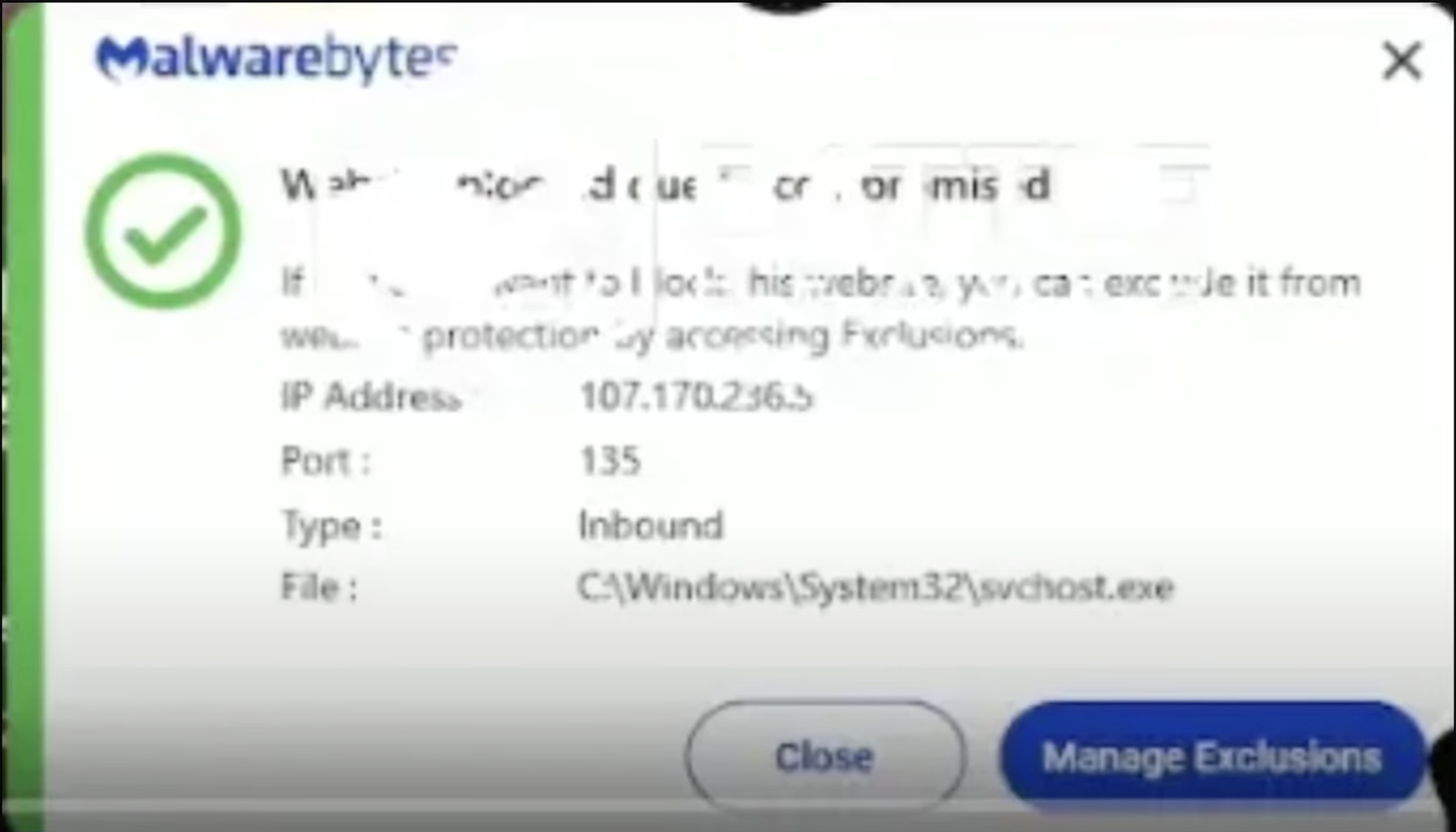
ImperialHal uses Malwarebytes to scan his machine which flags an inbound connection from an IP address linked to a server known for malicious activities.
It appears that the attacker had direct access to ImperialHal’s computer, likely via a Trojan. PirateSoftware concluded:
“I don’t see evidence of Apex having RCEs. It does not mean that it’s impossible but I still don’t see evidence, while I do see evidence of him having direct access to your machine.”
Protect yourself
We recommend that all gamers scan their computers with reliable security software. Malwarebytes Premium for Windows’ Brute Force Protection feature blocked the connection from being made to ImperialHal’s computer, so make sure you enable that feature.
We don’t just report on threats—we remove them
Cybersecurity risks should never spread beyond a headline. Keep threats off your devices by downloading Malwarebytes today.