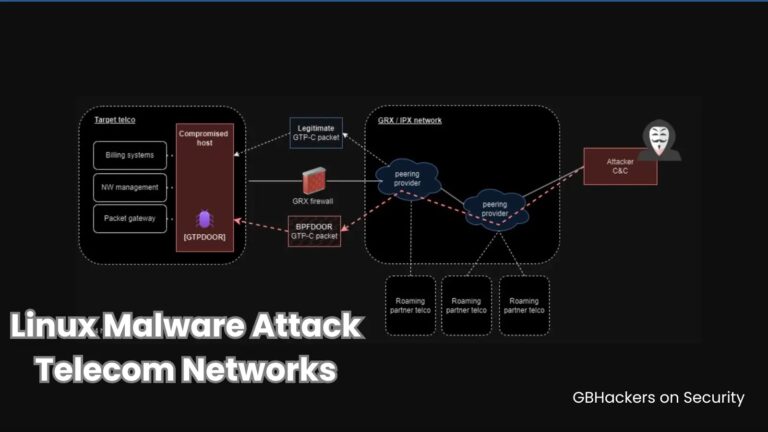
Researchers have discovered a new backdoor named GTPDOOR that targets telecommunication network systems within the closed GRX network, which connects multiple telecommunication network operators.
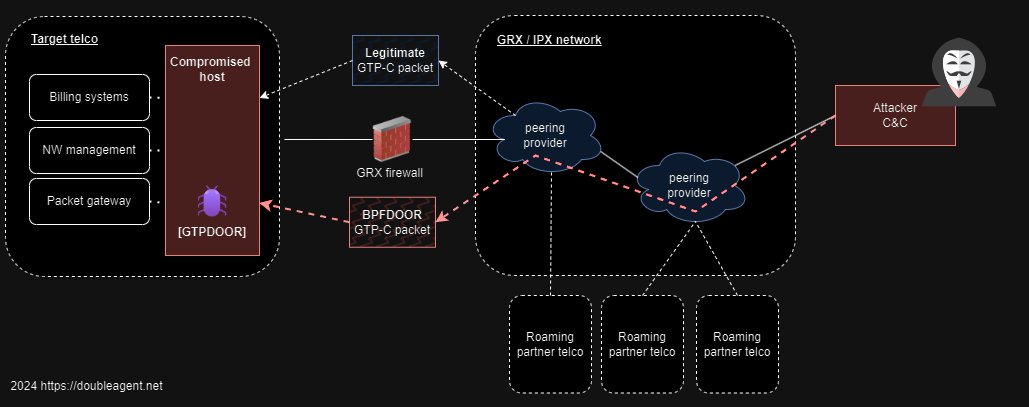
The GRX network is a closed network that connects individual network operators from various telecom companies.
Network elements like SGSN, GGSN, P-GW, STP, and DRA need direct connections to the GRX network to route roaming traffic, which typically uses the GTP-C protocol for communication.
GTPDOOR is designed to be stealthy and difficult to detect, as it leverages the GTP-C protocol, a legitimate protocol used for communication within mobile networks, to blend in with regular traffic.
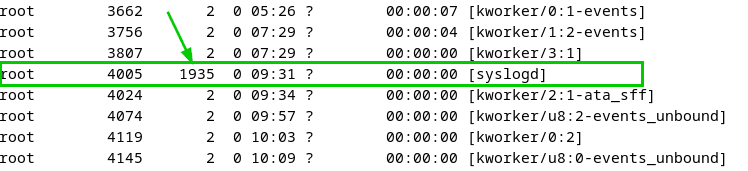
It can also modify its process name to mimic legitimate system processes and enhance its ability to evade detection.
Double Agent has observed that GTPDOOR communicates with a command and control server using the GTP-C protocol, which allows GTPDOOR to receive commands from the attackers and send back any stolen data or other information.
I recently found two very interesting Linux binaries uploaded to Virustotal.
I call this malware ‘GTPDOOR’.
GTPDOOR is a ‘magic/wakeup’ packet backdoor that uses a novel C2 transport protocol: GTP (GPRS Tunnelling Protocol), silently listening on the GRX network (1/n) 🧵 pic.twitter.com/IwuEcL14lx
You can analyze GTPDOOR malware file, network, module, and registry activity with theANY.RUN malware sandbox and the Threat Intelligence Lookupthat will let you interact with the OS directly from the browser.
Exploring GTPDOOR Functionalities and Versions:
GTPDOOR is a Linux malware targeting telecom networks that uses “magic” packets (GTP-C echo requests) to wake up infected systems, receive commands, execute them, and send results back.
It can be probed remotely, its process name can be changed to evade detection, and XOR encryption can be used for authentication and support key changes.
This malicious software utilizes established protocols and ports to hide within genuine network traffic, making identifying it challenging.
Two malware samples, pickup (enhanced version) and dbus-echo, targeted an outdated Linux system (RHEL 5.x). Their source code suggests poor maintenance by the attacker, and they were uploaded to VirusTotal in late 2023.
Novel GTPDOOR operations:
GTPDOOR utilizes GTP Echo Request messages for covert communication, which listens for UDP packets on port 2123, authenticates messages with a hardcoded key, and decrypts the payload. The message type determines the action:
0x03, 0x04, 0x08-0xFF: Execute a shell command and return the output.
0x05: Add an IP address/subnet to the Access Control List (ACL).
0x06: Get the current ACL.
0x07: Clear the ACL.
Version 2 adds:
Multithreading for handling GTP and TCP communication.
Liveness checks are performed by responding to any TCP packet with specific flags.
Forking a process for remote command execution using open().
GTPDOOR v1 offers a range of operations that can be performed on breached hosts:
Establish a fresh encryption key for C2 communications
Save custom information to a file on your local system called ‘system.conf’
Run any shell commands and return the results
GTPDOOR v2 includes additional operations beyond the ones mentioned above:
Please provide the IP addresses or subnets that are permitted to communicate with the compromised host using an Access Control List (ACL) mechanism.
Access the ACL list to modify the backdoor’s network permissions as needed.
Remove ACL to eliminate the malware
Defense and Detection:
System administrators can list raw sockets using tools like “lsof” and “netstat” to look for suspicious entries.
The GPTDOOR handles malformed GTP packets. The following test sets custom client’s GTP protocol type to 0 (GTP prime – charge related). GTP’ fails over GTP-C. Additionally, the extension header is corrupt. The GTP communication includes the encrypted GTPDOOR payload. GTP-capable firewalls can identify and drop anomalous traffic.
Also, processes with abnormal parent IDs or the presence of specific files like “/var/run/daemon.pid” and “system.conf” might cause a GTPDOOR infection.
Network traffic analysis can also reveal signs of malware, as it mishandles GTP packets. Firewalls should be configured to drop inbound packets on ports used by GTPDOOR and block TCP connections not essential for the network.
GSMA has released two (1,2) relevant guidelines for defense.
You can block malware, including Trojans, ransomware, spyware, rootkits, worms, and zero-day exploits, with Perimeter81 malware protection. All are incredibly harmful, can wreak havoc, and damage your network.
SpaceX’s satellite internet division, Starlink, has made a major breakthrough in its efforts to provide phone service directly from satellites. SpaceX CEO Elon Musk announced that the company has achieved peak download speeds of 17Mbps for satellite-to-phone connectivity using an “unmodified Samsung phone”.
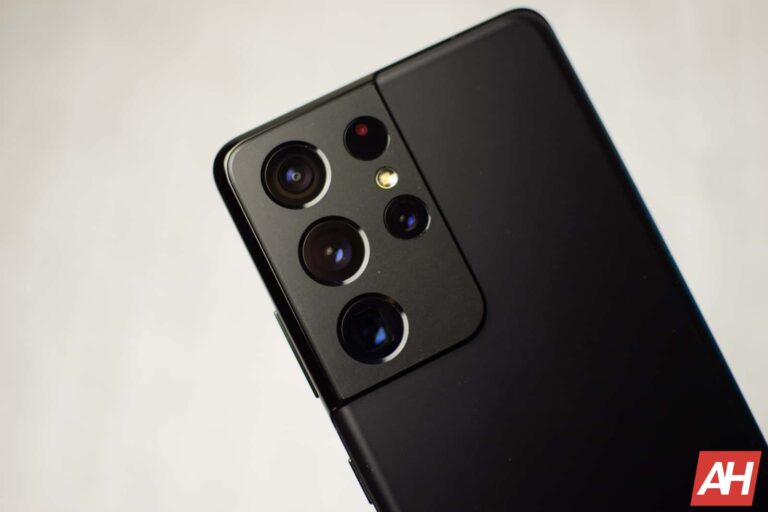
This test represents the fastest speeds yet for direct satellite connectivity on a standard smartphone without any special hardware. Elon Musk revealed the results on X, sharing a screenshot of the speed test performed on the Galaxy phone. Tracking the phone’s serial number revealed that it was a 128GB Verizon model of Samsung’s 2021 flagship, the S21 Ultra (128GB).
SpaceX just achieved peak download speed of 17Mb/s from satellite direct to unmodified Samsung Android phone pic.twitter.com/JqPHmkriv0
This demonstrates Starlink’s ability to leverage existing commercial satellites and unmodified consumer devices for new satellite communications services. The space company has been working with T-Mobile in recent months to develop this capability. If realized at scale, it could provide basic calling and messaging in remote areas without cellular.
Galaxy S21 Ultra reaches 17 Mbps satellite communication with Starlink
While 17 Mbps is sufficient for voice calls using existing protocols, video calls may struggle at these speeds. Data-heavy applications also won’t be practical. However, even a slow satellite connection could be a life-saving backup for emergencies offshore or in truly isolated locations.
On the other hand, Samsung and other OEMs like Google are promising direct satellite connections in their future devices. A screenshot from last week shows what appears to be the settings page of a Galaxy device running One UI 6.1, which will debut with the Galaxy S24 series. The page lists the features that can be helpful in an emergency. This would eliminate the need for carrier partnerships and allow for independent, satellite-only connectivity.
However, it appears that speeds would need to increase significantly for standard smartphone use cases beyond basic calls. Starlink and its competitors will look to increase performance through larger satellites, higher throughput satellites, and multi-access technologies.
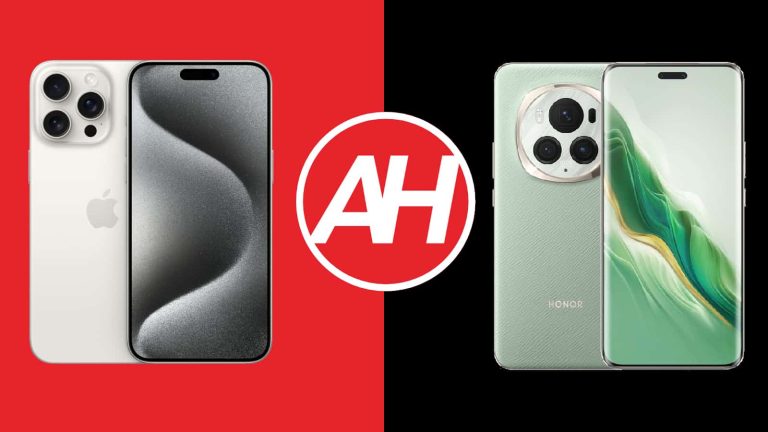
The HONOR Magic6 Pro is the company’s latest and greatest smartphone. It launched at this year’s MWC 2024, and in this article, we’ll pit it against the very best of Apple. This is a comparison between the Apple iPhone 15 Pro Max vs HONOR Magic6 Pro. Both of these are very large smartphones and very powerful ones at the same time. They are also quite a bit different, in many ways.
Their designs are quite a bit different, to start things off with, and those differences do spread to specs and other sections. Speaking of which, we’ll first list their specifications, and will then compare them across a number of other categories. We’ll compare their designs, displays, performance, battery life, cameras, and audio performance. Let’s get to it.
Specs
Apple iPhone 15 Pro Max vs HONOR Magic6 Pro, respectively
– Screen size: 6.7-inch Super Retina XDR display with ProMotion (flat, 120Hz, HDR10, 2,000 nits) 6.8-inch LTPO OLED display (curved, 120Hz LTPO, HDR, 5,000 nits) – Display resolution: 2796 x 1290 2800 x 1280 – SoC: Apple A17 Pro Qualcomm Snapdragon 8 Gen 3 – RAM: 8GB 12GB (LPDDR5X) – Storage: 256GB/512GB/1TB (NVMe) 256GB/512GB (UFS 4.0) – Rear cameras: 48MP (f/1.78 aperture, second-gen sensor-shift OIS), 12MP (ultrawide, f/2.2 aperture, 120-degree FoV, macro photography), 12MP (telephoto, f/2.8 aperture, 5x optical zoom) 50MP (wide, f/1.4-f/2.0 aperture, OIS, PDAF, Laser AF, 23mm lens), 50MP (ultrawide, f/2.0 aperture, 122-degree FoV, 13mm lens), 180MP (periscope telephoto, f/2.6 aperture, 2.5x optical zoom, OIS, PDAF) – Front cameras: 12MP (f/1.9 aperture) + TrueDepth 50MP (f/2.0 aperture, 22mm lens), ToF 3D camera – Battery: 4,422mAh 5,600mAh – Charging: 20W wired, 15W wireless (MagSafe & Qi2), 7.5W wireless (Qi), reverse wired charging (charger not included) 80W wired, 66W wireless, reverse wireless, reverse wired (charger not included) – Dimensions: 159.9 x 76.7 x 8.25mm 162.5 x 75.8 x 8.9mm – Weight: 221 grams 225/229 grams – Connectivity: 5G, LTE, NFC, Wi-Fi, USB Type-C, Bluetooth 5.3 – Security: 3D facial scanning In-display fingerprint scanner (optical) & 3D facial scanning – OS: iOS 17 Android 14 with MagicOS 8.0 – Price: $1,199 €1,299+ – Buy: Apple iPhone 15 Pro Max (Apple) HONOR Magic6 Pro (HONOR)
Apple iPhone 15 Pro Max vs HONOR Magic6 Pro: Design
Both of these phones do use metal for their frames, but they use different materials. The iPhone 15 Pro Max opted for titanium, while the HONOR Magic6 Pro uses aluminum. Both phones have glass panels on the back, but the HONOR Magic6 Pro also comes in a vegan leather (silicone polymer) variant. That model is considerably more grippy than the one with glass on the back. The iPhone 15 Pro Max is very slippery in general.
Having said that, both smartphones have very thin bezels around the display, and uniform ones at the same time. The thing is, the iPhone 15 Pro Max has a flat display, while the HONOR Magic6 Pro has a curved one. You will also spot a pill-shaped cutout on both of those displays, but the one on the iPhone 15 Pro Max is noticeably larger. Both devices pack in tech for 3D facial scanning in there, in addition to a front-facing camera.
Both phones have flat sides, but they’re still different. The ones on the iPhone 15 Pro Max do curve towards the sides, while the HONOR Magic6 Pro sides come with chamfered edges. The iPhone 15 Pro Max backplate is flat, while the one on the HONOR Magic6 Pro is curved. Their camera islands on the back are also quite different. Both have three cameras which sit in a triangle shape, but they look very different. Their placement is also quite different, as you can see. The ones on the iPhone 15 Pro Max are in the top-left corner, while the HONOR Magic6 Pro’s are centered.
The HONOR Magic6 Pro is taller, narrower, and slightly thicker than the iPhone 15 Pro Max. HONOR’s smartphone is also ever so slightly heavier, but the difference is under 10 grams, and that includes both HONOR Magic6 Pro variants. Both smartphones offer an IP68 certification for water and dust resistance. Both are more pleasant to hold and use than their predecessor, but the easiest of them to navigate is the vegan leather variant of the HONOR Magic6 Pro. That backplate is soft, and it does add grip to the experience, which is much needed.
Apple iPhone 15 Pro Max vs HONOR Magic6 Pro: Display
The iPhone 15 Pro Max features a 6.7-inch 2796 x 1290 LTPO Super Retina XDR OLED panel. That display is flat, and it has an adaptive 120Hz refresh rate. Dolby Vision is supported here, while this display also has HDR10 support. The iPhone 15 Pro Max’s display goes up to 2,000 nits when it comes to brightness, and it has a 19.5:9 aspect ratio. The Ceramic Shield glass protects this panel from scratches and drops.
Apple iPhone 15 Pro Max
The HONOR Magic6 Pro, on the flip side, includes a 6.8-inch 2800 x 1280 LTPO OLED display. This panel is flat, and it can project up to 1 billion colors. It also has an adaptive refresh rate of up to 120Hz, and HDR content is supported here. The theoretical max brightness of this panel is 5,000 nits. The display aspect ratio is 19.5:9, and the HONOR Magic6 Pro display is protected by Jurhino glass.
That being said, both of these smartphones have fantastic displays. They are not only plenty sharp and very vivid, but they also have great viewing angles. The touch response on both displays is very good. If PWM dimming plays a part for you, the HONOR Magic6 Pro is much better in that regard. The bottom line is, both of these displays are fantastic, just keep the PWM dimming difference in mind when making your decision, everything else is good enough on both.
Apple iPhone 15 Pro Max vs HONOR Magic6 Pro: Performance
Apple’s flagship comes with the Apple A17 Pro processor. That is Apple’s 3nm chip. The phone also packs in 8GB of RAM and NVMe flash storage. The HONOR Magic6 Pro, on the flip side, is fueled by the Snapdragon 8 Gen 3 processor, Qualcomm’s most powerful chip. That is a 4nm chip, by the way. The global variant of the phone comes with 12GB of LPDDR5X RAM, and it utilizes UFS 4.0 flash storage.
These two devices run different operating systems, iOS and Android, respectively. Still, HONOR’s MagicOS 8.0 does include a lot of iOS aspects to it, it’s kind of a blend between Android and iOS. That being said, both devices offer outstanding performance. Both have great animations and are very fluid in day-to-day tasks. Lag was not a part of the experience on either phone for us.
They both did a great job when it came to day-to-day tasks, such as browsing, messaging, opening apps, multitasking, taking pictures, and so on. None of that was any problem. Even when it comes to gaming, both phones are up to the task. They can run any title from their respective stores on high details. They do get quite warm after longer gaming sessions, but the performance does not get affected by that, nor do they get too warm.
Apple iPhone 15 Pro Max vs HONOR Magic6 Pro: Battery
The iPhone 15 Pro Max has a 4,441mAh battery on the inside. The HONOR Magic6 Pro, on the other hand, includes a 5,600mAh unit. Apple’s iPhones usually have smaller battery packs compared to their Android counterparts, as iOS handles battery differently. In any case, both of these battery packs are more than enough for these two smartphones. Both of them offer great battery life.
We’ve been able to cross the 8-hour screen-on-time mark on both of these smartphones. Even the 9-hour mark seemed reachable on both of them at times, it all depends on what you use them for. Do note that gaming was not a part of the ordeal on days that we reached such battery life highs, though. Also, your mileage may vary, of course. You’ll not only use your phone differently, but have different apps installed, and have different signal strengths too. If you’re moving a lot during the day, and enter lower signal areas, that will have an impact too.
When it comes to charging, the HONOR Magic6 Pro completely obliterates the iPhone 15 Pro Max. The HONOR Magic6 Pro supports 80W wired, 66W wireless, reverse wireless, and 5W reverse wired charging. The iPhone 15 Pro Max offers support for 20W wired, 15W Qi2 and MagSafe wireless charging, 7.5W Qi wireless charging, and 4.5W reverse wired charging. Do note that neither of the two devices comes with a charger in the box, though.
Apple iPhone 15 Pro Max vs HONOR Magic6 Pro: Cameras
Apple’s flagship has a 48-megapixel main camera, a 12-megapixel ultrawide unit (120-degree FoV), and a 12-megapixel periscope telephoto camera (5x optical zoom). The HONOR Magic6 Pro, on the flip side, includes a 50-megapixel main camera, a 50-megapixel ultrawide unit (122-degree FoV), and a 180-megapixel periscope telephoto unit (2.5x optical zoom), 100x digital zoom).
HONOR Magic6 Pro
Both of these smartphones are excellent performers but do offer noticeably different results. The iPhone 15 Pro Max is trying to keep things closer to real life, while the Magic6 Pro does tend to process images to… well, pop. In some instances, we preferred results from the former, in others, from the latter. Their main cameras are outstanding, basically. We did, however, tend to prefer HDR results from the Magic6 Pro more often than not, but that was also not the rule.
Ultrawide cameras did a great job of keeping the same color profile as the main ones, and the same goes for periscope telephoto shooters. I’d say that the HONOR Magic6 Pro’s periscope telephoto camera is more versatile, and covers the 2.5x-10x range better, but the iPhone 15 Pro Max does a better job if we only look at the 5x-10x range.
Low light performance is great on both devices. The iPhone 15 Pro Max does prefer to keep images slightly darker, and thus more realistic, but both phones do a great job of balancing those photos out. Even their secondary cameras are not bad in low light, not at all. We preferred the results from the HONOR Magic6 Pro’s periscope telephoto unit, and from the iPhone’s ultrawide camera in such conditions.
Audio
Both of these phones do include stereo speakers. The ones on the the iPhone 15 Pro Max sit at the bottom and under the earpiece. The ones on the HONOR Magic6 Pro are placed at the bottom, and at the top. Both sets of speakers are loud enough, and similar in that regard. They’re also well-balanced.
You will not find an audio jack on either of the two phones. They both include Type-C ports at the bottom, so you can use those to connect your headphones. Alternatively, both smartphones do support Bluetooth 5.3.
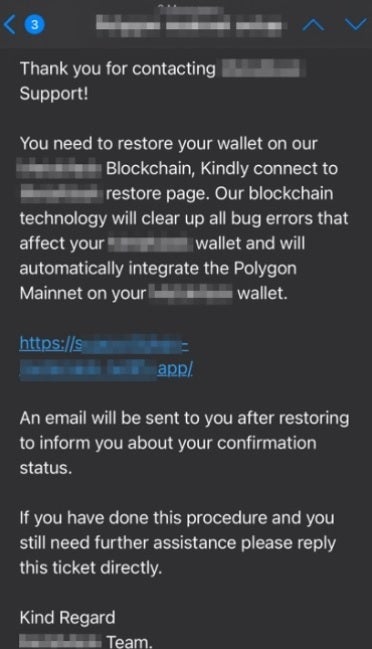
Both iPhone and Android users need to make sure that they do not have any of the 249 fake Crypto Wallet apps mentioned by Trend Micro on their phones. These apps pretend to be legit cryptocurrency wallet apps but have led to the theft of more than $4.3 million. Pretending to be from legit crypto wallet app companies, emails are sent out to potential victims containing “malicious links” that lead iOS and Android users to visit listings for the attackers’ fake apps.
Do you see the brilliance in this process? By sending victims to a page where their malware-laden apps can be installed, the attackers can avoid having to list their fake apps in the App Store or Google Play Store where they could get banned. And to get iOS and Android users who do have a legit crypto wallet app on their phone to tap on the link, these emails pretend to be from those real crypto wallet apps telling recipients that the current version of their crypto wallet app is out of date and that they must tap on the link to install the latest version.
This email tries to get the victim to click on a link to a fake website
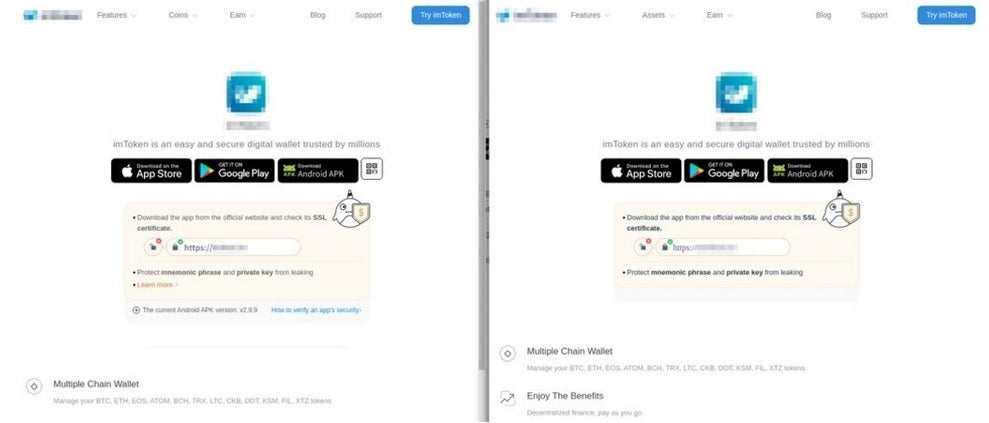
The hackers also created fake websites designed to look like the ones used by real crypto wallet apps and have domain names slightly different than the real ones. These fake websites appear high up in search results and are another way the criminals get their victims without having to list apps in the App Store or Google Play Store. Another ploy used is to post fake links on social media sites that show fake support messages. Again, the goal is to get victims to visit a fake website.
Real crypto wallet website on the left, a fake one created by the hackers is on the right
The Trend Micro Threat Research team found 249 fake crypto wallet apps including imToken, Bitpie, MetaMask, Trust Wallet, and TokenPocket. The apps were found on phones used by victims in the United States, France, Germany, Australia, New Zealand, and Japan.
The fake apps and fake websites steal victims’ mnemonic phrases. These phrases are a series of unrelated words, usually 12 to 24 words in length, that are generated when a crypto wallet app is created. The mnemonic phrases are used to recover a user’s cryptocurrency if a wallet is lost or damaged. But once a mnemonic phrase is typed into one of the fake websites or apps, it goes straight to the hackers.
When the mnemonic phrase is stolen, the hacker will transfer the victim’s cryptocurrency to multiple disposable wallets. Trend Micro’s Threat Research team discovered that $4.3 million passed through one of the disposable wallets. Since most hackers have multiple wallets that are used in these endeavors, we can assume that more than $4.3 million has been stolen.
So what can you do to avoid becoming a victim of this scam? Trend Micro makes the following suggestions:
Only download apps from the Google Play Store and the Apple App Store.
If you observe any suspicious behavior when updating a crypto wallet app, immediately terminate the update and uninstall the app.
To confirm the legitimacy of a crypto wallet app, the first time you transfer money, send only a small amount.
Don’t you hate it when you see something on your phone’s screen, but don’t have the time to screenshot it and analyze it with Lens? Well, Circle to Search could save you a bunch of time. With this feature, all you have to do is summon the assistant, draw a circle around the thing on your screen that you want to search, and Google will do the rest. It basically acts like a shortcut to using Google Lens. You’ve probably seen it in a bunch of Galaxy S24 commercials.
This feature seems cool, but you most likely won’t be able to use it for quite some time. Not too long ago, we got the news that Circle to Search won’t be coming to other phones until sometime in October this year. This means that most people won’t be able to use the feature for months. Since this is a Google feature, we’re not surprised that its Pixel 8 phones got first dibs after the Galaxy phones.
Circle to Search is coming to the Pixel 7 and 7 Pro
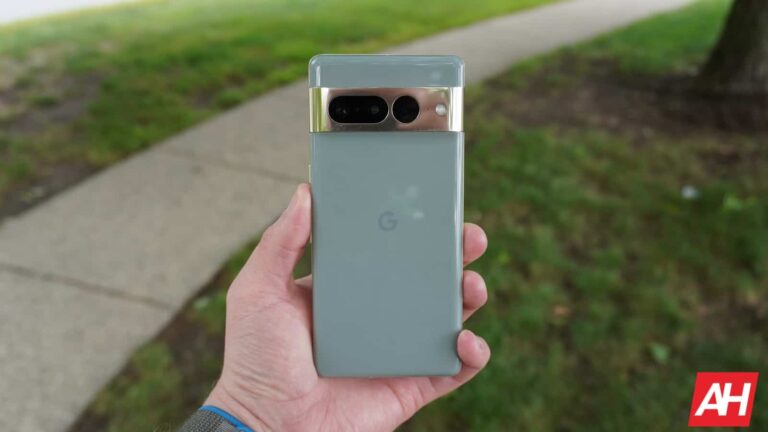
The next line of phones to get is the Pixel 7 series. The 2022 Tensor G2-powered phones still have a ton of life in them and are still some of the best Android phones you can get your hands on. They fall behind the Pixel 8 phones in terms of processing power and AI capabilities, but you’re still more than well off with them.
According to the reports, Google has started rolling this feature out to its users today. Depending on your region, you may or may not see the feature. It’s coming as a part of the latest Pixel feature drop. So, be sure to keep an eye out for the next system update coming to your phone.
When the update does land, you should be notified to install it. However, to manually check, go to your phone’s settings and scroll all the way down to the System section. There, scroll down to the Software Update section. In that section, tap on the button at the bottom of the screen to have your phone scan for the update. If you don’t see it pop up, then you’re just going to have to wait a bit.
Samsung recently carried out an “out-of-this-world” mission to promote the Galaxy S24 Ultra, particularly its cameras. The company sent four S24 Ultras to space and captured some stunning photos of the Earth with the phones. You can check out the photos in the galleries below.
Samsung captured the Earth from space using the Galaxy S24 Ultra
The Korean tech giant often comes up with unique promotional campaigns for its latest products. For the Galaxy S24 Ultra, which debuted in January this year, it sent the phone to space to market its camera capabilities. It is arguably the best Android phone today, so this is a fitting marketing effort.
According to a PetaPixel report, Samsung crafted a lightweight, carbon fiber skeleton to carry the devices to space. It designed four identical carriers and safely placed one Galaxy S24 Ultra each in a cage built onto the frame. The firm then attached the carriers to hydrogen-inflated balloons and sent its latest flagship high up in the sky.
The balloons took the phones 120,000 feet (36.5 kilometers or 22.7 miles) above the Earth’s surface, i.e., into the stratosphere. While it may not be space, it is three times the average height commercial airlines fly, even significantly higher than where the U2 Dragon Lady can reach. It is high enough to see the curvature of the Earth.
Samsung launched these balloons from four different locations across the US between January 25 and January 31, 2024: Los Angeles, Las Vegas, the Sierra Nevada mountains, and the Grand Canyon. It chose these locations “to capture a diversity of landscapes that would truly put the S24 Ultra’s capabilities to the test.” The phones periodically captured photos of our planet throughout this journey.
Samsung captured photos with the main, ultrawide, and zoom cameras
The photos were captured using the 200MP main camera, 12MP ultrawide lens, and 50MP 5x telephoto zoom camera. Overall, the four Galaxy S24 Ultras captured more than 150 high-resolution photos of the western US. To bring the phones back to Earth, Samsung vented the hydrogen gas and deployed parachutes to let the whole setup fall slowly.
The setup dropped at the speed of 8kmph or 5mph. Samsung’s team tracked their location and retrieved the phones from the cage. Each balloon took less than a week to complete the journey to space and back to Earth while capturing dozens of photos. This is certainly a unique way to promote the camera capabilities of a phone. You can find more photos below.
Since Google announced last year that it was no longer sticking to a strict monthly schedule for security updates and a quarterly schedule for feature drops, we’ve seen quite a few feature drops. This is the third feature drop of 2024, and it’s only March 4.
With this feature drop for the Pixel, Google is actually adding quite a few new features. This includes 10-bit HDR video and Ultra HDR photos on Instagram. Pixel is able to shoot and capture 10-bit HDR videos and can now be uploaded to Instagram Reels just as you’d expect, and the same goes for Ultra HDR photos on Instagram.
For those that are unaware, “Ultra HDR Photos” is a new format that Google added to Android 14 last year. So it’s good to see it finally coming to Instagram. This format lets images store more information about the intensity of light, resulting in more detailed highlights and shadows and more intense colors. Making it really feel like you are there.
Google is also adding improvements to Next Gen Call Screen. Users will now be able to get a call started when the caller is silent. It brings a new “hello” chip that you can tap while screening a call. Google Assistant will then prompt the caller to speak. Call Screen will also tell the caller to wait a bit longer if you’re not available right now.
Good news for Pixel 7 users: Circle to Search with Google is now rolling out to older Pixels. So now, only Pixel 7 and Pixel 8 series will have this feature along with the Galaxy S24 of course.
Pixel Watch gains quite a few new features
Google is also rolling out a ton of features to the Pixel Watch with this update. You can now get Public Transit directions on Wear OS. There’s a new Auto Workout Mode, which is rolling out to the first-generation Pixel Watch. Kind of amazing that it took this long. Google is also rolling out Pace Training, Heart Zone Training, and a new Relax app from Fitbit.
That’s not all; Google is also adding Partial Screen Sharing across the Pixel portfolio and allowing you to share one app at a time instead of your full screen. Fast Pair is getting updated with the ability to use previously set-up Bluetooth accessories on your new phone or tablet. Google Docs Markup is arriving with handwritten annotations on a document from your Android device.
And finally, Gboard Voice Toolbar for Tablets is rolling out. So, you can minimize the digital keyboard when voice input is activated, resulting in improved multi-tasking and optimized screen space.
These features are all starting to roll out today in a new OTA. You can head to Settings > System > Check for Update to update your Pixel today.
Samsung’s chip division, aka Samsung Foundry, is coming up with an innovative method to manufacture chips with smaller node sizes. As per a report by the Korean website Chosun Biz, Samsung Foundry plans to bring Backside Power Delivery Network (BSPDN) technology to its 2nm chips.
The chip race between semiconductor manufacturers is heating up with 2nm chips. These chips are mainly scheduled for smartphones to launch in 2025. By decreasing the nanometer count, manufacturers can place more transistors into chips, making them more powerful and enhancing their power efficiency.
Samsung’s 2nm chips land with Backside Power Delivery Network (BSPDN)
The Backside Power Delivery Network (BSPDN) is a technology that basically routes power supply lines on the backside of a chip and removes power-delivering interconnects beneath the silicon. This implementation creates space for the data interconnects above the silicon and allows manufacturers to build larger, less resistive power interconnects.
By implementing BSPDN, Samsung Foundry can reduce interference between power lines and simplify the production process. Additionally, smaller node sizes can potentially enhance the power and efficiency of Samsung’s 2nm chips.
Samsung initially planned to launch BSPDN with its 1.7nm chips. However, its roadmap indicates that the 2nm chips are the first to receive BSPDN. The chips will enter production in 2025. Japan’s Preferred Networks (PFN) and Qualcomm are said to be the first customers of Samsung’s 2nm chips. Qualcomm Snapdragon 8 Gen 5, which powers flagship Galaxy devices, relies on Samsung’s in-house SF2P process.
As we earlier reported, Apple has started designing its chips based on TSMC’s 2nm fabrication process. The chips are expected to land in the 2025 iPhone 17 series. Intel’s 2nm chips, dubbed Intel 20A, also enter production this year.
American Express cardholders are advised to be vigilant after a data breach at a third-party vendor potentially exposed some card information. While American Express systems remain secure, the breach may have compromised card numbers, names, expiration dates, and other details.
American Express notified card members today of a data breach impacting some customer information, emphasizing that its systems were not compromised. The breach originated from a third-party service provider used by numerous merchants, potentially exposing customer details including card numbers, names, and expiration dates.
What Happened:
American Express discovered unauthorized access to a system utilized by a third-party service provider engaged by various merchants. This incident may have compromised the account information of some American Express card members.
American Express has filed a data breach notification with the state of Massachusetts regarding potential impacts on cardholder information, which may include current or previously issued American Express card numbers, cardholder names, and card information such as expiration dates.
“At this time, we have been informed that your current or previously issued American Express Card account number, your name and other Card information such as the expiration date, may have been compromised. Please be aware that you may receive additional letters from us if more than one of your American Express Card accounts were involved.”
American Express
In response to this situation, American Express has taken several measures to address the issue. The company has affirmed the security of its own systems and is actively monitoring accounts for any signs of fraudulent activity.
Additionally, cardholders are reassured that they are not liable for unauthorized charges. American Express has provided resources and information on fraud protection through its Security Center website.
For insights into this, we reached out to Piyush Pandey, CEO at Pathlock who stated, “Over the last few years, we’ve seen a significant uptick in third-party data breaches. In this example, there are multiple parties, or what we call “nth party” risk. This places a much greater emphasis on organizations to vet their third parties during onboarding to minimize access risk.”
Piyush also cautioned businesses about the importance of scrutinizing third parties before entering into business partnerships with them. “Organizations must also ensure that the third-party partners of the third parties they are doing business with are assessed for access risk. It should become part of standard third-party contracts to specify breach response responsibilities,” he explained. “Masking data to provide only what is needed by third parties to provide services must be a best practice.”
Nevertheless, American Express card members are advised to review their account statements for any suspicious activity, especially over the next 12-24 months. They are also encouraged to enable account notifications via the American Express Mobile app or through email/text messaging for added security.
Furthermore, updating contact information with American Express is recommended to ensure smooth communication if necessary.
Rising Incidents of Third-Party Data Breaches
The beginning of 2024 has witnessed a noticeable uptick in data breaches affecting diverse sectors, including corporate entities and governmental organizations. On February 23 2024, a threat actor using the alias IntelBroker leaked 2.4 million data belonging to private plane owners linked to the Los Angeles International Airport.
In August 2023, an IT contractor employed by the Metropolitan Police Force experienced a cyberattack that impacted over 50,000 MET police personnel.
In September 2023, a third-party contractor experienced a data breach that affected over 8,000 Greater Manchester Police Officers. In October 2023, another contractor inadvertently exposed their database, resulting in the leakage of sensitive details about 500,000 Irish Police vehicle seizure records.
Google Maps already gives you an extremely useful and in-depth navigation experience. However, Google always finds more ways to make the platform better. According to a new report, Google Maps will soon show users building entrances. This will make using the app that much easier.
When you’re navigating to a certain location, you’ll see the general shape and location of the place you’re going, but not all places have conveniently located entrances. Some places have entrances in odd spots, and it can be tough pinpointing where they are. This can make navigating to certain locations tricky, especially if it’s your first time going there.
Google Maps is working on showing building entrances
Right now, this feature is available in a limited capacity. The folks are Android Police were able to get it working on a Pixel 7a running the software version 11.17.0101 of the Google Maps app. However, it doesn’t seem to be showing up for other devices, even devices running the same version of Google Maps. This is most likely a limited test for certain devices and certain regions.
As for the functionality, when you’re zoomed into a building fairly far, and you select it, you’ll see markers to indicate the entrances and exits. The markers will be little arrows enclosed in colored circles. Also, when you tap on a building, you’ll see the building turn red. This makes the building stand out on the map so you know that you’re looking at the right building.
You’re likely only to see this feature for select buildings. The company is still working on pushing this feature out to more places. Until then, many cities will be unsupported. Also, you can expect inaccurate results for the building entrances. The accuracy will go down as the size of the buildings shrinks.
At this point, we don’t know when Google is going to roll this out to more people. As time goes on, we will see this feature make it to more places.