Gemini keeps falling short of Google Assistant by not identifying songs

0
[ad_1]

“Hey Google, what song is playing?” Many of us are used to asking this question when we hear an absolute banger of a song playing in a bar or a restaurant. There are some people who use it so often that it becomes absolutely intuitive. However, it appears that the Google Assistant’s next of kin, Gemini, lacks this years-old functionality. According to a report, Gemini cannot identify songs.

In case you don’t know, Google is in the process of training Gemini to replace Google Assistant. The Google Assistant has been around for almost eight years. However, Google’s ambitious and very rushed generative AI plans have started putting nails into Google Assistant’s coffin. Over the past couple of weeks, Gemini’s assistant function has been gaining more features. For example, just recently, Gemini gained the ability to integrate with Google Assistant to create Tasks. Also, Gemini can now integrate with Google Calendar to view and create events.

However, this still shows how hastily Google threw Gemini out onto the market to keep up with the changing tech landscape. We are all still waiting for it to become a proper replacement for Google Assistant, but that could take a while. Google Assistant was gradually massaged into the Android experience over the course of years; Gemini is only a few months old.

Gemini cannot identify songs, and that’s a bummer

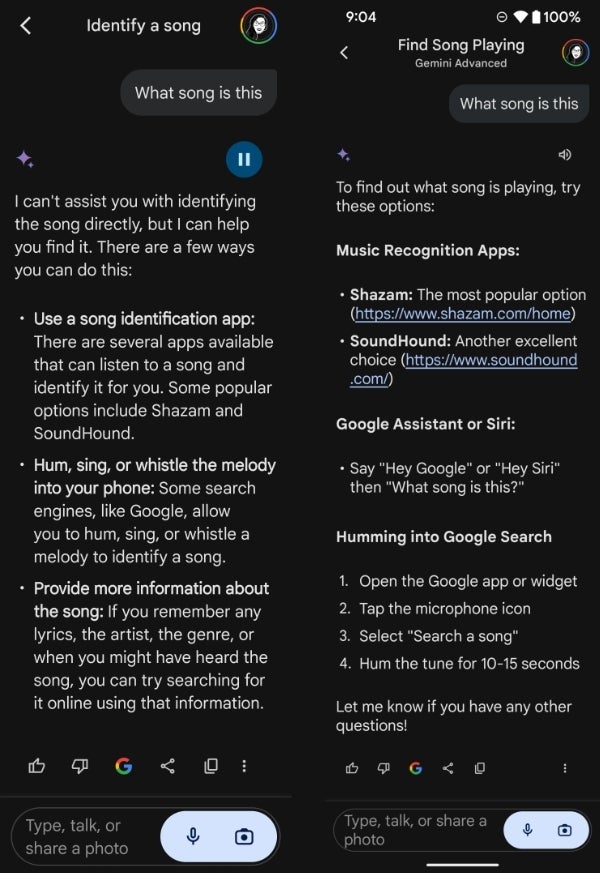
Right now, people using Gemini as an assistant are navigating its limitations. When they summon it to identify a song, rather than give them the song’s name, artist, and links to listen to it (like Google Assistant does), it does something that’s pretty surprising. Looking at the screenshot below, we see that, rather than identifying the song, it gives you suggestions of different apps to use to identify that song and tips on how to use those apps. One of the apps is Apple-owned Shazam.

gemini id song

This method is extremely counterintuitive to the concept of using Google Assistant. People use Google Assistant for the convenience. It’s supposed to quickly let you know what song is on with no additional steps. However, Gemini suggests that you download, install, sign up for, and use different apps just to identify a song. By the time you do that, the song will most likely have passed.

Another thing that Gemini does is recommend that you use Google Assistant… Again, it defeats the purpose of using Gemini if you have to switch to another assistant just to use a simple function.

At this point, we’re certain that Gemini will gain this functionality at some point in the future. It’s currently trickling features down to Gemini over time.

But this is still a major issue

Ever since Google unveiled its first generative AI products, they’ve been rife with issues, missing features, and overall frustration. Sure, the technology powering them is powerful, but Google has been rushing everything to the market. It all started with Google Bard’s unveil when it provided inaccurate information. This rushed mentality continues to this day. Rather than working on porting all of Google Assistant’s abilities over to Gemini internally and then launching a full product, Google launched Gemini as a bare-bones assistant and is slowly adding features.

This is extremely frustrating because people are constantly finding areas where Gemini is a poor assistant. For all its forward-thinking and paradigm-shifting AI prowess, it’s a massive step back compared to what we’ve had years ago. Google Assistant was a part of Android’s DNA and deeply integrated into the operating system. Google Gemini just seems like any AI app you could download from the Play Store. It may as well just be the ChatGPT app.

Google has to get its act together before Apple unveils its AI model. Undoubtedly, when Apple launches its AI model, it’s going to be extremely complete and integrated into the services that Apple users always use. It seems like Apple will take the time to make a complete product before unveiling it rather than unveiling an incomplete product and slowly adding features.


[ad_2]
Source link

X / Twitter Spaces adds video broadcasts for hosts

0
[ad_1]

Twitter’s audio-focused chatroom feature, Spaces, just got a major upgrade. Hosts of Spaces sessions can now broadcast live video alongside the usual audio discussions. A platform user noticed this feature addition, but the official X account later confirmed it.
If you enjoy hosting Spaces, you now have a new way to keep your audience engaged by enabling your camera and showing your face, if you wish. However, as reported by Engadget and The Verge, this feature appears to only be available for iOS users for now, and there’s no official word on if or when it will be coming to Android and the web.X (formerly Twitter) already offers live video broadcasting, but Spaces adds an extra layer of interactivity for engaging conversations. While only the host can go live with their video, other participants can still engage by speaking or co-hosting.

Keep in mind that, as with any new feature, there are some kinks that still need to be ironed out. So far, users trying out the feature are reporting lags when video is enabled, and landscape mode can make it tricky for hosts to manage their Space since the video overtakes the screen real estate.

Something else to note is that desktop users who join a space that involves a video broadcast will not be able to see the video feed yet and will only be able to hear the audio. Additionally, the video feed will only be visible during the live Space session. If you’re relying on recorded Spaces, they’ll still be audio-only for now.

This video integration within Spaces opens a new world of possibilities for more dynamic and visually engaging conversations on X. As the feature rolls out wider and gets further refined, I believe we can expect to see even more innovative ways to use Spaces for things like virtual events, panel discussions, interviews, and interactive presentations.


[ad_2]
Source link

Savvy Seahorse Using Fake ChatGPT, Facebook Ads in DNS Investment Scam

0
[ad_1]

Infoblox cybersecurity researchers are warning users about a fraudulent scheme launched by a DNS threat actor Savvy Seahorse, which uses Facebook advertisements to trick users into fraudulent investment platforms and transfers deposits to Russian-state-owned banks.

California-based IT automation and security company Infoblox has discovered a relatively new DNS threat actor called “Savvy Seahorse.” According to the company’s report, the actor creates fake investment platforms using popular icons like Tesla, Meta, and Imperial Oil and lures unsuspecting users into depositing funds. 

Savvy Seahorse prefers using Facebook ads to trick users into trusting fake investment platforms and transfers deposits to Russian-state-owned banks. Savvy Seahorse employs advanced techniques like fake ChatGPT and WhatsApp bots to lure users into high-return investment scams, which are the costliest category of threat reported to the FBI’s Internet Crime Complaint Center.

ChatGPT and WhatsApp bots engage users through automated responses for high-return investment opportunities. These campaigns target users in various countries, including Russian, Polish, Italian, German, Czech, Turkish, French, Spanish, and English speakers but interestingly users in Ukraine are protected. 

Through DNS canonical name (CNAME) records, the actor creates a traffic distribution system (TDS) for conducting sophisticated financial scams, controlling access to content and updating the IP addresses of malicious campaigns. This also helps them evade detection by the security industry. It is worth noting that Savvy Seahorse, active since 2021, is the first publicly reported threat actor abusing DNS CNAME records for sophisticated scam campaigns.

In a blog post, Infoblox researchers have identified several red flags associated with the Savvy Seahorse scam. These include short-lived campaigns (active for only 5-10 days), using a phased deployment system, frequent changes in IP addresses (to complicate/block tracking of malicious infrastructure), and the use of wildcard DNS entries.

These entries entail creating numerous subdomains, potentially confusing passive DNS analysis. These characteristics make it difficult to track and block malicious infrastructure. Victims’ data is sent to a secondary HTTP-based TDS server for validation and geofencing.

Around 4.2k base domains with CNAME records are used by Savvy Seahorse to host campaigns, Infoblox researchers confirmed. The attackers create subdomains for each SLD using a domain generation algorithm, using pseudo-random hostnames. Registration forms are used to gather victim information, and after validating it, they are redirected to the fake trading platform. The actor monitors users to prevent security threats.

The scam poses potential risks to individuals, including financial loss, data theft, and malware infection. Users who invest in the fake platform may lose their funds, while the scammers may steal personal and financial information.

Therefore, consumers must be vigilant when trusting unverified sources for making deposits. Remember that the US cumulatively lost over $4.6 billion in 2023 over investment scams.

  1. WhatsApp Pink is malware spreading through group chats
  2. Thousands of Dark Web Posts Expose ChatGPT Abuse Plans
  3. China Arrests 4 Who Weaponized ChatGPT for Ransomware Attacks
  4. Fake Telegram, WhatsApp clones aim at crypto on Android, Windows
  5. SpyNote Android Spyware Poses as Legit Crypto Wallets, Steals Funds

[ad_2]
Source link

nubia unveils Neo 2 gaming phone, Music, and Focus series at MWC

0
[ad_1]

Alongside its first foldable, ZTE subsidiary nubia unveiled a handful of other smartphones at the Mobile World Congress (MWC) 2024. The company brought four budget handsets to the tech event, which concludes today. The lineup includes a budget gaming phone called the nubia Neo 2, a music-centered nubia Music, and two camera-focused phones in the nubia Focus and Focus Pro.

The nubia Neo 2 makes gaming phones affordable

nubia is known for offering premium features at affordable prices. It did the same by pricing its first foldable at just $599. The trend continues with the Neo 2, an extremely affordable gaming phone. At $199, this phone gives you two dedicated capacitive shoulder triggers and a multi-layer heat dissipation system so you enjoy an immersive gaming experience without worrying about thermals.

The nubia Neo 2 boasts the Game Space 2.0 interface and dual DTS:X Ultra stereo speakers. You get a 6.72-inch FHD+ (1080×2400 pixels) display with a 120Hz refresh rate and a punch-hole design for smooth gaming. Unisoc’s 5G-enabled T820 chipset powers the phone with 8GB of RAM (up to 20GB Dynamic RAM) and 256GB of UFS 3.1 storage. The device is fueled by a 6,000mAh battery with 33W charging.

Nubia Neo 2 official 1

nubia has a dedicated phone for music lovers

If you aren’t into mobile gaming but love listening to music on your phone, the nubia Music might be the phone for you. It is a phone dedicated to music lovers. The device comes with a massive rear-facing speaker that is 600% louder than average smartphone speakers. The company claims high-quality audio thanks to DTS:X Ultra technology. The nubia Music also offers two 3.5mm headphone jacks.

nubia says the speaker design is inspired by the vinyl record player. The firm has added musical light effects around the display when playing music. The rest of the specs are decent too. The device features Unisoc’s SC9863A chipset paired with 4GB of RAM and 128GB of storage. You get a 50MP HD dual camera at the back and a 6.6-inch HD+ display with a 90Hz refresh rate. A 5,000mAh battery fuels the device. The nubia Music costs $149.

nubia also launched two camera-focused phones

nubia’s MWC 2024 smartphone lineup also includes a couple of camera-focused Android phones called the Focus and Focus Pro. Both models feature a 108MP primary rear camera with a 1/1.67-inch optical format and an f/1.75 aperture. It covers five focal lengths (18-72mm) on the Pro model and four on the vanilla nubia Focus. The Pro also boasts OIS (Optical Image Stabilization).

Both of these phones can record 4K videos and offer RAW HDR and RAW super night mode. You also get in-sensor zoom. The nubia Focus Pro adds a Street photography mode, a dedicated hardware shutter button that doubles up as a camera launcher, and a 32MP selfie camera to the setup. The non-Pro’s selfie resolution is not known but it is confirmed to miss out on the shutter button.

Elsewhere, the Pro sports a 6.72-inch FHD+ (1080×2400 pixels) display while the other model has a 6.6-inch HD (720×1612 pixels) display. Both phones boast a 120Hz refresh rate. The devices are powered by Unisoc’s T760 5G chipset and come with 8GB RAM (up to 20GB Dynamic RAM) and up to 256GB of UFS 3.1 storage. They pack a 5,000 mAh battery with 33W charging and feature DTS audio.

The nubia Focus series will cost $199 and upwards. The precise pricing will vary according to the market. This applies to the nubia Neo 2 and nubia Music as well. The company says these devices will be available in Europe, Latin America, Southeast Asia, the Middle East, and Africa. It has yet to reveal the release date for any of these markets.


[ad_2]
Source link

Microsoft and OpenAI are collecting more lawsuits for copyright infringement

0
[ad_1]

Microsoft and OpenAI are collecting more lawsuits than data to train their AI models. Many of the lawsuits center around copyright infringement, since AI models need to be existing data across the internet. Now, The Intercept, Raw Story, and Alternate have filed lawsuits against OpenAI and Microsoft regarding a similar subject.

At this point, we’re all still navigating the legal aspect of generative AI. In order to be trained on data, companies will use crawlers to scour the internet. Well, some of the content that’s being collected is actually copyrighted content. Companies like the New York Times have five lawsuits against OpenAI because its content is copyrighted and hidden behind the paywall. The same thing goes for other major publications. The main thing that the plaintiffs complain about is the fact that ChatGPT allegedly takes and redistributes major sections of the copyright works verbatim, which constitutes copyright infringement.

The Intercept, Raw Story, and AlterNet have filed lawsuits against OpenAI

The Intercept, Raw Story, and AlterNet are all news publications that have been around for some time. In fact, Raw Story is celebrating its 20th anniversary this year. So, since these are news sites, they are subject to OpenAI’s crawlers.

The three companies have filed lawsuits against both OpenAI and Microsoft over how ChatGPT uses their copyrighted works. They have filed separate lawsuits, but they’re all being litigated by the same New York law firm.

The three companies alleged that ChatGPT reproduces “verbatim or nearly verbatim copyright protective works of journalism without providing author, title, copyright or terms of use information contained in those works.” So, the companies are saying that tools like ChatGPT are reproducing parts of the company’s copyrighted works word for word. However, it’s not giving proper acknowledgment to the publications or writers.

Acknowledgment is a major rule in journalism. If you quote another publication’s article or use it as a source, you’re obligated to acknowledge the source by mentioning the publication’s name or providing a link. However, using ChatGPT and other models powered by OpenAI’s models, you will get results that give zero acknowledgment to the publications or writers.

Neither The Intercept, Raw Story, nor AlterNet commented on the lawsuits against OpenAI. We’re not certain how this lawsuit is going to turn out. It’s still new, so the details are being hashed out. Will keep you updated on how the story develops.


[ad_2]
Source link

RSM US Deploys Stellar Cyber Open XDR Platform to Secure Clients

0
[ad_1]

Stellar Cyber, the innovator of Open XDR, today announced that RSM US – the leading provider of professional services to the middle market – is leveraging the Stellar Cyber Open XDR platform to unify, expand and control the cybersecurity defenses across its Global MSSP Client Network.

RSM US runs a global managed security operations service called RSM Defense. This service helps its customers find threats, respond to them, and gather information around the clock.

Todd Willoughby is the Director of Defense at RSM and the leader of Threat Operations. As an MSSP, his team built a group of separate client data sources that each focused on a different part of security and had their own platform.

RSM Defense added Stellar Cyber’s Open XDR platform to the MSSP model’s process because it brings together those tools and gives you SIEM, NDR, UEBA, and TPA tools in one complete platform.

William Willoughby said, “Stellar Cyber is different from what has been on the market for the last 15 years.” “Instead of just releasing one tool, they are working on the problem of giving our clients a full view of all security events happening across their infrastructure in one pane of glass. And because it’s an open platform, it’s easy to add our clients’ new or existing EDR and other security tools and data sources.”

Willoughby found that the platform’s machine learning features and strong, out-of-the-box detection rulesets are also benefits. These let him level the playing field between less experienced and more experienced security researchers, making them all fully productive.

It’s hard to find great senior computer experts. If you do, they can cost the company more than $150,000 a year, which most clients can’t afford. he said.

Steve Garrison, SVP Marketing at Stellar Cyber, said, “Enterprises and MSSPs that protect multiple sites or customers need solutions that give them control with a single pane of visibility, automatic data correlation and analysis, and quick, two-way integrations to client security stack tools.” “No other solution on the market lives up to those promises like ours does.”

About Stellar Cyber

Stellar Cyber’s Open XDR platform delivers comprehensive, unified security without complexity, empowering lean security teams of any skill to secure their environments successfully. With Stellar Cyber, organizations reduce risk with early and precise identification and remediation of threats while slashing costs, retaining investments in existing tools, and improving analyst productivity. The company is based in Silicon Valley. For more information, contact https://stellarcyber.ai.

About RSM

RSM is the leading provider of professional services to the middle market. The clients RSM serves are the engine of global commerce and economic growth. RSM is focused on developing leading professionals and services to meet their evolving needs in today’s ever-changing business landscape. RSM’s purpose is to instill confidence in a world of change, empowering clients and people to realize their full potential.

RSM US LLP is a U.S. member of RSM International, a global network of independent assurance, tax, and consulting firms with 57,000 people in 120 countries. For more information, visit Security monitoring and response | Services | RSM US


[ad_2]
Source link

Airbnb scam sends you to a fake Tripadvisor site, takes your money

0
[ad_1]

One of my co-workers who works on Malwarebytes’ web research team just witnessed a real life example of how useful his work is in protecting people against scammers.

Stefan decided to visit Amsterdam with his girlfriend, and found a very nice and luxurious apartment in Amsterdam on Airbnb. In the description the owner asked interested parties to contact them by email.

“The property is listed on several websites so contact me directly by mail to check for availability.”

So Stefan emailed the owner. They replied, asking Stefan to book the property through Tripadvisor because, they said, the Airbnb platform was having some problems and the fees were higher than on Tripadvisor.

“My name is Carla Taddei, I am a co-host of this property, your dates are available.

The nightly rate is €250, also a €500 security deposit is required which will be fully refunded at the check out date (in case of no damages to the property). Cleaning and disinfection are included in the price. FREE CANCELLATION, FULL REFUND WITHIN 48 HOURS PRIOR THE CHECK IN.

Currently , we are encountering technical difficulties with the Airbnb calendar system, so we decided to use tripadvisor.com as our main platform. Because the Airbnb platform has very high fees, I choose to use only tripadvisor.com

If you would like to book our property, I need to know first some information about you, your name, your country and how many persons will stay with you in our property, also I want you to confirm me your email address. I will then make all the arrangements and I will send a tripadvisor invitation through tripadvisor.com in order to complete the reservation.”

Included in the mail were two shortened URLs which the owner claimed linked directly to the same property.

However, the link didn’t point to the real Tripadvisor site, but instead a fake one, which became clear when Malwarebytes Browser Guard popped up a warning advising Stefan not to continue.

Stefan received a mail that claimed to be from Tripadvisor, but more alarm bells were triggered when the sender email showed up as support@mailerfx.com — not exactly the email address you’d expect from Tripadvisor itself.

The owner sent a follow up email, saying the booking request had been sent out and insisting that Stefan had to pay and send confirmation before the booking could be validated.

“Everything was arranged from my side and you should have the booking request by now. My device routed it to my promotion folders so just check all your email folders because you must have it.

Please note, the full payment including the security deposit is required on the same time. The deposit is required for the security of the property, if there are any damages or something else is missing from the property and it is fully refundable on the day when you leave the property.

Please forward and the payment confirmation once done so I can validate your booking.”

The scammer hoped Stefan would click on the booking button on the fake Tripadvisor site. If he had done, he would have seen a prompt to register with ‘Tripadvisor’.

One step further and he’d have been asked to enter his credit card details, at which point he would have been likely to pay a lot more than the agreed €2000 for an apartment he would never see from the inside.

Further research based on the URL to the fake Tripadvisor website showed us that these scammers have probably been active for quite some time.

We found 220 websites related to this particular scam campaign. 26 of them were structured similar to tripadvisor-pre-approved-cdc0-4188-b6e5-0e742976f964.nerioni.cfd, and related sites. And 194 were structured similar to airbnb-pre-approved-0e03cd9c-7f5e.mucolg.buzz, and related sites.

How to recognize and avoid scams

There are several ways in which this procedure should have set your scam spidey senses in action, even if you’re not a professional like Stefan.

  • When it’s too good to be true, it’s probably not true. Don’t fall for a ‘good deal’ that turns out to be just the opposite.
  • Book directly via the platform you are on. If someone tries to get you to do something that’s not typical behaviour for that service, then they may well be up to no good.
  • Check the links in the emails are going to where you expect. Even though the links in the email say tripadvisor.com, in reality they pointed to tinyurl.com. The use of URL shorteners where there is no actual need to shorten a URL is often done to obfuscate the link.
  • In the same vein, check the address in your browser’s address bar to check if it is going to where you would expect. The fake Tripadvisor site was hosted at https://tripadvisor-pre-approved-7f18-4bf6-8470-a6d44541e783.tynoli.cfd/d07f/luxury-apartment-for-rent-in-amsterdam/f47fde which has been taken offline now.
  • Don’t get rushed into making decisions. Scammers are always trying to create a sense of urgency so you click before you can think.
  • Double check the website again before entering personal details or financial information.
  • Keep your software updated and use a web filter that will alert you to suspicious sites.

We don’t just report on threats—we remove them

Cybersecurity risks should never spread beyond a headline. Keep threats off your devices by downloading Malwarebytes today.


[ad_2]
Source link

X begins testing Video Spaces with Premium subscribers

0
[ad_1]

Spaces is a popular audio chatting feature on X that lets users host online sessions. While the feature has only allowed for audio chatting since its inception, the Dogedesigner account on X announced the launch of Video Spaces on Wednesday. The new video feature lets hosts open the phone’s camera during a session and reveal their faces or environment to the viewers.

Once you want to start a Spaces session, a new toggle called “enable video”  will appear in the app. The session host can also choose between front and rear cameras as well as landscape or vertical.

You can now start video sessions via Spaces on X

The Video Spaces is not yet widely available. And it has been rolled out to a limited number of X Premium users on iOS. Hopefully, Android users will also get the feature in the coming months. It remains to be seen if Elon Musk will make Video Spaces available to all users or offer it as a Premium perk. Since the feature has just launched, it still needs to be fine-tuned. Users reported several issues while trying to start video sessions.

If you’ve already used Twitch, the Video Spaces seem familiar. For now, it only lets the session’s host turn on the video and have a one-way video communication with participants. The feature might later turn into a video conference app like Zoom, with every participant being able to turn on the video and speak.

Last year, Musk promised to bring a video feature to Spaces. The feature is now live but still far from what the billionaires promised. Back then, Musk’s description of the video in Spaces was more like a video conferencing app.

“We’re working on adding video to Spaces so that it’ll just be a simple thing where you can turn the video on or off. And then the person who is speaking, the video will switch to them, like a group call or something like that,” Elon Musk said in December 2023. Video Spaces has just launched, and it will certainly undergo many changes by the end of the year.


[ad_2]
Source link

Adobe unveils a text-to-music generative AI tool

0
[ad_1]

It seems like every day, a company is unveiling a new generative AI tool to “help” creators in the creative process. Adobe, the media creation empire, has just unveiled a text-to-music generator. This is a tool that will generate music and assist in editing said music for projects.

Tons of major companies have been coming out with their own AI tools as we move forward in our AI-driven world. At this point, we can pretty much be sure that most companies whose products we use in our daily lives have jumped on the AI train. The fact that Adobe has gotten into AI is a little bit ironic because it’s another example of a company that supported human creators for years hopping on to the AI train. It’s similar to deviantArt making its generative AI product.

Adobe unveils its text-to-music generator

This was inevitable, as pretty much every creative industry has seen its generative AI tools. Writers have to contend with ChatGPT, artists have to contend with DALL-E, and soon, filmmakers are going to have to contend with Sora. Now, it’s the musicians’ turn.

Adobe just announced a new product called Project Music GenAI Control. At this point, we all know how it goes. This is a tool where you will go to a text field, input text, and the model will generate music. Adobe gave a few examples where a person could put in a text prompt like “powerful rock,” “sad Jazz,” or “happy dance,” and the tool will generate music based on that.

At that point, Adobe states that its text-to-music generator will give you tools to help edit that music. Users will then see an interface for remixing and reshaping the music to fit their liking.

At this point, Adobe is still developing this tool. Adobe partnered with colleagues at the University of California, San Diego, and colleagues at the School for Computer Science, Carnegie Mellon University to develop it.


[ad_2]
Source link

You can now try Galaxy AI on your phone via Try Galaxy app

0
[ad_1]

Samsung has made significant enhancements to its Try Galaxy app. According to the blog post, the app gives Android users the opportunity to experience the AI features on their devices. The updated app now simulates the user interface of the Samsung Galaxy S24 series released earlier this year.

Samsung says users can learn about and try out five new AI-powered features available on the Galaxy S24 through interactive tutorials and demo videos displayed as widgets on the virtual home screen. These features include Live Translate for communication, Note Assist for summaries, Circle to Search with Google for visually searching anything.

Samsung’s Try Galaxy app is available on all Android devices

According to Samsung, Live Translate enables real-time translation of conversations and text between two parties speaking different languages. Note Assist uses AI to analyze long notes and automatically bullet or highlight key points for a quick review. Chat Assist ensures messages have the right tone, whether for work or personal conversations.

Photo Assist introduces new ways to enhance photos using generative AI. Things like resizing or removing objects and removing unwanted reflections. Circle to Search builds on Google’s capabilities. It allows users to visually search for anything on the phone screen with a circular gesture without leaving the app.

In addition to highlighting these new AI features, the Try Galaxy app provides a look at the Galaxy S24’s camera system. Demo videos shot from a photographer’s perspective showcase the new features. Samsung offers Nightography Zoom for high-quality long-distance shots in the dark, Super Steady stabilization for action videos, and enhanced Portrait mode for selfies and portraits.

“Previously tailored to iOS users, the Try Galaxy app is now available on all Android devices including Galaxy models for the first time,” Samsung wrote. “This means more users can explore the latest features of the Galaxy S24 series and One UI 6.1.”


[ad_2]
Source link