A few more Galaxy smartphones are receiving Samsung‘s February 2024 security update. The Korean firm has released this month’s security patch for the Galaxy Z Fold 2, Galaxy Note 10 Lite, Galaxy A32, Galaxy A31, and Galaxy A12. The rollout isn’t global just yet but it should just be a matter of time before Samsung covers all users globally.
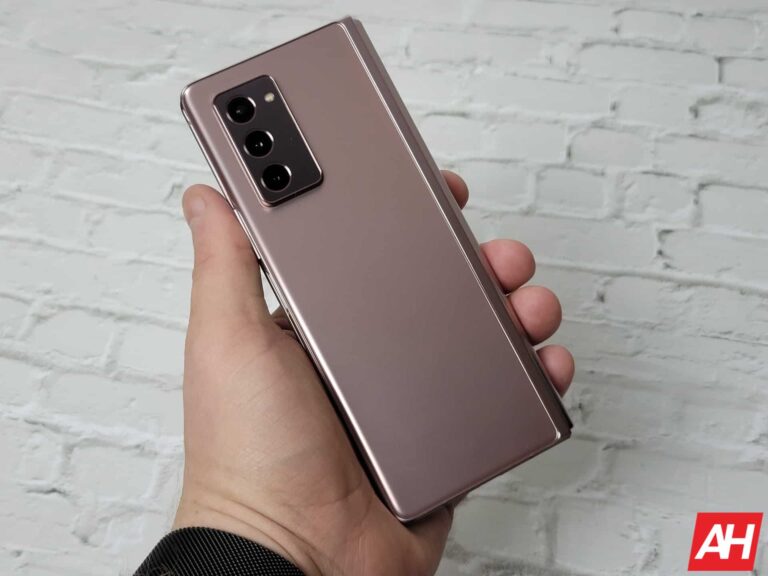
Galaxy Z Fold 2 picks up the February security update
Over the past three weeks, Samsung has updated more than three dozen Galaxy smartphones and tablets to the February security patch, aka Security Maintenance Release (SMR). The company has pushed the new SMR to all recent flagship and premium mid-range models. It is now weeping through the remaining few models.
The Galaxy Z Fold 2 is currently picking up the latest security update in South Korea. The update comes with the firmware build number F916NKSS2KXB1 and only brings this month’s security fixes from Samsung and Google. There are 69 of them, though not all of them exist on the foldable. This is the total number of vulnerabilities fixed across the Galaxy family.
Samsung will soon roll out the February SMR to the Galaxy Z Fold 2 in other markets. The build number may vary but the content of the update should remain the same. Don’t expect any new features or enhancements. The 2020 foldable didn’t get Android 14 and is no longer eligible for feature updates. Security patches will come for at least a few more months.
The Galaxy Note 10 Lite, which also debuted in 2020, is another Samsung device approaching its end of life. The S Pen-wielding affordable flagship is receiving the February security patch with the build number N770FXXS9HXA3. The update is available widely in Asia and Europe and should soon make its way into Latin America. There are no new features in tow.
The new security patch is also available for a few A-series phones
Samsung offers excellent update support to its A series mid-range phones. It has just released the latest security patch for the Galaxy A32, Galaxy A31, and Galaxy A12. The former is getting the update globally with varying build numbers—A325FXXS7DXA2 in Africa, Asia, and Europe, A325MUBU6DXB1 in Latin America, and A325NKSS5DXB1 in South Korea.
It’s a similar story for the Galaxy A31. It is picking up the February security update in Europe with the build number A315FXXS5DXB1 and A315GZHS4DXB1 in Asia. Finally, the Galaxy A12 is getting the new SMR in Latin America with firmware version A125MUBS4CXB1. If you are using any of these Samsung smartphones, watch out for an update in the coming days.
Despite facing a series of trade restrictions from the US regarding the import of advanced chip manufacturing equipment, Huawei has made substantial advancements, particularly with its Kirin 9000s SoC and AI-focused Ascend chip offerings. For those unfamiliar, Ascend chips are a series of AI chips developed by the Chinese giant placed as a competitor to NVIDIA’s AI chips.
Huang’s acknowledgment comes as Huawei‘s Ascend chips pose a challenge to NVIDIA’s dominance in the Chinese AI sector. The Ascend 910 chip, built on a 7nm process node, competes directly with NVIDIA’s A100 and A800 GPUs. It reportedly offers comparable performance levels for inference and training tasks. However, the actual real-world performance of Huawei’s chips remains to be fully evaluated.
Despite Huawei’s strides, NVIDIA maintains a strong position in the market
Chinese firms predominantly utilize Ascend chips for low-inferencing tasks. It indicates that NVIDIA’s products still hold sway in more demanding AI applications. Additionally, NVIDIA is reportedly developing new AI chips tailored for the Chinese market, targeting the low-to-mid AI performance segment. These developments suggest that NVIDIA is aiming to counter Huawei’s growing influence in the AI sector.
While Huawei’s progress is noteworthy, it’s essential to recognize that NVIDIA remains a leader in AI hardware technology globally. The company’s extensive portfolio and established reputation continue to attract clients worldwide. However, Huawei has emerged as a significant player in AI hardware manufacturing, at least inside China. It underscores the dynamic nature of the AI landscape, with competition driving innovation and technological advancements.
In conclusion, while Huawei poses a credible challenge to NVIDIA’s position in China’s AI sector, the latter remains well-positioned to maintain its leadership role. With ongoing developments in AI chip technology, the competition between these two tech giants is likely to increase, ultimately benefiting consumers and driving progress in the field of artificial intelligence.
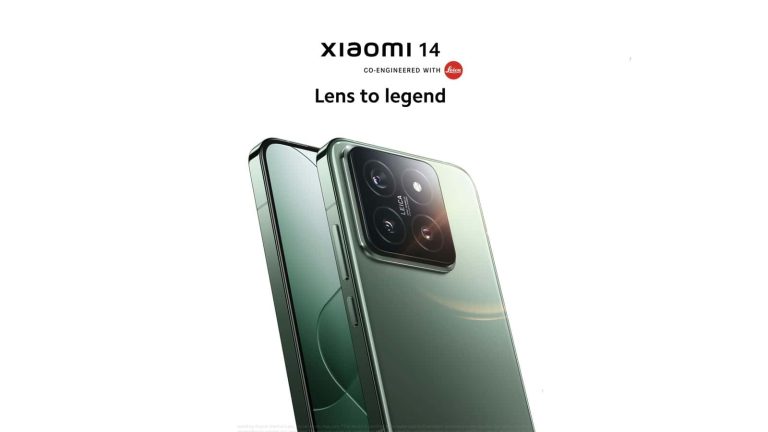
The Xiaomi 14 was originally launched in China back in October last year. It arrived alongside the Xiaomi 14 Pro. The Xiaomi 14 Pro did not launch globally, though, it was replaced with the Xiaomi 14 Ultra. That phone originally launched a couple of days ago in China.
The Xiaomi 14 reaches global markets, as a more compact flagship-grade option from the company
With that in mind, the Xiaomi 14 is also a flagship-grade smartphone, but a considerably more compact one. Before we get down to specifications, however, let’s talk about the phone’s design.
The Xiaomi 14 is made out of metal and glass. It has flat sides all around, with rounded edges. Its backplate is mostly flat, but it does curve towards the edges on all sides. A rectangular camera island sits in the top-left corner, with three cameras in there. Leica is a part of the equation.
It has a flat display, and very thin uniform bezels
A flat display sits on the front side of the phone, and it has a centered display camera hole up top. The bezels around that display are immensely thin, they measure only 1.71mm. That goes for all sides, as its bezels are uniform.
The Xiaomi 14 is fueled by the Snapdragon 8 Gen 3 processor, the most powerful chip from Qualcomm. The phone includes 12GB of RAM, and it comes in both 256GB and 512GB storage options. LPDDR5X RAM and UFS 4.0 flash storage are used here, while the storage is not expandable.
A powerful, and yet somewhat compact display is used here
A 6.36-inch LTPO AMOLED display is used. That display has a 2670 x 1200 resolution, and it offers an adaptive refresh rate (1-120Hz). It offers a 240Hz touch sampling rate and a peak brightness of 3,000 nits. It’s a Pro HDR display and supports HDR10+ content. Dolby Vision support is also included.
A 4,610mAh battery is included in the package, and the phone supports 90W wired and 50W wireless charging. Do note that the charger is included in the box.
Three 50-megapixel cameras are used, along with Leica lenses
A 50-megapixel main camera (f/1.6 aperture, Light Fusion 900 camera sensor, 2.4um pixel size thanks to 4-in-1 Super Pixel binning) is backed by a 50-megapixel ultrawide unit (f/2.2 aperture, 115-degree FoV, 6P lens). The third camera on the back is a 50-megapixel telephoto camera (f/2.0 aperture, 6P lens, 3.2x optical zoom). A 32-megapixel selfie camera (f/2.0 aperture, 0.7um pixel size) is also used.
The device is IP68-certified for water and dust resistance. It ships with Android 14, and Xiaomi’s HyperOS skin on top of it. Wi-Fi 7 is supported here, as is Bluetooth 5.4. The phone does include stereo speakers as well, but not an audio jack.
The Xiaomi 14 measures 152.8 x 71.5 x 8.2mm, while it weighs 193 grams. It comes in three color options, Black, White, and Jade Green. All three are made out of aluminum and glass. The Xiaomi 14 with 12GB of RAM and 256GB of storage is priced at €999 in the EU, and £849 in the UK. The 12GB RAM model with 512GB of storage costs €1,099 in the EU, and £899 in the UK. The phone is available in Black, White, and Jade Green colors, and if you get it between now and March 31, you’ll also get the Xiaomi Pad 6 for free.
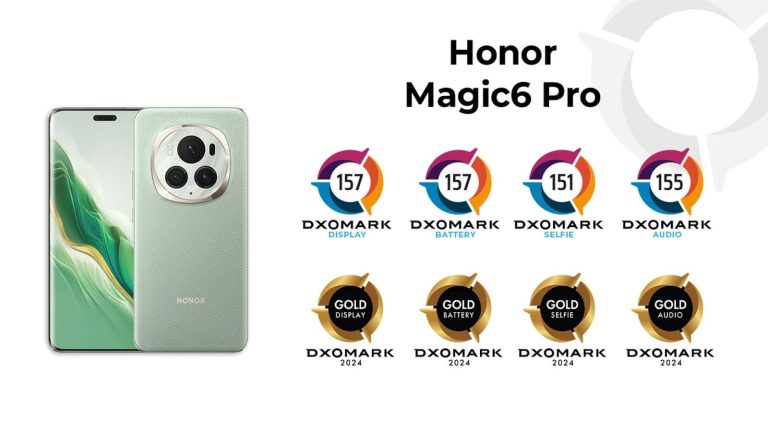
HONOR’s new flagship is not a top-placed smartphone in the Display, Battery, and Selfie categories. It also managed to take a very high second place in the Audio department. It received a ‘Gold’ rating from DxOMark in all those categories.
The HONOR Magic6 Pro breaks three records at DxOMark, starting with the display
The HONOR Magic6 Pro scored 157 points in the Display category, thus trumping the Samsung Galaxy S24 Ultra (155 points), and the Google Pixel 8 Pro (154 points).
DxOMark highlighted the phone’s “accurate, reactive, and smooth touch panel”, while it also praised its “best-in-class motion management”. The company also said that the display is well-suited for different lighting conditions, and has great HDR video experience in low-light conditions. You can read more about the display section here.
Outstanding battery
The device also took first place in the battery section with 157 points. It left the HONOR Magic5 Lite 5G behind itself with 152 points, and the HONOR X7b / OPPO Find X6 Pro both of which scored 151 points.
DxOMark highlighted the “excellent indoor autonomy” of the battery, and great battery life when the display is on but you don’t use it. It also showed great results in video streaming and gaming, now to mention that it charges really fast both via a wired, and wirelessly. You can get more details about the battery test by clicking here.
Selfie camera king… according to DxOMark
The HONOR Magic6 Pro sits at the very top of the food chain in the selfie camera category too. It scored 151 points, which is two more than the iPhone 15 Pro (Max) (149 points), and a iPhone 14 Pro Max (145 points).
In this section, DxOMark praised the phone’s “accurate target exposure and wide dynamic range”. On top of that, the company said that it had a neutral white balance and fairly pleasant color rendering.
The low noise levels in bright light and indoors were also a plus for DxOMark, and the same goes for the camera’s wide depth of field. Read more about the selfie camera here.
The Xiaomi 14 Ultra launched in China a couple of days ago. The phone became official on February 22. The Xiaomi 14 Ultra launch arrived to global markets thanks to a launch event that occurred in Barcelona.
Today is press day over at the Mobile World Congress (MWC) in Barcelona, a day before the show actually starts. The Xiaomi 14 Ultra is one of the biggest smartphone announcements in general at the event. The vanilla Xiaomi 14 also arrived, but we’ll talk about that in a separate article.
The Xiaomi 14 Ultra goes global only a couple of days after its launch in China
This phone was not exactly a secret thanks to a China launch a couple of days ago. Let’s take it from the top, though, starting with the design. The Xiaomi 14 Ultra is made out of metal and vegan leather. The Xiaomi 14 Ultra arrived in four color variants in China (and different materials), but it comes in only two globally.
The phone is available in black and white colors, both of which have vegan leather on the back. Unlike last year, the Xiaomi 14 Ultra has a flat display this time around, despite the fact the glass does curve on all four sides
The back side is different this time around, though the camera island looks similar
The backplate is also different this time around. It does not gradually rise in the upper portion of the phone. It’s mostly flat now, curving towards the metal on the sides. The central portion is flat, though.
Now, the camera island is large, and it does resemble the one from last year. It is round, and it does protrude on the back quite a bit. You’ll find four cameras on the inside, along with Leica’s optics. There is a display camera hole placed on the front, and it’s centered.
The Xiaomi 14 Ultra is fueled by the Snapdragon 8 Gen 3 processor, while it offers 16GB of RAM. The company also packed in 1TB of UFS 4.0 flash storage inside the device. The storage is non-expandable.
There is a 6.73-inch QHD+ (3200 x 1440) OLED LTPO display included on the front. That display is flat, and its refresh rate is adaptive between 1 and 120Hz. The panel does support HDR10+ content, Dolby Vision, and it has a 1,920Hz PWM dimming too. The maximum brightness of this display is 3,000 nits, while the Xiaomi ceramic glass protection is used.
Xiaomi used a huge battery here, while the phone supports 90W wired & 80W wireless charging
A 5,300mAh battery sits inside of this phone, while the device supports 90W wired charging. 80W wireless charging is also supported, as is 10W reverse wireless charging. Do note that the device is included in the box.
There are four cameras included on the back of this phone. A 50-megapixel main camera (Sony’s LYT-900 sensor, f/1.63-f/4.0 aperture, Hyper OIS, Leica Summilux lens) is backed by a 50-megapixel ultrawide unit (122-degree FoV, f/1.8 aperture, 5cm super macro, Sony’s IM858 sensor).
There are two periscope telephoto cameras used on the back
Two periscope telephoto cameras are also used. The first one is a 50-megapixel unit with 3.2x optical zoom, an f/1.8 aperture, OIS, and Sony’s IMX858 sensor. The other one is also a 50-megapixel unit with Sony’s IMX858 sensor, but it supports 5x optical zoom, OIS, and an f/2.5 aperture lens. A 32-megapixel selfie camera (OmniVision OV32B40 sensor, f/2.0 aperture) sits on the front.
There is an in-display fingerprint scanner included here, while Android 14 comes pre-installed with Xiaomi’s HyperOS skin. The phone includes two nano SIM card slots, and it is water and dust-resistant (IP68 certification).
Xiaomi included stereo speakers here with Dolby Atmos support. There is also a 4-microphone array included on the phone. Bluetooth 5.4 is supported, as is Wi-Fi 7.
The Xiaomi 14 Ultra measures 161.4 x 75.3 x 9.2mm and weighs 224.4 grams. The pricing will be announced soon, we’ll update the article once it does.
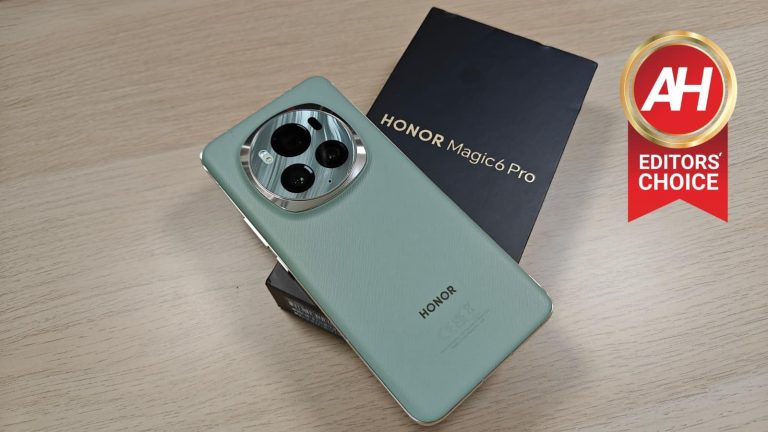
The HONOR Magic6 Pro is the latest and greatest phone HONOR has to offer. This is the company’s flagship offering, and it just got announced for global markets. We’ve had the phones for weeks at this point, and I’ve had time to compile the HONOR Magic6 Pro review in time for launch. Spoiler alert, it’s a great smartphone, but it’s not perfect, as nothing really is. This review will hopefully give you plenty of information about it, though, and help you decide whether it’s right for you.
This smartphone does improve upon the HONOR Magic5 Pro in a number of ways, and the camera department is just one example. This phone is heavily focused on the camera, so that’s not really surprising. It’s not just about the camera, though, not at all. It’s ready to provide competition to the best of the best out there, and I was even a bit surprised by how much I liked it, to be quite honest. So… let’s get to it, let’s see what the HONOR Magic6 Pro has to offer.
Table of contents
HONOR Magic6 Pro Review: Hardware / Design
The HONOR Magic6 Pro sure does look unique, that’s hard to deny. Not only does it have a centered pill-shaped cutout on the front, which is a rarity in the Android world, but its rear camera island differentiates too. We’ll talk about that soon, but let’s cover some other parts first. The HONOR Magic6 Pro is made out of metal (aluminum) and either vegan leather or glass, it all depends on the model. Our model is called ‘Sage Green’, and it combines a metallic silver frame with a washed-out green backplate. That’s a vegan leather backplate by the way, and it does provide plenty of grip. I assume the glass models are way more slippery.
The backplate is soft the touch, and does add grip
That backplate is actually very soft to the touch, and yet grippy at the same time, I really like the feel of it. This is one of the best implementations I’ve seen thus far. It also has protrusions on it, so the backplate is not perfectly flat. It’s certainly an interesting design. The area around the camera island is raised in height towards the camera island so that the phone is more comfortable to hold. HONOR refers to this camera island as the ‘Falcon Camera System’ and a ‘Star Wheel Triple Camera’, it all depends on if we’re talking about the design or not. There are three cameras included. The lower two sit one next to the other, and a periscope camera is placed above them. They are placed inside a circle, but the entire camera island is not circular. It has four edges, which are rounded. As I said, it’s an interesting look, that’s for sure. If you don’t plan on using a case on this phone, the area around the cameras is actually raised to protest them, so you’re good to go.
Uniform bezels & a pill-shaped cutout
On the front, you’ll find a curved display with seemingly uniform bezels. There is a pill-shaped cutout (aka Magic Capsule) on the front, as mentioned earlier, and the phone’s 3D facial scanning tech sits inside it, along with a front-facing camera. The sides of the phone are flat, but the edges are chamfered, so that the phone is more comfortable to use. All the physical buttons sit on the right-hand side of the phone, while the SIM card tray is accessible from the bottom. There is an IR blaster included at the top of the phone, along with a noise-canceling microphone, and the phone’s second speaker.
The phone is large, but it feels smaller than it actually is
The device measures 162.5 x 75.8 x 8.9mm, while our model weighs 225 grams. The glass variant is a bit heavier at 229 grams. Now, this phone will seem smaller than it is when you’re using it, which is a great thing. I always admire how HONOR manages to create really ergonomically pleasing smartphone. They’re always quite comfortable to hold, even if they’re large, and the same is the case here. The grippy backplate surely helps. The phone is neither small nor light, but it will feel smaller than similarly-sized competitors, at least from my experience. I also found myself using the rear camera island as an anchor for my index finger at times.
The HONOR Magic6 Pro is very comfortable to use, at least this variant
From the design standpoint, HONOR did a great job. I would have appreciated the overall appeal more if HONOR used a more regular green color (darker) here in collaboration with a dark frame, though that’s just a personal preference. I’m not a fan of this green color, and the metallic silver frame does pick up smudges quite easily. Those are just minor complaints, though, the design here is truly excellent.
HONOR Magic6 Pro Review: Display
This smartphone also comes with a top-of-the-line display. You’re getting a 6.8-inch LTPO Quad Curved Floating Screen here. Yes, it’s curved on all four sides, technically, even though the curves are way more pronounced on the sides. This panel can project 1.07 billion colors, and it supports HDR10+ content. Its refresh rate goes up to 120Hz, but it can also drop down to 1Hz when needed. The resolution you’re getting here is 2800 x 1280, and the PPI is 453, for those of you who are wondering. Dolby Vision certification is also included in the package.
This panel also gets immensely bright, as it can reach a max of 5,000 for HDR content. That’s the absolute maximum, though, you won’t get near it, realistically. The HONOR NanoCrystal Shield protects this display. It has proven to be quite durable, as SGS’s Five Star Glass Drop Resistance Ability was confirmed. This panel also has three TUV certifications and offers 4,320Hz PWM dimming to save your eyes. Its ‘Night Display’ feature is also customizable.
The display is vibrant, sharp & great overall
That panel does sound outstanding on paper, doesn’t it? Is it the same in real life, however? Well, yes, it is. I have to say that the panel is gorgeous. It’s vibrant and bright, and the blacks are deep. The viewing angles are excellent, and it’s really well optimized for a 120Hz refresh rate on MagicOS 8.0. I also feel like it’s excellent when it comes to tracking my finger as if it has a higher-than-usual touch response rate, which would not be surprising at all. I don’t have the information on the touch sampling rate, however, so I can’t share that detail.
You can switch between light and dark themes in the settings, or leave the phone to do it. Dynamic dimming feature is available, as is the eBook mode, not to mention that you have plenty of options in regards to manual tweaks to this display. I used it on default settings, without the ‘Natural Tone’ option, and it looked just right for my use. You can change that to ‘Natural Tone’, though, or tweak its color mode and temperature manually. Mine was set to ‘Vivid’, as that’s the default option. I never felt the need to change that, nor did I feel the need to change ‘Screen refresh rate’ to anything other than ‘Dynamic’. The phone did a great job of controlling that on its own.
Always-On Display (AOD) feature is also here, and it’s great
The HONOR Magic6 Pro also comes with a great Always-On Display (AOD) implementation. You have the option of having a dimmed display, a black display with some important info on it, or disabling the AOD display entirely. Now, you can have it on all the time in your preferred mode, or schedule it to be active whenever you want. Alternatively, you can only have it on when you tap the display. It’s all up to you. This is actually one of the best implementations I’ve seen considering how many options you have. You also have an option to see the notifications while the AOD is on or not.
In all honesty, I don’t really have a single complaint about this display. I would, of course, prefer for the pill-shaped cutout not to be on it. However, considering the functionality it brings, I really don’t mind it. We’ll talk more about that later on, though. All things considered, this is one of the best displays in the game at the moment.
HONOR Magic6 Pro Review: Performance
The HONOR Magic6 Pro is fueled by the Snapdragon 8 Gen 3 SoC. That is Qualcomm’s most powerful chip, and one of the best mobile processors on the market at the moment. HONOR paired it with 12GB of LPDDR5X RAM and 512GB of UFS 4.0 flash storage. Needless to say, this hardware is very powerful. If HONOR didn’t miss the mark on the software side of things, everything should be working properly. I have to say it does, very much so. We’ll talk more about MagicOS 8.0 in another section. From the sheer performance side of things, the HONOR Magic6 Pro does deliver, very much so.
The phone simply flew through regular, everyday tasks, even under heavy multitasking. It launched apps really fast, and the animations were great too. I have barely noticed any stuttering here, regardless of the weight put on the phone, which is truly impressive. In fact, this is one of the best-performing smartphones I’ve used. The phone’s hardware works great in collaboration with MagicOS 8.0 and ‘MagicLM’ that HONOR implemented. HONOR boasted about the performance improvements, and it shows, even though the HONOR Magic5 Pro also did a fantastic job.
The phone handled Genshin Impact like a champ, and the heat was well-controlled
What about gaming? Well, not a single game I tried out was a problem for this phone. Genshin Impact is once again the benchmark for performance on smartphones, and even after 30+ minutes of game time on the highest resolution, the phone did a great job. It did heat up, but not to the point of annoyance, nor did I notice any problems with the gameplay during that time. The FPS was constant, which is great to see. Games with lower requirements were a piece of cake for the HONOR Magic6 Pro. The phone also didn’t get too hot while gaming. We fired up Genshin Impact and played it for an hour to see how the thermals stand. The temperature was at 98.1F at that point, which is perfectly fine, and in line with the OnePlus 12, Galaxy S24 Ultra, and Pixel 8 Pro.
Benchmarks
When it comes to performance benchmarks, we usually run two tests, Geekbench 6 and 3D Mark Wildlife Extreme Stress Test. You can see a graph for the Geekbench 6 below, while we also talk more about 3D Mark down below.
In addition to that, we also tested the phone’s capability to process/export a video. We used our standard video clip, and CapCut to test it. The phone did a really good job processing a video in 1080p resolution at 30 FPS. You can check out the results below.
Geekbench 6
3D Mark
3D Mark has a number of benchmarking tests, but we usually run the 3D Mark Wildlife Extreme Stress Test. That puts quite a strain on the phone and usually heats it up quite a bit. It runs 20 loops of heavy 3D content, and the results can be quite interesting. The HONOR Magic6 Pro did a fairly good job here. Its best loop scored 5,054 points, considerably more than the Galaxy S24 Ultra (4,376) and Pixel 8 Pro (2,180). The OnePlus did get a better score with 17,047, though.
The lowest loop the Magic6 Pro provided was 3,492, which is higher than the Galaxy S24 Ultra (2,231) and Pixel 8 Pro (1,668). It’s lower than what the OnePlus 12 was able to provide (8,669), though. The HONOR Magic6 Pro did have higher stability than the OnePlus’ smartphone with 69.1% compared to 50.8%. It also did better than the Galaxy S24 Ultra (51%). The Pixel 8 Pro did do a better job stability-wise with 76.5%.
Video export test
3D face scanning & fingerprint scanning
The HONOR Magic6 Pro is equipped with both an advanced facial scanner and a fingerprint scanner. The facial scanning tech is included in the pill-shaped cutout at the top of the display, while the fingerprint scanner sits under the display. Let’s talk about the facial scanner first.
There are not many Android smartphones out there that offer facial scanning similar to Apple’s. The HONOR Magic6 Pro is one of them, as was its predecessor. Having that pill-shaped camera cutout at the top is definitely worth it, in my opinion. Facial scanning works like a charm on the HONOR Magic6 Pro. During my usage of over two weeks, I’ve unlocked the phone using this method a ton of times, and it failed me only twice. Both times it was on random during the day, other than that, it worked brilliantly every other time. It worked like a charm during the day and night, even when half of my face was covered. HONOR is probably using eye-tracking to an extent as well, I’m not sure, but I’ve purposely tried to hide the lower part of my face a number of times, and the feature worked great regardless.
The fingerprint scanner is fast and reliable
What about the fingerprint scanner? The HONOR Magic6 Pro uses an optical in-display fingerprint scanner. That sensor worked great for me. I’ve used it for about two days, just to try it out, as I was using facial scanning way more during the review period. The fingerprint scanner didn’t fail me once during those two days, and I only scanned one finger, once. If you don’t like facial scanning, this fingerprint scanner will serve you well.
HONOR Magic6 Pro Review: Battery
The HONOR Magic6 Pro comes with a 5,600mAh battery on the inside. Needless to say, that’s a rather large battery. HONOR is actually using a silicon-carbon battery inside of this phone, the second-generation one. The company even collaborated with YouTubers for some tests, to show how its new battery handles extremely low temperatures much better than regular batteries. That’s not all, considering this is a silicon-carbon battery, it has a higher density. That means that more capacity fits inside the same size, basically, which is another benefit. Is this capacity enough to power the phone through a demanding daily routine? Spoiler alert… yes, very much so.
In our battery rundown test, the HONOR Magic6 Pro did an outstanding job. It managed to beat the Samsung Galaxy S24 Ultra, our top performer thus far. We’ve basically fired up a YouTube video at 4K resolution, tuned up the brightness, and allowed it to run on the phone until the phone dies (well, dome to 1%, actually). We did that when the battery was full, of course. The HONOR Magic6 Pro proved it can handle that without a problem. What about actual usage? Well, read on.
I never felt the need to plug it in during the day
In daily usage, getting over 8 hours of screen-on-time was not difficult with this phone. Do note that I’m not much of a gamer, and I play games only for testing purposes. I do use my phone for various other tasks, though. The tasks ranged from plenty of multimedia consumption, emails, and messages, all the way to browsing, image editing, light video editing, and taking plenty of pictures… amongst other things. I did use the phone on Wi-Fi most of the day. Well, on most days. There were days with heavier 5G usage too. I didn’t notice any notable drop-off when the phone was connected to 5G. The signal was rather good at all times, though.
At the 8-hour screen-on-time point the phone had over 20% of battery charge left. Well, most of the time. That’s outstanding, needless to say. At one point I had 30% left. Your mileage may, of course, vary, as there are simply too many variables to consider. The point is, this phone offers great battery life. That big battery + HONOR’s optimizations obviously did the trick.
Charging
The HONOR Magic6 Pro not only has a big battery, but it also has immensely fast charging, in case you were wondering. The phone supports 80W wired charging and 66W wireless charging. One thing that surprised me is the fact that a charger did not come in the box, while it usually does. So keep that in mind if you plan on getting the device. Now, when it comes to sheer charging speed, I utilized one of the previous HONOR charging bricks, and at its max 80W charging the phone was fully charged for a little bit over half an hour, around 36 minutes.
HONOR Magic6 Pro Review: Camera
The HONOR Magic6 Pro has three cameras on the back. There is a 50-megapixel main ‘Super Dynamic Falcon’ camera (OmniVision H9000 sensor, f/1.4-f/2.0 adjustable aperture, OIS) back there. In addition to that, you’re also getting a 50-megapixel ultrawide camera (f/2.0 aperture, 122-degree FoV), and a 180-megapixel periscope telephoto camera. That periscope camera has a 1/1.4″ sensor, an f/2.6 aperture, and offers a 2.5x optical zoom, in addition to a 100x digital zoom. HONOR also boasted about improvements to dynamic range, light sensitivity, long-range vision, and dynamic visuals. The company is also using a new Shape Memory Alloy (SMA) actuator here, which combines autofocus and optical image stabilization. A Sport Portrait Algorithm is also included here, which is supposed to be able to take portrait shots even in fast-moving scenarios. The company also spent a lot of time on the periscope camera, and so on. You can read more about that here.
I captured over 1,000 images during the review period
I’ve spent over two weeks with this phone, and took over 1,000 images in that time. You’ll find around 100 of them shown at the very end of this section. I had a good feeling about this camera since I started using it, and I wasn’t wrong, it surely delivered. It’s not perfect, though, so let’s talk about it. In daylight situations, all three cameras do a great job. The main camera is the most consistent, though, as expected. It provides plenty of detail and handles dynamic range with authority. The images end up well-balanced and quite vivid. HONOR’s image processing also helps things. It doesn’t like to keep things in the shadows, which is likely what most people will prefer. This can make images look unrealistic, but not necessarily in a bad way. Sharpening is not an issue here, not at all, and the colors are great.
There are three shooting modes & an separate AI option
Do note that I used the camera mostly with the ‘AI Photography’ mode set to ‘Off’. I did take some with it on, but I didn’t notice much of a difference to be quite honest. It did recognize objects from time to time and did its thing. I didn’t really prefer those results, so I kept it in the off state most of the time. Also, there are three photo style modes you can choose from, Vibrant, Authentic, and Natural. I tried all three but stuck with the default one for the purposes of the review, the Vibrant mode. The Authentic Mode keeps things darker and more natural in a way, with a bit of vignetting. Natural mode is between the two and is the closest you can get to reality you’ll get. Still, I preferred the extra oomph the vibrant mode offered, and it was the default setting, so… there you go.
The camera shutter was quite fast, even without the special mode
The shutter was quite fast, especially on the main camera. If you need to take images of fast-moving objects, the motion-sensing option is no joke. Even when taking pictures of my dog, which is difficult to shoot as is due to all that white hair, it did a fine job. The same goes for the dog park. You also don’t need to activate night mode manually in auto mode when you’re in low-light situations. The phone does that on its own, and it’s very good at that.
The ultrawide camera did a very good job overall
The ultrawide camera did a great job of keeping the same color profile as the main shooter. The quality was also excellent, and the only thing that managed to throw it off was heavy light pollution in the background. That goes for mid-day when the sun is the brightest, and at night when there are a ton of street lights in the background. That’s what happens to many cameras, so I was not surprised. I was very pleased with that ultrawide camera, however, and it also has a very wide field of view (FoV), so it was quite useful at times. That’s the least impressive camera out of the three HONOR is using here, though.
its periscope telephoto camera is excellent
HONOR is very proud of this 180-megapixel periscope telephoto camera, and in my experience, it did a great job. The weakest performance was in low light, but it was still good. It actually exceeded my expectations. It was a great option for macro photos. You can see that ladybug in the gallery below, that one was taken using the telephoto camera, and it turned out fantastic. You will be using this camera for macro photos, that’s for sure. It also does a great job with far-off objects. Up to 10x, it’s great, the quality does drop the further you go, but you can really capture some great photos, depending on the scene.
Main camera samples:
Ultrawide camera samples:
Telephoto camera samples (various distances):
Colors sample controlled environment:
We take photos of a Rubik’s cube for every review now, in a controlled environment (photo light box). Here you can see a comparison between the shot from the HONOR Magic6 Pro, OPPO Find X7 Ultra, and the Samsung Galaxy S24 Ultra… in that order. Check out the gallery below.
HONOR Magic6 Pro Review: Software
The HONOR Magic6 Pro comes with Android 14, on top of which you’ll find HONOR’s MagicOS 8.0 skin. MagicOS 8.0 is a brand new version of the company’s Android skin, and it’s definitely an improvement compared to MagicOS 7.2. The UI looks a bit more modern than it did before, though further improvements are needed. The more I used MagicOS 8.0, the more I felt I was using a hybrid between Android and iOS. I believe that’s the best way to describe this UI. It’s the closest one to iOS that I’ve used in recent years. Many other China-based smartphone manufacturers stepped away from iOS, while HONOR is still trying to find the perfect blend between Android and iOS. I have to say that MagicOS 8.0 is much closer to it than MagicOS 7.2 and previous versions were.
MagicOS 8.0 feels like a blend between Android & iOS… in mostly a good way
Why do I even mention this blend? Well, I felt like I was using both OS’ while I was using this phone, to be quite honest. Let’s take iOS for example. The HONOR Magic6 Pro has a 3D facial scanner on the front, and a centered pill-shaped cutout to accommodate it, just like modern iPhones. That facial scanning works like a charm too, and when it recognizes your face, it shows you the content of your messages on the lock screen. Those messages are, by default, bottom-pinned, just like on an iPhone. You do have plenty of choices in regards to what you want them to look like, 3 in total, with some additional options. You can have them sit one above the other, for example, if you don’t like the stacked look.
Plenty of iOS elements are still here, but the integration is better than ever
We’re not yet over with iOS-like feel, not at all. HONOR still prefers to have many elements of its UI see-through, but that effect has been toned down in MagicOS 8.0. The quick toggles are separated from the notification shade, as they are on iOS. The entire look of the quick toggles screen is also reminiscent of iOS. You see where I’m going with this, even the Dynamic Island functionality has been ported over to a degree. When you fire up YouTube, for example, and then swipe up for home, you’ll get some additional UI elements around the pill-shaped hole at the top of the display. You can tap that for additional options, and from that screen, you can even get back to the app. It’s convenient, but it screams Dynamic Island.
MagicOS 8.0 could use more improvements, but it’s a lot better than it way
Those are the most obvious touches of iOS here. There’s a ton of Android too, as other than what I’ve mentioned, everything else is as you’d expect it. You can switch to an app drawer layout for your apps, even though they’re leaning towards iOS by default. The menus are Android-like, the entire notification system is more Android-like than iOS-like in terms of notification content and actions themselves, and so on. HONOR could still improve those notifications, though, as all content is blended together, and it’s not the best look, in all honesty. Plus that see-through iOS look is still present. HONOR can do a better job in that regard, that’s for sure.
Swipeable lock screen shortcuts are not customizable
YouTube did freeze a couple of times on MagicOS 8.0, I’m not sure why. I had to kill the app in order to get that sorted. There are also annoying lockscreen shortcuts which you can access by swiping from the bottom up while on the lock screen. Why do I say they’re annoying? Well, because I found now way to customize them. You get a voice recorder, flashlight, calculator, and a stopwatch there. I don’t really use none of those regularly, except the flashlight. I wouldn’t want it to be there even if I did, though. It would be great if we could completely disable this feature. I personally did tend to activate it by accident and I didn’t use it at all. There’s also no way to remove the step counter from the lock screen. That is also something that I don’t prefer to be there.
You can finally swipe across the screen to access your notifications
Now, MagicOS 8.0 finally brought over a feature I’ve been waiting for ages when it comes to HONOR phones… a customizable swipe-down gesture. There are only three options now, but that’s a huge change compared to previous versions. Why? Well, because you can now set it to bring down the notification shade instead of launching HONOR Search. The third option is ‘None’, so you can basically disable it. I appreciate this so much as reaching for the top of the screen for notifications was really annoying on previous versions. Do note that you can switch between the notification shade and quick toggles by simply swiping left or right when either screen is open. That is also quite convenient. One more thing, when you swipe down across the home screen from the left side of the screen, you’ll access the notification shade (if you set that option), if you do it from the right side, you’ll get to quick toggles. The thing is, 2/3 of the display is reserved for the notification shade and only 1/3 for quick toggle activation. This is a touch of genius on HONOR’s part, as you’ll be using the notification shade much more frequently.
Different lock screen styles are available
You can also choose between a ton of different style of lock screen styles. This feature is called the ‘Magic Lock Screen’, and it does allow you to adapt the lock screen to your preferences. Considering that you’ll be using that lock screen quite a bit if you choose the facial scanning security method, this is a nice touch. Those settings can be found in the ‘Home screen & style’ section of the settings, which is where you’ll find the Always On Display options, themes that you can choose from, fonts, and so on.
Speaking of the always-on display, that’s another great aspect that you get access to. We’ve already talked about it in the ‘Display’ section a bit, but it’s worth getting a bit more into it. There are two main screen-off modes to choose from, ‘Full screen’ and ‘Partial screen’. The ‘Full screen’ mode basically dims the display, which is something iOS users are probably used to. The ‘Partial screen’ mode leaves you with a black screen and only the most important information on the screen, without your wallpaper. You can schedule when you want the AOD display to be active, leave it on all the time, or have it activate when you tap the display (when it’s off). Whether you want notifications to be visible or not, well, that’s your call too.
The ‘One-Handed mode’ is good, but different
There is a ‘One-Handed mode’ here, and it’s great, even though different from what you’re used to on Android. Instead of swiping across the bottom navigation bar to lower the top portion of the display, you will have to swipe that bar to the right (or left) and wait a moment. At that point, the display will shrink itself (the entire display), and navigate to the side you chose. Many would say this is a more practical solution as you get access to the entire display. I tend to prefer the default Android option. Both are very good, though.
The ‘One-Handed mode’ is placed in the ‘Accessibility features’, along with ‘Shortcuts & gestures, Multi-Window’ and more. There are a ton of additional options that you can activate here. There is also a useful side panel that you can access no matter where are you in the menus or apps. You simply swipe from the left or right side of the display and hold for a moment, and then you’ll see a bunch of apps appear in a vertical alignment. You can customize what shows up here, and from there you can activate multi-window mode, or launch an app in a small window.
Bloatware?
There are a number of apps you likely won’t use pre-installed here, but the good news is, you can remove many of them. For example, Booking and Link to Windows. You can even remove some of HONOR’s very own apps, like Device Clone, for example, if you don’t plan on using it. So, the bloatware is not really a problem. There are a number of HONOR apps that you can’t remove, of course, but chances are you’ll be using many of those system ones.
Some elements are still not in tune with the theme of the UI
These are only some of the options available in MagicOS 8.0 Many of them have been around for a while now, others not so much. The whole UI looks a bit better than it did before, it’s a bit more consistent, but it’s still not there entirely. Different menu elements are not in cohesis as they should be, in my opinion. All caps font is a bit odd in places, while some UI elements look a bit cartoony still. If HONOR does continue in this direction, however, it’ll get great quickly. The good news is… everything works great. The animations are outstanding, the UI is very fluid and responsive. That’s the experience I had on previous versions too, and even devices that are not as powerful. HONOR does a great job with performance optimization, and this is no exception.
HONOR Magic6 Pro Review: Audio
The HONOR Magic6 Pro comes with a stereo speaker setup, with DTS: X Ultra support. We have our own audio tracks to test out the speakers so that we can get the best grasp of their loudness, distortion, bass, treble, balance, vocals, and immersion. The speakers on the HONOR Magic6 Pro are very good. They’re bottom and top-facing, and they’re really well-balanced. This is the best orientation after two front-facing speakers, as it really does add balance to the picture. The second speaker that sits below the earpiece usually does not work as well.
The speakers here do get loud enough. These are definitely not the loudest speakers we’ve heard, but they do get more than loud enough. The distortion is very minimal when you crank up the volume to the highest, many of you won’t even notice it. That’s also the case with most speakers we’ve tested. The bass is strong, but not overbearing, and the same goes for higher-end. It’s actually really well-balanced across the spectrum, I didn’t really hear any problems with low, mid, or high-end tones, to be quite honest. The vocals were also clear enough from the phone’s speakers.
HONOR Magic6 Pro: Should you buy it?
Is the HONOR Magic6 Pro the phone for you? Well… it’s certainly an interesting phone. As I mentioned several times in the review, I see this phone as a hybrid of iOS and Android, in a way. Throughout my entire usage cycle, I felt that way, and that’s not necessarily a bad thing. This is the first slab phone that I thoroughly enjoyed using since I switched to foldables. I don’t even know why, to be quite honest. I still have quite a few complaints about its software, but that combination of Android and iOS aspects really appealed to me, in combination with the phone’s camera performance, battery life, and design. The HONOR Magic6 Pro is a complete package, that’s hard to deny. Its software is noticeably improved compared to last year’s model, and the camera improvements are also easily noticeable. The HONOR Magic6 Pro is a great phone, and if you’re in the market for a flagship-grade device, this one is definitely worth considering.
You should buy the HONOR Magic6 Pro if you:
…love big phones, but you want a comfortable one …appreciate the added grip thanks to a vegan leather backplate (on that model) …love both Android & iOS and want a combo of both …need great camera performance …are a heavy user and need a phone that will last …like using wired & wireless charging, but want them to be fast …liked the iPhone’s facial scanning …need a reliable fingerprint scanner
HONOR announced a handful of products today, at MWC 2024. The company announced the global variant of the HONOR Magic6 Pro and teased the Porsche Design HONOR Magic6 RSR. We’ve already covered those two phones separately. In addition to that, however, the global Porsche Design HONOR Magic V2 RSR model also got announced, along with two more products.
The other two devices are the HONOR Pad 9 and HONOR MagicBook Pro 16, both of which have been announced for global markets. That’s five devices in total that HONOR presented at the largest tech tradeshow in the world.
Needless to say, out of the three devices mentioned here, the Porsche Design HONOR Magic V2 RSR managed to attract the most attention to itself. That is a premium device developed in collaboration with Porsche Design.
It shares the internals of the regular HONOR Magic V2, though it comes with topped-out specs. This phone packs in 16GB of LPDDR5X RAM, and 1TB of UFS 4.0 flash storage. It’s fueled by the Snapdragon 8 Gen 2 processor
It comes in a single color, Agate Gray
The phone comes in Agate Gray color, which is the same color the car its design is inspired to comes in. The camera island on the back has been redesigned compared to the regular Magic V2, and the same goes for the backplate in general, though it’s still quite slippery.
This smartphone is incredibly thin at 9.9mm when folded, and 4.8mm when unfolded. It’s also rather light, it weighs under 240 grams, and it looks great overall. The bezels are thin around both displays, and the folding mechanism is spot on as well.
Two 120Hz LTPO OLED displays are used, and a silicone-carbon battery too
The phone is equipped with two 120Hz LTPO OLED displays, and the crease on the main panel is well-hidden. Both displays do get quite bright as well. Three cameras sit on the back, a 50-megapixel main camera, a 50-megapixel ultrawide unit, and a 20-megapixel telephoto camera (2.5x optical zoom).
A silicon-carbon 5,000mAh battery sits on the inside here, while 66W wired charging is supported. 5W reverse wired charging is also supported, and more. This device actually packs in two charging bricks in the box, for different markets.
The Porsche Design HONOR Magic V2 RSR is priced at €2,699 in Europe. Pre-orders kick off today, while the device will go on sale on March 18.
The HONOR Pad 9 is a rather large tablet
The HONOR Pad 9 is the second product we’re here to talk about. That is a 12.1-inch tablet made out of metal and glass. It has flat sides, all of them, actually. It also has a 25600 x 1600 TFT LCD display, and and protection against glare too.
The Snapdragon 6 Gen 1 processor is included on the inside, while the tablet packs in 8GB/12GB of RAM, and up to 512GB of storage, depending on the model.
Android 13 comes pre-installed on it, along with MagicOS 7.2. An 8,300mAh battery is also a part of this package, while 35W wired charging is supported. The tablet has 8 speakers and two microphones.
There is a 13-megapixel camera included on its back and an 8-megapixel shooter on the front. Bluetooth 5.1 is included on this tablet, and there’s a Type-C port at the bottom.
The HONOR Pad 9 is a budget tablet, that much is obvious. It’s not particularly powerful, but it should be powerful enough for multimedia consumption and various other actions you’d usually perform on a tablet.
We still don’t have its price tag, but we’ll update the article once we get it.
The HONOR MagicBook Pro 16 info is scarce, for now
The HONOR MagicBook Pro 16 also got announced, though we don’t have much info at the moment. I do know it’s made out of metal, and that it’s quite thin, with thin bezels around the display.
It comes with the HONOR 140W Turbo Engine, and has a 3K HONOR Real Color Eye Comfort FullView Display. The HONOR Magic AI Workstation is also mentioned, and the device also includes six speakers. Spatial Audio is a part of the picture.
That’s all we have for now. We’re trying to get more information and the price tag.
HMD has just confirmed that it’s planning to launch a Barbie flip phone, and a customizable smartphone too. Unfortunately, the details are quite scarce, as neither will launch at MWC 2024. That’s where this info came from, though.
HMD will launch a Barbie flip phone this summer
Do note that this Barbie phone will be a feature phone, not a smartphone. That device is coming later this year, in July, to be more exact. So you can expect a summer launch for this one. We don’t know anything else about it. HMD did release the image below, though.
It’s not exactly difficult to guess that this will be a pink-colored smartphone. That’s also something that the other image HMD shared reveals, as you can see below. Everything is blurred out, but those four devices are likely the products that are coming. Once again, the summer launch is mentioned.
The company will also announce some sort of a customizable device
The other device that the company teased is some sort of a customizable device. That will be a full-fledged Android smartphone, though. It’s referring to this device as the HMD Fusion.
That smartphone will arrive a bit later on, in July 2024. HMD did say that you’ll be able to swap out its shells, and thus change its clothes for various occasions, basically. Android Authority snapped some examples of those shells, you can see them below.
The toolkit for the HMD Fusion has also been released, you can check it out here. It contains design files an software integration information. That’s basically all we know at this point.
I personally am hoping that magnets will be a part of the equation here, but that is still unknown. These will be the very first devices to launch under the HMD brand, instead of the Nokia brand. HMD Global has decided to switch things up, and ditch Nokia.
The Samsung Galaxy Book 4 series of laptops will be going on sale globally starting from February 26. Notably, the series was introduced in December and has already been available in South Korea since January. The brand claims that the new notebook has already outsold its predecessor’s initial sales in the South Korean market.
The Galaxy Book 4 series comprises three premium notebooks
First, the new Galaxy Book series comprises the Galaxy Book 4 Pro, Galaxy Book 4 Pro 360, and the Galaxy Book 4 Ultra. All new notebooks are now heading to global markets like the US, the UK, France, and Germany starting Monday. All three are premium laptops with a heavy emphasis on AI optimizations and up to Intel Core Ultra 9 series processors.
Samsung hasn’t yet revealed the global pricing of the new Galaxy Book 4 series notebooks. However, in South Korea, the Galaxy Book 4 Ultra is available starting from approx. $2,600. The Book 4 Pro and Pro 360 models are being offered for around $1,500 and $2,000, respectively. The Ultra model will be offered in Moonstone Gray hue. Samsung will be offering the Pro models in an additional Platinum Silver shade.
We will know more about their pricing in the United States in a matter of days. The company is expected to provide some launch day offers for these devices like discounted pricing during the initial sales.
The new notebooks flaunt AI capabilities and utilize up to Intel Core Ultra 9 processors
It’s worth adding that the Galaxy Book 4 series is supported by Intel’s AI PC Acceleration program. Thanks to this, they get enhanced AI (artificial intelligence) capabilities to offer improved productivity features. The laptops sport multiple AI-based creation tools and immersive gaming features. Notably, they also feature high-performance GPUs as well as a newly integrated neural processing unit (NPU).
Notably, Samsung has powered the latest Galaxy Book notebooks with the Intel Evo Edition processors. Furthermore, the Book 4 Pro and Pro 360 models can be configured with either the Core Ultra 5 or Ultra 7 processor. As for the higher-end Book 4 Ultra, it can be purchased with either the Core Ultra 7 or Ultra 9 processor.
Furthermore, the notebooks come with up to NVIDIA GeForce RTX 4070 laptop GPU with 8GB of video memory. The new notebooks offer up to 64GB of LPDDR5X RAM and up to 2TB of solid-state drives. All three come preloaded with the Windows 11 Home version, AKG quad speakers, and studio-quality dual microphones.
As for other highlights, the Galaxy Book 4 Ultra and Pro 360 variants get 16-inch AMOLED displays with WQXGA+ resolution. While, the Galaxy Book 4 Pro comes in 14-inch and 16-inch models, which both sport AMOLED WQXGA+ screen panels. Lastly, the notebooks have Wi-Fi 6E, Bluetooth 5.3, Thunderbolt 4 ports, and up to 76Wh batteries.
In a recent report by Counterpoint Research, it has been revealed that all top seven best-selling smartphone models of 2023 were iPhones, marking the first time in history for such a dominance.
Top 10 best-selling smartphones of 2023, globally
The top three positions were occupied by 2022’s iPhone 14 series, with the base model clinching the top position. Despite the release of the iPhone 15 series in September 2023, these models swiftly secured spots 5, 6, and 7 within just three months of sales. The iPhone 13, positioned between the 14 and 15 series, also made a notable appearance at No. 4, being the most affordable modern-looking iPhone offered by Apple.
The usually budget-friendly iPhone SE did not make it onto the list for 2023. Rumors circulating within the industry hint that Apple might not produce another SE model in the future. Notably, 2022’s report included the iPhone SE.
3 budget devices from Samsung accompanied expensive iPhones
While the list of top 10 global best-selling smartphones included the flagship iPhone 14 and 15 series with no place for a relatively more affordable iPhone SE last year, the 3 Android devices from Samsung, that probably replaced the iPhone 13 Pro models, were among some of the most budget-friendly offerings from Samsung. It’s important to note that the company also offers some of the most premium smartphones to the market.
Apple does not offer an aesthetically appealing yet affordable offering to users. On the other end of the spectrum, Android, users still get plenty of choices and a decent look (most of the time). It might be a reason for the 3 spots being occupied by budget Samsung devices – the Samsung Galaxy A14 5G (~$200), Samsung Galaxy A14 4G (~$160), and the Samsung Galaxy A04e (~$100).
Interestingly, Counterpoint Research’s list of the top 10 best-selling devices from 2022 included the Samsung Galaxy A14’s predecessor, the Samsung Galaxy A13, and additionally the Samsung Galaxy A03 alongside 8 iPhone models. And to my surprise, the list for 2021 included the Samsung Galaxy A12 along with two other cost-effective offerings from Xiaomi, but not a Galaxy flagship.