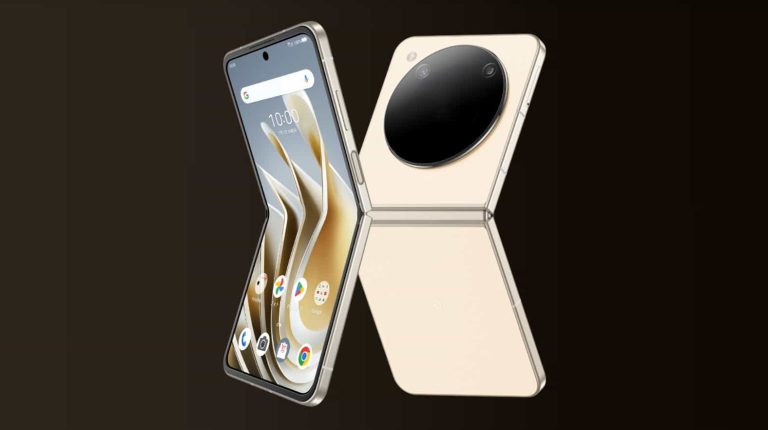
ZTE has just made foldable smartphones incredibly affordable. The Chinese firm collaborated with Japanese telecom company Y!mobile, a subsidiary of SoftBank Group, to launch a clamshell folding phone at just $420. The ZTE Libero Flip is available for pre-order in Japan, with sales beginning on February 29. There is no word yet on the global release of the world’s cheapest foldable.
The ZTE Libero Flip made mid-range foldables a thing
Foldable phones are generally more expensive than regular smartphones. Before ZTE entered the scene, the lowest launch price for a foldable was $699 for Motorola’s Razr 2023. If you want a more refined product, Samsung’s Galaxy Z Flip 5 is your best bet but costs $999. Of course, you can grab these phones at a lower price with offers and promotions, but that’s a different matter.
ZTE’s Libero Flip has a launch price of 63,000 yen in Japan, which is equivalent to $420. With offers, you can grab this foldable at just 39,800 yen or roughly $265. This is ridiculously affordable for a foldable phone, no matter the manufacturer. There is little chance the phone will arrive in the US or most other global markets, but hardly anyone imagined a brand-new foldable to be available at around $400 in 2024.
The device packs a decent set of specs too. Nothing magical, but acceptable for a foldable at this price range. You get Qualcomm’s Snapdragon 7 Gen 1 chipset paired with 6GB RAM and 128GB storage. The ZTE Libero Flip sports a 6.9-inch AMOLED display with a 2790×1188 pixels resolution on the inside and a 1.43-inch circular panel (466×466 pixels) on the outside. The secondary display can be used for notifications, whether, calls, and camera viewfinder.
Speaking of cameras, ZTE’s first foldable has a 50MP primary shooter and a 2MP depth sensor on the back. You also get a 16MP selfie camera here. The device sits rigid at various angles, so you can take hands-free photos. Other key specs include a 4,310mAh battery, 33W charging, side-mounted fingerprint scanner, Wi-Fi 6, Bluetooth v5.2, IP42 dust and water resistance, and Android 13. The device measures just 7.3mm in thickness when unfolded. You can find the full spec sheet here.
Samsung may also have a mid-range foldable in the works
Rumors say Samsung will launch three new foldables this year. Alongside the Galaxy Z Flip 6 and Galaxy Z Fold 6, we could see an affordable model priced similarly to the ZTE Libero Flip. Details are scarce but the Korean firm does seem to have this device in the pipeline. Either the plan will materialize this year or we will have to wait longer for it; only time will tell. Samsung’s next-gen foldables should arrive in July.
This new chipset will be used in most flagship smartphones that will launch in 2022. So it’s important to see what all this new chipset is actually capable of. Because, the chipset is what opens the door for these new smartphones to debut new features, like AI Video Bokeh.
So, here’s everything you need to know about the new chipset from Qualcomm.
Why the new naming scheme?
Qualcomm opted to use a new naming scheme with the Snapdragon 8 Gen 1 this year. Instead of going with the Snapdragon 898 which many were expecting. Qualcomm decided it was important to make its processors easier to decipher. Instead of using a three-digit number for each processor, it’ll now have the series, plus the generation after it.
This new naming scheme is going to be starting with the Snapdragon 8 series, but will trickle down to the Snapdragon 4, 6 and 7 series too.
240 12MP Photos in one second 3.2 Gigapixels per second 4 stops of dynamic range 8K HDR + 64MP 18-bit RAW 5X Better Night Mode Dedicated Bokeh Engine
200MP single shot 84MP single with zero shutter lag 64MP+25MP with zero shutter lag Triple 24MP with zero shutter lag Hybrid AF 10-bit HEIF image capture HDR video multi-frame noise reduction Real-time object classification, segmentation, and replacement
Video Capture
8K HDR @ 30fps 4K UHD @ 120fps 720p @ 960fps
8K @ 30fps 4K UHD @ 120fps 720p @ 960fps
Video Playback
8K 4K HDR up to 120fps H.265 and VP9 video decoder 360 degree
8K 4K HDR up to 120fps H.265 and VP9 video decoder 360 degree
First Available
Q4 2021
Q1 2021
What’s new in the Snapdragon 8 Gen 1?
For the Snapdragon 8 Gen 1, there’s a number of things that Qualcomm is focusing on. But it’s all of the usual talking points. That includes AI, Camera and 5G or WiFi 6E. Let’s talk about each of these new features in the new Snapdragon 8 Gen 1.
Faster and more advanced AI
Qualcomm calls it “AI for All”. With the Snapdragon 8 Gen 1, it has released its seventh-generation Qualcomm AI Engine, which is the fastest and more advanced engine ever. So that smartphone makers are able to use the AI to capture depth-defying images with the Leica Leitz Look mode. You can also analyze and intelligently group and prioritize your notifications with natural language processing from Hugging Face.
What does this mean for smartphone users? Well, it means that the artificial intelligence in your phone is going to get faster and get smarter. Google is one that uses AI for a lot of different things in its Pixel smartphones, but since they use Tensor now, this won’t matter for Pixel users. However, for Samsung, Xiaomi and others, it will make a big difference.
What is Snapdragon Sight?
Instead of talking about the ISP inside the Snapdragon 8 Gen 1, Qualcomm is bundling all of the camera features under a brand – Snapdragon Sight. This is a collection of premium camera features and technologies that include their first ever 18-bit ISP.
This is going to allow you to capture photos and videos in extreme dynamic range with vivid color and clarity. And this will be the first time that you can record in 8K HDR video quality, from a smartphone.
The new 18-bit ISP is able to capture over 4,000x more camera data than the 14-bit predecessor in the Snapdragon 888. It also has staggering capture speeds at up to 3.2 Gigapixels per second.
There’s also a dedicated Bokeh Engine available for 4K Video Capture with Snapdragon Sight. Which will work with AI Video Bokeh making for some really cool and cinematic videos, all taken with your smartphone.
Qualcomm has also made it so that the front-facing camera can be always-on, since it is the fourth ISP in the sensing hub. This is going to improve security, the ability to unlock your phone with face unlock. And it’ll also be able to determine if someone is looking over your shoulder.
Basically, the Snapdragon 8 Gen 1 is going to bring some really big changes to the flagship smartphones coming in 2022.
The next era of 5G
Once again, Qualcomm has released its most advanced 5G platform ever, with the Snapdragon 8 Gen 1. The fourth-generation Snapdragon X65 6G Modem-RF system, which offers unparalleled speeds and supports more networks, frequencies and bandwidths globally.
This is the world’s first 10-Gigabit 5G Modem-RF solution. It’s also the world’s first 3GPP Release 16 5G solution. And the world’s first 5G uplink carrier aggregation for unprecedented upload speeds.
This new modem does offer mmWave and Sub-6 5G support, as well as standalone and non-standalone modes, FDD and TDD. Which means that it is going to work better around the world. Not just in the US.
For mmWave it offers 1000MHz bandwidth, 8 carriers and 2×2 MIMO. For Sub-6 it’s 300MHz bandwidth and 4×4 MIMO. Finally, Qualcomm supports Global 5G multi-SIM with the new Snapdragon X65 5G Modem-RF System.
So what does this mean for consumers? Well, this means that we will see even fewer mmWave models of phones next year. 5G speeds will be faster, in areas that have faster speeds, and it will work for traveling from country to country. Like 4G LTE was doing prior to the launch of 5G.
WiFi 6E and WiFi 6-ready
The Snapdragon 888 5G did support WiFi 6E and WiFi 6 last year, but now, with the Snapdragon 8 Gen 1, you’re getting even better support. This is all thanks to the Qualcomm FastConnect 6900 System. It supports the following WiFi standards:
WiFi 6E, WiFi 6 (802.11ax)
WiFi 5 (802.11ac)
WiFi 2.4 (802.11a/g/b/n)
WiFi spectral bands: 2.4GHz, 5GHz and 6GHz.
Qualcomm quotes the peak speed on the FastConnect 6900 to be about 3.6Gbps. Which is likely way faster than anyone will actually get from a WiFi network right now. Considering the fact that Gigabit WiFi is still pretty scarce across the US.
This is all important as it means you’re getting faster speeds on your smartphone with the Snapdragon 8 Gen 1, as well as being less likely to drop connection from your WiFi network.
Snapdragon Elite Gaming continues to impress
With Snapdragon Elite Gaming in the Snapdragon 8 Gen 1, Qualcomm is claiming that you will get ultra-smooth responsiveness and color rich HDR scenes. That represents a huge step forward in the mobile gaming arena.
Qualcomm has also added the Adreno Frame Motion Engine, which means you’re getting more frames while using less power. That’s always a good thing. Qualcomm claims that you’ll get “desktop level capabilities” out of this new Adreno GPU on the Snapdragon 8 Gen 1.
Qualcomm’s new Snapdragon Studios has been working with a number of game publishers to adopt these new features that are part of Snapdragon Elite Gaming. That includes Epic Games, Tencent, Ubisoft, NetEase Games, Niantic, EA, 2K, Roblox, Netmarble, Gameloft, Square Enix, Sony, Microsoft and many others. So you’re likely to see a lot of games that will support these new features.
What this means for consumers is that you’re going to be able to have an even more impressive gaming experience on your phone. Giving you even less reasons to get a console like the PlayStation 5 or the Xbox Series X.
When can we expect the first smartphones with the Snapdragon 8 Gen 1?
As usual, Qualcomm did not specify who or what phone would be first with this new chipset. However, Qualcomm did mention that we will see it in a smartphone before the end of 2021. Given the fact that there’s really only a couple of weeks left in the year, it’s going to be very soon.
We have a feeling that it will be a Xiaomi smartphone. Since the Xiaomi MI 12 series is set to debut in December. So it’ll likely be the Mi 12 Ultra. We also expect to see this in the Samsung Galaxy S22 in the beginning of 2022.
A new cybersecurity threat targeting Facebook advertisers in Vietnam, known as VietCredCare, has emerged.
This information stealer has been active since at least August 2022 and is designed to hijack corporate Facebook accounts by automatically filtering out Facebook session cookies and credentials from compromised devices.
The malware assesses whether the stolen accounts manage business profiles and if they maintain a positive Meta ad credit balance.
DocumentLive Account Takeover Attack Simulation
Live attack simulation Webinar demonstrates various ways in which account takeover can happen and practices to protect your websites and APIs against ATO attacks.
How VietCredCare Operates
VietCredCare is distributed through links to bogus sites on social media posts and instant messaging platforms, masquerading as legitimate software like Microsoft Office or Acrobat Reader.
Once installed, it can extract credentials, cookies, and session IDs from web browsers, including Google Chrome, Microsoft Edge, and Cốc Cốc, a browser focusing on the Vietnamese market, Group-IB said.
How VietCredCare Operates
The malware is notable for its ability to retrieve a victim’s IP address, check if a Facebook account is a business profile, and assess whether the account currently manages ads.
It also takes steps to evade detection by disabling the Windows Antimalware Scan Interface (AMSI) and adding itself to the Windows Defender Antivirus exclusion list.
VietCredCare’s core functionality to filter out Facebook credentials puts organizations at risk of reputational and financial damages if their sensitive accounts are compromised, reads the report.
Credentials belonging to several government agencies, universities, e-commerce platforms, banks, and Vietnamese companies have been siphoned via the stealer malware.
The threat actors then use the stolen Facebook accounts to post political content or propagate phishing and affiliate scams for financial gain.
This large-scale malware distribution scheme facilitates the takeover of corporate Facebook accounts, targeting Vietnamese individuals who manage the Facebook profiles of prominent businesses and organizations.
Stealer-as-a-Service Model
VietCredCare is offered to other aspiring cybercriminals under the stealer-as-a-service model and is advertised on Facebook, YouTube, and Telegram.
It is managed by Vietnamese-speaking individuals.
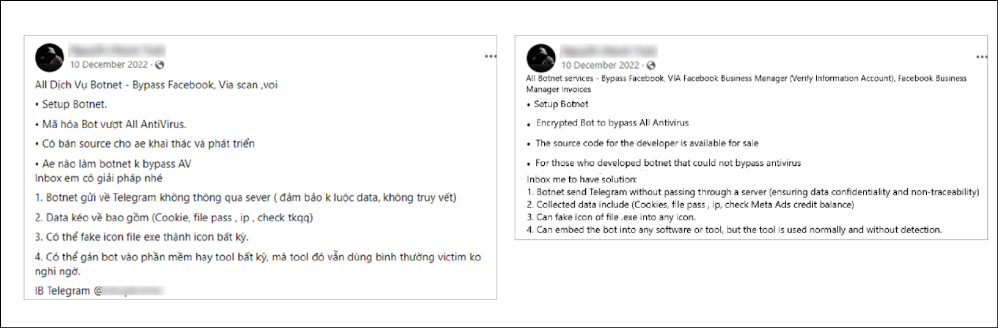
Example of an advertisement for VietCredCare posted on Facebook
Customers can purchase access to a botnet managed by the malware’s developers or procure access to the source code for resale or personal use.
They are also provided a bespoke Telegram bot to control the exfiltration and delivery of credentials from an infected device.
Protecting Against VietCredCare
Organizations and individuals must be vigilant and take preventive measures against malware-based attacks.
This includes regular software updates, the use of antivirus software, and strong passwords.
It is also crucial to be cautious when clicking links or downloading attachments from unknown sources, as these could potentially contain malware like VietCredCare.
In conclusion, VietCredCare is a sophisticated malware that significantly threatens businesses and their online presence.
The ability of this malware to target and steal credentials from business-related Facebook accounts underscores the need for enhanced cybersecurity measures and awareness among users and organizations alike.
You can block malware, including Trojans, ransomware, spyware, rootkits, worms, and zero-day exploits, with Perimeter81 malware protection. All are extremely harmful, can wreak havoc, and damage your network.
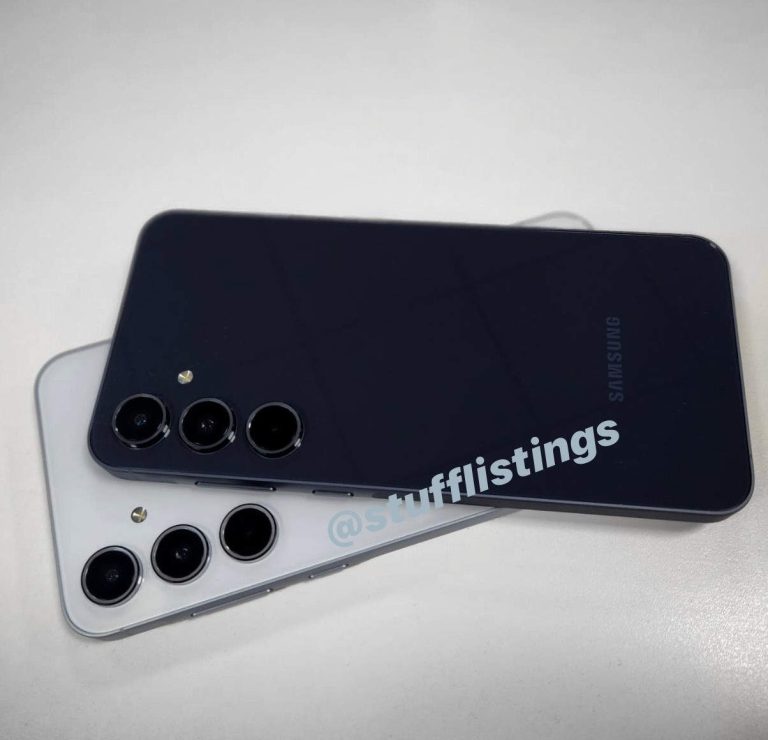
We’ve been following rumors surrounding Samsung’s upcoming mid-range phones, the Galaxy A55 and Galaxy A35. Well, we just got a big leak of the Galaxy A55 with live images showing this device in the flesh. Unsurprisingly, the design will look quite familiar.
At this point, we’re still dealing with leaked information, as Samsung has yet to officially announce these phones. So, you’ll want to take this news with a grain of salt. Any bit of information can change between now and the official launch date. So you’ll want to keep that in mind.
New live images of the Galaxy A55 leave very little to the imagination
The Galaxy A Series has been the next best thing to the Galaxy S series of phones… Well, that was until Samsung started releasing its Galaxy S FE phones. In any case, you’re still getting a compelling device with the Galaxy A series phone. Right now, we’re following links and rumors regarding the Galaxy A55. This is going to be the next premium mid-range phone from the company, and people who use the Galaxy A phones will be excited.
In the leaked images we have pasted below, we see that this phone is taking on the design aesthetic of the Galaxy S Series phones. So, we see the camera lenses extending individually from the body of the phone rather than being held within a camera bumper. This is the design aesthetic first introduced with the Galaxy S22 Ultra. Now, pretty much every phone, with the exception of the Galaxy Z Fold phones, has launched with this design.
This includes the Galaxy S24 series phones. The Galaxy S24 Ultra (Review) is the most powerful Galaxy phone today, and it comes with a ton of AI features. The Galaxy S24+ (Review) is also an extremely powerful device, and it comes with most of the AI features that come with the Ultra.
Rumored specs
For the Galaxy A55’s specs, they’re still rumored. However, they seem pretty accurate. They come from @stufflistings on X. According to the rumor, the Galaxy A55 will come with a 50-megapixel main camera accompanied by a 12-pixel camera and a 5-megapixel camera. Up front, we’re looking at a 16-megapixel selfie camera.
For the internals, we only have one spec, and that’s the fact that it could have up to 12GB of RAM. That’s very significant for a mid-range device. That’s more than the RAM in the base Galaxy S24.
One differentiator in terms of the design will be the new “Key Island”. This is a raised section of the frame that will house the power and volume buttons. It doesn’t really serve much of a purpose other than making the phone look slightly different.
Other than that, we see that this phone will have a flat frame, which is reminiscent of the Galaxy S24 phones. The frames on the Galaxy S23 phones were slightly rounded. However, the flat frame may make the Galaxy A55 feel a little bit more refined.
Battery health on every smartphone starts degrading after years of usage. Apple’s iPhones have significantly lagged in the battery department owing to smaller capacities. In a surprising development, the Cupertino-based tech giant has now confirmed that the latest-generation iPhone 15 series has long-lasting battery health. This is more than what Apple previously estimated.
Apple confirms iPhone 15 series has extended battery lifespan
On its official support page, Apple updated the battery lifespan expectations for the iPhone 15 and iPhone 15 Pro models. It says that all iPhone 15 models are designed to retain 80 percent of their original capacity after 1,000 complete charge cycles. This is twice as long compared to previous estimates of 500 charge cycles.
It’s worth noting that the exact capacity percentage and the battery’s wear depend on factors like regular usage and charging patterns. Apple says that a complete charge cycle is when the full 100 percent of the battery capacity has been used. Meanwhile, it is considered a half-charge cycle if the percentage levels go from 100 to 50.
Apple also told 9to5Mac that the iPhone 15’s testing involved charging and discharging the battery 1000 times under specific circumstances similar to real-world use cases. The extended battery lifespan is attributed to continuous improvement in battery components and power management over the years.
Batteries on older iPhones still have the originally estimated lifespan
The revised estimates make the iPhone 15’s battery health lifespan the longest and better than previous-generation models. However, older iPhone models are said to retain 80 percent of their original battery capacity after 500 charge cycles. However, Apple confirmed that it is investigating older models and if the estimates require any revision. Those who are expecting their charge cycles to go up should have their fingers crossed. This is because the battery longevity gets extended and you won’t need to replace it once it hits the 80 percent mark.
Users can check their iPhone battery by Settings > Battery > Battery Health & Charging. Meanwhile, this is not easily viewable on Android. Samsung and Google do not make any claims with respect to battery health.
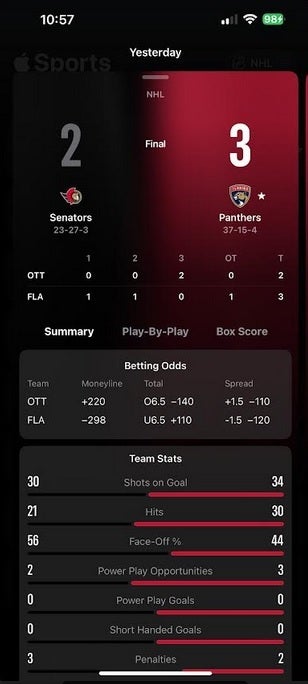
If you’re a big sports fan like this writer, you will probably open the App Store right away to install Apple’s new sports app named Apple Sports. The free app can be found right here and it delivers plenty of data including real-time scores, stats, standings, and gambling odds. Apple Sports, designed by Apple, is offered in the U.S., Canada, and the U.K. To install the app, your iPhone must be running iOS 17.2 or later.
This is the perfect time of the year to introduce Apple Sports in the U.S. and Canada since the NHL and NBA seasons are down to the last 25-30 games for each team and many squads face a must-win situation each night if they want to qualify for the playoffs. In the middle of April, the NBA and NHL playoffs begin at the same time that the latest Major League Baseball campaign picks up in earnest.
Screenshot from the new Apple Sports app
Whether your favorite basketball and hockey teams are in the hunt for a playoff spot, or pretty much assured of one, this might turn out to be the app you use to keep track of what’s happening on the hardwood or the ice every night.
Eddy Cue, Apple’s senior vice president of Services, said, “We created Apple Sports to give sports fans what they want — an app that delivers incredibly fast access to scores and stats. Apple Sports is available for free in the App Store, and makes it easy for users to stay up to date with their favorite teams and leagues.”
The app follows these leagues that are currently in season:
MLS
NBA
NCAA basketball (men’s and women’s)
NHL
Bundesliga
LaLiga
Liga MX
Ligue 1
Premier League
Serie A
Other leagues that the app will track when their schedule kicks off include MLB, NFL, NCAAF, NWSL, and WNBA.
Apple Sports can show you the latest scores for an entire league, or you can just see how your favorite teams are faring on any given night. And Apple Sports will also allow you to access the Apple TV app to watch live games streamed by Apple and other “connected streaming apps” although some require a subscription.
Apple Sports isn’t designed to give you an analysis of each contest. It is built to get the latest scores to you quickly and easily. So if you live and die with your favorite teams, you might want to install the app on your iPhone now.
Another day, another cryptocurrency exchange falls victim to a massive data breach. This time, it’s FixedFloat, a non-KYC Bitcoin and Ethereum crypto exchange targeted in a wallet-drainer attack.
FixedFloat, a decentralized crypto exchange, has been hacked for at least $26 million worth of Bitcoin and Ethereum. The attack, initially attributed to minor technical issues, has led to frozen transactions and missing funds.
For your information, FixedFloat is an automated crypto exchange with 26% of its web traffic coming from the US. It integrates with Lightning Network for Bitcoin transactions.
As seen by Hackread.com, users reported frozen transactions and missing funds on the X exchange since February 17, with 409 Bitcoin (Approximately $21 million) and 1,728 Ether tokens (approximately $4.7 million) drained on February 18.
The exchange is investigating the security incident. FixedFloat’s website is also displaying an error message on all pages, stating “ERROR – Technical work is underway, we will be back soon! If you need to contact us, you can do this via chat.”
The stolen funds were sent to the Ethereum exchange. Threat researcher going by the X (formerly Twitter) handle of “Officer’s Notes” revealed that the hacker first transferred ETH to different ETH addresses and finally moved them to the eXch exchange. They then sent funds to two HitBTC addresses, which received their initial ETH deposits in 2021. This seems to be an attempt to create a false trail.
. @FixedFloat hacked, resulting in ~1,728 ETH (worth ~$4.85m) and & 409 BTC (worth ~$21m) stolen. The drainer already transferred most of the stolen ETH to eXch on Ethereum. 26M$ loss in total!
“I don’t see any addresses (other than the hacker’s address) that link these 2 HitBTC deposit addresses…Most likely, the hacker created only a false trail,” the researcher explained on X (Twitter). This was confirmed by the Web3 security platform Cyvers on X as well.
The cryptocurrency exchange confirmed it was an external attack, rubbishing rumours of insider involvement. Users and analysts initially claimed FixedFloat developers were behind the hacking, but the exchange denied any internal involvement.
Although the company is yet to reveal the core information on how it happened, cybersecurity researchers are positive that the hack was caused by vulnerabilities and insufficient security measures, allowing the attacker to bypass defences and access core service functions.
Wallet Drainer Attack?
As to what type of vulnerabilities, researchers believe that it was a wallet drainer attack. A wallet drainer attack is a malicious technique employed by cybercriminals to steal cryptocurrency from unsuspecting victims’ wallets. It typically involves exploiting vulnerabilities in smart contracts or tricking users into granting unauthorized access to their funds.
FixedFloat stated that no user funds were affected, but the hack affected 30 outstanding orders, which the exchange will pay as soon as its services resume.
FixedFloat faced criticism for not reporting the hack immediately, while the company maintains it was focusing on minimizing loss and eliminating vulnerabilities. The platform expects full operations to resume soon and release a detailed report after the investigation is complete.
Surge in Drainer Attacks
Nevertheless, it is concerning that cryptocurrency exchanges have become a prominent target of scammers lately. Last month Group-IB Global Pvt. Ltd. disclosed details of a phishing operation dubbed Inferno Drainer targeting cryptocurrency wallet providers. The scammers targeted over 100 brands and 16,000 malicious domains, stealing over $80 million in digital assets from November 2022 to November 2023. The team reaped $87 million in illicit profits and scammed over 137,000 victims.
In June 2023, Pink Drainer, a notorious hacker group, successfully executed a series of high-profile Discord and Twitter hacks targeting projects like Evomos, Pika Protocol, OpenAI CTO, and Orbiter Finance. Online scam detector ScamSniffer confirmed Pink Drainer stole around $3 million from nearly 1,932 victims.
I know that some of you are expecting a post similar to that about a toothbrush botnet, but this is not a hypothetical case. It actually happened.
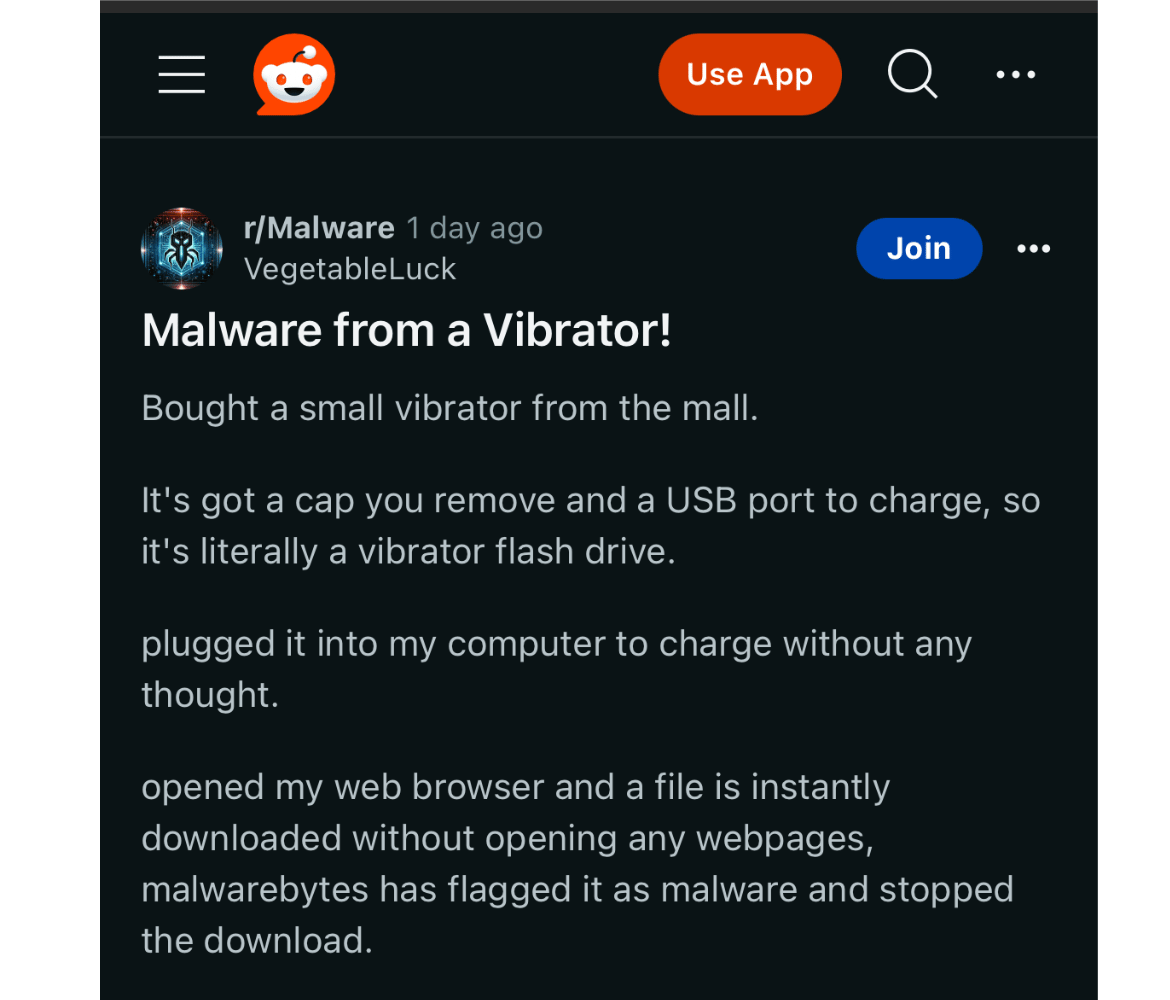
A Malwarebytes Premium customer started a thread on Reddit saying we had blocked malware from trying to infect their computer after they connected a vibrator to a USB port in order to charge the device.
The vibrator, Spencer’s Sexology Pussy Power 8-Function Rechargeable Bullet Vibrator, was infected with an information stealer known as Lumma.
Lumma is available through a Malware-as-a-Service (MaaS) model, where cybercriminals pay other cybercriminals for access to malicious software and its related infrastructure. Lumma steals information from cryptocurrency wallets and browser extensions, as well as two-factor authentication details. Lumma is often distributed via email campaigns, but nothing stops the cybercriminals from spreading it through infected USB drives, as is the case here.
The question that remains is, how did the vibrator get infected? The victim bought the vibrator at Spencer’s, so we reached out to the company in an attempt to get to the bottom of this.
Spencer’s acknowledged that it was aware of the problem, but the team investigating the issue was unable to provide further information at this point. We’ll keep you updated if we receive word from them or find out any more information ourselves.
Our advice when it comes to USB devices, including rechargeable vibrators:
Don’t connect the USB to your computer for charging. If you use a good old-fashioned AC plug socket then no data transfer can take place while you charge.
If you still want the option to connect via USB, USB condoms or “juice-jack defenders” as they are sometimes called will prevent accidental data exchange when your device is plugged into another device with a USB cable.
Treat untrusted devices like you would the “lost USB stick” in the parking lot. You know you shouldn’t connect those to your computer, right?
Always use security software. In this case, the customer was protected by Malwarebytes Premium. If they weren’t using security software, their personal information might have ended up in the hands of cybercriminals.
Technical details
The customer was kind enough to provide us with the content of the flash drive. On it were a host of XML files and a Microsoft Software Installer file (Mia_Khalifa 18+.msi).
The XML files all look very similar to the above and seem to be designed to functions as an XML bomb. An XML bomb is an exponential entity expansion attack, similar to a ZIP bomb, that is designed to crash the web application. This is likely used to draw the attention of the victim away from the actual malware.
The installer creates a program entry called Outweep Dynes.
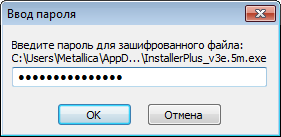
The Outweep Dynes “program” is yet another installer dropped in %USERPROFILE%\AppData\Local\Outweep Dynes\InstallerPlus_v3e.5m.exe
To hinder reverse engineering, extraction of the executable is password protected. But with the password hardcoded in the file, that was not a problem.
The file then executes a heavily obfuscated portable executable detected by Malwarebytes as Trojan.Crypt.MSIL which is Malwarebytes’ generic detection name for a type of obfuscated Trojan programmed in Microsoft Intermediate Language (MSIL).
The dropped executable is a combination of the Lumma Stealer and an additional .NET dll library.
Malwarebytes ThreatDown customers enjoy protection by Advanced Device Control. When a USB device is connected, ThreatDown now doesn’t just control access—it actively scans it. You can also now choose to block the device until the system scans it. This means threats are stopped in their tracks, well before they can do any harm.
Usually, WhatsApp tests its new features both for iOS and Android separately. Sometimes, the company will test features on Android and not on iOS, and vice versa. The favorite contacts feature was first spotted on the iOS beta not too long ago. This is a feature that will allow people to assign a certain number of contacts as favorites so that they can quickly access and call them from the Calls tab.
This eliminates the need to navigate through the app in order to find that special someone. At this point, we have no idea when WhatsApp plans to release this feature. We will just have to keep an eye out for new developments.
The WhatsApp favorite contacts feature was spotted in the Android beta
The favorite contacts feature was discovered in the beta version of the IOS app (version 24.310.70). If you have that version, there’s a chance that you will see the feature, but it’s not a guarantee. If you’re on the Android side of the track, then there’s a chance you’ll find the feature in version 2.24.5.5 of the Android beta.
In the screenshot below, we see a list of contacts in the search results. Up top, we see the text “Favorites appear on your calls tab so a phone call is only a tap away.” Think of it as speed dial for WhatsApp. All you have to do is access your call tab and tap on the contact you want to call. The app will place that call quickly.
At this point, it appears that the feature is pretty well into production, so hopefully, there won’t be much time to wait. If you are a part of the WhatsApp Android beta, make sure that your app is fully updated.
It should be obvious by now that pretty much every company is going all in on AI. Companies like Google have been focusing on it for years, but since the whole generative AI boom, all notable tech brands have been working on the technology. Now, Oppo is going all in on generative AI, and it’s going to bring some powerful tools to its Reno series later this year.
Oppo is a major Chinese tech firm, and it’s joined at the hip with OnePlus. In fact, OnePlus’ co-founder, Pete Lau, is the chief product officer of Oppo. The company has its popular Find N series of foldables. It also sells its Find X and Reno series of phones.
Oppo is going to bring generative AI tools to its Reno phones later this year
So far, we’ve already seen some of the impressive things that phones can do with on-device AI. We’ve seen the Pixel 8 Pro (Review) use some powerful generative AI tools. However, it’s really the Galaxy S24 series of phones that showcase some impressive on-device generative AI. Samsung announced Galaxy AI, and the company unveiled a bunch of AI features that are all done right on the device like text generation and translation.
Now, Oppo is looking to do much the same. According to the company, it has established a large R&D Center for AI research. The center will help research and develop powerful AI tools for Oppo’s products. Since Oppo and OnePlus are so closely integrated, we won’t be surprised if some of these tools make it to future OnePlus devices as well.
Oppo developed its own AI model called AndesGPT. The company plans on releasing some new AI tools to its Reno devices in the second half of the year. We’re not quite sure how many tools are coming or what they’re going to be. However, the company did mention that the intelligent object removal in photos and phone conversation summary will be making it to these phones later this year. These tools first landed on the Oppo Find X7.
This shows Oppo’s commitment to AI
It looks like Oppo is the next company to really hammer down on its AI capabilities. The company outlined four major defensive characteristics of AI smartphones:
-AI Smartphones must efficiently utilize computing resources to meet the computational needs of generative AI in the AI era.
– AI Smartphones should be aware of the real world in time through sensors, understanding the complex information of users and the environment.
– AI Smartphones also need to possess powerful self-learning capabilities.
– AI Smartphones will have multimodal content generation abilities, providing users with continuous inspiration and knowledge support.
So, the company is going to use these for its future AI phones going forward.