Types of SaaS Applications: Categories and Examples

0

[ad_1]

Learn about different types of SaaS solutions and the most widely used SaaS categories to create your own successful Software as a Service product!

Today, almost any company, from small startups to large enterprises, uses SaaS solutions in its day-to-day operations. With various types of SaaS products becoming essential for business operations, more and more companies are considering building SaaS applications.

If you want to know how to build a SaaS app, learning about the types and categories of these solutions is critical. With this knowledge, you can create a more comprehensive blueprint for your future product and have a deeper understanding of the modern SaaS market.

About SaaS solutions

Software as a Service (SaaS) is a software distribution model that allows users to access applications via the Internet on a subscription basis. SaaS is a subset of cloud computing due to the absolute majority of software-as-a-service apps being cloud-based.

Unlike traditional desktop apps, you don’t need to download and install SaaS solutions. Cloud computing allows users to enjoy all of the features and functionalities using remote servers.

The SaaS model began to gain traction in the late 1990s due to the success of web-based CRM systems, such as Salesforce. With the emergence of affordable cloud providers, many companies started to build SaaS products. Let’s talk about the main advantages of the SaaS model:

  • Cost-effectiveness. Companies and individuals can usually choose the one that fits them best from several subscription plans. Almost any SaaS offering will still be cheaper than buying traditional software, plus there is no need to spend money on hardware and infrastructure, the responsibility for maintenance, upgrades, and scalability lies with cloud service providers.
  • Accessibility. Cloud-based SaaS applications can be accessed from any device with an internet connection and web browser. With just a web browser, users can interact with Software as a Service product without the need to install or update anything manually.
  • Scalability. Scalability is often an issue for web applications and websites with traditional, client-server architecture. But you don’t need to worry about how to build a SaaS website or app that can provide scalability without sacrificing performance. Cloud services allow businesses to scale their product back and forth without significant investments or operational downtime.
  • Security. Protecting sensitive data is one of the main tasks in the modern software development industry. Reliable cloud providers offer a high level of security due to their decentralized nature. With information being stored in several places at once, it is more difficult for malicious actors to access it.

SaaS categories

When experts in SaaS application development describe different types of SaaS solutions, we can often hear two terms: horizontal and vertical. An experienced SaaS development company can consult you on which type of app you need, but it is still essential to have a basic understanding of these classifications yourself. Let’s talk about these two categories:

  • Horizontal SaaS. If you wonder how to develop a SaaS application that will meet the needs of businesses across multiple industries, horizontal solutions are for you. These products offer features and services that can be applied to various business settings. Horizontal SaaS platforms are often used for improving day-to-day operations, streamlining processes, and increasing productivity.
  • Vertical SaaS. If you, on the other hand, want to develop a SaaS application that is designed to meet the needs of a specific industry or organization type, this option is perfect for you. Vertical Software as a Service product is used in healthcare, retail, fintech, and governmental projects. You need specific SaaS development expertise in your team to create vertical apps.

Types of SaaS Applications

Vertical and horizontal are the key types of Software as a Service solution, but to know how to build SaaS applications with impressive functionalities and competitive advantage, you need to learn about the most widely used categories of SaaS.

CRM software

This is one of the most popular types of B2B SaaS software that almost any company has experience with. Customer Relationship Management (CRM) system is an essential part of any business workflow and enables companies to keep track of customer data and gain valuable insights about clients’ preferences and behaviour.

Most of the modern CRM solutions offer task automation, advanced analytics, and even predictive analysis based on customer data. The most well-known CRM software today are Salesforce, Hubspot, Zoho, and Microsoft Dynamics 365.

If you want to learn more about developing SaaS applications like these, take a closer look at their core features and implementation of cutting-edge technologies like AI and ML, and consult with a SaaS application development company that has successful cases of building CRM SaaS products.

CMS software

Content Management Systems (CMS) enable individuals with no experience in the software development process to create and manage web pages and digital content. Unlike the majority of SaaS types on our list, CMS is not designed specifically for business use, but companies still can benefit from them, creating basic websites without a development team.

Today, there are four top CMS SaaS products: WordPress, Drupal, Shopify, and Joomla. Each solution has its long list of pros and cons, struggling in certain aspects and excelling in others.

To build a SaaS app that will be as good if not better than these five, you need to not only have a good understanding of the SaaS model and have a reliable SaaS app development partner but also to become familiar with the most widely used CMS SaaS products and their features and functionalities.

ERP software

Enterprise Resource Planning (ERP) software is used by companies of any size for managing business processes. These SaaS applications offer such features as inventory and order management, operations scheduling, customer relationships management, and handling of accounting tasks. Many ERP solutions try to integrate CRM, project management, accounting, and HR modules, making them the types of SaaS software that companies need for managing day-to-day operations.

The most prominent players in the ERP industry are SAP, Oracle, NetSuite, and Microsoft Dynamics 365. As you can see, Microsoft Dynamics appears in our list in the second category already due to its different functionalities and features that can be used in various processes. It can serve as a lesson for anyone interested in how to create a SaaS application that is always in demand.

Project management software

Project management tools are widely used today for planning, executing, and monitoring projects. They help to improve efficiency by creating workflows, enabling teams to keep track of different tasks, and reducing the chance of miscommunications and errors. Modern project management software also leverages AI capabilities for repetitive task automation, data visualization, and report generation.

The most successful SaaS project management tools today are Trello, Asana, Jira, Microsoft Project, and Notion. These solutions offer essential features and capabilities needed for efficient project management, but each one has its own unique additions and distinct user interface. By researching these tools, you can learn how to create SaaS applications that can be used for project management tasks by companies from different industries.

HR software

Human Resources (HR) software enables organizations to seamlessly manage employee data and create a streamlined HR process from recruitment to retirement. It allows companies to save time, administrative resources, and money. No wonder that more and more SaaS development companies have decided to develop SaaS applications for HR purposes.

The most widely used and acclaimed HR software products are SAP, ADP, Workday, Zoho People, and BambooHR. These tools not only provide features and capabilities for managing all of an organization’s HR operations but also work seamlessly with third-party integrations and offer robust analytics. Of all the types of SaaS products, this is one of the most promising ones, considering that businesses of any size and industry have employees and HR tasks that need solving from time to time.

Accounting and billing software

Every company needs tools for processing payments and managing finances. Accounting and billing SaaS solutions offer an efficient and cost-effective way to control finances and streamline operations. The most widely used accounting Software as a Service platforms are Xero, QuickBooks Online, and Freshbooks. All of these solutions offer such benefits as easier compliance with regulations, real-time data insights, and improved collaboration between departments.

As for billing software, it is crucial to find reliable solutions with perfect reputations. Among the most well-known and established payment gateways you can integrate within your platform during SaaS platform development are PayPal and Stripe. By researching and comparing accounting and billing software, you can gain valuable insights into building a SaaS product for efficient financial management.

Communication software

During the global pandemic, communication software grew in popularity beyond the boldest projections, and today, more and more companies dream of building a SaaS platform that will be used for remote work and corporate communication.

The most popular SaaS communication software today is Slack, Google Meets, Zoom, Skype, and Microsoft Teams. Most of these tools are free, with some additional features available for an extra price. Modern communication tools provide such capabilities as file sharing, screen sharing, chat recording, and remote control. With remote work becoming more and more popular, developing SaaS applications for communication and collaborations seems like a safe bet and an excellent investment.

Conclusion

With numerous types of SaaS services available today, it can be easy to get confused, but a deep understanding of these basics is the first step to becoming a real expert in SaaS software development. Of course, you can just hire a SaaS application development services provider; however, without your input at the planning stage and a clear vision for the final product, chances for success are much lower.

After choosing the type of Software as a Service product you want to develop, you and your development team can choose the right tech stack, avoid many SaaS application development challenges, and build the SaaS application of your dreams.

  1. 20 Best Amazon PPC Management Agencies
  2. SaaS Security Best Practices: Safeguard Consumer Data
  3. 15 Best SaaS SEO Experts That Will Help You Dominate Online
  4. How To Reduce Cost Overruns For AI Implementation Projects
  5. The Role of DevOps in Streamlining Cloud Migration Processes


[ad_2]

Source link

WhatsApp is finally rolling out its text formatting feature

0

[ad_1]

For a while now, we’ve been waiting for WhatsApp to finally roll out its text formatting feature. This feature will give WhatsApp users much more flexibility and control when sending longer or in-depth messages. Well, the day has finally arrived. Text formatting is rolling out to all WhatsApp users starting today.

People typically use WhatsApp for work. This means that there’s always a chance that a message could require some sort of formatting. Whether you’re writing down a list of tasks for your team to do or making text bold to emphasize certain points. Well, this wasn’t a possibility until now.

WhatsApp is finally rolling out text formatting

Talk about a long time coming; we’ve been hearing news about WhatsApp eventually bringing text formatting to the masses for months. A while back, we got information on what sort of formatting tools WhatsApp was planning on bringing. Now, these tools are here.

If you need to jot down lists, there are two bullet point styles that you can use. Starting a new line with the dash (-) will give that line a standard bullet point. If you want a numbered list, simply type the number “1” with a period after it (1.) followed by a space. Each subsequent line you type will show a number.

If you need to put in a Block Quote, just type a less-than symbol (<) when you’re starting a new line. Everything on that line will be in that Block Quote style.

When referring to code within a line, type whatever line you want in between two backticks (`) – not to be confused with an apostrophe (‘). This will put the code inside the classic font and differentiate it from the rest of the text.

If you’re looking to make bold text, put the text in between two asterisks (*). For italic text, put it in between two underscores (_). Adding a strike-through is as easy as putting your text in between two tildes (~). Lastly, if you want to text in monospace, just put your message in between three apostrophes (”’).

Since this is still rolling out, there’s a chance that you won’t have it just yet. Keep a lookout for a new update coming to the app.

[ad_2]

Source link

RedMagic is launching a 150W GaN charger and it looks pretty rad

0

[ad_1]

RedMagic has made some pretty unique-looking products in its time but the company’s newly announced GaN charger has to be one of its coolest product designs to date. The RedMagic DAO 150W GaN Charger has a maximum output of 150W and it comes with a partially transparent look. Transparent accessories and devices aren’t necessarily all the rage but they have become popular, and it’s always cool to see what companies come up with.

RedMagic’s take on the transparent product trend lets you peer into the side of the charger to see some of the internal components. You can view these from a transparent window on the top of the charger as well. This neat little detail is designed to give it an eye-catching and pleasing aesthetic that you’d be able to view pretty consistently. As this was designed to be a desktop charging station too. The only thing that might hold people back from picking this up is that it costs $199. If that doesn’t deter you, then you can snag it from RedMagic directly. The company says that sales will open on March 1.

Plus, RedMagic is offering a bonus $20 discount if you place the order by March 31. So there is definitely an incentive to pick it up sooner rather than later.

The RedMagic DAO 150W GaN charger can double as a desktop charging station

Lots of chargers that can be used at your desk feature multiple ports. But what sets RedMagic’s GaN charger apart is the double-duty design. The charger comes with a replaceable section at the back where you can swap out, let’s call them modules. One module has folding prongs that allow you to plug this into a power outlet. What’s more, is that RedMagic includes both US and EU plugs.

The second module turns this thing into a desktop charging station. So if you want to use it on your desk, you pop this on. You can then plug that into a power source and then plug your devices in accordingly. The charger features four ports too — one DC port, two USB-C ports, and one USB-A port. The DC port is the only one that has a 150W output and is designed for things like gaming laptops and other big devices. But the two USB-C ports have an output of 140W so you can still charge smaller devices fast. Then there’s the USB-A port with a 30W output for anything else.

Another neat detail that you don’t see as often is stats. The DAO GaN charger has a small LCD screen on the front that displays information about the charging status for each port. If you’re in need of a multi-device desktop charging solution, the RedMagic DAO 150W GaN charger is pretty rad and should solve your problems.

Buy At RedMagic

[ad_2]

Source link

Top Software Development Outsourcing Trends

0

[ad_1]

Eastern Europe is swiftly rising to prominence in the software development outsourcing sector. This ascendance is marked not only by its combination of cost-effectiveness and 1.3 million unparalleled talent but also by the attention it’s receiving from major companies.

Tech giants such as Google, Apple, Microsoft, and successful startups like Spotify and Slack have recognized the potential and established developer teams in the region. And what is the key to the successful establishment of a software development team in Eastern Europe?

At Alcor, we specialize in IT recruitment in EE and Latin America, concentrating primarily on middle, senior, and C-level positions. We cater to IT product companies eager to hire talent from countries like Poland, Romania, and other parts of Eastern Europe. Our commitment to bridging talent needs has positioned us as a go-to for organizations keen on leveraging the region’s tech expertise.

For a more comprehensive insight into IT outsourcing to Eastern Europe, read this article that provides a deeper dive into the region’s growing significance.

Eastern Europe: The Undisputed IT Outsourcing Hub

Projected global IT spending is set to reach an astonishing $4.5 trillion by 2023, as per Gartner’s recent forecast. This elevates the importance for businesses to derive maximum value from every penny spent. Validating this trend, 60% of technology companies are turning towards outsourcing partners for a certain portion of their software development needs.

While India and China have been historical leaders in IT outsourcing, there’s a notable drift towards Eastern Europe. This is driven by various factors, chief among them being the pressing concerns over Intellectual Property Rights in countries like China, accompanied by communication barriers and significant time differences. According to a comprehensive study, the Eastern European IT industry is set to grow annually by 7.84%, reaching an impressive $15.70bn by 2027. 

Several factors contribute to this shift:

  • Quality Over Quantity: Eastern Europe is gaining traction due to its emphasis on quality, ensuring that projects aren’t just completed but stand out in a competitive global market.
  • Cultural and Temporal Proximity: Eastern Europe’s closeness to Western European and North American markets means fewer time zone issues and cultural barriers. This streamlines communication and ensures smoother project executions.
  • Educated Workforce: Having over 300 higher education institutions that provide STEM programs (most of which are among the QS World University Rankings 2023), the region has plenty of highly qualified software developers.

But, what are the most significant software development trends in EE?

A Flourishing IT Landscape in Eastern Europe

Eastern Europe, encompassing nations such as Poland, Romania, Ukraine, Czech Republic, Hungary, Slovakia, Bulgaria, and Estonia, is swiftly emerging as a heavyweight in the international IT arena. The region’s allure is grounded in a blend of advantageous tax regimes, burgeoning IT advancements, and a vast reservoir of adept professionals. Initiatives from governments, like backing for startups and the proliferation of tech parks and innovation centers, amplify this attraction, spotlighting Eastern Europe as a potential IT powerhouse.

However, it’s the region’s multifaceted technical prowess that truly differentiates it. Poland, for example, is distinguished for its expertise in languages like JavaScript, Java, Python, and TypeScript. Romania excels with skills in PHP, C#, Java, and C++. The Czech Republic showcases deep knowledge in areas such as JavaScript, Java, PHP, and C#. Neighbouring countries like Hungary and Slovakia further enrich the tech tapestry, with commendable skills in areas spanning JavaScript, HTML/CSS, Python, Java, and PHP.

Understanding the Tax Landscape: Poland, Romania, Bulgaria, and Ukraine

Bulgaria stands out with its straightforward tax system. Both corporate and personal income taxes are set at a uniform rate of 10%. This simplicity is attractive to many businesses and professionals looking for clarity in fiscal matters.

Poland presents a more nuanced tax structure. CIT is typically 19%, but a reduced rate of 9% is available for smaller entities, barring certain exceptions. Individuals, on the other hand, pay 12% for income up to PLN 120,000. Beyond this threshold, they’re taxed at 32%. Additionally, high earners with an income surpassing PLN 1 million face a solidarity surcharge of 4%.

In Romania, companies face a corporate tax of 16%, while individuals are charged a 10% personal income tax. Ukraine, meanwhile, sets its corporate tax at 18%. The personal income tax is relatively low, standing at 5% for the majority, though there are specific exceptions to this rate.

Prioritizing Cybersecurity in Outsourcing

In an age where data breaches and cyber threats loom large, outsourcing shouldn’t be just about getting the job done but also about ensuring it’s done securely. However, IT outsourcing does not always let businesses reach complete security. There are cases when clients risk or even lose their intellectual property rights if they don’t sign an IT rights transfer agreement with their IT outsourcing firm. If they cooperate with IT recruitment or R&D providers, though, this never happens. Meanwhile, Eastern Europe, with its strong emphasis on IT education and rigorous data protection laws (GDPR), ensures that businesses aren’t just given quality work but also the peace of mind that their data remains secure.

The Talent Over Cost Paradigm

Although affordability is a compelling consideration, the genuine essence of value is in work quality. In the corporate realm, there’s an escalating recognition that, while trimming expenses is advantageous, skimping on talent could have long-term repercussions. This mindset is evident in Eastern Europe’s recruitment strategies, emphasizing the skills and versatility of professionals over mere hourly compensation.

Moreover, IT recruitment & R&D services companies like Alcor are setting the gold standard in IT recruitment services. Prioritizing talent ensures a symbiotic relationship where businesses get top-tier solutions, and developers get a conducive environment that nurtures their skills.

Such vendors offer IT businesses access to pre-vetted talents with their guarantee of quick and efficient hiring. Plus, software developers hired via such agencies go through a pre-screening interview stage, which boosts the overall quality of candidates. Such practices ensure businesses stay ahead of technological advances and market demands.

The global IT landscape isn’t just grappling with the complexities of outsourcing; it’s contending with a deeper issue of employee retention. As highlighted by a recent Gartner survey, a mere 29% of IT professionals express a solid intention to stick with their current roles. In the outsourcing model, frequent project shifts can sometimes make developers feel detached, leading to a decreased perception of value in their work. This transience often prompts them to seek new job opportunities.

Conversely, product-based companies tend to have a different dynamic. Here, developers aren’t just part of the solution-making process but are integral to business growth. Their roles and contributions directly influence their career trajectories and earnings. This sense of purpose and alignment with the company’s growth often translates to higher job satisfaction and longer tenure.


[ad_2]

Source link

Signal waves goodbye to phone numbers, and rolls out usernames

0

[ad_1]

There are several instant messaging apps available, such as WhatsApp, Telegram, and others. However, one app that prioritizes user privacy is Signal. And now, Signal is upping the game by adding usernames, so if you don’t like sharing your phone number with people, you’ll love this. However, the feature is in the beta version and is yet to roll out for others.

Signal is introducing usernames

Signal will let you pick a unique username that you can share with others and initiate conversations. Once the feature rolls out to everyone, you can head to Settings > Profile and create a username for you. Next up, you can also create a QR code or link that directs others to you in the app. Take note, others can also type your username into the chat bar and shoot a message.

Signal explains that the username you choose isn’t permanent and won’t be seen by the people you’re chatting with. It’s important to understand that your username isn’t the same as the name others see in chats; instead, it’s a convenient way to start a conversation without giving out your phone number.

You’ll (still) need a phone number

Signal usernames differ from account names on other platforms because they don’t serve as login credentials. Instead, they offer a way for people to connect with you quickly without needing your phone number. You still need a phone number to sign up for the app, but you can choose whether to share it or not.

Additionally, Signal will automatically hide your phone number by default for users who haven’t saved it in their phone contacts. You can adjust this setting by going to your privacy settings and selecting “Who can see my number.”

These features will soon make it to the stable version of Signal.

[ad_2]

Source link

Google Tasks gets a big boost with Gemini

0

[ad_1]

It seems like everyday, Google’s Gemini is taking a step closer to being a replacement for Google Assistant. Today, Google’s most advanced AI model has just taken another step forward. According to sources, Gemini now has the ability to create reminders using Google Tasks.

Right now, you can use the Gemini app on your phone, and it could also be used as a light assistant. You can set it as your default assistant, and summon it when you need quick help. Because of this, it feels less likely that Google Assistant will be a mainstay in Android for much longer. Since it’s powered by generative AI, Gemini can be much more helpful when it comes to gathering information. However, Google has not publicly expressed any plans to replace Google Assistant with Gemini. We’re just going to have to wait.

You can use Gemini to make reminders in Google Tasks

Right now, Google is working long and hard to make Gemini a useful assistant on your phone. Many of the assistant tasks are missing from Gemini, so the experience feels a bit fragmented. One of the features missing was the ability to create reminders using Google Tasks. However, according to a new report, Google has finally brought this functionality.

If you summon Gemini Advanced and ask it to remind you to do something, the chatbot will tap Google Assistant to set up a task for you through Google Tasks. It will then make the task for you and set it at the proper date and time. So, if you’ve gone all in with Gemini on your phone, you know that you have the ability to set reminders again.

Gemini Google Tasks

At this point, this feature is still rolling out. There’s still a chance that you could get an error message or a fake acknowledgment that Google has set the reminder. This is what happened to us at Android Headlines from trying to use this feature. However, the folks at 9To5Google have been able to see this feature in action. So, it all depends on when the feature makes it to you. Just make sure that you have the Google Tasks app installed on your phone.

[ad_2]

Source link

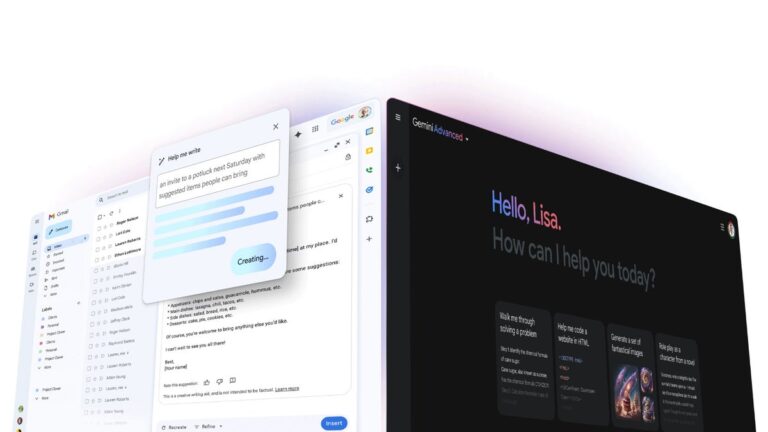
Gemini arrives in Gmail and Workspace apps (formerly Duet AI) with Google One AI Premium plan

0

[ad_1]

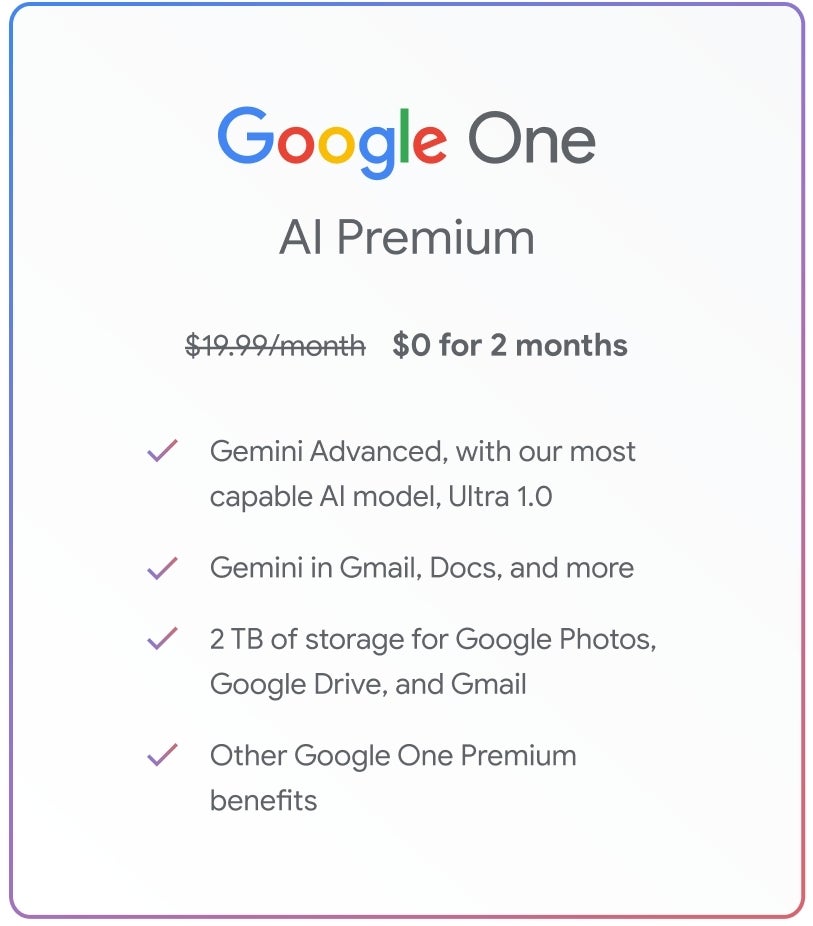
Google completed its rebrand of Bard AI earlier this month, along with the launch of the new Gemini Android app and a new Google One tier created for those that wanted to take advantage of the new Gemini Advanced and its most capable AI model, Ultra 1.0. This new Google One tier, aptly named “Google One AI Premium”, also gave users access to 2TB of storage, as well as other Google One benefits.

Gemini’s Ultra 1.0 LLM model has been praised for introducing new advances to the world of AI, such as improved processing efficiency, advanced comprehension of instructions and programs, and better problem-solving skills. The model is said to be able to analyze and explain data, as well as write high-quality code in many programming languages. All of this will now compliment your experience in Workspace apps, without having to switch apps or tabs.

Google also wants you to know that, as outlined in its AI data privacy principles, Gemini in Google Workspace does not use your personal and/or business information to train or improve its AI models without your permission. This is important to note in this age of AI where the lines of where privacy begins and ends can sometimes become very blurry.

Source: Google

Gemini in Gmail, Docs, Slides, Sheets, and Meet is starting to roll out today for AI Premium members across more than 150 countries in English. Just like at launch, AI Premium subscribers also enjoy Gemini Advanced, 2TB of storage that can be used across all Google services (like Google Photos and Drive), and other Google One perks for $19.99 a month, with an introductory two months for free.

[ad_2]

Source link

Security Onion 2.4.50 Released for Defenders With New Features

0

[ad_1]

Security Onion Solutions has recently rolled out the latest version of its network security monitoring tool, Security Onion 2.4.50.

This updated version comes equipped with an array of new features and bug fixes, making it an even more critical tool for enterprise security management, threat hunting, and network security monitoring.

Document

Live Account Takeover Attack Simulation

Live attack simulation Webinar demonstrates various ways in which account takeover can happen and practices to protect your websites and APIs against ATO attacks.

New Features and Enhancements

The release of Security Onion 2.4.50 marks a pivotal moment for the cybersecurity community. Among the notable new features is adding the Suricata PCAP module to Sensoroni, although it is currently disabled by default.

Security Onion 2.4.50 Released for Defenders With New Features
Security Onion 2.4.50 Released for Defenders With New Features (Source: security onion)

This module is expected to enhance network traffic analysis capabilities, providing defenders with more granular data for threat detection and analysis.

Another significant enhancement is introducing a new SOC action designed to show process ancestry. This feature will allow security operations center (SOC) analysts to trace the origins of processes, a critical capability for uncovering stealthy attacks and understanding attack chains.

Doug Burks, the founder of Security Onion Solutions, took to LinkedIn and Twitter to announce the release, emphasizing that Security Onion is developed “by defenders, for defenders.”

This community-driven approach ensures that the platform remains responsive to the evolving needs of cybersecurity professionals.

The development team, including Josh Brower, Jason Ertel, Wes Lambert, Corey Ogburn, Josh Patterson, and Mike Reeves, received special thanks for their hard work in making this release possible.

Additionally, the contribution of GitHub user petiepooo, who submitted pull requests and helped answer questions on the Security Onion Discussions site, was highlighted.

Impact on Cybersecurity Practices

Security Onion 2.4.50 is set to have a profound impact on cybersecurity practices. Providing advanced tools for log management, threat hunting, and security monitoring enables organizations to detect and respond to threats more effectively.

The platform integrates seamlessly with various security tools, including Suricata, Zeek, and Wazuh, making it a versatile solution for defending against sophisticated cyber threats.

The release of Security Onion 2.4.50 is a testament to the ongoing commitment of Security Onion Solutions to provide the cybersecurity community with powerful, open-source tools for defending against cyber threats.

Its new features and improvements make Security Onion indispensable for SOC analysts, network administrators, and security professionals worldwide. Users are encouraged to download the latest version and explore its enhanced capabilities for a more secure cyber environment.

You can block malware, including Trojans, ransomware, spyware, rootkits, worms, and zero-day exploits, with Perimeter81 malware protection. All are extremely harmful, can wreak havoc, and damage your network.

[ad_2]

Source link

New Linux Malware “Migo” Exploits Redis for Cryptojacking, Disables Security

0

[ad_1]

New “Migo” malware targets Linux servers, exploiting Redis for cryptojacking. Using a user-mode rootkit, hides its activity, making detection difficult. Secure your Redis servers and stay alert!

A sophisticated Linux malware campaign has been discovered targeting Redis, a popular data store system, to gain initial access using “System Weakening Commands,” revealed Cado Security Labs.

Cado researchers disclosed that the malware, dubbed Migo, exploits Redis for cryptojacking. The attackers execute commands on their target’s Redis servers to disable configuration options and make them vulnerable before deploying the payload.

The primary payload, Migo, is a Golang ELF binary that retrieves an XMRig installer from GitHub. Redis system weakening commands are used to disable configuration options, such as protected mode and replica-read-only, using CLI commands to execute malicious payloads from external sources like Pastebin to mine cryptocurrency in the background.

For your information, Protected mode is a Redis server operating mode introduced in version 3.2.0 to mitigate potential network exposure. It only accepts connections from the loopback interface and is likely disabled at initial access to allow attackers to send additional commands.

Conversely, the replica-read-only feature in Redis prevents accidental writes to replicas that may result in out-of-sync. Cado researchers report exploitation of this feature for malicious payload delivery, with Migo attackers likely disabling it for future Redis server exploitation.

Migo uses compile-time obfuscation and a user-mode rootkit ‘libprocesshider,’ to hide processes and artefacts, making it difficult for security analysts to detect and mitigate the threat. Once the miner is installed, Migo sets XMRig’s configuration to query system information, including logged-in users and resource limits.

“It also sets the number of Huge Pages available on the system to 128, using the vm.nr_hugepages parameter. These actions are fairly typical for cryptojacking malware,” Matt Muir, Cado Security’s security researcher noted in a blog post.

It executes shell commands to copy the binary, disable SELinux, identify uninstallation scripts, execute the miner, kill competing processes, register persistence, and prevent outbound traffic to specific IP addresses and domains.

Moreover, Migo relies on systemd service and timer for persistence and the developers have obfuscated symbols and strings in the pclntab structure to complicate the malware analysis process. The involvement of a user-mode rootkit also complicates post-incident forensics of compromised hosts, and libprocesshider hides on-disk artefacts.

Migo’s emergence shows that cloud-focused attackers are continually refining their techniques and focused on exploiting web-facing services. They used Redis system weakening commands to disable security features, a move not previously reported in campaigns exploiting Redis for initial access, researchers concluded.

  1. Hackers behind Mirai botnet & DYN DDoS attacks plead guilty
  2. Hackers behind Mirai botnet to avoid jail for working with the FBI
  3. Tiny Mantis Botnet Can Launch Powerful DDoS Attacks Than Mirai
  4. Reaper malware outshines Mirai; hits millions of IoT devices worldwide
  5. Mirai Variant ‘OMG’ Turns IoT Devices into Proxy Servers for Cryptomining


[ad_2]

Source link

ZTE launches Libero Flip, the world’s cheapest foldable smartphone

0

[ad_1]

ZTE has just made foldable smartphones incredibly affordable. The Chinese firm collaborated with Japanese telecom company Y!mobile, a subsidiary of SoftBank Group, to launch a clamshell folding phone at just $420. The ZTE Libero Flip is available for pre-order in Japan, with sales beginning on February 29. There is no word yet on the global release of the world’s cheapest foldable.

The ZTE Libero Flip made mid-range foldables a thing

Foldable phones are generally more expensive than regular smartphones. Before ZTE entered the scene, the lowest launch price for a foldable was $699 for Motorola’s Razr 2023. If you want a more refined product, Samsung’s Galaxy Z Flip 5 is your best bet but costs $999. Of course, you can grab these phones at a lower price with offers and promotions, but that’s a different matter.

ZTE’s Libero Flip has a launch price of 63,000 yen in Japan, which is equivalent to $420. With offers, you can grab this foldable at just 39,800 yen or roughly $265. This is ridiculously affordable for a foldable phone, no matter the manufacturer. There is little chance the phone will arrive in the US or most other global markets, but hardly anyone imagined a brand-new foldable to be available at around $400 in 2024.

The device packs a decent set of specs too. Nothing magical, but acceptable for a foldable at this price range. You get Qualcomm’s Snapdragon 7 Gen 1 chipset paired with 6GB RAM and 128GB storage. The ZTE Libero Flip sports a 6.9-inch AMOLED display with a 2790×1188 pixels resolution on the inside and a 1.43-inch circular panel (466×466 pixels) on the outside. The secondary display can be used for notifications, whether, calls, and camera viewfinder.

ZTE Libero Flip 2

Speaking of cameras, ZTE’s first foldable has a 50MP primary shooter and a 2MP depth sensor on the back. You also get a 16MP selfie camera here. The device sits rigid at various angles, so you can take hands-free photos. Other key specs include a 4,310mAh battery, 33W charging, side-mounted fingerprint scanner, Wi-Fi 6, Bluetooth v5.2, IP42 dust and water resistance, and Android 13. The device measures just 7.3mm in thickness when unfolded. You can find the full spec sheet here.

Samsung may also have a mid-range foldable in the works

Rumors say Samsung will launch three new foldables this year. Alongside the Galaxy Z Flip 6 and Galaxy Z Fold 6, we could see an affordable model priced similarly to the ZTE Libero Flip. Details are scarce but the Korean firm does seem to have this device in the pipeline. Either the plan will materialize this year or we will have to wait longer for it; only time will tell. Samsung’s next-gen foldables should arrive in July.

ZTE Libero Flip 3

[ad_2]

Source link