Ulefone is a name that we cover pretty often here at Android Headlines. However, we very often don’t review their phones. This is simply because their phones don’t work 100% in the US, which is the case with a lot of phones destined for the Chinese and even the European market.
However, the Ulefone Armor 23 Ultra really caught our eyes because it has just about everything you could want at a price you can actually afford. Let’s talk about a few of the specs here. Ulefone has included a 5,280mAh capacity battery, which can be charged at 120W wired or 50W wireless. It also comes with 512GB of storage, 12GB of RAM, and a pretty good-looking 6.78-inch 120Hz display. All of that (and more) for under $600. That’s a pretty incredible value.
This is a rugged phone from Ulefone, which is pretty evident by how thick the phone really is. This is a 12.75mm thick phone that weighs 332 grams. By comparison, one of the heaviest foldables on the market – Google’s Pixel Fold – is only 283 grams. It’s a heavy one, but you know what? When using this phone, I never worried about dropping it. Because I knew it was protected.
Those looking for a rugged phone to use, is this the ultimate one to get? Let’s find out in our full review.
Ulefone Armor 23 Ultra Review: Build and Design
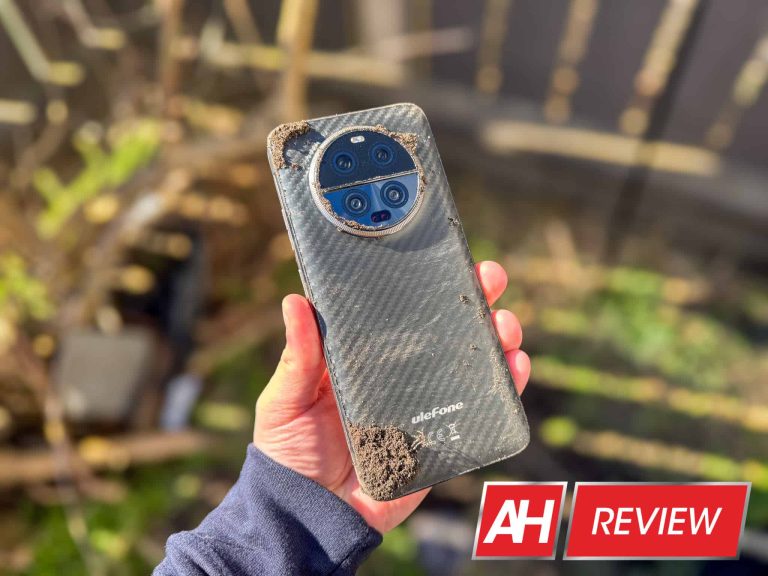
Rugged phones are pretty well-known for being thick, heavy, and ugly. While the Ulefone Armor 23 Ultra hits two of those things, it’s actually not that ugly. I really like how this phone looks. It sports a cool carbon fiber back, that is a tiny bit slippery, but because the phone is so thick, it’s pretty tough to drop.
Interestingly, despite this phone being 12.75mm thick, there’s still a pretty sizeable camera bump on the back. It’s not as thick as some other phones – like the OnePlus Open – but definitely still there.
Ulefone has added a few ridges to the side of the Armor 23 Ultra, which does feel like it’s metal, but it is plastic. These really help to make it easier to hold onto the phone and use all of the different buttons on this phone.
With the Armor 23 Ultra, there is a power and volume button on the right side, and on the left side, there is a SIM card slot plus a custom key that can be mapped to do just about anything. I’ve got it mapped to the camera, as I usually do with buttons like this. On the top, there is an SOS button, as well as the IR blaster. This is the second phone I’ve reviewed in 2024 with an IR Blaster, surprisingly. The SOS button will immediately open the Bullitt app to do SOS via Satellite. Speaking of which, the Ulefone Armor 23 Ultra is capable of two-way satellite text messaging. Surprisingly, that’s something the iPhone can’t do.
On the front, there’s a pretty big lip over the display, which also has some thick bezels, particularly on the bottom. This is what really makes me feel okay with dropping this phone, as the screen definitely won’t touch the ground.
Probably one of the best-looking rugged phones on the market. That’s saying a lot too, since it’s still not the best looking phone on the market. But this is one that I could see myself carrying day-to-day.
Able to withstand 1.8m drops!
Ulefone claims that this phone is able to withstand up to 1.8 meter drops. While we did not test that, we did test the rest of the MIL-STD-810H spec, which includes dirt and water. I dropped it from about five feet up into dirt and got it nice and dirty. Then washed it in the kitchen sink, and it works perfectly fine still.

That’s what makes this a rugged phone, the fact it can get dirty and then washed without any issues. As well as the drop protection.
Ulefone Armor 23 Ultra Review: Display
I was shocked at how good this display actually is. Given the fact that this is a rugged phone that is under $600, I really did not expect this type of display here. It’s a 6.78-inch FHD+ display with 120Hz refresh rate. It also uses Corning Gorilla Glass Victus, meaning that it’s going to be pretty resistant to shattering.
The downside is, this is an LCD panel. So it’s not OLED like we’ve seen on virtually every other phone in the past few years. However, the color reproduction is really good here. Comparing the video we use for battery rundown tests on the Galaxy S24 Ultra to the Ulefone Armor 23 Ultra, it’s pretty incredible how similar the two are. Obviously, Samsung is going to do better colors here, since it’s an AMOLED display versus an LCD panel. It’s not the best, but for an LCD, it’s really good.

We did test out the display to measure how bright it gets. To do this test, we essentially go into a dark room, bring up a fully white picture onto the display, and shine a flashlight on the light sensor. This allows it to get as bright as it can. We measured 500 lux on the panel here. You can read more about our testing procedures for reviews.
Obviously, that is a lot less bright compared to other flagships we’ve tested lately. However, the important thing is, can you see it outdoors? And the answer is yes. I’ve taken it outside and had no problem seeing the display, however it has been pretty cloudy the last few days here in Michigan. So, I was unable to really test it in direct sunlight.
If you’re looking for a phone with the best and brightest display, the Ulefone Armor 23 Ultra is not the one for you. But you probably expected that given this is a rugged phone and under $600.
Ulefone Armor 23 Ultra Review: Performance
Inside the Ulefone Armor 23 Ultra, we have a MediaTek Dimensity 8020 with 5G chipset, 12GB of RAM, and 512GB of storage, which is an interesting setup. This processor is a 6nm processor, up to 2.6GHz, and the Arm Mali-G77 graphics are on board. So it’s a high-end processor, but not relatively as high-end as the Qualcomm Snapdragon 8 Gen 3.
So, I was pleasantly surprised at how good the performance actually was on this phone. Typically, MediaTek chipsets are somewhat slow and sluggish compared to Qualcomm. But that’s not the case with the Dimensity 8020.
While playing games and browsing through Twitter/X, Facebook, etc., I’ve had no problems with the phone getting hot or slowing down either. So I have very little complaints about this phone’s performance, which is surprisingly another area that rugged phones tend to skimp on.
Benchmarks
Now let’s talk benchmarks. As we’ve done with every other major phone, we’ve put this through three benchmarks. Let’s go over the results.
Starting with Geekbench 6, we use this test to check out the raw performance of the CPU and the GPU. The results here were 997 for the single core, and 3369 for the multi-core while GPU scored 4,185. So, where does this rank among other phones? It’s similar to the Tensor G3 in the Google Pixel 8 and Pixel 8 Pro. It’s not crazy low in raw performance, but it’s also not the best.
The next benchmark we run is 3D Mark Wild Life Extreme Stress Test. This is a test that will run the same benchmark 20 times (it lasts about a minute per round). The purpose of this test is to push the phone to its limits and see it holds up. Here, we get three scores: Best Loop Score, Lowest Loop Score and then the Stabiliy. Typically, phones will store around 50% to 70% on this test. The Ulefone Armor 23 Ultra scored 99.1%, with a Best Loop score of 4,274 and a Lowest Loop score of 4,234. We’ve really only seen this kind of stability scores on lower-end processors, like the HONOR Magic 6 Lite with the Snapdragon 6 Gen 1. The Snapdragon 8 Gen 2 and Gen 3 phones are all between 50% and around 80% stability, which is rather interesting to say the least.
The third benchmark we run on every phone is Capcut. Basically, what we do here is we take a 60-second video, import it, add an effect, and then export it. We time how long it takes to export. For the Armor 23 Ultra, it took 23.34 seconds to export the 60-second video. That is right in the middle of our testing. It is quite a bit faster than the Pixel 8 Pro, however, which clocked in at just over 40 seconds. But given the GPU score from Geekbench 6, we kind of expected this type of time in the Capcut test.
Thermals
Another important part of this phone is the thermals. I fully expected that this phone would not heat up all that much, given how much space it has to dissipate the heat.
With the thermals, we again run three tests. The first one is done while running the 3D Mark Wildlife Extreme Stress Test. This benchmark is known to really heat up phones and push them to their limit. Typically, it’s the highest temperature of the three tests, and the Ulefone Armor 23 Ultra clocked in at 97.5 degrees Fahrenheit. That’s honestly a really good temperature reading. Most phones are over 100 degrees Fahrenheit when doing this test.
The next test is the camera. We do a video recording in 4K60 for 10 minutes, checking the temperature at 5-minutes and 10-minutes to see the difference. Typically this test is lower than the 3DMark stress test benchmark, and that’s the case here. The Armor 23 Ultra barely got warm, coming in at 94.3 degrees Fahrenheit.
Finally, we play Genshin Impact for an hour at the maximum settings and maximum brightness. It’s one of the most resource-intensive games on Android (and iOS) right now. This test typically lands between the camera and the 3DMark benchmark, and after an hour of Genshin Impact, it recorded a temperature of 95.4 degrees Fahrenheit.
Honestly, these readings are all really impressive but also not surprising. As mentioned before, this phone has a lot more space to dissipate heat than the Armor 23 Ultra. I would have been more surprised if any of these had readings above 100 degrees Fahrenheit.
Ulefone Armor 23 Ultra Review: Battery Life and Charging
Let’s start out with the good, charging. As mentioned before, the Ulefone Armor 23 Ultra is capable of doing 120W charging with the charger that’s in the box. Unfortunately, that charger is an EU plug, and we’re testing this in the United States. So instead, I plugged it into my 96W charger for my MacBook Pro, and it performed beautifully. It was able to fully charge in under 30 minutes. That’s rather incredible, and it’s a feature I wish more companies in the West would jump on.
It also charges at up to 50W wireless, and we were sent Ulefone’s new 50W wireless charging to test this. It performed really well. Just under an hour to go from 1% to 100% on the 50W wireless charger. That’s something we can get behind, though Qi2 would have been even better.
Now, battery life. It’s, well, average. Honestly, given the specs of this phone, I was really expecting some great battery life, especially after seeing how good the thermals were here. But even with a 5,280mAh capacity battery, the battery life was just average here. It will get you through the day, but don’t expect much more than that. It’s pretty clear that there’s some areas that are not optimized here, and I’d be willing to bet its the processor and the software. We’ll get to the software next, but it is essentially stock Android, with almost no changes on-board. That’s nice to see, but optimization does need to be done so that the battery lasts longer.

In our battery test, which takes a YouTube video and plays it until the phone dies at full brightness, the Ulefone Armor 23 Ultra actually performed the worst out of any phone we’ve run this test on. Which is rather surprising, it scored a time of 10 hours and 20 minutes. That’s more than an hour less than the HONOR V Purse, which scored just under 12 hours in this same test.
The skinny is, it’s a charging champ but not a battery champ. Luckily, it charges very fast, so you can top it if you need to.
Ulefone Armor 23 Ultra Review: Software
Ulefone ships the Armor 23 Ultra with Android 13 on-board. However, we don’t know when it will get Android 14. There’s not a lot of changes between Android 13 and Android 14 anyway. Ulefone has stuck with a basically stock Android approach to its software. It essentially looks exactly like AOSP, with Google Mobile Services (or GMS) built-in. So, you can use this with your favorite Google services and apps.
One of the downsides to that is that there are not a lot of features here. It’s pretty barebones. However, one of the features that Ulefone did include is a big deal for those who want a rugged phone. And that’s Satellite SOS. There is a button on the top of the phone that’s in red. If you push that, the Satellite SOS app will open up. It’ll tell you to only use this in a genuine emergency, and you can send a message over satellite and provide your location too.

The Satellite Service is brought to you by Bullitt, which does require an additional subscription. You can get the Essential plan, which offers up to 30 messages per month. Everyday plan offers up to 80 messages per month; Freedom offers up to 250 messages per month; and Premium offers up to 300 messages per month. These are priced from 5 Euro to 30 Euro per month.
There is also a Custom Key on the side of the phone, which you can use to map to just about anything you can think of. This is very useful for a slew of different things, including the camera, screenshots, and more. Ulefone also included the Outdoor Toolbox, which is an app with a bunch of features you’d want to use on a hike or when you’re outdoors, including a flashlight, compass, and much more.
The software is pretty good, though it lacks a lot of features that many flagship phones have these days. But again, this is a rugged phone, which is normally pretty barebones when it comes to features, and it’s also under $600.
Ulefone Armor 23 Ultra Review: Camera
On the camera front, I was actually very impressed. Typically, phones running AOSP, with the stock camera app, offer a pretty mid-camera experience. The Ulefone Armor 23 Ultra is above that. It’s still below the flagships, which cost two to three times as much. But there’s one camera in the quad setup that really impressed me: the night vision camera. I can’t say it’s something I’d use often, but I still really like it.
Ulefone has included four sensors on this phone: a 50-megapixel primary sensor, 64-megapixel night vision, a 50-megapixel 3.2x telephoto sensor, and a 50-megapixel ultrawide sensor that has a 117.3-degree field of view.

These are all decent cameras, and they will take some pretty good pictures for you. But the night vision camera is really cool, actually. It’s in black and white, but takes some really good pictures in next to no lighting. I used it in my basement to find the fuse box when a fuse blew a couple of days ago. Obviously, I could have used a flashlight, but I thought that this would be cooler, and it was. No lights on in the basement, and I got a really great picture that’s pretty much crystal clear. You can see it below.

Obviously, this is not a feature that everyone is going to love or want on their phone. Or even use all that much. However, it is nice to have, especially for those that might be buying this phone. That includes contractors, construction workers, and more.
With the other cameras, I was pleasantly surprised at how good they were. Again, it’s hard not to compare these to the Galaxy S24 Ultra, which I just reviewed, but that’s gonna happen. The bokeh effect on all three lenses is really good, actually. This is without using any type of portrait mode, so you’re getting the natural bokeh effect here. You can check out a few of the pictures from the different rear sensors on the Ulefone Armor 23 Ultra below.
Then there’s the front-facing camera. I was honestly surprised at how good this picture came out. Again, this is in the basement, where the lighting isn’t the best. I’m to the left of a light bulb hanging from the ceiling, and I was lit pretty well. If you zoom in, it does tend to fall apart. But it did also do a good job of separating the foreground from the background. Typically, phones have trouble with my glasses, but that’s not the case with the Armor 23 Ultra. It did it nearly perfectly.

Finally, we tested the main, default sensor in our photography test. This basically is taking a photo of a Rubik’s cube in the same position across multiple phones. Below, you can see it compared to the Galaxy S24 Ultra and iPhone 15 Pro Max. And to be quite honest, I prefer the Ulefone Armor 23 Ultra. The whites are more white in that image, versus what Samsung and the iPhone are offering up. It’s also a tad sharper. Very interesting results here.

Should you buy the Ulefone Armor 23 Ultra?
The Ulefone Armor 23 Ultra is built for a very small portion of the population. If you are someone who is in need of a highly rugged phone due to your occupation, then this might be the best one you can buy. Based on specs, nothing comes close to the Armor 23 Ultra for the money. However, if you do want some other features, like maybe some AI add-ons, then you will want to look elsewhere, but you will lose that MIL-STD-810H rating.
You should buy the Ulefone Armor 23 Ultra if:
- You are in construction and need something that can hold up.
- You want something that can be dropped often and is cheap.
- You want something that is waterproof but also offers a lot of storage at a low price.
You should not buy the Ulefone Armor 23 Ultra if:
- You want the latest features.
- You want the best camera on the planet.
- You want the best battery life available.
[ad_2]
Source link