After Apple launched its Vision Pro headset, competition in the AR/VR headset market is heating up, and more companies are entering this segment. As expected, Chinese companies don’t want to fall behind.
Huawei Vision Pro is a response to Apple with a competitive price tag
According to Li, Huawei’s alleged virtual reality headset is powered by an in-house chip from the Chinese firm. This might make Huawei drop the EyeSight feature. As a side note, the EyeSight feature shows the person’s eye on the front of Apple Vision Pro to create a sense of actual eye contact.
The device reportedly weighs 350 grams, almost half the weight of Apple Vision Pro. Li added that Huawei’s headset could cost around CNY15,000. Apple Vision Pro is currently priced at around CNY27,999 in China, and the device is expected to land there in April or May.
Huawei Vision Pro will also get the Sony micro-OLED 4K display to offer a similar immersive experience as Apple’s headset. However, Apple has the upper hand with the M2 and R1 chipsets. Huawei would need a more powerful chipset than the Kirin 9000S for a zero-lag experience. Apple is also acquiring a German AI startup to foster its Vision Pro development. All in all, Huawei would have a hard time competing with Apple in this market.
Meanwhile, Apple might need to launch the Vision Pro headset with a new name in China. Huawei registered the “Vision Pro” name in its homeland in 2019 and used it for some of its smart TVs and Glasses lineup.
Li also stated that Sony will prepare and ship Huawei orders in six months. So, we can expect the Huawei Vision Pro to land by the end of the year.
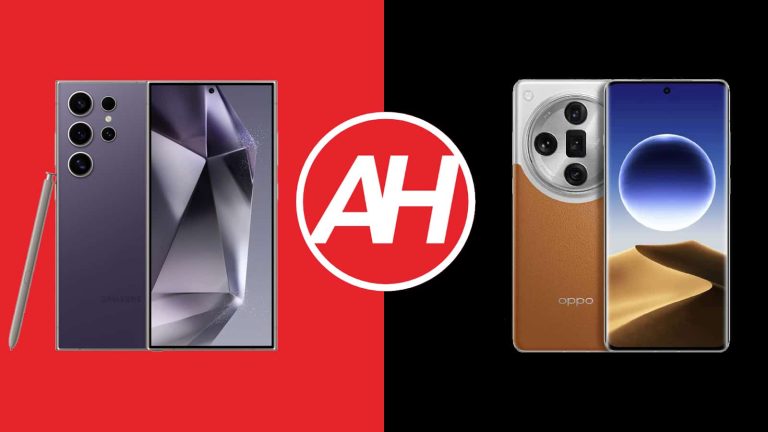
This time around we’re comparing two ultimate flagship smartphones. This is a comparison between the Samsung Galaxy S24 Ultra vs OPPO Find X7 Ultra. Both of these phones are extremely powerful, and the best smartphones their respective companies have to offer at the moment. The thing is, the OPPO Find X7 Ultra is only available in its homeland. Well, at least at the time of writing this article. Still, if you do import it, and install the Google Play Store, the phone works great.
Having said that, we’ll first list their specifications, and will then move to compare them across a number of other categories. We’ll compare their designs, displays, performance, battery life, cameras, and audio performance. There is a lot to talk about here, as these two devices are quite different. So, let’s get down to it.
Specs
Google Pixel 8 Pro vs OPPO Find X7 Ultra, respectively
Samsung Galaxy S24 Ultra vs OPPO Find X7 Ultra: Design
The moment you lay your eyes on these two phones you’ll realize how different they are in terms of the design. The Samsung Galaxy S24 Ultra has a flat display, slightly rounded sides, and flat top and bottom. The OPPO Find X7 Ultra includes a curved display, curved back (proportionally to the front), and very thin frame on the sides compared to the Galaxy S24 Ultra. Both phones do include a centered display camera hole on the front.
Both devices have extremely thin bezels around their displays. The Galaxy S24 Ultra utilizes titanium and glass, while the OPPO Find X7 Ultra combines aluminum for its frame, and glass and vegan leather on its back. Both smartphones include physical buttons on the right-hand side, while the OPPO Find X7 Ultra also has an alert slider on the left side. The Galaxy S24 Ultra includes an S Pen stylus, which is accessible from the bottom-right side of the phone.
If we flip the two phones over, you’ll see even more differences. The Galaxy S24 Ultra has four cameras each of which protrudes directly from the backplate. There is no dedicated camera island. The OPPO Find X7 Ultra has a dedicated camera island on the back, a circular one. That camera island is quite pronounced, and it includes four cameras as well. We’ve actually realized that it’s a good anchor for your index finger when you hold the phone, so it has a practical use too.
The OPPO Find X7 Ultra is slightly taller and narrower than the Galaxy S24 Ultra, while it’s also a bit thicker. The Galaxy S24 Ultra is heavier, though, over 10 grams heavier. Neither phone is particularly light, though. OPPO’s flagship does offer more grip in comparison, though, mainly thanks to the vegan leather implementation on the back. You will be getting an IP68 certification on both of these smartphones for water and dust resistance. They do feel entirely different in the hand, but offer that premium feel.
Samsung Galaxy S24 Ultra vs OPPO Find X7 Ultra: Display
The Galaxy S24 Ultra features a 6.8-inch QHD+ (3120 x 1440) Dynamic LTPO AMOLED 2X display. That panel is flat, and it offers a 120Hz refresh rate. Its refresh rate is adaptive by the way, it goes from 1 to 120Hz. HDR10+ content is supported here, while the theoretical max brightness is 2,600 nits. The phone has a 19.5:9 aspect ratio, while the panel is protected by the Gorilla Glass Armor.
Samsung Galaxy S24 Ultra
The OPPO Find X7 Ultra includes a 6.82-inch QHD+ (3168 x 1440) LTPO AMOLED display, which is curved. This panel can project up to 1 billion colors, and it has an adaptive refresh rate (1-120Hz). Dolby Vision is supported on this panel, while the display can theoretically go up to 4,500 nits of brightness at its peak. This display is protected by Corning’s Gorilla Glass Victus 2 protection.
Both of these smartphones offer outstanding displays, to say the least. They’re extremely bright, very sharp, and offer vivid colors, and deep blacks. The viewing angles are excellent on both panels, while the touch response is also very good on both. The Gorilla Glass Armor does help with reflections, though, so the Galaxy S24 Ultra’s panel is less reflective. The OPPO Find X7 Ultra display is not too reflective or anything like that, but you do notice the difference when you place them side by side. Corning really did make a difference with the Gorilla Armor protection.
Samsung Galaxy S24 Ultra vs OPPO Find X7 Ultra: Performance
The Samsung Galaxy S24 Ultra includes the Snapdragon 8 Gen 3 for Galaxy, worldwide, unlike its siblings. The OPPO Find X7 Ultra, on the other hand, is fueled by the Snapdragon 8 Gen 3. The difference is in the clock speeds, the ‘for Galaxy’ SoC is clocked a bit higher. That shouldn’t really play a role in your choice, though. Now, the Galaxy S24 Ultra comes with 12GB of LPDDR5X RAM and UFS 4.0 flash storage. The OPPO Find X7 Ultra offers up to 16GB of LPDDR5X RAM and UFS 4.0 flash storage.
It is worth saying that both of these phones do offer outstanding performance. They both handle regular, everyday tasks with ease. They’re smooth and very responsive. The same can be said for gaming as well, actually. We did not notice any excessive heat, not even during longer gaming sessions, and they can both play the most demanding games from the Google Play Store without a problem. They’re not technically gaming smartphones, but they do the job really well, they are flagship phones after all.
Samsung Galaxy S24 Ultra vs OPPO Find X7 Ultra: Battery
A 5,000mAh battery sits inside the Galaxy S24 Ultra. The OPPO Find X7 Ultra, on the other hand, carries a 5,000mAh battery as well. Now, both of these phones do offer great battery life, but the Galaxy S24 Ultra takes the cake, at least based on our testing. Getting over the 8-hour screen-on time mark is possible on both smartphones, though the Galaxy S24 Ultra can take things even further than that.
It will all depend on your usage, of course. Such numbers may be more difficult to reach if you do count in gaming sessions in there, of course. Still, even with some gaming included, we managed to get great battery life from both of these smartphones. Both devices will be more than enough for most people to get through the day, the vast majority of people, actually, so that’s not something you should be worried about.
When it comes to charging, the OPPO Find X7 Ultra blows the Galaxy S24 Ultra out of the water. It supports 100W wired, 50W wireless, and 10W reverse wireless charging. On top of that, it comes with a charger in the box. The Galaxy S24 Ultra offers 45W wired, 15W wireless, and 4.5W reverse wireless charging. It does not have a charger in the box. The OPPO Find X7 Ultra does charge much faster. In fact, wireless charging on the OPPO Find X7 Ultra is faster than wired charging on the Galaxy S24 Ultra.
Samsung Galaxy S24 Ultra vs OPPO Find X7 Ultra: Cameras
The Galaxy S24 Ultra has a 200-megapixel main camera, a 12-megapixel ultrawide unit (120-degree FoV), a 10-megapixel telephoto camera (3x optical zoom), and a 50-megapixel periscope telephoto camera (5x optical zoom). The OPPO Find X7 Ultra, on the other hand, includes a 50-megapixel main camera, a 50-megapixel ultrawide unit (123-degree FoV), a 50-megapixel periscope telephoto (2.8x optical zoom), and a 50-megapixel periscope telephoto camera (6x optical zoom).
OPPO Find X7 Ultra
These are some of the best camera smartphones on the market, to say the least. So do have in mind that you’ll likely be happy with the performance from both of them. Still, the OPPO Find X7 Ultra does have the edge in terms of hardware, and it is also backed by Hasselblad. We did notice a lot of difference in terms of output and mostly prefer the results from the OPPO Find X7 Ultra. The Galaxy S24 Ultra did win in some scenarios, though.
Images from the OPPO Find X7 Ultra did tend to offer better colors more often than not. That especially goes in demanding scenarios when there wasn’t enough light in the image or something like that. The OPPO Find X7 Ultra also tended to provide more detail, and that is especially true when it comes to its ultrawide, and periscope telephoto cameras. Both smartphones did a great job in HDR conditions, and depending on the scene, they also did a great job in low light.
The OPPO Find X7 Ultra tends to leave the shadows a bit darker in order to provide a more realistic image. The Galaxy S24 Ultra tends to brighten up shadows whenever it can. The Galaxy S24 Ultra tended to overdo it with processing a bit more often. Ultrawide and periscope telephoto images ended up looking better on the OPPO Find X7 Ultra more often than not, especially up to 10x zoom. The OPPO Find X7 Ultra tended to offer better and more natural-looking bokeh.
Audio
You will find a set of stereo speakers on both of these smartphones. The fact of the matter is, that both sets of speakers offer great audio output. They’re both more than loud enough, and you won’t really have to deal with any distortion at higher volumes.
What you will not find on either phone, however, is an audio jack. You can always utilize their Type-C ports to connect your headphones via a wire, though. Bluetooth 5.3 is supported on the Galaxy S24 Ultra, while the OPPO Find X7 Ultra offers Bluetooth 5.4.
2024 is a busy year, especially in the political context. Elections will take place in major parts of the world, including the US Presidential Election, South African General Elections, and Indian General Elections. There’s no denying that social media doesn’t help people shape opinions, especially about global leaders. While this may help build awareness, it has the potential of playing the devil’s skit. Amid this situation, Meta has come forward with a distinctive approach. It says that Instagram and Threads will not recommend political content if you wish to. Not to forget, Google had also mentioned something on the same notes about how it’d limit election-related queries on Bard.
Instagram and Threads will limit political content
Meta is expanding an existing policy to Instagram and Threads. Previously, political content from accounts users don’t follow was restricted in suggestions on Reels. Now, this policy extends to Threads and Instagram as well.
Instagram boss Adam Mosseri shared related updates on Threads. He confirmed that these updates will be coming over the next few weeks. Meta-owned Facebook, which was embroiled in the Cambridge Analytica data scandal involving the improper use of user data to create voter profiles, will implement similar measures at a later date.
“Our goal is to preserve the ability for people to choose to interact with political content while respecting each person’s appetite for it,” writes Mosseri.
There’s always an option to go back
With that said, Instagram and Threads aren’t overriding the preferences of political aficionados. They’ll always have an option to reverse these changes within the app. They can find the toggle to limit or not limit political content in the app’s Suggested Content section.
However, it won’t affect how users see posts from accounts they follow directly. So, users who follow those Instagram and Threads accounts that post political content needn’t worry.
Meta also said that Professional accounts on Instagram will be able to check if they’re eligible for content recommendations based on their recent political posts. They can do this using the Account Status feature. These users can review their recent posts, make changes if needed, ask for a review if they disagree with Meta’s decision, or stop posting political content temporarily to become eligible for recommendations again.
YouTube Music continues to evolve, positioning itself as a strong competitor to Spotify with interface tweaks and quality-of-life additions. The latest enhancement on YouTube Music, which looks somewhat similar to the latest directions search UI redesign in Google Maps, focuses on refining the casting interface across Android and iOS platforms. This redesigned interface, however, is currently under development and not widely rolled out yet, notes 9to5Google.
The casting options in most Android apps typically appear as a floating window in the middle of the screen upon tapping the cast button. However, YouTube Music is experimenting with a new bottom-based sheet for cast targets, as revealed by screenshots shared by Redditor u/notjhoan. This redesigned interface in YouTube Music is denser and potentially displays more casting targets at a time.
Instead of overlaying the volume slider, it now appears in a bottom-based card, contributing to a more cohesive user experience. However, there seems to be an oversight regarding the option to stop casting via this interface as of now.
Tweaks to the casting interface include an absence of the ‘stop casting’ button as of now
“I don’t like it because it does not have a ‘stop casting’ button. You have to basically redirect the cast to the device you’re holding in your hand,” a Reddit user commented. However, the redesign is still in its development stage. So it might get fixed in the future before a wider rollout.
This redesign brings YouTube Music’s interface on Android closer to its iOS counterpart, which has long featured a similar design. Although iOS users have had a comparable layout, not all have experienced the inclusion of suggested targets as seen in the Android app.
In addition to the casting interface improvements, Google has recently simplified the process of switching between voice control and touchscreen control when using Nest audio devices or displays. This seamless transition allows users to start a session via voice and continue controlling playback, queue, and more through the YouTube Music app on their phones, enhancing the overall user experience.
While YouTube Music’s controls may not yet match the sophistication of Spotify Connect, these recent updates demonstrate Google’s commitment to bridging the gap and providing users with a more intuitive and integrated music streaming experience.
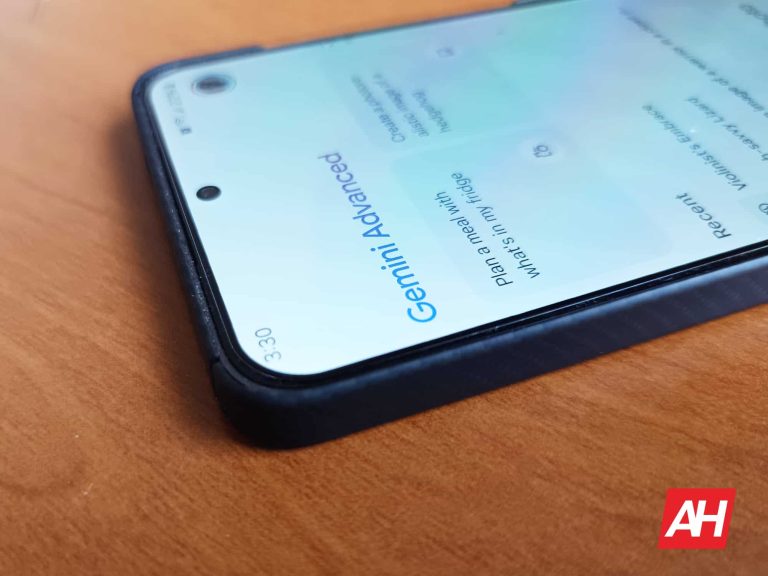
Not too long ago, Google released its official Gemini app. You can download it now on the Google Play Store and use it for free. Since this is a new app release, people in some regions are complaining that they couldn’t access it. Well, this is changing, as the Gemini app is now available in more regions.
When the app launched, it was available primarily in the US. That’s understandable, seeing as Google is a United States company. Many people complained that it was not available in their region. So, if you don’t live in the US, you’ll just have to play the waiting game until it lands on your device.
Google is still working on distributing this app, so patience is a virtue. There are even people complaining that it wasn’t available on the Pixel Tablet. We’re not sure this is for lack of a tablet-optimized version, as people were able to use the app on their Pixel Fold. So, people with the Pixel Tablet will just have to wait until it eventually reaches them.
If you’re also curious about Gemini Advanced, you can sign up for it today. You can access Gemini Advanced through the $19.99/month subscription service on Google One. For a full guide on how to do this, check out How to sign up for Gemini Advanced.
The Gemini app is coming to more regions
The Gemini app is making it to more places in the world, and we’re seeing hints of this throughout the internet. On X, a Google employee named Jack Krawczyk posted a progress report detailing some feedback the company got about it. In the post, he mentions that the mobile app is “still rolling out; opening to LATAM, Africa, Asia Pacific, Canada on Monday, Europe ASAP”. So, over the weekend, people in Europe should have been getting access to it.
This is further supported by a post from Lukas Boguth. This user side-loaded the app via the APK on February 9th, but it was not functional then. However, he posted that it’s currently working on his Pixel 7 Pro. Other users across the internet are reporting much the same thing.
As per Krawczyk, the Gemini app is making it to more regions starting today so, if you live somewhere within the list of regions mentioned, be sure to check to see if the Gemini app is available to download. If you don’t see it yet, then you may just want to wait a few days.
Apple researchers have introduced a groundbreaking AI model, MLLM-Guided Image Editing (MGIE), capable of editing images based on text prompts. Developed in collaboration with researchers from the University of California, Santa Barbara, this model represents a significant advancement in image editing technology. Unlike existing models, MGIE reportedly handles a wide range of editing scenarios, from simple color adjustments to complex object manipulations.
The core of the MGIE is a Multimodal Large Language Model (MLLM), which interprets user requests and provides concise instructions for image editing. This approach enables the model to address ambiguous commands effectively, achieving reasonable editing results. For instance, the MLLM understands a request to “make a pizza more healthy”, and connects the term “healthy” with “vegetable toppings,” instructing the diffusion model to edit the image accordingly.
The MGIE can edit images from your text description
What sets MGIE apart from existing models like LLM-Guided Image Editing (LGIE) is its enhanced visual perception. While LGIE is confined to a single modality, MLLM within MGIE has access to the input image and cross-modal understanding, allowing for more descriptive instructions. This capability enables the model to identify specific regions in the image that need adjustment, such as brightening certain areas for a desired effect.
MGIE is now available as an open-source project on GitHub, offering code, data, and pre-trained models for download. Additionally, a web demo hosted on Hugging Face spaces allows users to experience the image editing capabilities of the model firsthand. However, Apple has not yet disclosed its plans for integrating MGIE into its products beyond research projects.
During Apple’s recent quarterly earnings call, CEO Tim Cook confirmed the company’s ongoing work on AI features for its devices. The company is likely to announce the results later this year. Business Standard expects these AI enhancements to extend to various Apple services, including Siri, Messages, and Apple Music. With the incorporation of generative AI features, users can anticipate improvements such as text summarization, personalized suggestions, and enhanced functionality across Apple’s ecosystem.
With many innovations happening around the world, simultaneously, there’s always a risk of technology going into the wrong hands. That’s what happened at the Apple’s headquarters, it seems. A former Apple engineer is the person in question. Ex-Apple staff, Xiaolang Zhang found himself guilty and sentenced to 120 days in jail, along with a fine of up to $147,000.
More importantly, he had a key role in Apple’s self-driving car, much like Tesla, but we’re unsure how Apple plans to pull it off. The project, called “Project Titan,” has been in the works for over a decade. Mark Gurman adds more to this story. He reported that Apple is instead focusing on bringing electric vehicles (EVs) into the picture, a future often touted by several carmakers. Coming back to Apple Car, reports suggest it’s not coming any sooner than 2028.
Ex-Apple engineer, Xiaolang Zhang, sentenced to 120 days in jail
There’s a little backstory to this incident. So, Xiaolang Zhang was caught at the airport in 2018 when he was about to fly to China. At first, he said he didn’t do it, but in 2022, he confessed to stealing secrets. Now, he has to go to jail and pay almost $147,000 to make up for it. At first, he could have gone to jail for up to 10 years and had to pay $250,000.
The ex-Apple worker was part of a team developing Apple’s self-driving cars. He got in trouble for taking important documents about the car’s technology and putting them on his wife’s computer. He also took some physical parts from Apple’s labs. After leaving Apple, he said he would work for another company in China. But Apple found out he was up to no good after checking security footage. He’s supposed to turn himself in and will likely go to a low-security jail near his home.
That’s pretty much it. In the meantime, we’ll have to wait until at least 2028 to see Apple roll a self-driving car or electric vehicle, at least.
One suspect from Malta managed the Warzone Rat distribution network, while another from Nigeria developed and maintained the malware.
In a major blow to cybercrime, the US Department of Justice, along with international partners and private companies, has dismantled the infrastructure behind the infamous Warzone RAT malware. Two individuals believed to be key players in the operation have also been arrested, while the website used in the operation has been seized as well.
What Was Warzone RAT?
Warzone RAT, short for Remote Access Trojan, was a powerful and versatile tool used by cybercriminals to gain complete control over infected devices since 2018.
This malware granted attackers access to steal sensitive data like passwords and financial information, spy on victims through webcams and microphones, lock them out of their devices for ransom, and even launch further attacks. Its widespread use and sophisticated capabilities made it a major threat to individuals and organizations alike.
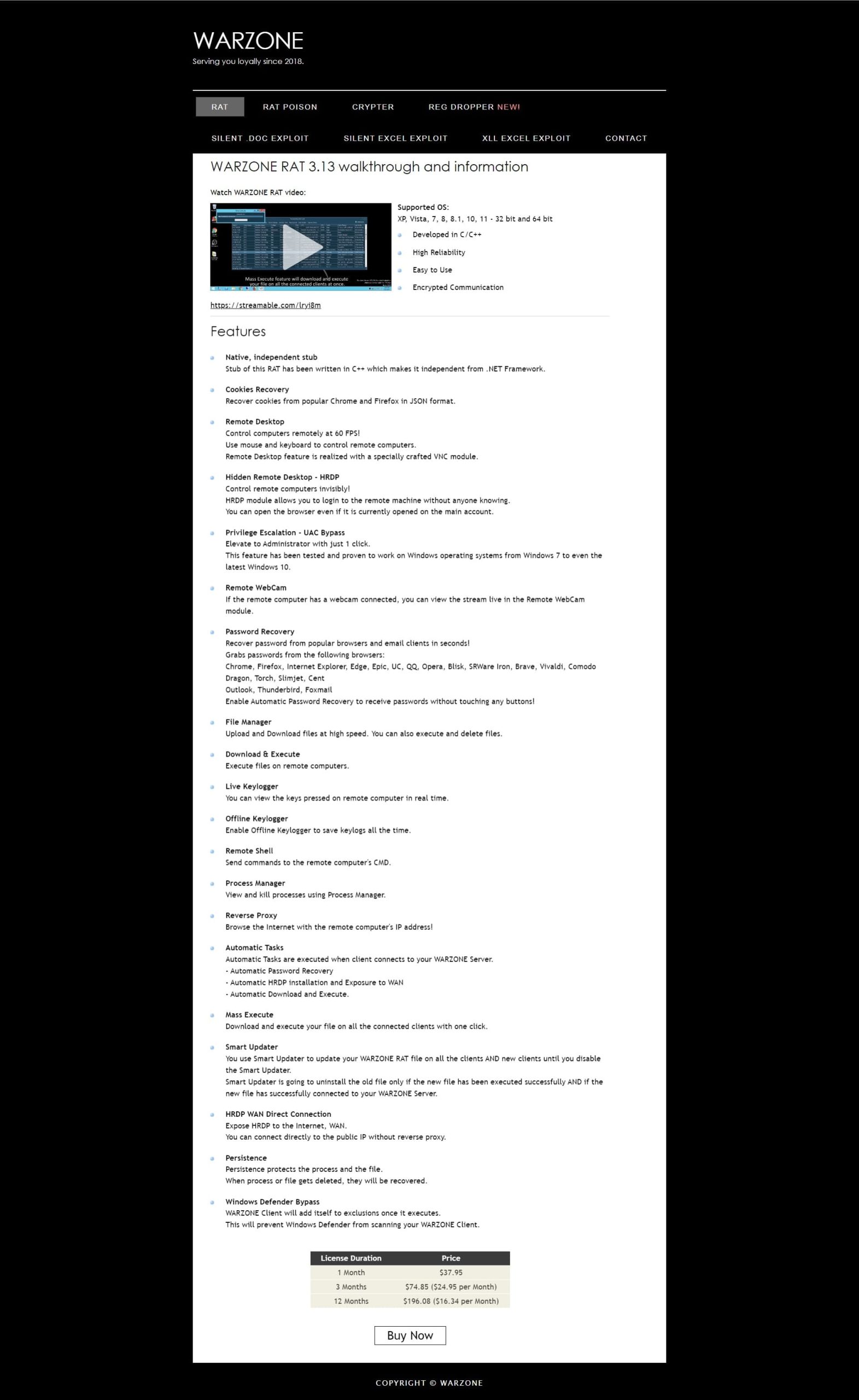
The website that sold Warzone RAT (Screenshot: Hackread.com)
Operation Shut Down:
On February 9, 2024, the US Department of Justice announced a coordinated effort involving the FBI, international law enforcement agencies, and private cybersecurity firms that successfully dismantled the Warzone RAT infrastructure. This action effectively crippled the malware’s distribution and operation, significantly disrupting cybercriminal activities relying on it.
Arrests Made:
As part of the operation, two individuals were arrested and charged with their involvement in the Warzone RAT scheme. One suspect, residing in Malta, was accused of managing the malware distribution network. The other, based in Nigeria, was allegedly responsible for developing and maintaining the malware itself. Both face serious charges related to computer fraud and abuse.
Impact and Significance:
The takedown of Warzone RAT represents a significant victory for law enforcement and cybersecurity experts. It demonstrates the effectiveness of collaboration between international partners and the private sector in combating large-scale cybercrime. While this specific threat has been neutralized, it serves as a reminder that the fight against cybercrime is an ongoing battle.
The specific details of the investigation and technical aspects of the operation that dismantled Warzone RAT remain undisclosed for security reasons. The disruption of Warzone RAT is expected to have a ripple effect on other cybercriminal activities that relied on this tool. Continued collaboration and attention from law enforcement and cybersecurity experts are essential to combat evolving cyber threats.
What You Can Do:
While the dismantling of Warzone RAT is encouraging, it’s crucial to remain alert against growing cyber threats. Here are some steps you can take to protect yourself:
Keep software and operating systems updated.
Use strong and unique passwords for all accounts.
Stay informed about emerging cyber threats and scams.
Be cautious about clicking suspicious links or opening attachments.
Consider using a reputable security solution with anti-malware protection.
If your IT and security teams think malware is bad, wait until they learn about everything else.
In 2024, the modern cyberattack is a segmented, prolonged, and professional effort, in which specialists create strictly financial alliances to plant malware on unsuspecting employees, steal corporate credentials, slip into business networks, and, for a period of days if not weeks, simply sit and watch and test and prod, escalating their privileges while refraining from installing any noisy hacking tools that could be flagged by detection-based antivirus scans.
In fact, some attacks have gone so “quiet” that they involve no malware at all. Last year, some ransomware gangs refrained from deploying ransomware in their own attacks, opting to steal sensitive data and then threaten to publish it online if their victims refused to pay up—a method of extracting a ransom that is entirely without ransomware.
Understandably, security teams are outflanked. Defending against sophisticated, multifaceted attacks takes resources, technologies, and human expertise. But not every organization has that at hand.
What, then, are IT-constrained businesses to do?
Today, on the Lock and Code podcast with host David Ruiz, we speak with Jason Haddix, the former Chief Information Security Officer at the videogame developer Ubisoft, about how he and his colleagues from other companies faced off against modern adversaries who, during a prolonged crime spree, plundered employee credentials from the dark web, subverted corporate 2FA protections, and leaned heavily on internal web access to steal sensitive documentation.
Haddix, who launched his own cybersecurity training and consulting firm Arcanum Information Security this year, said he learned so much during his time at Ubisoft that he and his peers in the industry coined a new, humorous term for attacks that abuse internet-connected platforms: “A browser and a dream.”
“When you first hear that, you’re like, ‘Okay, what could a browser give you inside of an organization?’”
But Haddix made it clear:
“On the internal LAN, you have knowledge bases like SharePoint, Confluence, MediaWiki. You have dev and project management sites like Trello, local Jira, local Redmine. You have source code managers, which are managed via websites—Git, GitHub, GitLab, Bitbucket, Subversion. You have repo management, build servers, dev platforms, configuration, management platforms, operations, front ends. These are all websites.”
Overwhelmed by modern cyberthreats? ThreatDown can help.
The 2024 ThreatDown State of Malware report is a comprehensive analysis of six pressing cyberthreats this year—including Big Game ransomware, Living Off The Land (LOTL) attacks, and malvertising—with strategies on how IT and security teams can protect against them.
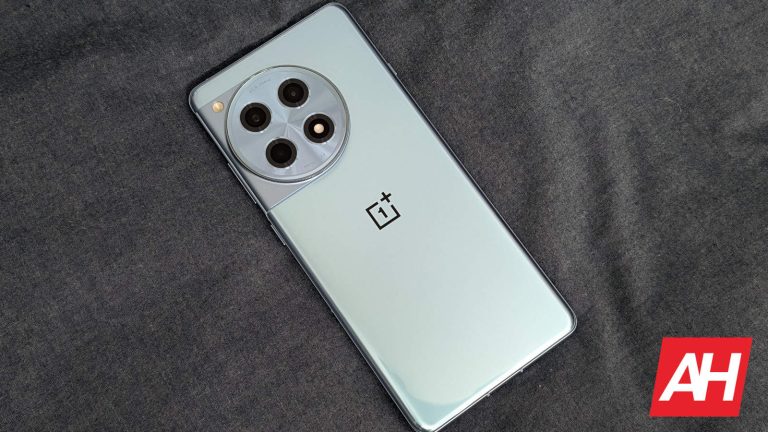
OnePlus recently issued a clarification regarding a mistake in the product specification listing for their OnePlus 12R (Review) smartphone. Initially, OnePlus India listed the 256GB variant of the OnePlus 12R with UFS 4.0 storage. However, the company has now corrected this error, confirming that the 256GB variant of the OnePlus 12R actually comes with UFS 3.1 storage, the same as the 128GB variant.
Despite this discrepancy in the initial listing, OnePlus assures users that the device will still offer excellent performance, with features like launching apps faster and maintaining smooth operation over time.
OnePlus assures users that the OnePlus 12R will still offer excellent performance
“During the launch of the OnePlus 12R, we announced Trinity Engine, a new set of software algorithms that help keep your phone’s memory and storage running fast and smooth for years to come,” wrote OnePlus president Kinder Liu on the OnePlus Community forum.
However, some customers who purchased the 256GB variant of the OnePlus 12R expecting UFS 4.0 storage may feel disappointed by the discrepancy. There have been inquiries about potential refunds for customers who received the UFS 3.1 version instead.
Android Authority has contacted OnePlus asking whether the company will offer a refund to the customers who have purchased or pre-ordered the said variant of the OnePlus 12R. As of now, OnePlus has not provided a response to these inquiries.
OnePlus encouraged its customers to contact its Customer Service team for further quarries
“Of course, I understand that some of you who have purchased or pre-ordered a OnePlus 12R may want to discuss this further with our team, and I’d encourage you to contact our Customer Service team through the usual channels,” said Kinder Liu.
Despite the oversight regarding the storage specifications, OnePlus emphasizes its commitment to ensuring a positive user experience with the OnePlus 12R. As stated by the company, the device underwent full certification testing using UFS 3.1 storage, ensuring its performance and longevity.