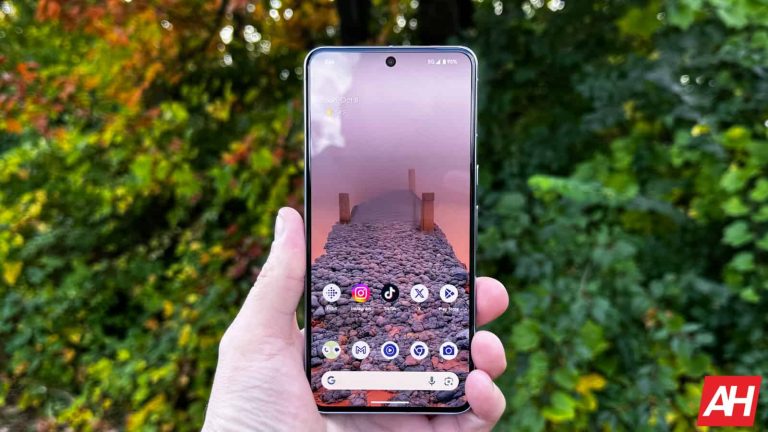
The Google Pixel 8 series, launched in October, introduced support for the Ultra HDR images for devices on Android 14. It provided users the ability to capture brighter and more dynamic images and experience them on supported devices with HDR screens. Samsung followed suit with the Galaxy S24 series, announcing that popular social media platforms like Snapchat and Instagram would now support Ultra HDR on their new phones.
Now, Android expert Mishaal Rahman has uncovered evidence suggesting that Google is set to expand Ultra HDR support to third-party camera apps using the CameraX API, allowing users on Android 14 to capture stunning HDR images beyond the confines of their OEM camera apps.
The integration of Ultra HDR image capture support into the CameraX API holds promising implications for users who prefer third-party camera apps. Rahman’s findings indicate that apps utilizing the CameraX API will soon be able to output images in the new JPEG_R format designed for Ultra HDR.
Users will probably be able to use their preferred third-party camera app without sacrificing the JPEG_R format
This development will not only benefit social media and messaging apps but also open up exciting possibilities for third-party camera applications. Users on Android 14 can look forward to a more diverse range of apps that can leverage the enhanced capabilities of Ultra HDR, making it easier to capture stunning and lifelike images across various scenarios.
While the details on which phones will support this functionality remain unclear, the move to integrate Ultra HDR support into the CameraX API is a positive step toward widespread availability. As HDR technology becomes more prevalent in smartphones, Google’s initiative to extend the support beyond its proprietary apps showcases a commitment to enhancing the overall user experience and fostering innovation within the Android ecosystem.
In summary, Google‘s efforts to bring Ultra HDR support to third-party camera apps through the CameraX API is a promising development for photography enthusiasts.
Back in 2018, Google was testing the Smart Reply feature for the omnipresent Gboard, providing suggestions in chats. Fast forward to 2024, now the Gboard Smart Reply is on the AI juice (in the case of the Pixel 8 Pro) and it’s expanding.
The Pixel 8 Pro was announced months before the Galaxy S24, and out of the two, the Koreans were far louder when presenting the AI – they even came up with the whole “Galaxy AI” thing. However, the Pixel 8 Pro is as AI as it gets, taking advantage of Google’s AI model Gemini Nano (via Android Headlines).
For example, there’s the Recorder Summarize, which transcribes audio recordings and spits out an AI-generated summary – tailor-made for lengthy podcasts. If you scoff at people not thinking with their own heads in 2024, just wait until such features become mass-available.
Gboard Smart Reply is also AI-boosted on the Pixel 8 Pro and is now compatible with two more messaging apps.
This is a feature that uses generative AI to suggest the next message you should send in a conversation. It uses conversational awareness to ascertain what the conversation is about and gives you a suggestion of what you should type next.
Only compatible with WhatsApp at the beginning, the Gboard Smart Reply is also available for Line (a telemedicine service that lets you book appointments and talk with doctors online) and KakaoTalk (a popular Korean messaging service with a 53 million monthly active user base).
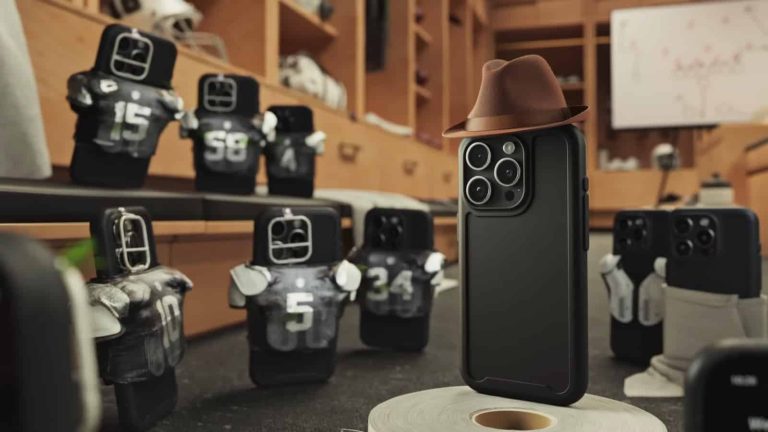
An iPhone becomes a motivational speaker during halftime of a match against Google’s Pixels
Why is he trying to motivate his team, though? Well, because of the Pixel’s new AI features. As per usual, this is Google’s way of taking a dig at Apple in an entertaining way.
Now, in this ad, iPhones find themselves in a locker room at halftime of a ‘Big Game’, a game against the Pixels. Coach iPhone decides to hold a speech in order to motivate his players, as they’re worried about Pixel’s new AI features.
He says “This game isn’t over yet”. To what one of the players says “But Coach, the other team keeps getting new AI features”. At that point, others start listing Google’s new features, as does the Coach as part of his speech.
Various Google AI features are mentioned here
Features such as Circle to Search and Video Boost features are mentioned. One of the players says “We’re doomed”. Coach iPhone doesn’t give up, however, not at all. He proceeds by saying “Sure, Team Pixel got advanced AI to fix group photos and summarize recordings and reduce noise in videos. But it doesn’t matter what you got on the inside. It’s what’s on the outside that counts”.
He then mentions some changes that the new iPhones have seen, such as a “different shaped charging port”, hinting at a Type-C charging port, and an Action Button too, amongst other outside changes.
To make things even funnier, at one point, one of the players/iPhones starts to ring, as a spam caller is on the other side. Towards the end of the ad, a Pixel appears, and iPhones says “I, um, lost my playbook. Can I borrow yours?”
This add has a duration of less than a minute. The video is embedded below in case you want to check it out. It sure is entertaining, as were all the previous ones.
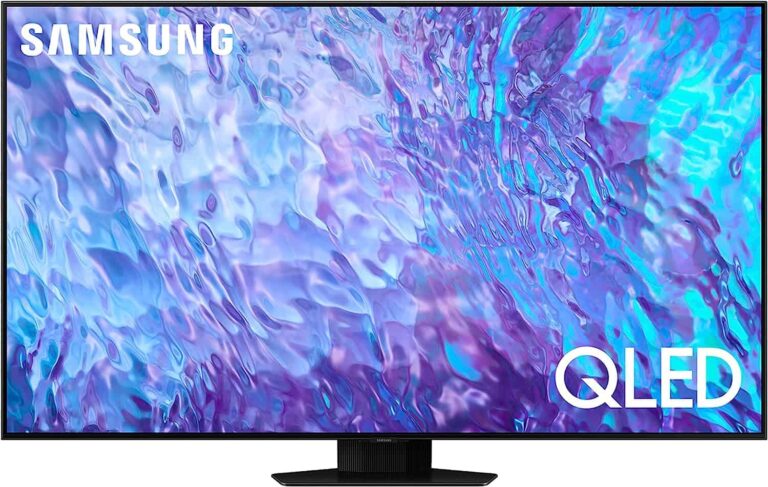
The Super Bowl is coming up pretty quickly here, on February 11, and the Samsung Q80C is going to be the perfect TV to watch the big game on. And today, you can grab the Q80C at some of its lowest prices ever. Here’s the breakdown per size:
50-inch: $897 (reg. $997)
55-inch: $997 (reg. $1,197)
65-inch: $1,097 (reg. $1,397)
75-inch: $1,497 (reg. $1,897)
85-inch: $1,897 (reg. $3,297)
98-inch: $4,997 (reg. $7,997)
The Samsung Q80C QLED TV is a great choice for anyone looking for a high-quality, feature-rich TV. With its stunning picture quality, immersive sound, and smart features, the Q80C is sure to impress.
One of the biggest selling points of the Q80C is its picture quality. The TV uses Quantum Dot technology to deliver over a billion colors, resulting in incredibly vibrant and lifelike images. The Q80C also supports HDR10+, which provides a wider range of colors and contrast for an even more immersive viewing experience.
In addition to its excellent picture quality, the Q80C also offers great sound. The TV is equipped with a 2.2.2-channel speaker system that delivers clear, powerful sound. The Q80C also supports Dolby Atmos, which creates an immersive soundscape that surrounds you with audio.
The Q80C is also packed with smart features. The TV runs on Samsung’s Tizen operating system, which gives you access to a wide range of streaming apps, including Netflix, Hulu, and Amazon Prime Video. The Q80C also supports voice control, so you can control the TV with your voice.
Overall, the Samsung Q80C QLED TV is a great choice for anyone looking for a high-quality, feature-rich TV. With its stunning picture quality, immersive sound, and smart features, the Q80C is sure to impress.
You can pick up the Samsung Q80C QLED TV from Best Buy at the link below.
It was previously reported that Jenkins was discovered with a new critical vulnerability, which was associated with unauthenticated arbitrary file reads that can be utilized by threat actors to read sensitive files on the server. The CVE was mentioned as CVE-2024-23897, and the severity is yet to be categorized.
There were also reports mentioning a massive scan of Jenkins servers over the internet, according to a security researcher. However, currently, it has been reported that there are more than 45,000 publicly available Jenkins instances online.
DocumentRun Free ThreatScan on Your Mailbox
Trustifi’s Advanced threat protection prevents the widest spectrum of sophisticated attacks before they reach a user’s mailbox. Try Trustifi Free Threat Scan with Sophisticated AI-Powered Email Protection .
Publicly Exposed JenkinsServers
According to the reports shared with Cyber Security News, Jenkins has a total market share of 43%, which is a massively higher quadrant number than other CI/CD software. This makes Jenkins one of the most used open-source CI/CD servers across organizations.
Moreover, the vulnerability CVE-2023-23897 does not require any authentication on vulnerable instances. Though there is a specific criterion for exploiting the vulnerable instances, it is still deemed as a critical vulnerability due to the ease of exploitation.
For a security researcher or threat actor to find if a specific Jenkins instance is vulnerable, they do not require any kind of special skills. A simple cURL command with only the IP address and port number of the server is more than enough to confirm if an instance is vulnerable.
45000 Servers exposed
Shadowserver reported that there were more than 45,000 servers that could be exploited if they had been misconfigured. Adding to the threat, another vulnerability was also reported that was in combination with CVE-2023-23897.
This vulnerability was an unauthenticated, remote code execution vulnerability that could allow a threat actor to execute arbitrary commands on the vulnerable instance. However, as per Shadowserver reports, China has the highest number of Jenkins instances, accounting for nearly 12,000 servers.
Followed by the United States of America with 11,830 servers. Germany and India have approximately 3000 and 2500 servers, respectively. Other countries had multiple Jenkins servers exposed over the internet.
Nevertheless, it is recommended that all organizations upgrade the Jenkins servers to the latest versions to prevent these servers from getting exploited by threat actors.
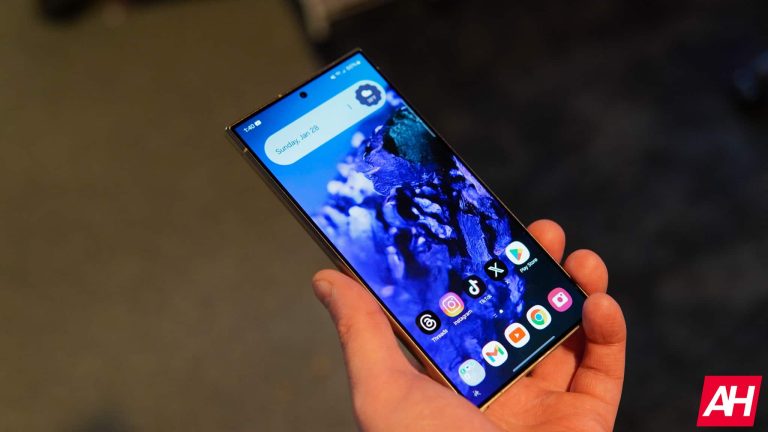
You can now hide the gesture navigation bar on your Samsung Galaxy device as long as it supports Good Lock. The latest update for NavStar, which is part of the Good Lock suite, brings this ability. It is available on devices running One UI 6.1, so currently limited to the Galaxy S24 series. Older Galaxy models will get the One UI 6.1 update later.
NavStar update lets you hide the gesture navigation bar on your Galaxy
Good Lock is a suite of customization apps for Galaxy smartphones and tablets. It consists of a bunch of apps that let you customize various system elements, including the Quick Settings panel and the navigation bar. NavStar is the app responsible for the latter. It lets you add more buttons to the navigation bar and adjust its height among other things.
Samsung recently pushed a new update to NavStar, adding the ability to hide the gesture navigation bar. This allows you to see more content on the screen. If you are using a Galaxy S24, Galaxy S24+, or Galaxy S24 Ultra, update the app from the Galaxy Store and follow the steps below to hide the gesture bar that appears at the bottom of the screen.
Firstly, open Good Lock and go to the NavStar module. Now switch to the Swipe gestures tab and turn the “Enable extra gesture settings” toggle on. After that, exit Good Lock and go to the Settings app. Enter the Display section and navigate to the Navigation bar menu. Select Swipe gestures, tap on the “More options” button, and disable “Gesture hint”.
The gesture navigation bar will then disappear from the screen. You can still use the same gestures for navigation, but without your Galaxy phone showing you a bar at the bottom of the screen. You can also use the existing gesture to activate Circle to Search (long press of the home button). Enable “Gesture hint” to bring back the navigation bar.
Samsung will bring back its custom navigation gesture system
Long-time Galaxy users might have noticed that Samsung removed its custom navigation gesture system with One UI 6.1. Galaxy users must use the default Android gestures or navigation buttons. Thankfully, this isn’t a permanent change. Samsung will bring back its custom system with an upcoming update for NavStar. As said earlier, older Galaxy devices will also get One UI 6.1, so these features will be available to more models soon.
Google’s first foldable smartphone has finally landed, the Pixel Fold is its name. The phone got announced on May 10, during Google I/O 2023. It was basically the showpiece of that whole keynote, which is understandable.
The Pixel Fold is a book-style foldable, but it takes a different approach than the Galaxy Z Fold 4. It’s closer to the OPPO Find N2 due to its horizontal orientation when unfolded. That makes it wider than you think when folded too, and shorter as well. It definitely looks like it belongs in the Pixel series of smartphones, though. In this article, we’ll try to group a lot of useful info together, so that you’re well-informed about Google’s latest offering.
Google Pixel Fold specs
Here are the specs for the Google Pixel Fold.
Google Pixel Fold
Display
Inner: 7.6-inch 2208 x 1840 120Hz foldable OLED 6:5 aspect ratio UTG Outer: 5.8-inch fullHD+ 120Hz OLED 17.4:9 aspect ratio Gorilla Glass Victus
Processor
Google Tensor G2
RAM
12GB LPDDR5
Storage
256GB/512GB UFS 3.1
Battery Capacity
4,821mAh
Charging Speeds
20-30W wired (charger not included), not confirmed yet Wireless charging
Software
Android 13 (5 years of security updates)
Rear Cameras
48MP wide 10.8MP telephoto 10.8MP ultrawide
Front Camera
Outer: 9.5MP Inner: 8MP
Dimensions
Unfolded: 139.7 x 158.7 x 5.8mm Folded: 139.7 x 79.5 x 12.1mm
Weight
283 grams
Price
$1,799 (256GB storage) $1,919 (512GB storage)
Colors
Obsidian Porcelain
Available
May 10
How much does the Google Pixel Fold cost?
The Google Pixel Fold starts at $1,799, that much we do know. That model includes 12GB of RAM and 256GB of storage. Google did announce a more pricey variant too, with more storage, 512GB. That is the only difference between them. Needless to say, that variant will be a bit more expensive, it’ll cost you $1,819.
When will the Google Pixel Fold be available?
The Google Pixel Fold will go on sale on May 27. The good news is, you can pre-order it today, on launch day, May 10. It is available to pre-order from Google directly only, though. That will change later this month, as carriers and other partners are expected to open pre-orders later on. The device will be available both via the carriers, and retailers. More on that in the next section.
Where can I buy it?
Starting today, you can pre-order it from Google, while it will get a wider availability later this month. It will be available from T-Mobile, Verizon, AT&T, Amazon, Best Buy, and more. We’ll be adding links below as the device becomes available.
What carriers will support the Google Pixel Fold?
The Google Pixel Fold is being sold as an unlocked phone, and you’ll be able to use it on basically all carriers. It doesn’t matter if you’re on AT&T, T-Mobile or Verizon, you’re good to go. The phone supports both mmWave and Sub-6 5G networks, so you’ll also get 5G regardless of which carrier you choose.
If you opt for an MVNO instead, that’s not a problem either. Google Fi, Cricket, Metro by T-Mobile, Mint Mobile, and so on.
What colors does it come in?
Google has announced only two color variants of the Pixel Fold. The device comes in Obsidian and Porcelain color options. These are basically black and white colors. The Obsidian model comes with a black backplate, while its hinge and camera island are dark gray. The Porcelain model includes a white backplate, in addition to a silver hinge and camera island.
Some would argue that these are not ‘fun’ colors, but it makes sense. This handset costs a lot, and it’s also a first-gen product. Google went with the colors it thought would sell best to its target consumers. The Porcelain variant will definitely hide fingerprints better than the Obsidian model will, by the way.
What new features are coming with the Google Pixel Fold?
The Pixel Fold comes with a mix of great old features and some new ones. We’ll focus on the new ones here, as there’s simply too much to cover. We will, however, also mention some existing ones. Do note that we’ll include both software and hardware features here.
Hinge
The Pixel Fold’s hinge is made out of stainless steel. Google says that the hinge is “smooth, secure, and the most durable of any foldable phone” (among foldable phones in markets where the Pixel Fold is sold). We’ll, of course, have to test it in order to figure out if it lives up to this. There are a lot of great hinge implementations out there.
Tabletop mode
The Google Pixel Fold comes with a Tabletop mode feature. We’ve seen something similar on other foldables, but not yet on a Pixel, of course. You’ll be able to set the phone on a table, fold it to a certain degree, and that way you enter Tabletop mode. This is great for video calls, taking pictures, watching videos, and so on. Not only do you get a software feature here, but the phone also acts as a stand too.
Two-panel shade
Google also added a “two panel shade” to the Pixel Fold. When you swipe up from the top, if the phone is unfolded, you’ll be able to see both your notifications and quick toggles on the same screen. They’ll be set side by side, with the notifications on the right side. That was you will have everything in one place. That makes sense as there’s a lot of screen real estate to work with here.
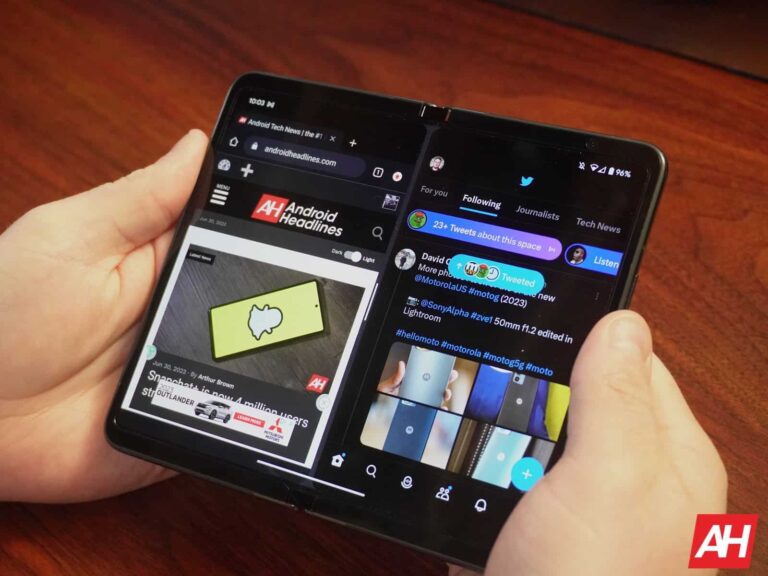
Multitasking windows paired
If you split your screen to run two apps side by side, either horizontally or vertically (which is possible), the Pixel Fold will remember that if you switch apps. It’ll keep that combination of apps in the overview menu for you, so that you can easily multitask. That makes all the sense in the world, and yet not all foldables offer the feature.
New taskbar
You will find a new Android taskbar here too. It allows you to swipe from the bottom to access a bunch of apps which you can then either tap, or utilize for split screen. That taskbar will also pop up every time you enter the overview/multitasking window.
Camera features
The Pixel Fold includes a promising set of camera hardware. It’s different than what we get on the Pixel 7, Pixel 7 Pro, and Pixel 7a. Google decided to differentiate, but the camera hardware sure looks interesting. To complement it, we’ll get Google’s well-known image processing, and a number of software features we know and love. Features such as: Night Sight, Face Unblur, Magic Eraser, Portrait Mode, and much more. On top of that, 5x optical zoom is possible here, in addition to 20x Super Res Zoom.
IPX8 water resistance
We’ve seen quite a few foldable smartphones in the market thus far, but not all of them offer water resistance. In fact, until recently, only Samsung’s devices did. Well, the Pixel Fold comes with IPX8 certification. That is not as good as IP68 that many regular smartphones come with, but if you get caught in the rain or something like that, you don’t have to worry. Needless to say, that is important.
Should I buy the Google Pixel Fold?
Should you buy the Google Pixel Fold? Well, that’s a rather complex question, actually. For most people, the answer is probably no, but then again, most people don’t really want or need a foldable phone. If you do have the money to get it, and don’t mind spending it, and you wanted a Pixel experience on a foldable, then, by all means… go for it. This phone will not only give you the stock Android experience in a foldable form factor, but it’ll also provide you with a truly capable set of cameras. That is not something we see on many foldables. In fact, the Pixel Fold could end up offering the best set of cameras out of any foldable phone.
Updated January 30, 2024:
Google opted to release a bunch of new features as part of the Pixel Feature Drop for January 2024. The Pixel Fold is, of course, one of the devices that is receiving these features. So, let’s see what’s new on the device, shall we? We’ll talk about all the new features below, separately.
Circle to Search
Have you ever wanted to simply make a circle around something you want to search on Google? Well, now you can. You can simply long-press on the home button or the navigation bar to activate the feature. Simply make a circle around what you want to search, and that’s it. You can also scribble or tap in order to search, by the way. This feature will start rolling out on January 31. Do note that this feature seems to be coming to the Pixel 8 and Pixel 8 Pro first.
Magic Compose for Google Messages
Have you ever wanted to make your messages sound more dramatic than they are? Well, Magic Compose can do that for you. It can rewrite your drafted messages with ease, and make them sound completely different, if you want. This feature seems to be coming to the Pixel 8 series phones first.
Photomoji
Photomoji is a new feature that can create emojis for you, from real-life people or animals. Simply choose a favorite image of your cat, and Google will scan it, and create a usable cutout for you to use.
Quick Share
Nearby Share is no more, as it was replaced by Quick Share. The feature remains pretty much the same, even though Google basically partnered up with Samsung to rename it. You can still send files via WiFi across platforms (Android, ChromeOS, and Windows).
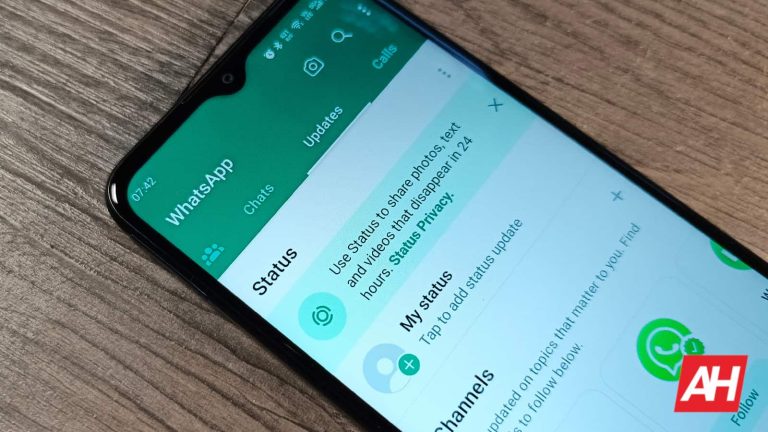
When using WhatsApp, especially for business, you want to make sure that your data is all backed up. You never know when you’re going to need it. This is why the app allows you to back up your data using the cloud. iPhone users can back up their data to iCloud, and Android users can back up their data to Google Drive. Well, unfortunately, WhatsApp backups now eat into your Google Drive storage.
Ever since 2018, Android users have been able to back up their storage to Google Drive, and their backups would not count toward their drive storage. This is great for free Google Drive users who only have access to 15GB of cloud storage. However, all good things must come to an end
WhatsApp backups will count toward your Google Drive storage
This is unfortunate, but it wasn’t unforeseen. WhatsApp announced this back in November. It said that this is going to come to an end in early 2024. Well, it’s early 2024, and people are starting to see this happen. So, if you have a ton of data backed up to your WhatsApp account, you’ll want to see how much space is being taken up.
A good way to check is to go to the Google One app. Open the app and go to the storage tab at the bottom. There, you’ll see a breakdown of how much storage is being used from different Google services like Gmail, Google Photos, ETC. Your WhatsApp data should be under a section named “Other”. It will show you how much storage is being taken up by your WhatsApp data.
Managing your data
So, if you want to reduce how much data is being taken up by WhatsApp, tap on the WhatsApp section on the storage page. You’ll be taken to another page that shows you a breakdown of all of your WhatsApp files. Look through your files, and see which ones you want to keep and which ones you want to trash. You never know if you’re holding on to old files that you don’t need anymore.
If you want to stop backing up your data altogether, go to WhatsApp and go to your Settings. There, tap on the Chats button. Go to the bottom and click the chat backup button. About halfway down, you will see the Backup to Google Drive button. Tap on that and choose the Never option up top.
Foldable phones are getting better over time, but one issue they’re still battling is poor battery life. Because of the nature of their design, clamshell foldables are stuck with smaller batteries. This means that phones that should realistically use 5,000+mAh batteries are stuck with sub-4000mAh batteries. However, it appears that the Galaxy Z Flip 6 could have a nice capacity boost over the Galaxy Z Flip 5.
Why do clamshell phones have smaller batteries? Well, a battery in a typical slab phone occupies a large section of its internal space. Whoever, in a foldable phone, the hinge takes up a lot of space that would otherwise have been occupied by the battery. So, a large chunk of the battery can’t exist, reducing its size.
The Galaxy Z Flip 6 could have a larger battery than its predecessor
We’re still months away from this phone’s unveiling, so you’ll want to take this news cautiously. At this point, it’s still a leak, and information is subject to change in the coming months. According to a new leak, Samsung is testing a battery with a notably higher capacity than what we saw in the Galaxy Flip 5. Last year’s Flip phone had two batteries with a combined rated capacity of 3,591mAh; that equals an advertised capacity of 3,700mAh.
Well, according to the leak, Samsung is testing two batteries with a combined of 3,887mAh. That equates to an advertised capacity of 4,000mAh. That’s an 8% increase over last year’s advertised battery capacity. That’s a nice battery capacity increase, and it could bring this phone’s battery a little bit closer to what a typical slab phone would have. It’s still far behind the standard 5,000mAh battery that we see across the industry. However, it’s still a step in the right direction.
Right now, it’s evident that Samsung is still in the early stages of testing this phone. Either that, or the phone’s been in active production for months, and this leak is explaining months-old data. Devices are usually in production long before we even start getting leaks about them. There’s no doubt that Samsung was already putting the Galaxy Z Flip 6 together before the Galaxy Z Flip 5 even launched.
AT&T Cybersecurity warns of a new threat: Microsoft Teams targeted for phishing and malware attacks. Learn how to protect your organization against these evolving cyber threats.
Cybersecurity experts from AT&T Cybersecurity have uncovered a concerning trend: Microsoft Teams, the widely used collaboration platform, being exploited as a vector for phishing scams and malware attacks.
While traditional phishing via email remains a pervasive threat, the integration of External Access in Microsoft Teams has opened up a new frontier for malicious actors to exploit. For your information, External Access enables streamlined communication and collaboration with individuals outside your organization using Teams, Skype for Business, or Skype.
In a recent incident reported by AT&T Cybersecurity’s Managed Detection and Response (MDR) team, a client raised alarms after an external user, not affiliated with their organization, initiated unsolicited Microsoft Teams chats with internal members. Suspicions were raised, and upon investigation, it was confirmed that the chats were indeed phishing lures.
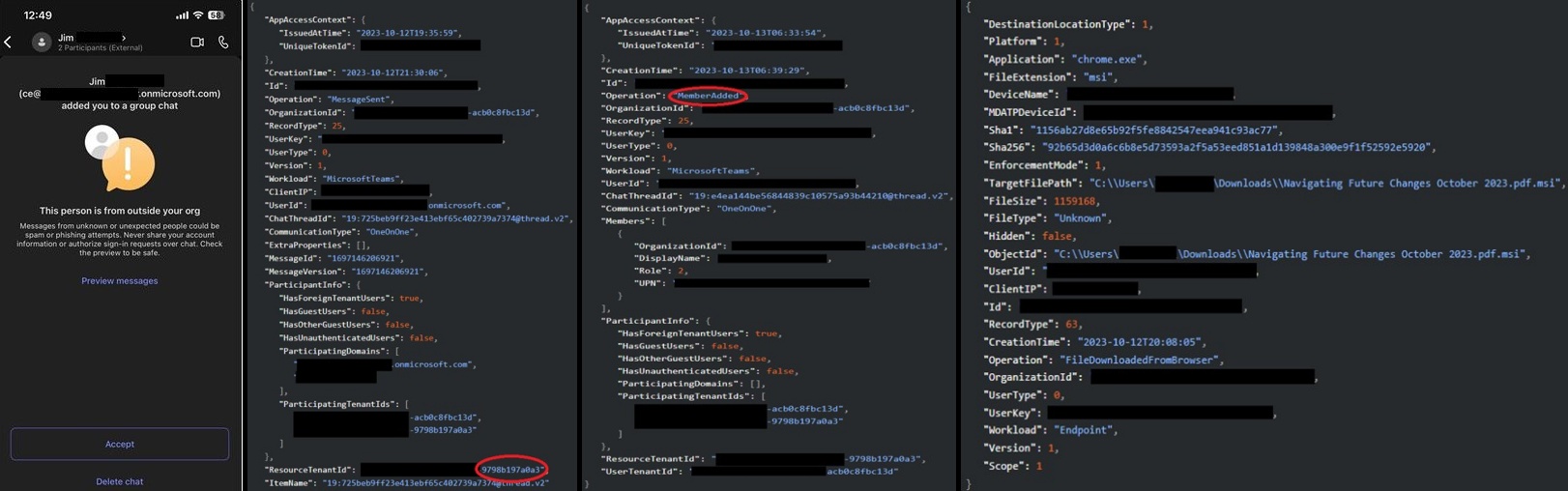
Message sent by the malicious external user, user tenant ID, Member Added event and the malicious file used in the attack (Screenshots: AT&T Cybersecurity)
The sophistication of the attack was revealed in a blog post published on January 30, 2024, as the MDR team delved deeper into the incident. Analysis of the tactics and indicators of compromise (IOCs) employed by the attacker uncovered associations with DarkGate malware, a notorious threat in the large as well we small businesses.
The DarkGate malware first emerged on December 25th, 2017, initially functioning as a password stealer and cryptocurrency miner, primarily spreading through Torrent files. It was identified by enSilo researcher Adi Zeligson, who observed its targeting of Windows workstations.
In October 2023, DarkGate resurfaced, this time associated with threat actors based in Vietnam. Their latest campaign focused on infiltrating META accounts, particularly in India, the United States, and the United Kingdom.
As for the latest attack, the timely intervention of the MDR SOC team thwarted the attack before significant damage could occur, showcasing the importance of proactive cybersecurity measures.
Key to the investigation was the identification of suspicious activities within the Teams environment. Over 1,000 Microsoft Teams events were flagged, indicating the scope of the phishing attempt. By leveraging Microsoft 365 tenant IDs and meticulously tracing chat interactions, the MDR SOC team successfully pinpointed compromised accounts and assets for remediation.
Further examination revealed that some users had unwittingly downloaded double-extension files, a common tactic used by attackers to conceal malicious executables. Armed with this information, the client swiftly took action, initiating password resets and isolating infected assets to contain the threat.
As organizations increasingly rely on collaboration platforms like Teams for remote work, they must remain alert against emerging threats. Recommendations from AT&T Cybersecurity include considering the disabling of External Access in Microsoft Teams, unless essential for business operations, and reinforcing user training to recognize and report phishing attempts across all communication channels.