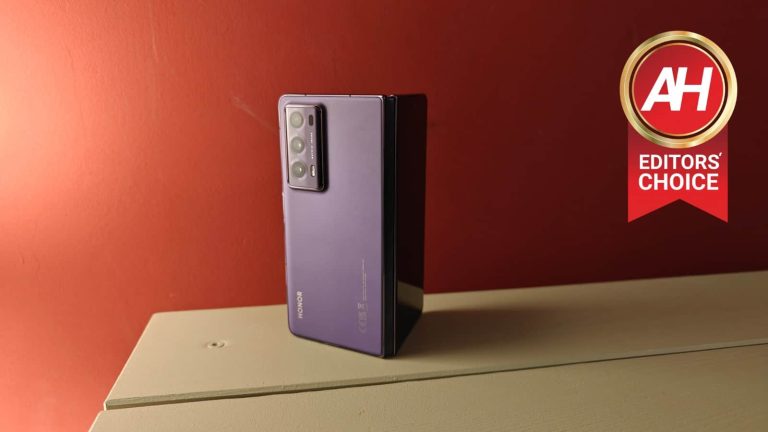
The global variant of the HONOR Magic V2 finally launched, and here’s our review of it. I’ve been using this device for quite some time now, actually, despite the fact it launched globally today. First I had some experience with the Chinese model in Berlin at IFA, which was last September. Then the global variant was shipped my way weeks ago. I’ve been using the device for over two weeks at this point, and I do have a lot to say.
The HONOR Magic V2 managed to wow me back at IFA. It had the same effect on many other people, mainly due to its design. This phone was (and still is) incredibly thin and light for a book-style foldable, and it doesn’t feel cheap or bad because of that. HONOR managed to achieve something great here, and I couldn’t wait to get my hands on it. So, let’s see what you’re getting here, shall we?
Table of contents
HONOR Magic V2 Review: Hardware / Design
The HONOR Magic V2 is made out of metal and either glass or vegan leather, depending on the model. There’s also the Porsche Design variant, which looks a bit different, but it still has glass on the back. Either way, we’re focusing on the regular model with a glass back, as that’s the one I reviewed. I got the Purple variant. The other variant that will be available outside of China is the ‘Black’ model, and that model has a vegan leather backplate.
The HONOR Magic V2 is gorgeous, but also very slippery
First things first, the glass Magic V2 is immensely slippery. It’s very comfortable to hold when folded, due to its rounded shape, but that only makes it more slippery. A very slim case is included for the phone’s back, and it does add plenty of grip, and it even has a kickstand, more on that later, though. The HONOR Magic V2 is only 10.1mm thick when folded, the vegan leather model is 0.2mm thinner. When unfolded, it’s incredibly thin at 4.8mm (0.1mm less for the vegan leather unit). My model weighs 237 grams, while the vegan leather unit is 6 grams lighter. In translation, this phone is lighter than some regular flagships out there.

HONOR does a great job designing its products, as they’re usually very pleasant to hold. That goes for its mid-range smartphones too, such as the HONOR 90, and budget phones like the Magic6 Lite. The same goes for this foldable. It’s very comfortable to use. Its sides are not flat, but slightly curved. The hinge is very narrow, and it only helps make this phone look truly unique. All the physical buttons are on the right side when the device is folded, while the volume rocker buttons jump on the left side when you unfold the phone. You also do get that satisfying thump (for lack of a better word) when the phone is unfolded or folded. It confidently folds and unfolds, and it’s actually a pleasure to do, which is the complete opposite of what the HONOR Magic Vs offered. So that’s great to see.
The bezels around both displays are very thin
On the phone’s main display, you’ll notice a centered display camera hole. The bezels around the display are very thin, and the right side is even slightly curved. There is also a camera on the main display, which is centered on the right half of the display if that makes sense. The bezels around the main display are also quite thin.
If we flip the device around, you’ll see a gorgeous-looking purple backplate. HONOR used dark purple color here, but it does change shades depending on the ambient light. It also has this glitter effect when it’s out in the sun. All in all, it really does look outstanding. The camera island sits in the top-left corner, and it does protrude a bit. HONOR included three cameras in there. HONOR’s logo is also on the left side, but in the bottom-left corner, and it’s vertically aligned.

This phone feels like a regular smartphone when folded
If one of Samsung’s foldable flagships is the only one you’ve used thus far, simply handling this phone will seem like a revelation. Not only is it much thinner, and lighter, but it simply feels nicer in the hand. On top of that its display crease is almost not there. It’s much better than the one on the Galaxy Z Fold 5, for example. You can see it under certain angles, but you can barely feel it with your finger. Overall, HONOR did an outstanding job with the design here, that’s for sure.
A nice case is included in the box
There is a case included in the HONOR Magic V2 box. It’s a very thin case for the back side of the phone. It covers the entire back when folded, and half of it when unfolded, of course. The case seems to be plastic, but it’s actually very grippy. It’s not your cheap, slippery plastic. Also, there is a stand built into this case, on the back. It stays in place with the help of a magnet, and you can easily pop it out when needed. You can use it to hold the phone, or to prop it up on the table. It also rotates, so getting the perfect angle is a joy. I really do appreciate HONOR included this case in the box. Not only does it add some much-needed grip to the device, but it barely adds any bulk to the phone. Considering the inclusion of this case, I didn’t even feel the need to get another one.
HONOR Magic V2 Review: Display
Considering this is a foldable phone, there are two displays to speak of, of course. The main one is a 7.92-inch panel with a resolution of 2156 x 2344 pixels. This is an LTPO OLED display that can project up to 1 billion colors. It supports HDR10+ content, and it’s ‘IMAX Enhanced’. The refresh rate here goes up to 120Hz. Its peak brightness is at 1,600 nits, and the bezels around it are very thin. There is a display camera hole on the right side of that panel, up top. It’s centered on the right portion of the display if that makes sense. The cover display, on the flip side, measures 6.43 inches. That panel has a resolution of 2376 x 1060 pixels. It’s also an LTPO OLED display that can project up to 1 billion colors. It supports HDR10+ content and its refresh rate peaks at 120Hz. HONOR used nanocrystal glass 2.0 to protect this panel. This display peaks at 2,500 nits, theoretically.

Both displays are excellent, and a huge improvement over the Magic Vs
Now, the HONOR Magic Vs, the company’s foldable phone that came before this one, didn’t have very balanced displays. Its main display had a lower refresh rate than the cover one, and using them felt disjointed. That’s not the case here. You’re getting the exact same experience, and it’s also great, by the way. Both panels are immensely responsive and do get very bright. It’s wintertime here, but we did have some sun during my usage, and both panels were very bright outdoors, I don’t see brightness being a problem, at all. The viewing angles were also great on both displays, and so was the touch response. The colors do pop, and the blacks are as deep as you’d expect them to be. Both displays are also more than sharp enough. The cover panel does have lower sharpness, but it’s also smaller. You won’t really notice the difference, to be quite honest.
The crease on the main display is not very noticeable
The phone’s foldable display does have a crease, but you’ll only notice it under certain angles if you tilt the phone to the side. You’ll barely feel it when going over it with your finger, and will even forget it’s there after a brief period of time. This crease is one of the most minimal ones in the industry. It’s on par with what OPPO has to offer in that regard, and much better than what Samsung offers on its foldables. It has to be said, as the difference truly is monumental. It’s hard to describe how not an issue this crease is. You have to experience it for yourself to truly appreciate it.

I don’t really have any complaints about either of these two displays. They’re bright, vivid, responsive, have great viewing angles, and even the bezels are minimal. You’ll enjoy using both of them equally, but for different things, of course.
HONOR Magic V2 Review: Performance
The HONOR Magic V2 is fueled by the Snapdragon 8 Gen 2 SoC. That is technically not the most powerful processor Qualcomm has to offer at this point. It was back when the Magic V2 launched, but not anymore. That doesn’t mean that it doesn’t offer great performance, though, because it does. The Snapdragon 8 Gen 2 is still around the top of the food chain, and that shows on this phone. Before we get into the performance, do note that our model runs 16GB of LPDDR5X RAM and 512GB of storage.
General day-to-day performance is outstanding
The general performance was outstanding. The phone was able to multitask with ease, and it fired up apps really quickly. Everything ranging from browsing and taking pictures, to image processing and consuming multimedia worked flawlessly. The gaming was also not an issue, and even though the phone did get quite warm after a longer session of Genshin Impact, it never got too hot to hold or anything like that. That’s quite a feat considering how thin the HONOR Magic V2 is. Games that were not as demanding only made the phone warm, nothing above that.
I did not notice any unusual slowdowns or outstanding performance-related crashes. I’ll talk more about the software itself in a different section, as there’s plenty to talk about. Regarding performance itself, there’s nothing to complain about.
Benchmarks
We’re not the biggest fans of benchmarks, but many of you want to see them. Also, they’re great indicators of raw performance capabilities in some cases. Below, you’ll see three different benchmarks. The Geekbench 6 will give you a general idea of the raw power of this phone, considering its specifications. You’ll see both the Magic V2’s CPU and GPU performance levels. The second benchmark is the 3D Mark Wildlife Extreme Stress Test. That test runs 20 loops of simulated usage on the phone, and it really pushes the phone to its limits. The Magic V2 didn’t get too warm at any point, not even during this stress test, which is great to see. The last benchmarks shows how long it takes for the HONOR Magic V2 to export a video (1080p, 30 FPS) using CapCut.
Geekbench 6
CPU (single-core): 1,908
CPU (multi-core): 4,573
GPU: 8,745

3D Mark Wildlife Extreme Stress Test
Video export test
It took the phone 16.99 seconds to export a full HD 30 FPS video.

HONOR Magic V2 Review: Battery
HONOR managed to pack a 5,000mAh battery inside of this phone. Does that seem impossible considering how thin and light it is for a foldable phone of that size? Well, it would be, if the company used a regular battery. HONOR reached for a silicon-carbon battery in order to make that happen. That battery offers a higher density and thus needs less space to provide the same battery capacity. These batteries provide a 12.8% higher energy density compared to lithium batteries, in case you were wondering.
HONOR managed to fit in a 5,000mAh battery here, a higher density battery
With that being said, a 5,000mAh battery pack is actually great for a foldable smartphone of this size. The Magic V2 basically has a larger battery pack than the competition. Does that reflect in terms of battery life? Well, I wouldn’t say that the phone has outstanding battery life, but it sure is excellent. In our battery stress test, it landed below the OPPO Find N3. That’s just a benchmark that we use and doesn’t necessarily reflect real-life usage. In real-life usage, however, the Magic V2 did perform similarly to the best from OPPO.

I’m getting over 7 hours of screen-on-time, and even over 8 hours at times. Do note that my usage between the two screens is somewhat balanced, but I’m using the outer screen more. I’d say it’s about 60:40. Also, I spend most of my days on Wi-Fi. I did use 5G more on a couple of days, and have noticed a dip in terms of endurance. Truth be said the signal was also not the best, so… take that into account. I’d say this is really good battery life, though, I didn’t have to plug in the phone before the end of the day at all, not once.
The battery life was really good
Also, to clear things up, I didn’t play games on the device, outside of testing. I do use my phones quite intensely, though. Ranging from messaging, sending emails, browsing and taking pictures, to processing images, processing videos, transferring files, consuming multimedia via YouTube and TikTok (mostly), and so on. The HONOR Magic V2 handled all that with grace, not only on the performance side of things but in the battery department as well.

66W charging is fast enough
What if you run out of battery before the end of the day? Well, don’t fret, as 66W wired charging is on offer here. Wireless charging is not on offer, as HONOR wanted to keep the phone as thin and light as possible. That omission may bother some of you, but we are getting rather fast charging. Getting this phone from 0 to 100% takes less than an hour. That’s much faster than the Galaxy Z Fold 5 has to offer, for example. When I specifically tested how long it takes, the phone fully charged in 55 minutes. You’ll be glad to know that a charger is included in the box too. OPPO provides a 66W charger, along with a Type-A to Type-C cable in the box.
HONOR Magic V2 Review: Camera
The HONOR Magic V2 doesn’t exactly have the most powerful camera setup out there, but to be quite honest, I was pleasantly surprised. Don’t get me wrong, the camera setup itself is not bad at all, but some phones in the market really pushed up the ante. In any case, you’re getting a 50-megapixel main camera here with OIS, Laser autofocus, and PDAF. 8×8 dToF is included, and we’re looking at an f/1.9 aperture lens here.
Another 50-megapixel camera sits on the back, the phone’s ultrawide snapper. That camera has an f/2.0 aperture lens and an 13mm lens. It’s less fancy than the main shooter, of course. The third camera is a 20-megapixel telephoto unit with 2.5x optical zoom. That camera does offer OIS support, and PDAF as well. It’s the equivalent of a 62mm lens, in case you were wondering. Each display has a 16-megapixel camera placed on it, and a hole punch too.

The camera performance is good, but not excellent
With that being said, is the camera performance any good? Well, yes, it is, though it’s not at the very top of the pecking order. The images that come out of the main camera are good in most lighting conditions. The thing is, they can look a bit artificial at times. The colors can be a bit too saturated. Also, in some scenes, you’ll notice a bit more sharping than should be used, but that is not an often occurrence when it comes to the main camera. The main camera actually does a good job with processing. If you pixel peep, you will find flaws, of course, as the images are not as sharp as the very best phones out there offer, but those are not the differences most people will care about.
In low light, the phone tends to brighten up the scenes quite a bit. That’s what most phones do, as they don’t have the advantage of huge 1-inch camera sensors. Most of the time, I was happy with the results. Just keep in mind you’ll need to keep your hand rather still in low light and let the phone do its thing, otherwise you’ll end up with a blurry shot. I realized that’s more of the case here than on some flagship phones, but it’s not a big deal. There is a separate night mode included, but you won’t need to activate it. The phone recognizes when you’re in low light, and will do everything on its own. It doesn’t take too long to take images either unless you’re in really pitch-black situations.
Ultrawide camera does manage to keep up with the main sensor, where it matters
The ultrawide camera does its best to keep up with the main shooter in terms of the color profile. It actually doesn’t do a bad job with it either. Most of the time, the colors are similar, but that’s not the rule. It all depends on the scene. The quality of the main snapper is obviously higher when you compare the images, though. The ultrawide camera does have more of a darker tone sometimes though, and can be a bit colder than the image the main camera provides. You’ll notice a more pronounced difference in low light, as noise will creep in a bit, and images won’t be as sharp as the ones provided by the main sensor.

What managed to surprise me most was the telephoto camera, however. I didn’t expect much from this 20-megapixel camera, as it only offers 2.5x optical zoom. To my surprise, however, 5x shots were not bad at all most of the time, and even some 10x shots that I took were usable. Don’t get me wrong, having a dedicated 5x or 6x camera would be far better, but for what it is, it’s not bad. During the day, the camera is actually really good, while the quality does deteriorate in nighttime situations, but it’s still good.
Portrait should can look a bit artificial, but they’re generally good
The phone also takes really good portrait shots, and macro images are not bad either during the day. The point I’m trying to make is… this phone can take really good photos. it’s not the best camera out there, not at all, but for the vast majority of people, this will be more than enough. I was pleasantly surprised, though my expectations were not as high.
Main camera samples:
Ultrawide camera samples:
Telephoto camera samples:
HONOR Magic V2 Review: Software
The HONOR Magic V2 comes with Android 13 out of the box. On top of it, you’ll find HONOR’s MagicOS 7.2 skin. Those of you who have used one of HONOR’s smartphones in the last couple of years will be right at home here. Not much has changed, and there are some features that HONOR added for foldable displays, but not much. I’ve seen far more options and general features available on other devices, so I do hope that MagicOS 8 will change that. This phone could benefit from more features that target its foldable form factor, and by that, I primarily mean revamped multitasking. Some of the competitors are ahead in that regard.
MagicOS is not for everyone, but it works well
With that being said, there is a lot to like in MagicOS, as long as you don’t mind getting into something different. MagicOS is not exactly all that similar to stock Android. In fact, it’s more different than a number of other Android skins are, including OxygenOS, ColorOS, ZenUI, and so on. HONOR’s devices are rocking a skin that is a mix of Android and iOS in a way and the company’s users seem to like it… so, as long as it works… you know how the saying goes. We’ll get a bit more into it, of course, as it’s the main thing you should know about MagicOS going forward.

What exactly am I talking about? Well, first of all, all your apps are on your home screens by default. Not their shortcuts, but your home screen acts as an app drawer. That’s the case on many other Android skins though, and luckily you can change that. On some previous versions that was not possible. That’s not too bad. What else? The notification shade is also considerably different, as is the screen with quick toggles. Yes, those are two separate screens, unfortunately, and no, you cannot combine them. You access the notification shade by swiping from the top-left side of the screen while doing the same from the top-right will get you your quick toggles.
It’s clearly inspired by iOS
Even the notification cards are transparent, which is more in line with Apple than any other Android OEM. To make things even more similar to iOS, the notification cards are navigating towards the bottom of the screen when you’re on the lock screen. They also disappear from the lock screen when you see them, even if you didn’t open them. The same way it works on iOS, basically. The thing is, it doesn’t happen with everything, even though the settings are the same. For example, it did not happen with Gmail for me, even though the settings are exactly the same as for my messaging apps… and yet it happens with all the messaging apps. I didn’t find a way to change this behavior, which was annoying.
There’s some customization included, but not a lot
There is some customization here, but not a lot. MagicOS allows you to change up the icons, but the options are not exactly vast. It does not support third-party icons from the Google Play Store, unfortunately. You’re also quite limited in terms of the home screen. There is no double tap to lock screen option, nor can you swipe from top-down in order to call up the notification shade. That action is reserved for HONOR Search (system-wide search), and if you don’t want to use it, you can disable the gesture. There is no secondary option, unfortunately. You can change the icon layout on the home screen, but barely. Only 4×6 and 5×6 options are at your disposal.

What about some special features, you may wonder? Well, there are some. The Always-On Display (AOD) is available, and there are quite a few options that you can choose from there. HONOR has a really nice one-hand mode too. By swiping from left to right (or vice versa, at the bottom of the screen), and pausing for a second, you’ll activate one-hand mode. The screen will shrink down, and navigate to the corner you activated it from. This way it’s great for both lefties and righties, and it makes everything rather easy to reach when you’re using the phone in folded mode.
You do have access to knuckle gestures, Multi-WIndows, and more
What else? Well, there are knuckle gestures. You can use your knuckles to capture a screenshot, a partial screenshot, and so on. The so-called ‘Multi-Window’ dock is also quite useful. By swiping from the right side of the screen and pausing, that dock will open. From there, you can jump into a split screen mode, or open a floating window. That’s something most of you will be using on the main display, of course. You can achieve the same things without a Multi-Window dock, by the way. You’ll see a white horizontal line at the top of the screen when you’re in an app. Dragging that somewhere will activate different functions, which is also rather useful.
There’s not much to find in the ‘Foldable phones’ submenu. It’s mostly things related to app scaling. There’s also the ‘Parallel Space’ option. This is actually a very neat feature that allows you to separate your workspaces, essentially. It’s especially useful on the main display. It works really well. One thing I’d like to note when it comes to jumping from the main to the cover display, and vice versa, is that some apps don’t really play nice with it. The apps won’t reload on their own, but instead get a weird layout and a notification that offers you the chance to reload the app manually. It would be nice to have an option to avoid this entirely, and simply force the app to reload or something if it’s not coded properly to switch between screens. I am talking about third-party apps here, by the way, the native ones work beautifully. What’s odd is that some apps that switch screens nicely on other foldables don’t do the same here, apps like Feedly, for example. That leads me to believe it’s due to MagicOS, but I cannot be sure.
There are quite a few pre-installed apps, but you can remove the vast majority of them
When it comes to pre-installed apps, there are quite a few here. Google’s essential apps are included, and HONOR does include quite a few of its own apps. The thing is, you can easily remove plenty of those. You can even remove most of HONOR’s pre-installed apps, all but the essential ones. HONOR Search, for example, is removable, and the same goes for Device Clone. You can even ditch the HONOR Push service if you want, though that one can only be disabled, not removed from the phone entirely. You shouldn’t be worried about pre-installed software, to be quite honest, you really can ditch many of it if you choose to do so.
Overall, I do feel like MagicOS needs a revamp. I’ve been having that thought for quite some time now. Yes, it works very smoothly and all that, but it just doesn’t seem coherent from one side to the other. In one menu there’s a see-through card, in the other, there’s not. Also, HONOR should offer some more customization options, and introduce some features that other Android OEMs have been carrying for quite some time now. On top of that, a new multitasking UI for the main display wouldn’t hurt either. If you do tend to like MagicOS, well then, this is just the right Android skin for you, as it really does work really well from the performance side of things. The animations are as smooth as butter, and everything simply flies.
MagicOS 7.2 on the HONOR Magic V2:
HONOR Magic V2: Should you buy it?
HONOR made a considerable move forward with the Magic V2, compared to the HONOR Magic Vs. Not only is the hardware a lot better than it was, ranging from the general feel to the size, folding mechanism, and so on… but the use of a silicon-carbon battery is also a smart move. This phone is not perfect, but if you don’t mind MagicOS; or actually like HONOR’s software, this could be a great option for you. The phone originally launched in China, but the company did announce its availability for Europe as well. In other words, the global variant is now also available, and this phone surely has a lot to offer. It sure is not cheap, but if you want one of the best foldables around, which shocked the world with its thinness and weight, this is a great choice.

You should buy the HONOR Magic V2 if you:
…want the thinnest book-style foldable on the market
…want a foldable phone that feels like a regular phone when folded
…need good battery life in a compact foldable form factor
…want to experience a different feel to a foldable phone
…need a large display, but hate bulky foldable smartphones
…want a good camera, but it doesn’t have to be the very best
…want a phone that adapts to you
You shouldn’t buy the HONOR Magic V2 if you:
…need water and dust resistance
…want the very best camera on a foldable phone
…need wireless charging
[ad_2]
Source link