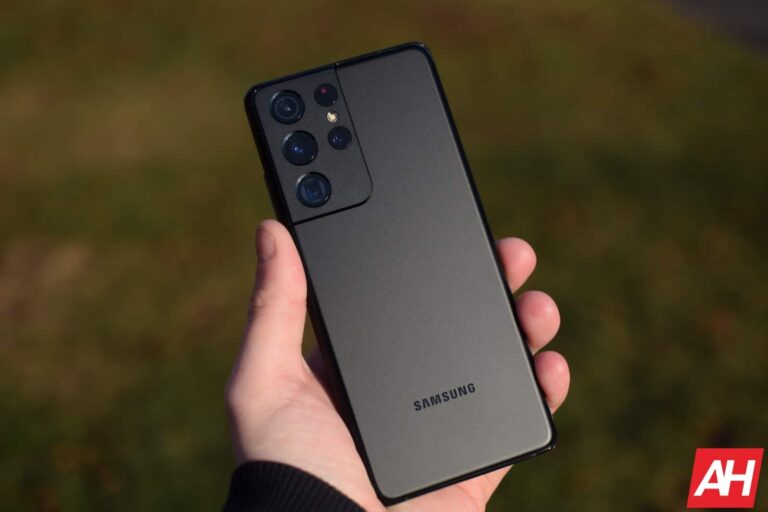
It’s been nearly a week since Samsung launched its 2024 flagship lineup, the Galaxy S24 series. As usual, people have started delving deeper to find out a winner between the Galaxy S24 Ultra and last year’s iPhone 15 Pro Max, in their own ways. One of the ways to find out the winner turned out to be the storage speed test.
@sakitechonline on X measured the storage speed with a synthetic benchmark called Jazz Disc Bench, where the Galaxy S24 Ultra surpassed last year’s iPhone 15 Pro Max with a decent margin. For those unaware, the Galaxy S24 Ultra comes with the UFS 4.0 storage while the iPhone 15 Pro Max comes with its iconic NVMe storage. According to ‘allaroundreview’, the UFS 4.0 storage is significantly faster than the NVMe modules used on iPhones.
Galaxy S24 Ultra performed 75% faster in sequential read speed
According to the results obtained by sakitech, the Galaxy S24 Ultra scored 75 percent higher than its competitor in sequential read speeds and 15 percent higher in sequential write speed. Speaking of numbers, the ultra flagship from Samsung achieved a transfer speed of 2547.26MB/s as compared to 1450.42MB/s of the iPhone. The write speeds are relatively close at 1442.25MB/s and 1257.99MB/s from the Galaxy S24 Ultra and iPhone 15 Pro Max respectively.
Notably, the random read and write speeds are also quite a bit higher on the Samsung flagship as compared to the iPhone. The latency in read and write speeds is also lower (better) on the Android side.
However, faster loading of Apps and games depends on the Apps themselves and the OS as well
While the numbers shown by Jazz Disc Bench will surely impress users of the latest Galaxy flagship, one should also consider the fact that the two phones are running on completely different platforms and the apps are also built differently.
Not to mention, how an app, for example, YouTube, interacts with the system in two different cases is also not going to be identical. Real-life performance for different apps may vary based on their optimization with the platform, and sometimes this may lead to results that deviate from the showcased benchmarks.
In conclusion, loading times and overall response in heavy apps and games will also depend on system-specific optimization.
OPPO announced its new flagship this month, and our review went out quite recently. Having said that, in this article, we’ll compare it to one of the best flagships around. We’ll compare the Google Pixel 8 Pro vs OPPO Find X7 Ultra. These two smartphones are both quite powerful, but they’re also quite different at the same time. They not only look different, but have different sets of specs, and approaches to photography too.
We’ll kick things off by comparing their specifications, and will then move to a number of other areas. You’ll see a comparison between their designs, displays, performance, battery life, cameras, and audio output. Before we start, do note that the OPPO Find X7 Ultra is not available globally at the time of writing this comparison. The chances of that changing are very slim. It does work fine when you install the Google Play Store, though, so… importing is always an option. Having said that, let’s get started.
Specs
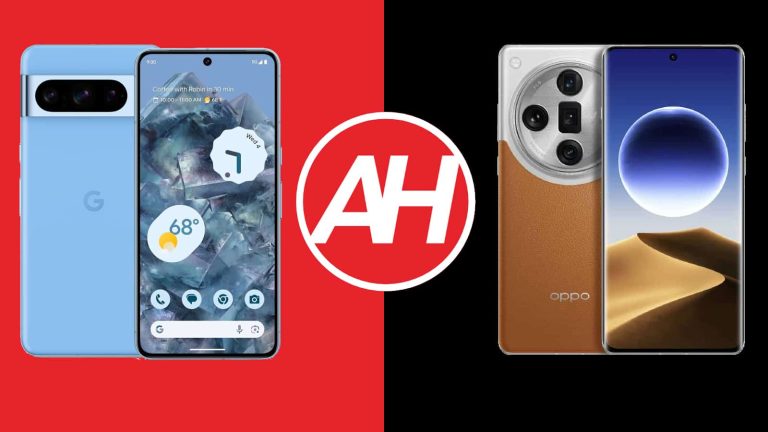
Google Pixel 8 Pro vs OPPO Find X7 Ultra, respectively
The moment you lay eyes on these two phones you’ll notice how different they are. The Google Pixel 8 Pro is made out of metal and glass. It has a flat display on the front and a centered display camera hole. The bezels around its display are immensely thin. The OPPO Find X7 Ultra is made out of metal, glass, and vegan leather, as vegan leather covers two-thirds of its backside. It has a curved display, a centered display camera hole, and very thin bezels around its panel.
Now, on the back of the Pixel 8 Pro, you’ll find glass and a camera visor. That camera visor is horizontally aligned, and it stretches from the right side of the frame to the left. It does protrude noticeably. The OPPO Find X7 Ultra has glass and vegan leather on the back and a huge camera oreo. That camera oreo also protrudes quite a bit. Both camera bumps are a good anchor for your finger when you hold these devices. Due to its vegan leather on the back, we found that the OPPO Find X7 Ultra is less slippery. Neither phone is particularly grippy, though.
The OPPO Find X7 Ultra also has an alert slider on the back, unlike the Pixel 8 Pro. That’s a three-step alert slider. Physical buttons sit on the right-hand side of both phones, but they have different alignments. All physical buttons are quite clicky, though. The OPPO Find X7 Ultra does have a slightly larger display, and it’s slightly taller, slightly narrower, and slightly thicker than the Google Pixel 8 Pro. It’s also slightly heavier, by 8 grams. It’s worth noting that both smartphones are IP68 certified for water and dust resistance and that both feel like premium devices.
Google Pixel 8 Pro vs OPPO Find X7 Ultra: Display
The Pixel 8 Pro includes a 6.7-inch 2992 x 1344 LTPO OLED display on the back. That panel is flat, and it offers an adaptive refresh rate, it can go from 1 to 120Hz. This panel supports HDR10+ content, and its max theoretical brightness is 2,400 nits. The display aspect ratio is 20:9, and the display is protected by the Gorilla Glass Victus 2. The bezels around this display are very thin.
The OPPO Find X7 Ultra, on the other hand, includes a 6.82-inch QHD+ (3168 x 1440) LTPO AMOLED display. This display is curved, and it can project up to 1 billion colors. It has an adaptive refresh rate (1-120Hz), and supports Dolby Vision too. HDR10+ content is supported, and the maximum theoretical brightness is at 4,500 nits. The Gorilla Glass Victus 2 protects this display. The bezels around the panel are very thin.
There’s really not much to complain about here, regarding either display. Both are outstanding, actually. Not only do they offer great viewing angles, and very vivid colors, but they’re also quite color accurate. On top of that, they’re very sharp and have good touch response as well. Both panels also get more than bright enough in all situations, even when you’re outside in direct sunlight. You’ll be happy with either of these panels.
Google Pixel 8 Pro vs OPPO Find X7 Ultra: Performance
The Google Pixel 8 Pro is fueled by the Google Tensor G3 processor. Google also included 12GB of LPDDR5X RAM inside of the device, along with UFS 3.1 flash storage. The OPPO Find X7 Ultra, on the other hand, comes with the Snapdragon 8 Gen 3 processor. OPPO also placed up to 16GB of LPDDR5X RAM inside of the phone, along with UFS 4.0 flash storage. OPPO’s handset does have a theoretically more powerful processor and faster storage. The Tensor G3 is made for the Pixel, though, and it does bring plenty of AI features to the table.
Both of these smartphones do offer great performance, to say the least. For the vast majority of tasks, both smartphones are truly fluid. They can multitask like nobody’s business while consuming multimedia, browsing, emailing, and other everyday tasks are not a problem at all. Even image and video editing, and some more advanced tasks are running smoothly, at least they did for us.
When it comes to gaming, the OPPO Find X7 Ultra does have the advantage. It not only has faster storage but also a more powerful processor. We did notice that extremely demanding games are running better on OPPO’s handset, at the highest settings. Still, the Pixel 8 Pro can play those games too, they’re definitely not out of the question. Neither phone got too hot while running those games either. There’s also no outstanding lag to talk about either.
Google Pixel 8 Pro vs OPPO Find X7 Ultra: Battery
You will find a 5,050mAh battery inside Google’s flagship, while the OPPO Find X7 Ultra carries a 5,000mAh unit. The battery life is very good on both smartphones, though we’ve experienced better results on the OPPO Find X7 Ultra. The Pixel 8 Pro managed to get around 7+ hours of screen-on-time for us, most of the time. We managed to get over the 8-hour mark a couple of times.
The OPPO Find X7 Ultra was able to cross that 8-hour mark consistently, and even go beyond it at times when needed. Having that in mind, both smartphones do offer very good battery life, and chances are both will be able to get you to the end of the day. Your mileage may vary, though, of course, so keep that in mind. Also, if you’re playing games on your phones, or run very demanding apps, the results will be different, of course.
In terms of charging, the OPPO Find X7 Ultra blows the Pixel 8 Pro out of the water. The Pixel 8 Pro supports 30W wired, 23W wireless, and 5W reverse wireless charging. It does not come with a charger in the box. The OPPO Find X7 Ultra supports 100W wired, 50W wireless, and 5W reverse wireless charging. A 100W charger is included in the box as well, so keep that in mind.
Google Pixel 8 Pro vs OPPO Find X7 Ultra: Cameras
The camera setups and general approaches to photography are completely different between these two phones. The Pixel 8 Pro has a 50-megapixel main camera, a 48-megapixel ultrawide unit (126-degree FoV), and a 48-megapixel telephoto camera (5x optical zoom). The OPPO Find X7 Ultra includes four 50-megapixel units. A 50-megapixel main camera (1-inch sensor) is backed by a 50-megapixel ultrawide camera (123-degree FoV), a 50-megapixel periscope telephoto unit (3x optical zoom), and a second 50-megapixel periscope telephoto camera (6x optical zoom).
OPPO not only includes a 1-inch main camera sensor, but rather large sensors overall. Even its ultrawide and periscope telephoto sensors are larger than the ones on the Pixel 8 Pro. On top of that, Hasselblad is a part of the picture here as well. Google is, however, using very compelling sensors too, and it’s well known for producing outstanding camera smartphones. How do they compare?
Well, both smartphones do provide outstanding results, which are different. The Pixel 8 Pro loves to use plenty of processing for images. It will provide you with great results in both day and night. Daytime images do look processed but in a good way. The HDR shots in particular end up looking great, while in low light the phone does like to brighten up the scene quite a bit. The ultrawide camera does keep up with the main unit in terms of colors, while 5x shots look great.
The OPPO Find X7 Ultra likes to keep things a bit closer to real life, but still make the photos pop. The images during the day are great, the HDR performance is outstanding, and the phone has an outstanding white balance. OPPO’s new flagship shines when it comes to images with demanding light sources. In low light, it tends to keep things a bit darker, and closer to real life, while obtaining plenty of detail. Even its secondary sensors do great in low light, including periscope telephoto cameras. The OPPO Find X7 Ultra also covers more focal lengths.
Audio
There is a set of stereo speakers on both of these smartphones. Those speakers are quite loud and well-balanced. There are some differences between them, but they’re minimal. You’ll be more than happy with both pairs.
What you will not find is an audio jack. You will need to use their Type-C ports in order to hook up your wired headphones, which will require a dongle. For wireless connections, however, Bluetooth is supported. The Pixel 8 Pro supports Bluetooth 5.3, while the OPPO Find X7 Ultra includes Bluetooth 5.4.
Google introduced “Help Me Write” to Gmail back in June of 2023, and now Gmail Voice Compose seeks to up that AI-powered convenience. AI tools have been making their way into all sorts of services and industries, and for good reason. Long gone are the days of wonky voice recognition and misbehaving mobile assistants. AI-powered voice recognition works wonders, naturally; as this was one of the first proposed uses of Large Language Models. Gmail’s newest upcoming feature will let you make use of this to craft professional emails just by speaking into your phone.
Gmail Voice Compose works just like “Help me write”
The “Help Me write” feature in the Gmail apps on Android and iOS lets users draft emails from snippets of text. Users write the main points of what their email is about, and AI does the rest. “Help Me Write” not only saves time, it drafts a complete and professional email from just a few lines of informal text. Voice Compose seems to work the same way, but by listening to a user speak instead of having them write.
As discovered by TheSpAndroid, the Gmail Android app version 2023.12.31.599526178 release contains a new feature accessible via toggling a flag value. This feature allows you to record yourself when writing an email by tapping a microphone button. When you’re done recording, hitting “Create” will prompt AI to create your email from your recording. Though very similar to the “Help me write” feature, Voice Compose is definitely faster and more convenient.
How does AI speech-to-text work?
AI speech-to-text is much more accurate at deciphering what someone says than older speech recognition models. The jump in capability was almost jarring, but also very understandable once you understand how LLMs work. Large Language Models, in a very simplified manner, are thought of as “word predictors”. As in, what they do is predict what word should come after the last one.
This definition does a disservice to the complex neural network LLMs possess, but it does help to understand how their speech recognition works. Older speech recognition models used to parse each sound and try to figure out what word it was. This would very often lead to completely nonsensical sentences. AI speech recognition doesn’t just listen to and parse each individual word. It compares it to everything that’s been said before and guesses what is most likely to have just been said. This is why AI speech recognition is miles ahead of older models; it has some intelligence behind it.
Gmail Voice Compose should be rolling out pretty soon as it’s been purported to have been in the works since October of last year. If it works as well as other AI speech-to-text models do, it will be a massive step forward in convenience for those who use the Gmail app.
Google this morning posted another teaser for the upcoming Mint color of the Pixel 8 Pro. This time suggesting what the hue or shade of green the color will be. If you missed it initially, at the end of last week Google teased the Pixel 8 Pro would be coming in a new color. The teaser didn’t explicitly state that a new color was coming. It did, however, say that fans should expect something “Minty Fresh” to be revealed on January 25. The hint was accompanied by a picture of a Bay Pixel 8 Pro being “spray-painted” over with green paint.
The color used for the paint seems the most likely to be what you can expect for the shade of this new colorway. But Google’s teaser from this morning might suggest something different. Or at the very least where Google might be drawing some inspiration from. Google is also pushing out its reveal for the morning of January 25. It was initially set for midnight on the day. But it now looks like Google is going to set the reveal for 6 a.m. Pacific Standard Time.
Mint Pixel 8 Pro teaser hints at ocean waves inspiring the shade of green
While it was assumed at first that the green spray paint might have been the shade of green Google would use, that might not be the case. The company’s second teaser shows the outline of the Pixel 8 Pro with a video of ocean waves playing inside of it. Near the beginning, you can see the waves crashing in and just for a brief second you get a glimpse at the waves looking almost light green. Sort of like mint.
What might be more important to pay attention to though is the blank area surrounding the Pixel 8 Pro outline. At first glance, it looks almost white. But if you look hard enough you can tell it’s actually a very light shade of green. This might be the shade of green Google uses for its new color release this week. You can see a similar shade, if not ever so slightly darker, being used on the ‘New Pixel Release’ landing page. A small banner halfway down the page highlights the mural painting event that takes place in New York City a couple of hours after Google’s 6 a.m. reveal.
As 9To5Google points out, Google technically already has a Green Pixel 8 series phone with the Hazel Pixel 8. But it is a much darker shade of green and is almost gray. This new Mint color looks to be quite a bit lighter. Perhaps almost pastel, not too unlike the Lemongrass Pixel 7.
In truth, it’s still unclear how green the new color will be. But it seems quite likely it’ll be somewhere around the light shade of green you can see in the image above, and the shade of green seen on the event banner on Google’s teaser page for the color reveal. Either way, everyone will find out for sure in just a couple of days.
Two separate reports surfaced regarding the Huawei P70, sharing not only the launch timeframe, but some specs too. Let’s talk about the launch information first, shall we?
The Huawei P70 launch timeframe has been shared, along with some specs
That information comes from a Weibo tipster known as fixed focus digital. He claims that the Huawei P70 series will launch towards the end of March this year, or in early April. No exact dates were mentioned, though.
That timeframe makes all the sense in the world as the Huawei P60 series launched at the end of March last year. Do note that this is probably a China launch, however, as the global launch may come later on.
A 6.7-inch quad-curved display is expected
Now, in regards to specs, this information comes from Digital Chat Station, one of China’s most prominent tipsters. He mentions a quad-curved OLED display with a 1.5K resolution. When it comes to size, a 6.7-inch panel was mentioned.
Two front-facing speakers could also be a part of the package, but machine translation is a bit weird about that part. Take that detail with a grain of salt, as we’re not sure that’s the message the tipster wanted to get across.
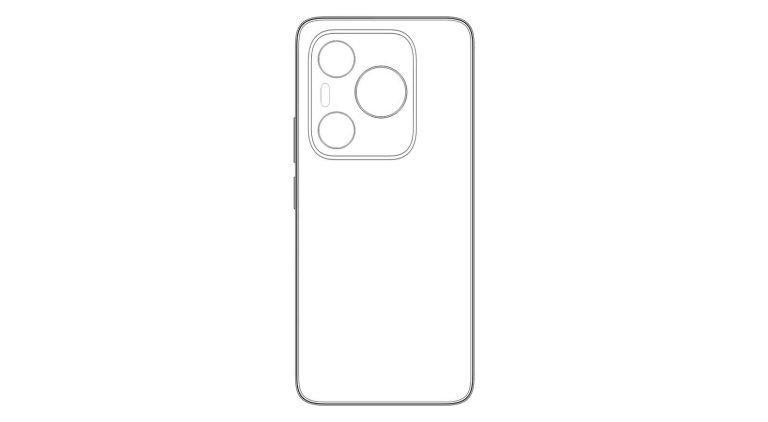
He did, however, mention three rear-facing cameras. The main one is expected to be OmniVision’s 50-megapixel OV50H unit. That camera will offer variable aperture, and this is a 1/1.3-inch sensor that we’re looking at. It will deliver a 1.2um pixel size.
The phone will come with a considerably better ultrawide camera
A 5,000mAh battery will also be included in the package, while the Kirin 9010 SoC could also be there. We wrote earlier about an upgraded ultrawide camera, so you can expect that too.
Just to be clear, the tipster mentioned this information tied to the Huawei P70 series. It’s possible some of it relates to the more powerful versions, though, the Huawei P70 Pro and Huawei P70 Art, which are expected. The Huawei P70 will be inferior to the other two models.
Amazon sells the Hisense 50-inch U6 Series Google TV for just $299. That’s going to save you over $200 off of the regular price. Which is low enough for an all-time low price on this model.
But other sizes are also on sale. The 58-inch is now $349 (reg. $599), the 65-inch is now $449 (reg. $749) and the 75-inch is now $629 (reg. $1,149). Great prices on all of these models to be honest.
The Hisense U6 Google TV is a great option for anyone looking for a high-quality 4K TV with a great smart TV platform. The TV features a number of impressive specs, including a 50-inch 4K Ultra HD display with HDR10+ support, a powerful quad-core processor, and 2GB of RAM. This combination of features provides smooth and crisp images with excellent color reproduction.
In addition to its impressive picture quality, the Hisense U6 Google TV also has a number of other features that make it a great choice for anyone looking for a smart TV. The TV runs on the Android TV operating system, which gives you access to a wide variety of streaming apps, including Netflix, Hulu, Disney+, and Amazon Prime Video. The TV also has a built-in Chromecast, so you can easily cast content from your phone or tablet to the TV.
Another great thing about the Hisense U6 Google TV is its price. The TV is currently on sale for just $499, which is a great value for all the features it offers. If you are looking for a great 4K TV with a great smart TV platform, then the Hisense U6 Google TV is a great option.
Here are some of the reasons why you should buy the Hisense U6 Google TV:
Excellent picture quality: The Hisense U6 Google TV features a 50-inch 4K Ultra HD display with HDR10+ support. This means that you can enjoy movies and TV shows with stunning clarity and detail.
Powerful processor: The Hisense U6 Google TV is powered by a quad-core processor and 2GB of RAM. This ensures that the TV can handle even the most demanding tasks, such as streaming 4K content or gaming.
Android TV operating system: The Hisense U6 Google TV runs on the Android TV operating system. This gives you access to a wide variety of streaming apps, including Netflix, Hulu, Disney+, and Amazon Prime Video.
Built-in Chromecast: The Hisense U6 Google TV has a built-in Chromecast. This means that you can easily cast content from your phone or tablet to the TV.
If you are looking for a great 4K TV with a great smart TV platform, then the Hisense U6 Google TV is a great option. The TV is currently on sale for just $299, so act fast before this deal expires.
Trezor, the hardware wallet manufacturer, has disclosed a data breach involving unauthorized access to a third-party support portal used by the company.
In a worrying development for cryptocurrency enthusiasts, hardware wallet manufacturer Trezor disclosed a data breach on January 20, 2024, that potentially exposed the contact information of nearly 66,000 users.
While the company assures that no user funds were compromised, the incident highlights the importance of cybersecurity even for hardware wallets, which are often touted as the most secure way to store digital assets.
What Happened?
The breach involved unauthorized access to a third-party support portal used by Trezor. The incident occurred on January 17, 2024, and potentially affected users who interacted with the support team since December 2021. The exposed information included email addresses and usernames, however, Trezor confirmed that the attacker did not access the phone numbers or postal addresses of victims.
We are making every effort to work with the third-party service provider to comprehensively investigate the incident. However, our internal audit of the incident suggests potential access to contact details, limited to email and name/nickname.
Trezor
Why is This Concerning?
Even though user funds and addresses remain safe, the exposed contact information puts users at risk of phishing attacks. Hackers could use this information to send targeted emails impersonating Trezor and attempt to steal users’ login credentials or private keys. These keys are essential for accessing and managing cryptocurrency holdings, and if compromised, could lead to significant financial losses.
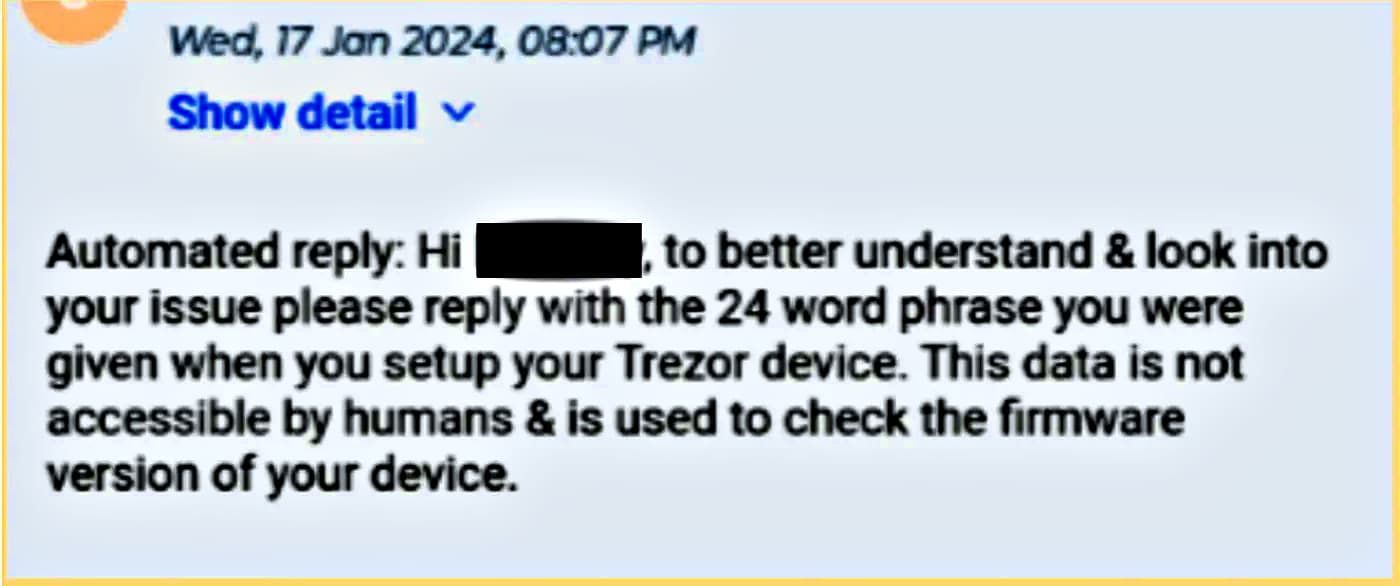
Here is an image capturing the email sent to users by the malicious actor during the security breach. (Screenshot via Trezor’s blog post)
What Trezor is Doing
Trezor has taken several steps in response to the breach:
Notified all 66,000 potentially affected users via email.
Emphasized that user funds were not compromised.
Investigated the incident and took steps to prevent future breaches.
Advised users to be wary of phishing attempts and to take steps to protect their online accounts.
What Users Can Do
If you are a Trezor user and received an email about the breach, here are some steps you can take to protect yourself:
Be cautious of any emails claiming to be from Trezor.
Do not click on any links or open any attachments in suspicious emails.
Change your Trezor PIN and password immediately.
Enable two-factor authentication for your Trezor account.
Regularly update your software and operating system.
Report any suspicious activity to Trezor support.
Impact of the Breach
The Trezor data breach is a reminder that no system is foolproof, even for hardware wallets. While user funds were not compromised in this incident, it serves as a wake-up call for the cryptocurrency community to be vigilant about cybersecurity. Users should be aware of the risks associated with phishing attacks and take steps to protect themselves.
Google flipped the switch to RCS messaging a while back, and messaging on Android has gotten so much better. One of the most popular messaging applications for Android is Google Messages. Not to be confused with Google Chat, Google Messages is the platform that people use for typical phone number-based communication. Well, Google Messages is bringing image captioning, another great benefit of having RCS technology.
RCS messaging brings a ton of benefits over the oldest SMS messaging. People using Google Messages have already seen some benefits of this including better security, larger file sharing, message reactions, and more. Later this year, Apple is going to finally enable RCS messaging for iPhones. However, Apple’s implementation will still be a fair bit behind Google’s.
Google Messages is finally bringing image captioning.
We’re all used to sharing images with our messages, and we sometimes want to add just a little bit more context to them. Maybe you want to send an image of a cat comfortably sleeping inside of a juice pitcher with a caption reading “my weekend plans”. Well, certain platforms like Facebook Messenger and WhatsApp allow you to add a caption directly onto an image posted. It means that the text and image will occupy one message bubble. This is actually a relatively new feature for WhatsApp.
However, in the case of Google Messages, this was not a possibility. When you would send an image with text, they will be sent as separate messages. However, according to a new report from @AssembleDebug on X, Google Messages is working on bringing image captioning. In the image shared by AssembeDebug, we see screenshots with the text added.
This is a great feature to have, and it will make sending messages between people in Google Messages what’s more convenient. At this point, we don’t know when Google is going to roll this feature out to everyone. It seems complete enough to be rolled out soon. However, there’s no telling if Google is going to roll this out arbitrarily or as part of a new feature drop. If it’s part of a feature drop, then it will be a few months away. Hopefully, that’s not the case
At long last, Samsung has released its Android 14-based One UI 6.0 update for the unlocked variants of the Galaxy S21 series in the US. The big Android update is rolling out widely to users on all major carrier networks. The remaining few will also join the party soon.
Android 14 is now available for unlocked Galaxy S21 in the US
Samsung started pushing Android 14 and One UI 6.0 to the Galaxy S21, Galaxy S21+, and Galaxy S21 Ultra in November last year. Following an international release, the update arrived in the US in early December. However, the company initially only updated the carrier-locked units of the 2021 flagship trio.
It was expected to roll out One UI 6.0 to unlocked units in a week or two but the company kept users waiting for over six weeks. The wait has finally ended. The update is rolling out to the unlocked Galaxy S21 trio with the firmware build number G99xU1OYM9FWL3. It is available nationwide on most networks.
Since this is a major Android OS upgrade, the update that you are getting over the air (OTA) is massive. It has a download size of over 2GB. The update brings UI revamps, new camera features and editing tools, improved stock apps, smoother system animations, and many functional improvements to your Galaxy phone.
Additionally, Samsung is pushing the December 2023 security patch with more than 60 vulnerability fixes. So, your phone is getting security enhancements too. The Korean firm has already released the January 2024 patch, which is also available to the carrier-locked Galaxy S21 in the US. It contains 80 security fixes. Unlocked units should get it in the coming weeks.
If you are using a Galaxy S21, Galaxy S21+, or Galaxy S21 Ultra in the US and haven’t yet received One UI 6.0 or a new security update, you can check for it from the Settings app. Go to the Software update section and tap on Download and install. If there is no update available for you, wait a few days and check again.
The aging Samsung flagships will get One UI 6.1 soon
Android 14 is the penultimate major Android OS upgrade for the Galaxy S21 series. The lineup will get Android 15 and that’s it. While the next version of Android is still several months away, another major feature update is on the way for the devices. Samsung is readying One UI 6.1 with new AI features. The update is expected to roll out in the coming months.
Data breaches are happening with alarming frequency lately, which means it’s increasingly likely your data is out in the wild somewhere. If there’s one place that user data is likely to exist, it’s in a massive data breach pool that was recently discovered by CyberNews and SecurityDiscovery.com. This data pool looks to be a compilation of many major breaches and includes over 26 billion data breach records. That amounts to over 12TB of data, and it includes more than just passwords.
The exact nature of the records is unknown, but there are a few possibilities. The most likely records to be found in this data breach are usernames and passwords. However, it’s possible that other types of information, like credit card information or addresses are included as well. The good news is, the researchers do not suspect that new data is included in the pool. Rather, it’s a major sourcing of pre-existing data breaches. According to the researchers, this suggests that the owner has a “vested interest in storing large amounts of data.”
What’s included in the data breach’s 26 billion records
The research into this data breach was led by Bob Dyachenko, a cybersecurity expert and the owner of SecurityDiscovery.com. Although the team says that no new data leaks are known to be included, that doesn’t mean end users shouldn’t be concerned. “The dataset is extremely dangerous as threat actors could leverage the aggregated data for a wide range of attacks,” the researchers told CyberNews. “Including identity theft, sophisticated phishing schemes, targeted cyberattacks, and unauthorized access to personal and sensitive accounts.”
The data breach’s 26 billion records also include information that users probably won’t want getting out. The company or brand with the most leaked records in the data pool was Tencent, a Chinese tech giant, who had 1.5 billion records leaked. Tencent, among other things, operates the Tencent QQ messaging app. Other sites with millions of leaked records include LinkedIn, Deezer, Adobe, and Canva. Some adult sites were also included in the data pool such as 220 million records from AdultFriendFinder.
Besides companies and brands, some data is also stolen from governments, such as the U.S., Brazil, Germany, Philippines, Turkey, and more. But the real concern is that malicious actors could use the stolen data for more widespread identity theft. For example, if you use the same password for LinkedIn as your banking app, you might be in trouble. A potentially-compromised social media site could spiral into a financial disaster quickly.
How to check if your data is in the breach
There’s no clear cut way to know if your data has been breached with absolute certainty. However, there are a few things you can do. There’s a search bar at the bottom of CyberNews’ article that lets you search through every site that was compromised. If you use a site that has been breached, you should change your password just to be safe. You can also visit haveibeenpwned.com and enter your email to see if it has appeared in a data breach. Otherwise, a good rule of thumb is to use strong passwords, different passwords, and change them if you think they’ve been compromised.