Samsung just announced its new Galaxy S24 phones, and we’re really excited to see what they will bring. One of the major announcements (alongside the new AI features) that happened during today’s Unpacked event had to do with these phones’ software updates. According to Samsung, the Galaxy S24 phones will come with seven years of software support.
This makes the second major Android OEM to offer this many years of software updates. Notably, Google announced that the Pixel 8 phones will receive seven full years of software updates. This means that the phones will be supported until the year 2030.
At first, we were skeptical about Google’s claims because we know that software updates and platform upgrades are two different things. However, Google announced that the Pixel 8 will receive a new version of Android every year of its support. So, it will be supported until Android 21.
The Galaxy S24 phones will have seven years of software support
When it comes to Samsung, the company has been improving its update game over the years. In 2020, the company announced that its phones would get five years of software support with four major platform upgrades. Seemingly in response to what Google did, Samsung took another leap forward with software updates.
The company announced today that the Galaxy S24 phones will have seven years of software support. Again, any person would be skeptical about this because of the difference between software updates and platform upgrades. However, the company stated that this phone will receive seven years of major Android platform upgrades. This means that the phone should be supported until Android version 21. That’s pretty far in the future, and Android would have run out of letters of the alphabet by then.
It’s great to see more companies embracing longer lives for their phones. Right now, smartphones are getting much more capable, and they’re better able to stand the test of time. Nowadays, a five-year-old phone can still operate and perform as a daily driver. These phones are getting better and more equipped to last, and the only thing missing is proper software support
Google’s New Disclaimer Confuses Users with Data Collection Admission – It All Happened After the Company Had to Face a Whopping $5 Billion Lawsuit.
For years, “Go incognito” has been the whispered mantra for those seeking online privacy. Google Chrome’s private browsing mode promised a cloak of anonymity, letting users roam the web free from watchful eyes. But a recent lawsuit and a quiet update by Google have cast a shadow over this digital haven, raising questions about its effectiveness and the company’s commitment to user privacy.
Google’s New Disclaimer
Google has updated its Incognito mode ‘disclaimer’ to reflect its data collection practices, which were previously unnoticed and got the company into legal trouble. The Chrome Incognito mode disclaimer initially stated users could “browse privately,” but the new version claims more privacy.
The update was added to the Chrome Canary build, a version (122.0.6251.0) created for developers that includes experimental releases and is updated daily. The Incognito mode disclaimer previously stated:
“Now you can browse privately, and other people who use this device won’t see your activity. However, downloads, bookmarks, and reading list items will be saved.”
After the update in Canary, the disclaimer states the following:
“Others who use this device won’t see your activity, so you can browse more privately. This won’t change how data is collected by websites you visit and the services they use, including Google. Downloads, bookmarks, and reading list items will be saved.”
Old and New disclaimers (Screenshot credit: Hackread.com)
Both versions acknowledge that web activity may still be visible to sites, but the newer version informs users that websites, including Google, continue to collect browsing data in Incognito tabs, allowing tracking of Incognito users and Google users using Google services like Ad Manager and Analytics. Judge Yvonne Gonzalez Rogers cited this as a reason for ruling against Google’s motion for summary judgment in a privacy lawsuit.
For your information, in 2020, Google faced a $5 billion class action lawsuit for collecting user data through its services in Incognito Mode. The lawsuit alleged that Google tracked sensitive user data, such as browsing history, device data, and IP addresses even when users believed they were surfing privately.
Google initially dismissed the allegations, but US District Judge Lucy Koh disagreed, stating that Google never explicitly informed users about its continued data collection. The company then stated that the websites collect data in this mode, but the disclaimer does not mention it.
Google redesigned its Incognito mode pages, but this has not been enough. The company, thus, had to agree to pay $5 billion in settlement in December 2023, expected to be presented for court approval by February 24, 2024. It also reworded the disclaimer and changed everything else except the first paragraph to appear more transparent about data collection practices in Incognito mode.
Google has added disclaimers to Chrome Canary on Android, Windows, and other platforms when users open a new incognito tab/window. It is worth noting that Incognito mode is not anonymous, and third-party cookie tracking prevention is enabled by default to protect user activity. Still, the case highlights the need for more transparent data collection practices, particularly in sensitive features like Incognito mode, by tech giants like Google.
For insights into this, we reached out to John Bambenek, President at Bambenek Consulting. “Incognito mode, and its equivalent, to other browsers, has never offered much more privacy protection than people hiding their web viewing habits from their parents or partners,” John argued.
“This lawsuit highlights that this mode doesn’t offer much in the way of privacy at all. While organizations were concerned about what third parties might be collecting about their employees or their workplace, they should be focusing on migrating to privacy-centric, browsers, and using browsing plug-ins that prevent websites from collecting data in the first place,” he advised.
What Does All This Mean?
So, what does this mean for the web-weary wanderer? First, a dose of realism: incognito mode is not magic. Embrace its limitations, and consider alternative tools for truly sensitive web journeys. Second, demand more transparency. Google’s quiet update, while a step in the right direction, pales in comparison to the need for clear, comprehensive explanations of data collection practices.
Ultimately, the battle for online privacy is far from over. Google’s incognito update is a small victory, a flicker of light in the ever-growing digital surveillance landscape. But the fight for truly private browsing, for a web where anonymity isn’t an illusion, continues.
The onus lies on users to stay informed, to demand accountability, and to push for technological solutions that respect our right to digital discretion. Only then can the internet become a space where “incognito” truly means unseen, unheard, and ultimately, free?
After firing over 1,000 employees as we enter 2024, Google is planning yet another round of layoffs for its advertising sales team. Business Insider first learned and reported this. Subsequently, The Verge reached out to the company. One spokesperson confirmed to the publication that this decision involves getting rid of “a few hundred roles globally” as part of a restructuring plan. Notably, he mentioned that affected employees can apply for other roles within Google.
Google is laying off more than a hundred jobs globally
The first news about Google’s potential layoff came from Business Insider, which somehow accessed an internal memo from Google’s senior vice president, Philipp Schindler. The memo hinted that the job cuts would mainly affect the Large Customer Sales (LCS) unit, dealing with ads for big businesses.
On the other hand, the Google Customer Solutions team (GCS), handling ads for smaller clients, is going to become the main ad sales team. There were previous reports of job cuts in the LCS team in October of last year. More importantly, California’s tech major has made layoffs in other teams, including Pixel, Nest products, and engineering.
The industry is changing rapidly
While Google has often been likened to Apple, the dynamics might be shifting. Microsoft has surpassed Apple to become the world’s most valuable company. Amid this, Google has introduced new tools like Bard and Gemini to compete with the likes of Microsoft-backed OpenAI’s ChatGPT. With upcoming releases like the Pixel 9 series, Google seems poised to secure its standing. Consequently, the recent changes within the company may aim at aligning its workforce with evolving business needs.
Tech layoffs have been in pretty bad shape over the last few years. Layoffs.fyi, a website tracking tech layoffs, reports that layoffs affected an alarming 260,000 employees worldwide in 2023 alone. As we transition into 2024, the situation persists, with over 7,500 individuals already experiencing layoffs.
At the CES 2024 event, tech companies showcased a lot of cool concepts. Doublepoint was one of these companies that demoed a very interesting application called WowMouse. The tiny little app is capable of turning WearOS-based smartwatches into a wireless mouse.
While most of the other concepts showcased at the tech show won’t make it to the market, WowMouse is already available.
WowMouse offers open-air gestures to control the mouse of your notebooks
Made by the touch interface company, WowMouse offers slightly similar features as the Apple Watch’s Double Tap functionality. The Double Tap feature only lets you use air gestures to control the Apple Watch. However, the WowMouse application takes the game to the next level and lets you use open-air gestures to control your laptops.
WowMouse not only lets you use gestures to control devices, but it also enables instant Bluetooth connectivity to a range of products. These devices can include smartphones, tablets, computers, headsets, and more. When using the app as a wireless mouse for your desktop, simply hit your index finger and thumb together. You can move around your arm to control the cursor.
Though it might sound gimmicky, the app appears to be working very usable in hands-on demos. You can watch a demo video posted by Snazzy Labs on X, where it appears to be working very well. Essentially, the app utilizes the existing sensors of your smartwatch to convert it into a spatial mouse. One of the best use cases of the app is when moving around during a presentation on your notebook.
Tested on Samsung’s WearOS watches, WowMouse is available for free
The WowMouse app is available to download for free on the Google Play Store. The app was released on January 5th, but received a major update on January 16th. The developer’s description reads that the gesture detection algorithm has been most tested on Samsung’s WearOS watches.
The officially tested devices by the developer include the Galaxy Watch 4, Watch 5, and Watch 6. As per some reports, WowMouse doesn’t support the first-generation and second-generation Google Pixel watches.
The phishing scam falsely asserts that the victim’s Facebook page will be permanently deleted due to a post allegedly infringing on trademark rights. However, there is no actual infringement; it’s all part of the scammer’s malicious plan.
In a recent wave of cybersecurity threats, scammers have unleashed a sophisticated phishing scam targeting META business owners on Facebook. Perpetrators are sending deceptive messages claiming trademark rights infringements, posing a severe risk to unsuspecting page owners.
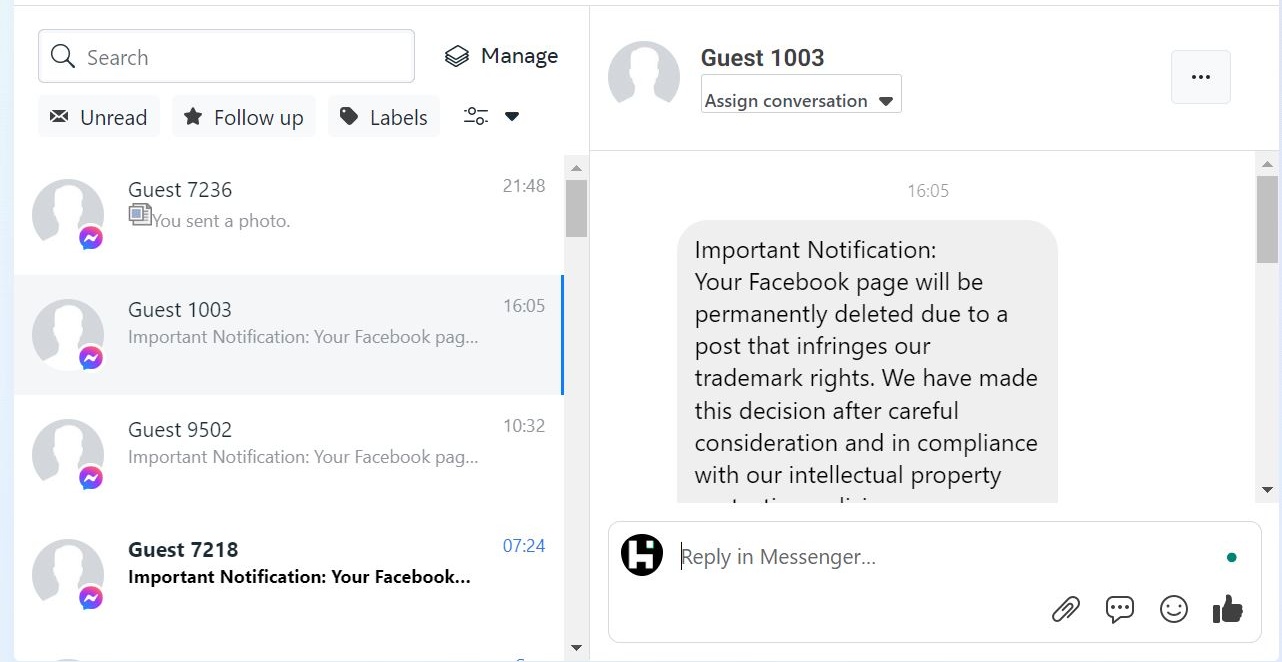
Messages sent by scammers to Hackread.com and several other pages have also been reaching out to us. Users have noticed a sudden increase in receiving similar messages (Screenshot: Hackread.com).
A concerning phishing scam has emerged, specifically targeting business owners associated with Meta Platforms, Inc. Scammers are exploiting fears of trademark rights infringements, attempting to force page owners into clicking on malicious links under the guise of resolving alleged policy violations.
In reality, the scam is aimed at stealing the email address and password of the Facebook account further leading to the takeover of the page, profile and financial information.
The fraudulent message, seemingly originating from a supposed temporary support agent, warns recipients of an impending permanent deletion of their Facebook page. The scam leverages the authority of Meta Platforms, Inc., formerly Facebook, to create an atmosphere of urgency and legitimacy.
The Deceptive Message:
“Important Notification: Your Facebook page will be permanently deleted due to a post that infringes our trademark rights. We have made this decision after careful consideration and in compliance with our intellectual property protection policies. If you believe this is a misunderstanding, please submit a complaint requesting the restoration of this page before it is removed from Facebook.
Request for Review: We understand that this may impact your current business objectives. If we do not receive a complaint from you, this will be our final decision.
In normal circumstances, scammers and two-bit thieves create phishing pages which are full of coding errors, spelling and grammar mistakes. Additionally, their design lacks sophistication and often turns out to be broken pages.
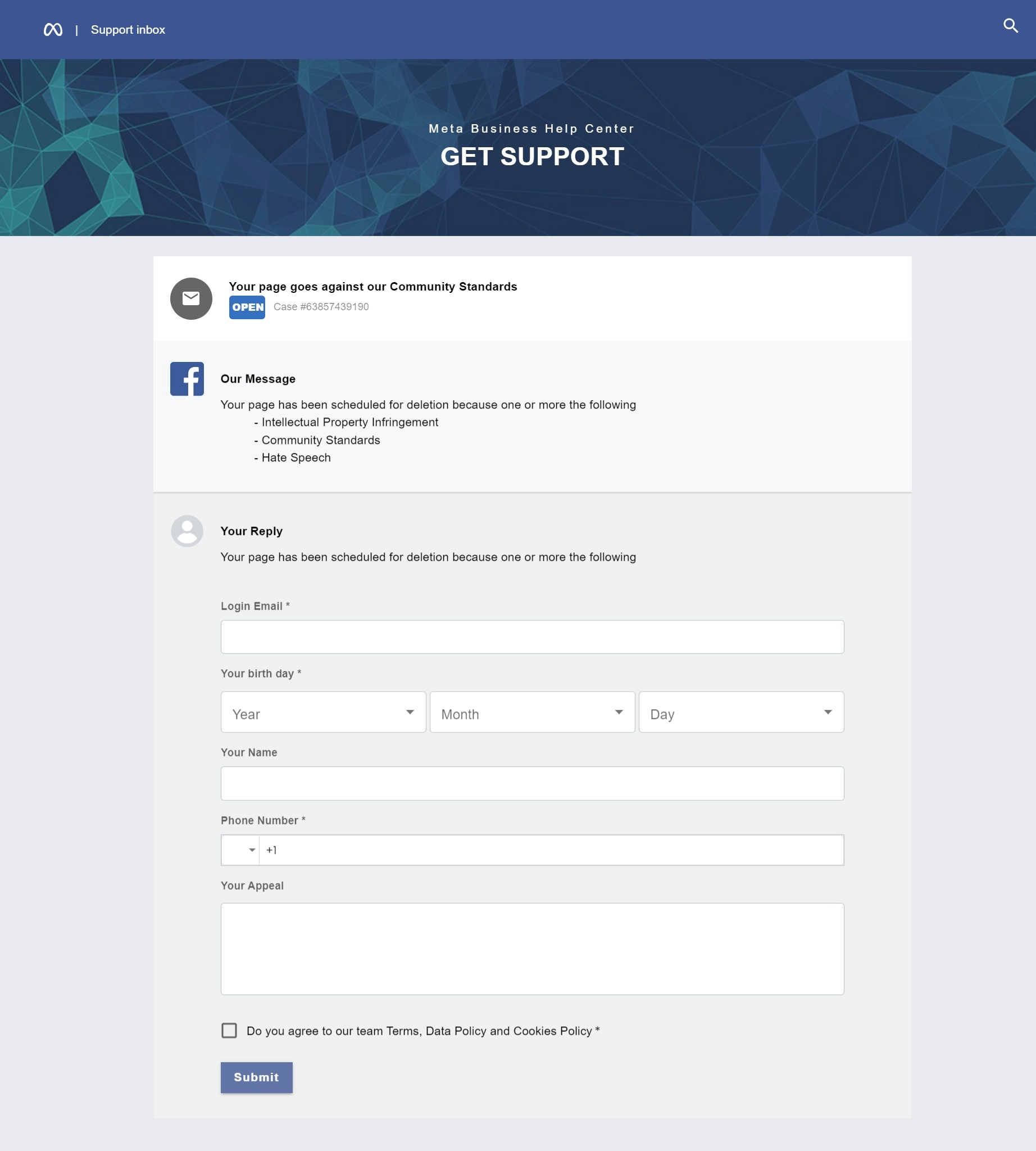
However, the ongoing phishing scam is quite sophisticated only and only because of its flawless design. A look at the screenshot captured by Hackread.com shows scammers have become professional in coding and web design:
The UI of the phishing page looks as authentic as possible (Screenshot: Hackread.com).
Modus Operandi
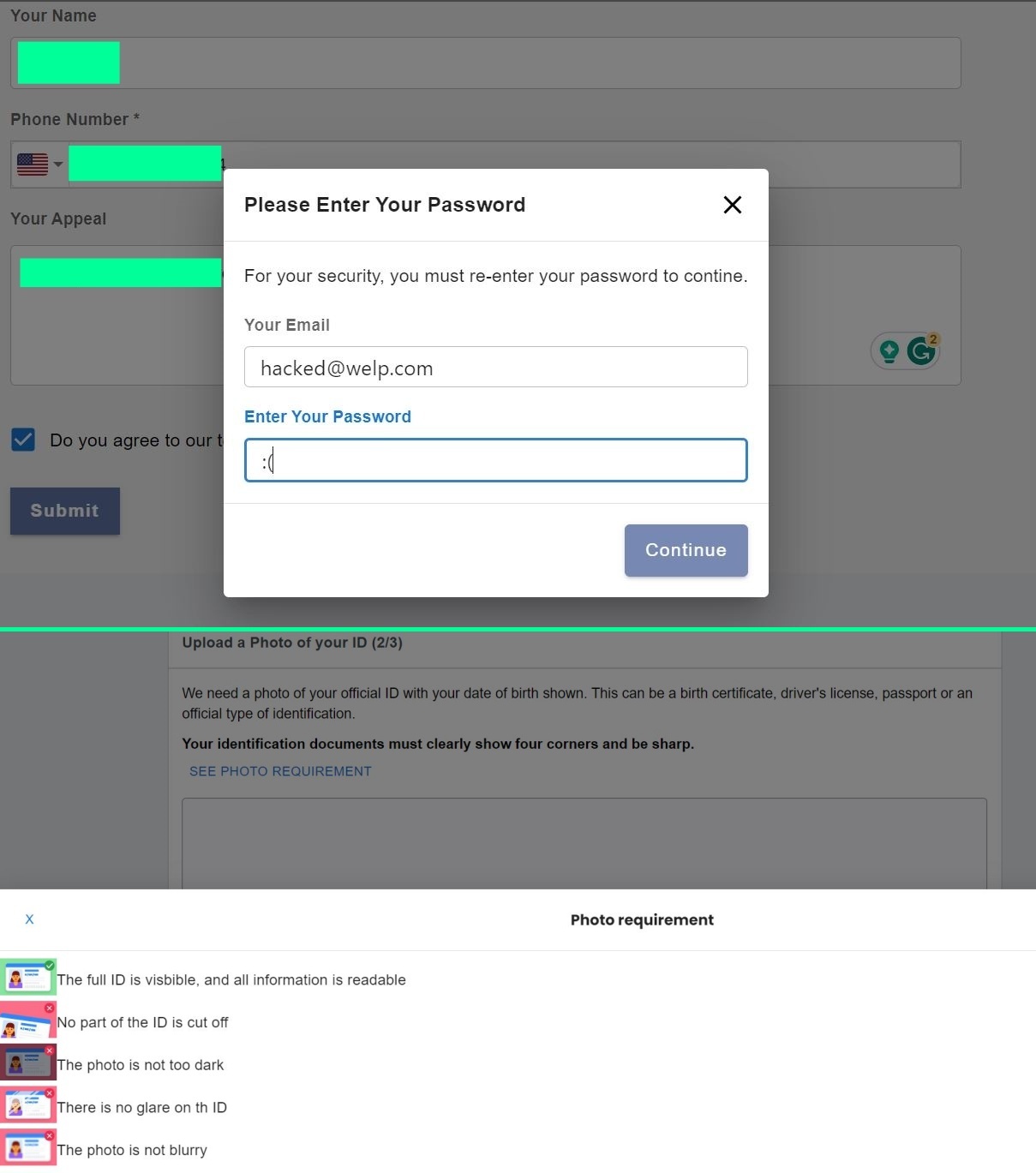
The phishing scam involves collecting personal data, including full names, email addresses, phone numbers, and dates of birth. It deceives victims by prompting them to file an appeal, but before doing so, they are asked to sign in to their accounts. Once signed in, the scammers siphon off their email and password.
Your email and password are gone (Screenshot: Hackread.com)
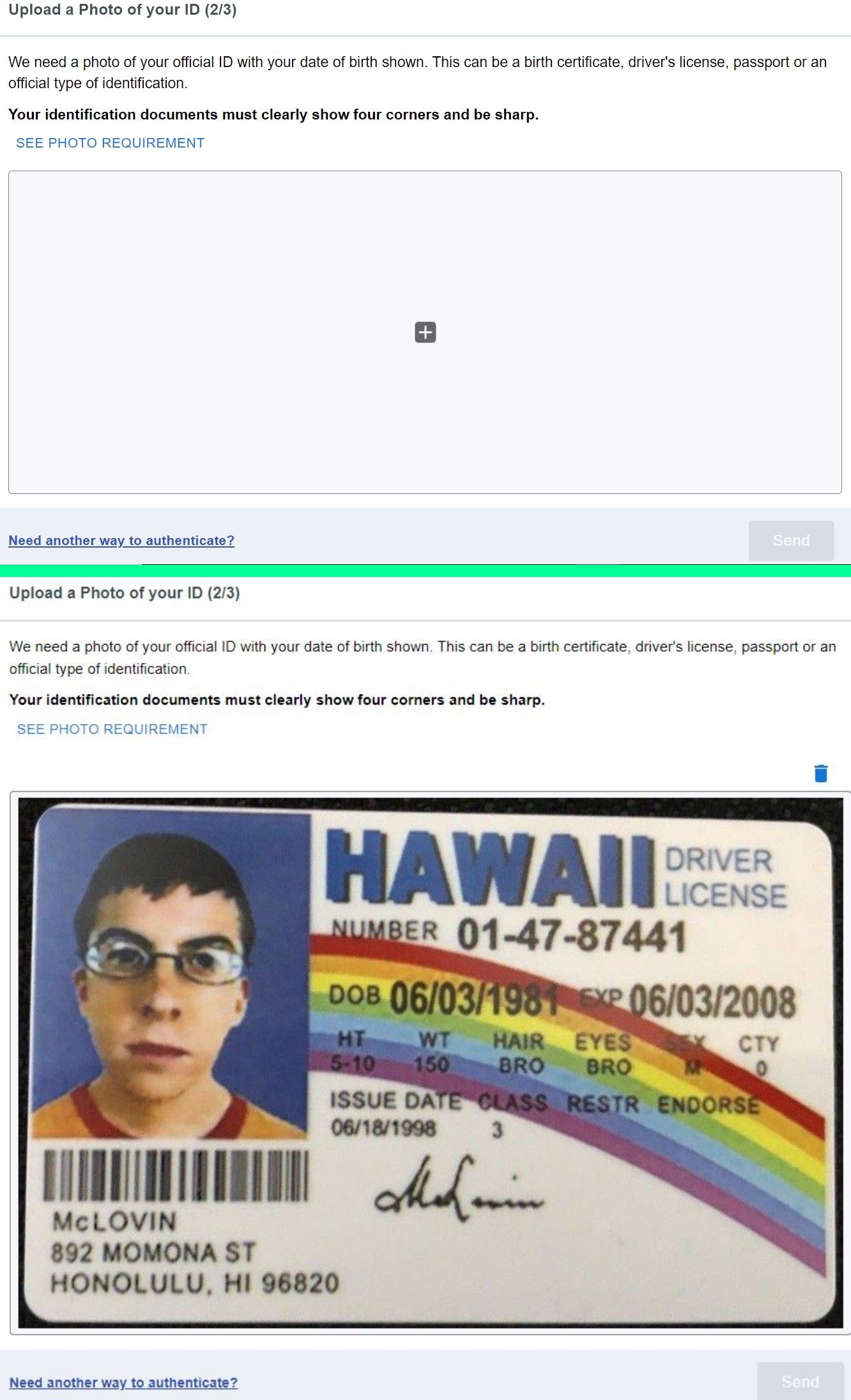
In the next stage of the scam, victims are requested to provide additional Personally Identifiable Information (PII) for supposed verification, such as an ID card, passport, or driver’s license. However, uploading these documents leads nowhere; it is merely a gimmick to keep the victims busy. Meanwhile, behind the scenes, the scammers attempt to change the passwords of the victims’ email addresses and Facebook accounts.
We submitted McLOVIN’s ID but unfortunately, it did not go through (Screenshot: Hackread.com)
The scam relies on the victim’s anxiety about losing their Facebook page and business reputation. By including an official-looking Meta Platforms, Inc. copyright notice and a seemingly authentic support ID, scammers aim to lend credibility to their fraudulent message.
This isn’t the first instance of Meta business owners falling victim to a phishing scam. In October 2023, Vietnamese hackers were reported to have employed DarkGate malware targeting META accounts in India, the United Kingdom, and the United States.
Protecting Against the Scam:
To safeguard against falling victim to this phishing scam, business owners are urged to:
Verify Official Communications: Authentic notifications from Facebook or Meta Platforms, Inc. would typically appear directly in the platform, not via external links.
Cross-Check Support IDs: Legitimate support communications usually come from official channels within the platform, not from temporary support agents with ambiguous IDs.
Exercise Caution with Links: Avoid clicking on any suspicious links. Official communications and actions can typically be verified by accessing the platform directly.
As cybersecurity threats continue to evolve, caution is crucial. META business owners and Facebook page administrators are advised to stay informed about potential scams and report any suspicious activity to the platform’s official channels.
Stay tuned for updates on cybersecurity measures and protect your online presence against emerging threats. Follow us on Twitter (X) @Hackread – Facebook @/Hackread.
Internet research firm Ookla has released its latest Speedtest test report. The report claims that the top-of-the-line iPhone 15 Pro Max was the fastest 5G phone in the US during Q4 2023. The second spot on the list is also taken by another Apple offering, the iPhone 15 Pro. The Galaxy Z Fold 4 and the Galaxy S23 Ultra flagships are also among the fastest phones on the list.
iPhone 15 Pro Max managed to achieve a whopping median download speed of 213.84Mbps
According to the Ookla report, the iPhone 15 Pro Max managed to achieve a maximum median download speed of 213.84Mbps. It also offered the highest median upload speed of 14.70Mbps. As for the iPhone 15 Pro, it was the second fastest 5G phone with a peak speed of 189.33Mbps. The Galaxy Z Fold 4 took the third spot with a maximum median download speed of 184.69Mbps.
The Galaxy S23 Ultra is the second offering from the South Korean tech giant on this list. This one managed to achieve a maximum download speed of 181.04 and a peak median upload speed of 13.88Mbps. Lastly, the iPhone 15 took fifth place on the list with a max median download speed of 172.12Mbps.
The Galaxy S23 Ultra offered the best latency of 52ms during the Q4 2023
While iPhone 15 Pro models were the fastest in terms of download speeds, the Galaxy S23 Ultra offered the best latency. The Galaxy S23 Ultra offered a latency of 52ms, while the iPhone 15 Pro Max had a latency of 54ms. Notably, the Galaxy Z Fold 4 also managed to perform better than the iPhones with a latency of 53ms.
Ookla has also mentioned that it didn’t find any statistical winner when it comes to the combined performance. Samsung offered an average median download speed of 113.74Mbps and an upload speed of 10.51Mbps. As for Apple, it offered a peak download performance of 103.74Mbps and a max upload speed of 9.20Mbps.
The Snapdragon X70 5G recorded the fastest median download speeds
As for the chipsets, the Qualcomm Snapdragon X70 5G managed to achieve the fastest median download speed at 205.38Mbps. The Snapdragon 8 Gen 2 was the second fastest chipset with a download speed of 173.55Mbps. The third place was taken by the Snapdragon 8+ Gen 1 at 169.27Mbps. Lastly, the Snapdragon X65 5G (151.54Mbps) and Snapdragon 8 Gen 1 (149.65Mbps) took fourth and fifth place, respectively.
Notably, T-Mobile has been revealed to be the fastest top mobile operator during the period with a max speed of 188.96Mbps. Also, Verizon Wireless and AT&T were distant runners-up with a speed of 91.62Mbps and 90.82Mbps, respectively.
Samsung has finally released the Android 14 update for the Galaxy Tab A7 Lite tablet. The two-year old tablet’s latest update brings the One UI 6 user interface, apart from the usual Android 14 features. The new firmware for the Galaxy Tab A7 Lite is reportedly being rolled out in South Korea at the moment.
The update weighs around 1.5GB and is rolling out in South Korea right now
According to SamMobile, the Android 14 update for the Galaxy Tab A7 Lite carries the firmware version “T225NKOU6DWL9”. The size of the update is over 1.5GB. The update is expected to be rolled out in more countries within the next few weeks. The update is being rolled out over the air in a gradual manner, so not everyone will get it right away.
Those living in South Korea can check if the update is available by going to Settings > Software update > Download and Install. The update is currently reportedly only available for the LTE version (SM-T225) of the device. It should be released for the Wi-Fi model (SM-T220) in the near future.
The Android 14 update for the tablet brings the latest One UI 6 user interface
One of the biggest highlights of the new Galaxy Tab A7 Lite update is the One UI 6 user interface. The new UI brings a brand new design, apart from a handful of new features to offer a more intuitive experience. There are new widgets like the Custom Camera and Weather Insights. The Quick Panel area now provides a refreshed design. The update brings a new default font, styling options for the lock screen, and more.
After the update, the users can expect new features and design changes for all the built-in applications. The One UI 6 UI also has new categories for the Reminders app and a new layout for the home screen. Also, the Gallery app as well as the Photo Editor apps are also getting new options. Other highlights included a dedicated entry for the Battery section in the Settings app and updated Internet and Keyboard apps.
It is quite impressive to see Samsung updating such an old entry-level tablet to the latest version of Android. Furthermore, it is expected to be the last major Android update for the Galaxy Tab A7 Lite. Currently, the tablet is retailing at the starting price of $139.99 on the company’s website.
According to Reuters, the Epic Games vs Apple legal saga, lasting over three years, has finally wrapped up – at least for now, as you will see if you continue reading. The US Supreme Court decided not to hear appeals from either company, letting the previous judgments from lower courts stand.
In 2020, Epic threw an antitrust lawsuit at Apple, claiming it was playing the illegal monopolist game. The gripe was that Apple forces folks to snag apps from its App Store and purchase digital goodies using its own system. Oh, and Apple takes a cut, pocketing up to 30% in commissions for in-app buys.
Epic’s legal team couldn’t quite pin the antitrust label on Apple in the lower courts. Still, the District Court did call out Apple for some not-so-cool moves, specifically anti-steering tactics. Basically, Apple got called out for playing referee and stopping developers from letting users know about other payment options.
In 2021, a court ordered Apple to address its anti-steering practices. However, implementation was on hold during the appeal process. Now, with the legal battle concluded, Apple has to comply with the court order. In essence, this means allowing app developers to include links and buttons guiding users to alternative payment methods for in-app content.
Tim Sweeney, the founder and CEO of Epic, stated on X, “As of today, developers can begin exercising their court-established right to tell US customers about better prices on the web.”
Apple swiftly made updates to its App Store Review Guidelines, introducing a new section outlining the dos and don’ts regarding external payments for apps. It’s important to note that these modifications apply to the iPhone and iPad App Store and are applicable solely in the United States.
Yet, these fresh guidelines might not be set in stone. Sweeney has already announced that Epic will contest them, arguing that Apple is not complying with the injunction in good faith. Seems like the Apple vs Epic legal saga isn’t quite ready to wrap up. Keep an eye out for more updates!
The San Francisco Chronicle tells a story about a family that almost got scammed when they heard their son’s voice telling them he’d been in a car accident and hurt a pregnant woman.
Sadly, this is becoming more common. Scammers want to spread panic among their victims, and to do this, they feign an emergency situation. That may be a car accident, unexpected hospitalization, or any other scenarios which instantly cause concern and cause victims to act quickly.
Sometimes it’s a pregnant woman who is hurt, sometimes it’s a diplomat.
In earlier days of scams like these, success depended a great deal on the criminal’s skills at social engineering, but rapid advancements in Artificial Intelligence (AI) mean scammers can now easily and convincingly fake the “voice” of the relative that is the supposed victim of the accident.
What better way to make the victim believe that something bad has happened than hearing their loved one cry out for help in their own voice. With the help of various AI powered tools, criminals can easily compose fragments based on a short voice clip they found online.
FBI Special Agent Robert Tripp said:
“Now criminals can fabricate a voice using AI tools that are available either in the public domain for free, or at a very low cost.”
The criminals will keep that part of the communication short, so the target is unable to ask the relative any questions about what happened. While it is possible to fake entire conversations with the help of AI, the tools that can do that are much harder to operate. The criminal would have to type out the responses very quickly and the target might get suspicious. In the story from the San Francisco Chronicle, the phone was “taken over” by the so-called police officer at the scene of the accident, who told the parents that their son would be taken into custody.
This was later followed a cold call by someone posing as legal representative for their son, asking for money to for bail. The intended victims got suspicious when the so-called lawyer said he’d send a courier to pick up the bail money.
The FBI says it has received more than 195 complaints about this type of scam that it refers to as “grandparent scams.” It reports nearly $1.9 million in losses, from January through September of 2023.
How to avoid scams like this
One of the main tools for the imposters is the amount of information they can round up about the target. Their main sources will include social media and phishing.
There are a few simple precautions to lessen the chances of falling victim to such scams:
Avoid letting third parties know too many personal details about you.
Do not answer telephone calls from numbers you do not recognize or calls from private numbers.
Ask for the caller’s telephone number and check it.
If necessary, try to reach your allegedly implicated family member by phone. If you can’t reach them directly, call someone else who might know where they are.
Hang up if in doubt and never give financial or personal information to the caller.
If you receive or have received such a call, please notify the police immediately and under no circumstances respond to the perpetrators’ demands.
We don’t just report on threats – we help safeguard your entire digital identity
Cybersecurity risks should never spread beyond a headline. Protect your—and your family’s—personal information by using Malwarebytes Identity Theft Protection.
Oh, not again, Samsung! The company prematurely listed the unannounced Galaxy S24 phones on its official website, again. Product pages for the base and Ultra models were briefly up on its website for Ecuador, revealing the design, prices, and colors. Its branded retail partner in Colombia made a similar blunder in late December. The new flagships go official later today.
Samsung accidentally publishes Galaxy S24 product pages on its website
Spotted by leakster Roland Quandt, Samsung’s Ecuadorian website accidentally listed the 256GB variant of the Galaxy S24 and 1TB variant of the Galaxy S24 Ultra. Or at least these two listings were caught by the public eyes before the company realized the mistake and took the pages down. Archivecopies of both listings are available, though.
Listed with the SKU SM-S921BZKKGTO-1, the Galaxy S24 has a price tag of $1,399, discounted to $1,049. The Ultra (SKU SM-S928BZTIGTO-1) is listed with a price tag of $1,749, discounted to $1,499. Whether these prices are accurate, we’ll know in a few hours—the launch event kicks off at 10 AM PT/6 PM GMT. Meanwhile, this leak from Samsung confirms the colorways for the new flagships.
We can see that the Galaxy S24 and Galaxy S24 Ultra will come in the same four colors: Black, Gray, Violet, and Yellow. The Plus model is also rumored to be available in the same set of colors. Leaks suggest Samsung will market these colors as Onyx Black, Marble Gray, Cobalt Violet, and Amber Yellow. For the Ultra, which has a Titanium frame, they are allegedly called Titanium Black, Titanium Gray, Titanium Violet, and Titanium Yellow.
In addition to these, Samsung may also offer three limited edition colors of these phones exclusively through its online store. The company has always done that in the past and there are rumors this time around too. These colors may not be available globally, though. Thankfully, it won’t be long before we have all the missing details about the Galaxy S24 series.
You can livestream the launch event
Samsung’s Galaxy S24 launch event will take place in San Jose, California. The company will livestream the event on its official website and YouTube channel. So, you can catch everything as it happens. The Korean firm has been building up hype around Galaxy AI, its suite of on-device AI features for the Galaxy S24 series. We will soon see what it is all about, and how it will transform the way we use our mobile phones.