In major App Store change, Apple lets developers link to outside payment platforms in the U.S.

0
[ad_1]

Earlier today, the U.S. Supreme Court decided not to hear Apple’s appeal related to the Epic v. Apple court case. That means Apple now has to follow the ruling of Judge Yvonne Gonzalez Rogers who ruled in 2021 that Apple would have to allow developers to send their customers a link that would take them to a third-party platform to pay for in-app purchases and subscriptions.
Apple previously prevented developers from disseminating such a link since it would allow them to avoid paying Apple its 30% cut of in-app purchases. But with the judge’s ruling taking effect, Apple has changed its App Store Guidelines in the U.S. so that it complies with the results of the Epic v. Apple trial. Developers will be allowed to link to alternative payment platforms as long as the app also offers payments through Apple’s in-app payment platform.
In the App Store Review Guidelines under section 3.1.1(a), Apple writes “Developers may apply for an entitlement to provide a link in their app to a website the developer owns or maintains responsibility for in order to purchase such items….In accordance with the entitlement agreement, the link may inform users about where and how to purchase those in-app purchase items, and the fact that such items may be available for a comparatively lower price.

The entitlement is limited to use only in the iOS or iPadOS App Store on the United States storefront. In all other storefronts, apps and their metadata may not include buttons, external links, or other calls to action that direct customers to purchasing mechanisms other than in-app purchase.”


Don’t worry about Apple missing out on the so-called Apple Tax. Apple will still be entitled to a slightly smaller 27% slice of the revenue generated by an in-app purchase if an outside payment platform is used to process an in-app purchase. That drops to 12% if the developer belongs to the App Store Small Business Program.
Epic Games CEO Tim Sweeney, whose lawsuit against Apple came after its popular Fortnite game was kicked out of the App Store (and the Google Play Store) for offering a link to its own in-app payment platform inside the game, was not happy with the changes announced by Apple. In a tweet, Sweeney called the 27% cut that Apple receives on payments processed by a third-party platform “anti-competitive” and plans to “contest the bad-faith compliance plan in District Court.”

[ad_2]
Source link
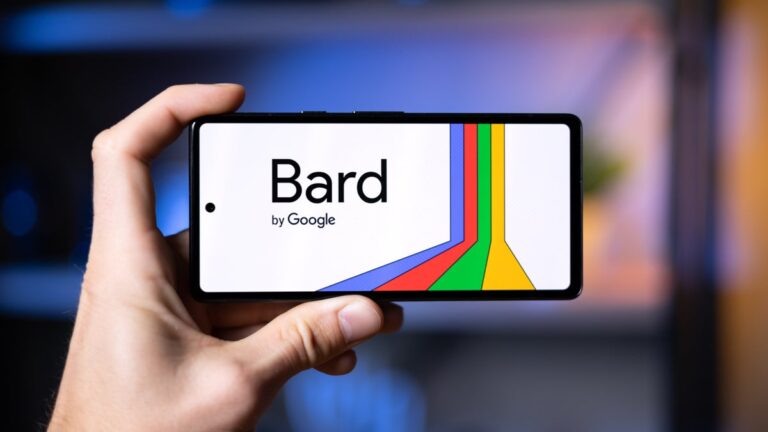
Google very likely to rebrand Assistant to Bard ahead of release

0
[ad_1]
Google is likely to replace the Assistant moniker with Bard before it launches the digital assistant later this year. Officially unveiled back in October during the Pixel 8 event, Assistant with Bard is scheduled for release in 2024.

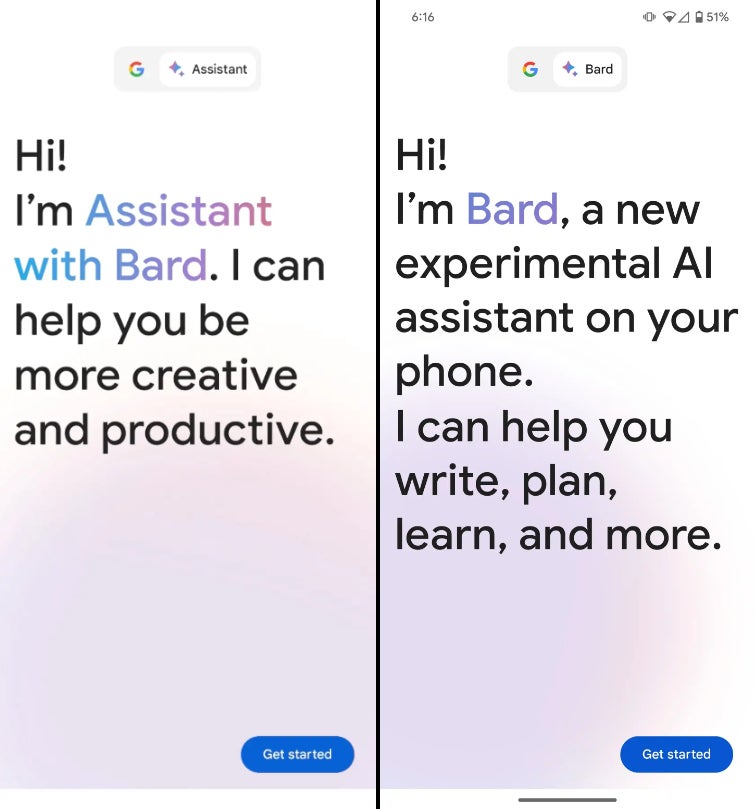
However, Google plans to remove “Assistant” from the name and simply call it “Bard.” The fine folks at 9to5google have decompiled the latest version of the Google app and found that the app’s greeting screen has been changed from “Hi! I’m Assistant with Bard” to “Hi! I’m Bard.”

Not only that, but nearly all mentions of Assistant with bard have been replaced with just Bard. And since Google is now calling Bard a digital assistant rather than another version of Assistant, it’s pretty clear that the search giant is going for a rebrand ahead of launch.

The problem is that Bard is still an “experimental AI assistant,” while Google Assistant is an established product that’s being improved all the time. The decision to remove many good Assistant features last week was probably one of the steps Google needed to take before completely replacing Assistant with Bard.

This suggests that Bard will not come with all the features Assistant offered, although Google might promise to add many of them over the coming months. Clearly, it will take some time before Bard moves from the “experimental” status to a stable one, but it looks like Google is determined to make it work.

[ad_2]
Source link

Google makes stunning admission in new Incognito mode disclaimer

0
[ad_1]

When Google Chrome’s Incognito mode is enabled on your phone, it means that none of your browsing history or information entered into forms can be seen by someone who has access to your device or shares the device with you. So if you have been looking online to buy a present for a relative, the sites you visited cannot be discovered. 

Google is about to settle a class-action suit that involved Incognito mode for $5 billion and it accused Google of committing privacy violations. Now, the company is revising the disclaimer that appears when Incognito mode is used on Chrome to allow Android users, Windows users, and others to understand that their personal data can still be collected by Google and others even when browsing the web in Incognito mode.

Google has made a key change to the first paragraph of the Incognito mode disclaimer

That Google and others can still collect your data while you’re in Incognito mode isn’t made clear with the current warning. And just because you have Incognito mode enabled, you can still be tracked by websites or internet service providers. According to MSPoweruser, in the unstable Chrome Canary beta app (which is updated nightly), Google made some changes to the first paragraph of the aforementioned disclaimer that appears when you enable Incognito mode.

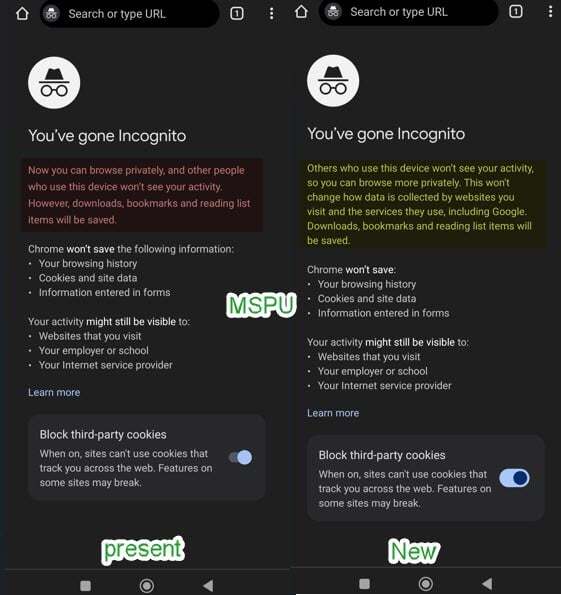
The current disclaimer starts by saying, “You’ve Gone Incognito. Now you can browse privately, and other people who use this device won’t see your activity. However, downloads, bookmarks, and reading list items will be saved.” The revised version found on Chrome Canary reads, “You’ve Gone Incognito. Others who use this device won’t see your activity so you can browse more privately. This won’t change how data is collected by websites you visit and the services they use, including Google. Downloads, bookmarks, and reading list items will be saved.”

Let’s look at the changes in the paragraph again. The current disclaimer says, “Now you can browse privately, and other people who use this device won’t see your activity. However, downloads, bookmarks and reading list items will be saved.” The revised version on Chrome Canary reads, “Others who use this device won’t see your activity, so you can browse more privately. This won’t change how data is collected by websites you visit and the services they use, including Google. Downloads, bookmarks and reading list items will be saved.”

Follow these directions in order to enable Incognito mode on your Android device.

The revised disclaimer is admitting that enabling Incognito mode won’t change how your data is collected by the sites you visit and by Google and that’s a rather stunning admission. While the current disclaimer doesn’t mention it, the revised version makes it clear that enabling Incognito mode doesn’t make you invisible to third-party trackers and Google. 

Had Google made this clear before, perhaps it wouldn’t have settled the previously mentioned class-action suit for $5 billion since the suit accused Google of using analytics, cookies, and other tools to track their browsing histories along with device data, and the content of webpages visited even with Incognito Mode enabled. Now, Google is making it clear that this kind of activity takes place when Incognito mode is enabled.

To use Incognito mode, when you have the Chrome app open, tap on the three-dot icon (on Android) in the top right of the screen, or the profile icon (on iOS) on the right side of the search field and tap on New Incognito tab. From that point forward, use the Chrome browser like you usually would. When your browsing session is over, you can tap to disable the Incognito mode.

[ad_2]
Source link

LG confirms release of an XR device as early as next year

0
[ad_1]

The race in the extended reality (XR) market is heating up as LG Electronics plans to join the competition with the release of an XR device as early as next year.

The announcement comes as LG aims to make an entry into the XR market, following in the footsteps of tech giants like Apple and Samsung Electronics. CEO Cho Joo-wan revealed the company’s XR plans during a press interaction at CES 2024.

LG Electronics has been actively working on XR device development, establishing a dedicated ‘XR Business Department’ within the HE Business Division (the division that makes TVs) this year. LG intended to accelerate development as the XR business gained visibility, Cho explained.

XR encompassing virtual reality (VR), augmented reality (AR), and mixed reality (MR), is gaining renewed attention, especially with recent developments like Apple’s pre-sales of the XR headset ‘Vision Pro‘.

LG previously demonstrated a StreamVR prototype, although, it never came out

It turns out that LG has some sort of experience with this product category. While LG’s history in VR has been relatively short-lived with previous attempts like a smartphone-tethered headset in 2016 and a PC-tethered SteamVR prototype in 2017, the company is gearing up for a fresh XR venture.

A previous report from ETNews (in Korean) suggested that the upcoming XR device from LG might leverage the recently announced Snapdragon XR2+ Gen 2 platform. According to Qualcomm, multiple upcoming XR devices including Samsung’s Google-powered headset and Sony’s ‘special content creation tool‘ have already adopted the chipset.

A South Korean media outlet SBS Biz previously reported about Meta engaging in talks with LG for sourcing OLED microdisplays for its own XR devices. So the company already has at least one key component for the XR product that matches the requirement.

Presence Research expects the global XR market to grow substantially in the near future, with projections indicating a rise from $41.56 billion in 2022 to $859.35 billion in 2030.


[ad_2]
Source link

Next Snapdragon 7 Plus to inch midrange phones closer to flagships

0
[ad_1]

The next iteration of Qualcomm’s mid-range Snapdragon 7 Plus processor (presumably Snapdragon 7 Plus Gen 3) is expected to bring a “huge upgrade,” according to a recent Weibo post from Digital Chat Station. The leaker suggests that the upcoming Snapdragon 7 Plus Gen 3 will adopt the architecture of the Snapdragon 8 Gen 3. If true, it may bring significant improvement over its predecessor.

The Snapdragon 7 Plus Gen 2, launched last year, already represented a substantial performance boost for mid-range smartphones, sharing the same CPU cores as the Snapdragon 8 Plus Gen 1 from 2022. Now, with the anticipation of the Gen 3, users can expect another notable enhancement.

Digital Chat Station specifically mentions that the Snapdragon 7 Plus Gen 3 will incorporate the architecture of the Snapdragon 8 Gen 3. The latter is Qualcomm’s latest flagship processor for 2024. This setup includes a Cortex-X4 big core, five Cortex-A720 medium cores, and two Cortex-A520 little cores.

The Snapdragon 7 Plus Gen 3 may use downclocked version of the cores from the Snapdragon 8 Gen 3

While the details regarding clock speeds remain unclear, it’s worth noting that the previous Snapdragon 7 Plus Gen 2 experienced certain downgrades compared to the Snapdragon 8 Plus Gen 1 it replicated. These included lower CPU clock speeds and other feature reductions. For instance, the 7 Plus Gen 2 featured the Adreno 725 GPU instead of the Adreno 730 found on the latter.

Despite the impressive capabilities of the Snapdragon 7 Plus Gen 2, it had limited adoption, featuring only in a select few devices from Xiaomi and Realme. None of these devices were available in the US either. With the promising upgrades expected in the Gen 3 variant, there is hope for broader adoption among mid-range smartphones, potentially expanding its availability to a wider range of users.


[ad_2]
Source link

Meta to limit kid’s access to sensitive content on its apps

0
[ad_1]

Meta and its subset social platforms  Instagram and Facebook have been a target of public criticism over children’s safety and exposing them to unpleasant content for a while. However, in recent years, the firm has taken some good steps to limit kids’ exposure to sensitive content by adding various settings and options for both kids and parents.

But the latest addition to Meta’s safety procedure aims to keep suicide and eating disorder content away from teenagers even more. According to Androidcentral, Meta announced a new set of privacy and safety policies on Tuesday in order to show more age-appropriate content to teenagers. The new policy will apply to all under 18 users on Instagram and Facebook. Meanwhile, a global rollout might take a few months.

Teen Instagram and Facebook users have more restricted access to self-harm and eating disorder content

As per the company’s blog post, content with self-harm and eating disorder materials will be removed from user’s Instagram and Facebook feeds. Both platforms have already limited kids’s access to such content on Reels and Explore. However, the restriction is now expanding to Feed and Stories. Meta says it will restrict the content even if it’s shared by someone the user follows.

Additionally, if an underage user posts about dealing with self-harm and eating disorders, the company would refer them to expert organizations like the National Alliance on Mental Illness. Meta added the new policy is in line with expert guidance. Also, they’ll continue to hide more search results related to suicide, self-harm, and eating disorders on Instagram.

Another change is to the recommendation settings for teens. Meta now automatically puts users under 18 into the most restrictive content control setting on Instagram and Facebook. The company previously applied this policy to newly registered users. However, it’s now expanding it to all underage users, regardless of their sign-up period.

The settings aim to limit teenager’s access to sensitive content on Search and Explore. As a side note, the setting is known as “Sensitive Content Control” on Instagram and “Reduce” on Facebook. Finally, Meta said it sends users notifications to inform them of the latest privacy settings.


[ad_2]
Source link

Leaked Galaxy S24 promo video shows off AI features in action

0
[ad_1]

The Samsung Galaxy S24 is poised to come with some nifty AI features using Samsung‘s rumored ‘Galaxy AI’ technology, and some of those features have just been shown off in a leaked promo video.

We’ve seen some of these AI features before. Both on other devices and in other leaks pertaining to the Galaxy S24 series. But with regards to the Galaxy S24 series, this would be the first time we’ve seen the features shown in-use. Earlier this month, Samsung announced reservations for its upcoming phones and it teased some of the features there. But again, those teasers didn’t show the features being used.

This recently leaked ad, courtesy of @MysteryLupin and @VideoArchiveAS, shows how the features will work. This includes some of the AI camera features that allow users to shrink, delete, and move objects in a photo after it’s been taken. It’s the same kind of capability that we discussed in our exclusive report from last week. You’ll be able to snap a photo, then in post-processing, you can edit the photo by shrinking or enlarging objects and moving them around. All you have to do is draw a circle around the object. Simple enough, right? The ad shows a handful of other features too.

Galaxy AI promo video shows features like live translate

Live translation is nothing new. Google Translate offers it on phones through the official Translate app if you hold the camera up to something you want to be translated. You simply have to set the languages first, and the languages need to support the live translation. There are more than a few devices outside of smartphones that promise live translation as well. Samsung’s Galaxy AI will have a live translation feature that lets you speak a foreign language on the spot and understand responses.

Here’s how it appears to work in the ad. The Galaxy S24 user is on a call with a taxi company to find an item that was left behind. They speak English, while the person on the other end speaks Spanish. Both the user’s English responses and the taxi company’s Spanish responses are translated appropriately. This is a feature that could come in very useful for travelers. But in general, it could even be useful in everyday life if you live in a larger city that’s ethnically diverse.

There is no doubt going to be more AI features shown off in future ads. And Samsung may just show some off during Galaxy Unpacked tomorrow.


[ad_2]
Source link

Whelp, AI-generated art made it into a AAA game

0
[ad_1]

Well, it was only a matter of time. While AI image generators seemed to be a fun little to mess around with at the beginning, this technology is now making its way into AAA gaming. One example of this is a game coming from Square Enix. The game, called Foamstars, uses AI-generated art to an extent.

Thanks to the overall speed and efficiency of AI, many big-name companies are seeing the utility of using it. For example, There’s a partnership between Xbox and Inworld to use AI to generate NPC quests and stories. This is something that will add dimension to a game, as it could open up the door for unlimited types of quests in games. However, this is yet to be seen.

Foamstars has been confirmed to use AI-generated art

While the title seems a bit foreboding, the news isn’t quite as bad as it sounds. The game’s producer, Kosuke Okatani, said that the mass majority of the game is still done by hand. So, Foamstars is still a human-created game with human-created art. The only art that was generated was art for in-game album covers. So, the company didn’t exactly fire its entire art department.

The only question remaining is Why? What benefits did using MidJourney to make the album covers provide? Was this because of the overall efficiency or were there stylistic advantages to using AI? While the AI art accounted for a very small chunk of the game, this news will not sit well with a lot of people.

However, this is the path that Square Enix has chosen. Previously, the company announced that is going to move ‘aggressively’ to using AI technology. That’s pretty ominous for many of the workers working there, as there’s no telling if the speed and efficiency of AI technology will cost them their jobs.


[ad_2]
Source link

Samsung could push One UI 6.1 update to these devices

0
[ad_1]

The Samsung Galaxy S24 series is just hours away from officially launching. Amid that, Samsung is prepping to release its next operating system update, One UI 6.1. Ahead of the launch, we have come across several features that will be coming in the next update. Interestingly, One UI 6.1 update could be released soon and be coming to many Galaxy devices.

What features to expect?

Reliable tipster Ice Universe has shared some details about One UI 6.1 before it goes live. The tips suggest users might be able to download different clock styles for their phone’s lock screen from Samsung’s Galaxy Store. So, one could use a variety of clock styles with possible support for further customization. Additionally, Ice suggests that One UI 6.1 has made improvements to animations and styles throughout Android 14, promising a smoother user experience.

Moreover, the upcoming update may feature battery protection options, and likely make your Galaxy phone compatible with Google’s AI wallpapers. After all, the AI game is on, signals the recently concluded CES has been filled with AI innovations.

Samsung One UI 6.1 eligible devices

This comes from tipster Tarun Vats (via 9to5Google). He shared a list of Galaxy phones claiming eligible for the One UI 6.1 update. Most importantly, Samsung hasn’t officially announced the list of devices running One UI 6.1, but this list seems just right.

According to Vats, some of the devices that are almost certain to get the One UI 6.1 update include Galaxy Z Fold 5, Galaxy Z Flip 5, Galaxy S23, Galaxy S23+, Galaxy S23 Ultra, Galaxy Z Fold 4, Galaxy Z Flip 4, Galaxy S22, Galaxy S22+, Galaxy S22 Ultra, Galaxy A54, Galaxy A34, Galaxy S21 FE, Galaxy S21, Galaxy S21+, and Galaxy S21 Ultra. Plus, most devices that received the Android 14-based One UI 6.0 update will eventually receive the One UI 6.1 update. And goes without saying, that Samsung Galaxy S24 will also be among the first to receive One UI 6.1.


[ad_2]
Source link

Xiaomi 14 Ultra could include an under-display camera

0
[ad_1]

The Xiaomi 14 Ultra could include a major design boost and an under-display camera. Now, that may not be the best thing for the quality of the selfie camera, but it is for the look of the phone as a whole.

One of the Xiaomi 14 Ultra models could include an under-display camera

This report comes from GSMChina, not your usual tipsters from China, so take it with a grain of salt. According to the report, Xiaomi will actually ship two different versions of the phone. One will have a regular hole punch with a selfie camera, and the other will pack an under-display unit.

Why would Xiaomi do something like that? Well, we have no idea, and we can only guess, the same as you. Based on this report, the version with the standard camera has codenames ‘aurora’ and ‘aurorapro’, while the version with an under-display camera is known as ‘Xiaomi Suiren’.

What’s interesting is that a device with the ‘Suiren’ name was spotted on Geekbench recently. The listing revealed that the device is fueled by the Snapdragon 8 Gen 3 processor. So, it’s definitely flagship-grade.

The ‘Xiaomi Suiren’ was initially believed to be the Xiaomi MIX 5

Some outlets suggested that the ‘Suiren’ could be the Xiaomi MIX 5. Well, GSMChina believes the opposite, as this could be one of the Xiaomi 14 Ultra models. Is that odd, especially considering the difference in codenames? Yes, but we’ll have to wait and see what’s true and what’s not.

The Xiaomi 14 Ultra is coming, likely in early Q2 this year. The Xiaomi 13 Ultra arrived in April, so the Xiaomi 14 Ultra could as well. It’s actually tipped to arrive alongside the Xiaomi Pad 7.

That smartphone is tipped to utilize Sony’s LYT-900 camera sensor, the same unit the OPPO Find X7 Ultra is using. Xiaomi will also throw a variable aperture on top of that sensor. A 50-megapixel ultrawide camera, a 50-megapixel telephoto camera, and a 50-megapixel periscope telephoto camera are also tipped.

A two-way satellite communication could also be a part of the package. A 5,180mAh battery is tipped as well, and the same goes for 90W wired, and 50W wireless charging.


[ad_2]
Source link