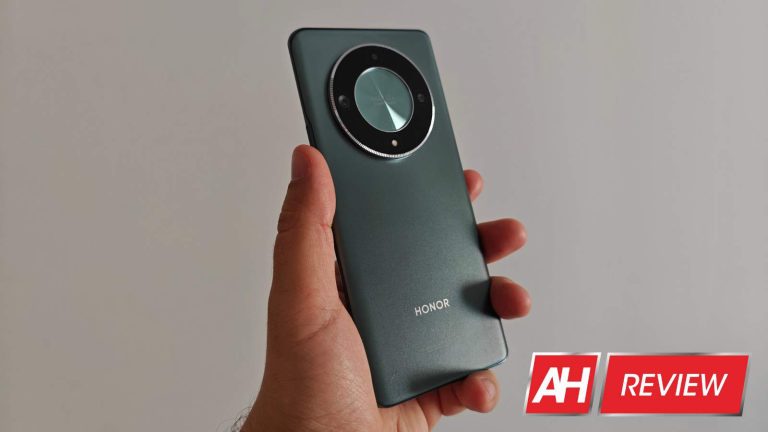
The HONOR Magic5 Lite (aka the HONOR X9), which launched last year, proved to be a compelling offering at its price bracket. It was a budget phone, and it tried to offer the best specs for the price. Well, its successor arrived quite recently, and we’re here to check it out. I’ve been using the HONOR Magic6 Lite for a while now, and this is my review of it.
The HONOR Magic6 Lite is not trying to reinvent the wheel, not at all. In fact, it is simply an evolution of the Magic5 Lite, design-wise. That’s not a bad thing, though, as the Magic5 Lite design was not bad at all. HONOR did, though, change things up under the hood, making this phone even more compelling from the price perspective. This phone is also known as the HONOR X9b 5G in some markets. Having said that, let’s dive in.
Table of contents
HONOR Magic6 Lite Review: Hardware / Design
The HONOR Magic6 Lite is very similar to its predecessor… design-wise. The phone looks almost the same from the front, and the same goes for the back. The camera island on the back does have a wider black portion, where the cameras are placed, which is how you can differentiate these two phones. The HONOR Magic6 Lite is also a bit larger due to a larger display. We’ll talk more about that a bit later on.
The model we reviewed has a glass backplate
The HONOR Magic6 Lite comes in four different colors. Those colors are Emerald Green, Midnight Black, Sunrise Orange, and Titanium Silver. We received the Emerald Green model, by the way. Every model except the Sunrise Orange one has glass on the back. The Sunrise Orange variant includes vegan leather on its back, so it’s less slippery. This Emerald Green variant is very slippery, as you’d expect out of a glass sandwich design, but it’s also very nice to look at. Its backplate sparkles when it’s hit by light, and it really does look quite nice.

The HONOR Magic6 Lite is very comfortable to hold despite its size
This phone is also very comfortable to hold. That’s something we’re used to when it comes to HONOR. The company has been making very ergonomic smartphones for quite some time now, this one is no different. There are no sharp angles to worry about or anything like that. It is slippery, but it’s also very comfortable. Make no mistake, though, this is a large phone. It measures 163.6 x 75.5 x 7.98mm, and weighs 185 grams. So it’s not that heavy at all, it’s actually quite light for its size. It is quite large, though, in every way. Its weight is quite surprising considering that it has a gigantic 5,800mAh battery.
It is also IP53 certified
The HONOR Magic6 Lite is IP53-certified for water and dust resistance. That is nice to see on budget devices, that’s for sure. The phone has very thin bezels and a centered display camera hole. The circular camera setup on the back is unique. It does protrude a bit, but not as much as the ones on flagship devices. All in all, there’s not much to complain about here, design-wise.

Accessories
When it comes to accessories, you may be surprised by what you get here, in a negative way. I was expecting to get both a charger and a silicone/gel case. That was not the case. That’s something I realized the moment I’ve seen how small and thin the box is. A charging cable (USB Type-A to Type-C) is included, but not the charging brick. You won’t find a case on the inside either. A SIM ejector tool is included, and some paperwork, of course. That’s it. I have to admit I was negatively surprised, but you should be able to find a compatible charger without a problem. More on that later on.
HONOR Magic6 Lite Review: Display
The display on the HONOR Magic6 Lite is… well, great. In all honesty, there’s nothing to complain about here at this price tag, not at all. In fact, this display is shooting above this price range. We’re looking at a 6.78-inch AMOLED display, which is curved. It has a resolution of 2652 x 1200, and a 120Hz refresh rate. The peak brightness is set at 1,200 nits and it also comes with TUV Rheinland Low Blue Light certification. The PPI here is 429, and a 1,920Hz PWM dimming is also a part of the package. That’s something that much more popular and expensive phones don’t offer.
On top of all this, HONOR refers to this display as ‘Ultra-Bounce Anti-Drop Display’ with ‘SGS Five-star Overall Drop Resistance”. That’s a certification, yes. I did not attempt dropping this phone, or anything of the sort, but you can find a ton of drop tests online. Do note that the ‘HONOR X9b’ could be the name of the phone related to those drop tests. It’s the same device but for different markets. That display really managed to survive a lot in those tests, and I was quite impressed, in all honesty.

The display is more than sharp enough and quite responsive
This panel is more than sharp enough, and quite responsive. It doesn’t have a particularly high touch sampling rate, but that’s per course for phones in this category. That’s not something many people will notice, though. The viewing angles are great, and the display is quite vivid. Its brightness is high enough for usage in basically all conditions, even though the panel is not as bright as some flagship ones out there, of course. That’s not something that should worry you, though. All in all, it’s a great display, especially at this price range. After using a ton of flagship phones in the last year or so, I really don’t have any outstanding complaints.
HONOR Magic6 Lite Review: Performance
HONOR improved this smartphone in the performance department too, compared to its predecessor. The Snapdragon 6 Gen 1 SoC is included here, and it’s over 30% faster than the Snapdragon 695 that HONOR used last year. On top of that, faster UFS storage is used here. The HONOR Magic6 Lite utilizes UFS 3.1 flash storage, compared to UFS 2.2 last year. You’re getting 8GB of RAM here, with 256GB of storage. That is the only variant of the HONOR Magic6 Lite, the HONOR X9b could be a different story, of course.
The performance is here more than fine
Do those improvements result in an obvious performance advantage? Well, to be quite honest, the HONOR Magic5 Lite performed really well for me. I didn’t have any major complaints, and the same is the case here. The phone was quite smooth during my usage over the course of almost two weeks. Even more advanced multitasking was no problem. There was a dropped frame here and there, but that’s about it. The phone didn’t even get hot during extended usage, actually, not even when I was running demanding benchmarks, such as the 3D Mark Stress Test, which you can check out below.

This device is not made for gaming, but it handles “normal” games without a problem
If you’re planning to play more demanding games with the HONOR Magic6 Lite, well, I’d recommend a different phone. This phone can run the vast majority of games without a problem, but it’s not exactly a machine for Genshin Impact. Casual games of all sorts are not a problem, the phone handles those without breaking a sweat. Chances are that cameras are not exactly considering this phone at all, so… that’s a non-issue. All in all, the performance was really good, and the heat was not an issue at all, not even close. This handset will be more than good enough for the vast majority of users.
Benchmarks
Benchmarks are never the best way to assess what the phone performs like, but they’re a good way to see how powerful and capable a phone is in general. That being said, we ran two different benchmarks here, rather different ones. Geekbench tests both the single and multi-core performance of a device and also its GPU performance. The 3D Mark Wildlife Extreme Stress test is different. It simulates using your phone for work stuff, as it runs continuous loops of simulated usage. On top of all that, we also tested how long it takes the HONOR Magic6 Lite to export a video via Capcut in 1080p at 30 fps. You can see all those results below.
Geekbench 6

3D Mark Wildlife Extreme Stress Test

Video export test

HONOR Magic6 Lite Review: Battery
There is a 5,800mAh battery included inside the HONOR Magic6 Lite. Needless to say, that’s quite a large battery. This phone does have a large display, which is also quite sharp, but its SoC is not particularly power-hungry, and this battery should… in theory, be enough to handle everything. Is that the case in practice, however? Well, yes, it is, definitely. In fact, I’d say it’s one of the major selling points of this smartphone. If you need a large phone that also offers great battery life, this one is for you.
This can be a two-day battery smartphone for some people
This will be a two-day phone for most people. Of course, if you are a power user, you’ll likely want to charge it on a daily basis. After two days of use, I ended up with over 8 hours of screen-on-time. That was the case several times. At one point the phone actually reached the 9-hour mark, even though it was almost dead at that point. Usage on those days included everything but gaming, basically. As I did take pictures, a couple of video clips, streamed multimedia, used a browser, sent emails and messages, and so on. All in all, the battery life is great, and the video streaming test we’ll talk about next proves that.
Video streaming battery test
We’ve started doing a video streaming test for our review units not long ago. We have a specific video that we run at max resolution and at full brightness (manual). I’ve set the speakers to 50% volume, as that’s more realistic than 100%, that’s for sure. The phone did great in this test, as it reached 16 hours and 37 minutes before it died. That’s how long it took it to go from 100% all the way to empty battery.
35W wired charging is here, though it’s not particularly fast

What about charging? Well, the phone does support 35W wired charging. The thing is, there is no charger in the box, all you get is a Type-A to Type-C charging cable. Having that in mind, I charged the phone using a UGREEN 65W GaN charger and was able to utilize proper fast charging on the device. I didn’t test the charging speed with that charger, however. Just to be as accurate as possible, I used one of HONOR’s newer chargers, the one that came with the Magic5 Pro. The phone charged at max 35W, and it took it around two hours to fully charge. Well, a bit under two hours, 1 hour, and 56 minutes. For half that time, I was able to reach 80%. That’s not exactly the fastest charging around, but we’ve seen much slower, so… it’s not as bad in this price bracket.
HONOR Magic6 Lite Review: Camera
The HONOR Magic6 Lite is not a camera phone, far from it. Still, HONOR used a rather capable 108-megapixel main camera here with an f/1.75 aperture. That is the only camera worth paying attention though. Why? Well, there is also a 5-megapixel ultrawide camera, and a 2-megapixel macro camera, neither of which deliver good results. In any case, let’s talk a bit about those cameras, as not everything is bad.

The camera samples are separated into three different galleries
Before I get into everything, do note that there are three galleries at the end of this section. The first one shows you samples from the main camera (day and night), the second will show you main, ultrawide, and 3x zoom samples side-by-side. The last gallery focuses on samples with and without night mode. With that in mind, let’s talk about the main camera first.
During the day, the performance is passable
Almost every shot from the main camera that you’ll see in those galleries has been taken with the ‘AI’ mode on. That enables some additional processing on the phone’s part, and scene recognition as well. Images taken in that mode do look a bit more saturated and brighter than the ones without ‘AI’ mode on. The images during the day are passable, but I’m not impressed by any stretch of the imagination. We do have to keep the price tag in mind, though. Some images do end up looking really nice, others are underexposed, or too saturated. I didn’t really enjoy the inconsistency in the performance of this camera.
You can get a passable low-light shots, but that’s definitely not this phone’s strong suit

The same goes for low-light shots, actually. Some of them are passable, others are very blurry. The best ones I was able to capture were outdoors with a decent amount of street lights in the mix. Now, in some scenes, the photos look better with night mode off, while others are better with night mode on. I’ve noticed that night mode comes particularly handy when you’re indoors and there are not plenty of street lights in the mix. It does take the phone quite a bit more time to capture an image in night mode, though. You’ll have to wait for about 2 seconds for the capture, and 2-4 seconds for processing. It all depends on how dark it is.
Ultrawide camera on this smartphone is not particularly good
If you jump over to the second gallery below and check out main vs ultrawide camera samples, you’ll notice a huge difference. Ultrawide camera samples look very washed out, and they’re also missing details. That’s not all that surprising considering what sensor are we looking at here. 3x zoom shots are essentially processed crops of the main camera, and truth be said I prefer what they look like over what the ultrawide camera provides. Macro camera shots are not even worth mentioning, to be quite honest. Not a single phone out there should include a 2-megapixel macro camera. I’ve said it before, and I’ll say it again.
Camera performance is not the HONOR Magic6 Lite’s strong suit
So, to sum up, the HONOR Magic6 Lite can take a passable picture with the main camera, but that’s about it. This is not a camera smartphone, and the camera performance proved to be one of its weakest links during my testing. Luckily the phone does a great job in almost every other way, though.
Main camera samples:
Main vs ultrawide vs telephoto camera samples:
No night mode vs Night mode:
HONOR Magic6 Lite Review: Software
The HONOR Magic6 Lite ships with Android 13, on top of which you’ll find HONOR’s MagicOS 7.2 skin. If you’ve used any of HONOR’s smartphones in the last couple of years, you’ll be right at home here. For some, MagicOS is great, for others, not so much. It is rather different than stock Android, and different from what other OEMs tend to use on their smartphones. That doesn’t necessarily mean it’s bad, but you will be missing some features, while other things do work differently than you may be used to.
HONOR’s MagicOS 7.2 is clearly inspired by iOS
Truth be said, MagicOS 7.2 still looks a bit like iOS. HONOR is sticking with that theme. Just to list a couple of similarities, the notification cards on the lock screen are moved to the bottom of the screen. Those notifications do disappear after you see them, regardless of whether you’ve opened/swiped away the notification or not. The notification shade and quick toggles are two separate entities. You can move between them by swiping left and right, but they’re accessed differently. In order to access the notification shade, you need to swipe down from the top-left side of the screen. If you do the same from the top-right side, you’ll access the quick toggles. Speaking of which, quick toggles on this phone do look a lot like what iOS has to offer in that regard. In fact, the entire MagicOS 7.2 style resembles iOS, for better or worse.

There are some customizations included, but more options would be welcomed
In fact, even the lack of customization options is the same here. From the get-go you don’t have an app drawer, though you can luckily change that in the settings. What you can’t change, however, is what a swipe down across the screen does. On most Android phones you can set that action to open the notification shade, that’s not the case here. You’re stuck with HONOR Search, or nothing, as you can disable HONOR Search. There is also no double tap to lock option, but there is double tap to wake. Don’t get me wrong, there are customization options available here, but not as many as you’d like, and many of the ones you can find on plenty of other Android UIs are not here. HONOR is sticking with its choices.
The software has great animations and offers great performance overall
Now, I had to get that out of the way, as MagicOS is really not my favorite UI in its current state. That has been the case for quite some time. Still, if you like how it looks like, and the fact that some customization features are not available, this UI will serve you great. It worked very smoothly even on this budget phone, with gorgeous animations, and responsiveness. I really don’t have any complaints in that regard. Also, there’s not much bloat included on top of Android here. Only some HONOR apps and Google apps, most of which you can actually remove/disable, if you want. You do get an Always-On Display (AOD) feature here, the same goes for theming, changing the way icons look like, even a sidebar with app shortcuts if that’s something you want/need. Check out the screenshots I’ve left below if you’d like to take a closer look at MagicOS 7.2.
HONOR Magic6 Lite Review: Should you buy it?
Should you get the HONOR Magic6 Lite? Well, that’s a question only you can answer. But… if you have a limited budget, and this phone is in it, it’s worth considering, at the very least. There are a lot of upsides when it comes to the HONOR Magic6 Lite. This smartphone offers great design, and I’m not only talking about how it looks, but how it feels in the hand. It may be large, but it’s not heavy at all, and HONOR did an outstanding job with the shape of the device. There are no sharp edges or anything of the sort, not even close to it.
There are a lot of upsides here
On top of that, the HONOR Magic6 Lite has a great display. This is one of the best displays in this price range, without a doubt. The performance is also really good, and the battery life is great. Charging could be faster, but we do have to keep in mind what’s the price tag here. This phone’s weakest point is in the camera department. The cameras here are usable, especially the main one, but they’re not that good. So if you do tend to take a lot of pictures, and want them to look really good, well… that’s one area this phone is not really great at. Still, as mentioned, it has a ton of upsides, so… it’s your call.

You should buy the HONOR Magic6 Lite if you:
…are on a budget, and you like what this phone offers
…want a great display at this price range
…good performance is a must for you
…if you don’t want to charge your phone in the middle of the day
…like HONOR’s MagicOS implementation of Android
You shouldn’t buy the HONOR Magic6 Lite if you:
…don’t want to buy a charger separately
…want great camera performance
[ad_2]
Source link