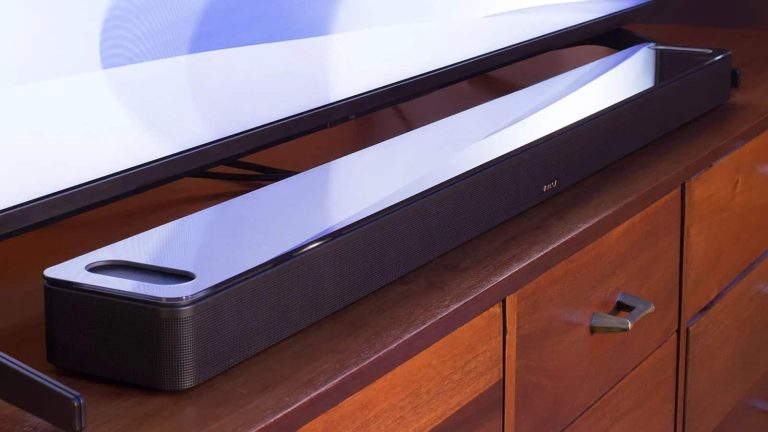
In need of a new soundbar for your living room or maybe your man cave? Well, the Bose Smart Ultra Soundbar is on sale during Amazon Prime Day today, which is quite rare. Bose rarely ever discounts its products, outside of Prime Day or Black Friday, so this is a good time to pick one up. It’s discounted to $749, saving you $150 off of its regular price.
The Bose Smart Ultra Soundbar is a really impressive soundbar. Not only does it sound great, but it does also have support for Dolby Atmos. And once you’ve experienced Dolby Atmos, you won’t want to go back – trust me. Bose has also included a surround sound system using artificial intelligence here, so without needing a subwoofer, you can get a surround sound setup here. And that is truly quite impressive.
Bose offers the Smart Ultra Soundbar in two colors: white and black. It also comes in a metal body with a glass top. Making it look rather unique and high-end, and that should also help to keep it from attracting so much dust. It’ll also fit quite nicely in your living room.
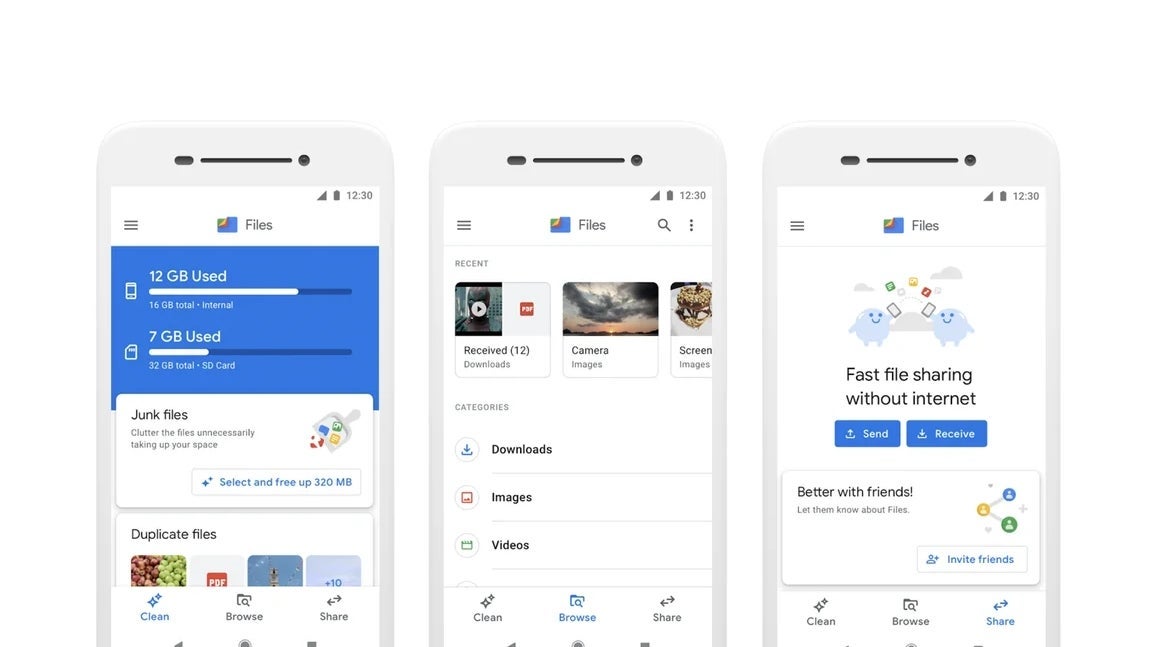
The Files by Google app, known for its user-friendly interface and helpful file management features, may soon be getting a significant upgrade. Hints of upcoming features have been discovered in the app’s latest beta version, suggesting that Files by Google is aiming to enhance its capabilities and compete with the best file explorer apps available.One of the most exciting potential additions is a “Compress” option. This would allow users to create zip files directly within the app, simplifying the process of sharing multiple files or archiving data. While the current version of Files by Google already allows users to extract files from zip archives, the ability to create them would be a valuable addition for many users.
Another feature that could be on the horizon is the “Add to collection” option. This would let users pin any folder to the “Collection” tab on the app’s home page. Currently, this tab only houses a safe folder and a folder for starred files. The new feature would provide greater flexibility in organizing and accessing important folders. However, it appears that this feature will be limited to folders, as individual files cannot be pinned to the Collection tab.
In addition to these new features, the beta version also reveals that Google has switched the positions of the “Collection” and “Categories” tabs, placing the Collections tab above Categories. This small change could be a sign of Google’s emphasis on the upcoming collection feature and its potential importance to users.
Files by Google app’s new “Compress” and “Pin to collections” options, old layout versus new layout | Images credit — Android Authority
It is important to note that these features are not yet functional in the beta version of the app, but rather enabled by tinkering with the underlying code. However, as Files by Google is already a popular choice for many Android users due to its simplicity and ease of use, it would be to everyone’s benefit that they do make it to the stable build.
If these new features are successfully implemented, the app could become even more versatile and powerful, potentially rivaling some of the top file explorer apps on the market. It will be interesting to see how these features evolve and what impact they have on the app’s overall functionality and user experience.
Google Chrome is undoubtedly one of the most popular web browser apps for desktop and mobile clients out there. It offers users one of the best web browsing experiences. And that’s why Google actively experiments with it and adds new features. More recently, there were reports about a new feature that allows Chrome to auto-revoke site permissions. While that news is still fresh, a new report published today hints about Chrome users seeing fewer APK download warnings on Android devices down the line.
You’re likely to see fewer APK download warnings in Chrome for Android soon
As you may know, there’s a lot of risk involved in downloading APK files from any other source than the Google Play Store. If the file turns out to be malicious, it could be a nightmare for the end user. And, Google doesn’t want its users to go through all that hassle. Therefore, to help users understand this risk, Chrome on Android displays a warning prompt when you try to download APK files from any website.
While this feature is mostly useful, these download warnings can be overwhelming or unnecessary for users at times. Usually, when you try to download an APK file from any website using Chrome on Android, you would see a “File might be harmful” warning. The annoying part is you get to see those warnings even if you’ve enabled Google Play Protect (GPP). However, this will change soon.
Google is apparently aware of this issue and is working towards showing fewer unnecessary APK download warnings. That too, specifically when you’ve Play Protect enabled on your Android device. The news comes via MSPowerUser which recently spotted a commit on Chromium that hints towards this feature. Notably, this behavioral change will apply to all downloads and not just APK files. It means when you download a file and haven’t chosen a location yet, you won’t see the “File might be harmful” warning.
Users will still see the download warnings, but there’s a condition
The “File might be harmful” download warnings will still be visible to users when downloading a file. This will only happen when they have disabled Google Play Protect. Well, that’s fair enough though. With these download warnings in place, users will be more cautious about what they are downloading or installing on their Android devices.
The planned changes related to download warnings are currently being tested. There’s no mention of when this feature will be rolled out. All in all, these planned changes will provide Android users with a safer internet browsing experience using Chrome down the line.
If you are on the hunt for a powerful new Windows laptop, you may not need to look beyond Samsung’s Galaxy Book 4 Pro during this Amazon Prime Day sale. Powered by Intel’s Core 7 Ultra processor with 1TB SSD storage and 16GB LPDDR5X RAM, this laptop is currently selling for $1,299.99. It usually costs $1,749.99, so you are saving several hundred dollars with this deal.
Samsung Galaxy Book 4 Pro selling for $1,299 during Prime Day
Released in early 2024, the Galaxy Book 4 Pro is a high-end Windows laptop with on-device AI features. It sports a 16-inch Dynamic AMOLED 2X touchscreen display with a 16:10 aspect ratio, WQXGA+ or 3K resolution (2880×1800 pixels), 120Hz refresh rate, 400nits of peak brightness, and 120% DCI-P3 color volume. The laptop has two Thunderbolt 4 ports, a USB Type-A, an HDMI 2.1, a Micro SD, and a headphone/microphone jack.
For wireless connectivity, the Galaxy Book 4 Pro has Wi-Fi 6E and Bluetooth v5.3. Samsung offers studio-quality dual microphones and bi-directional AI noise canceling for crystal clear voice during video calls. The laptop also has AKG-tuned quad speakers with Dolby Atmos for loud and clear sound during calls and media consumption. Speaking of video calls, you get a 2MP front-facing camera with 1080p resolution.
This Samsung laptop features a large touchpad and a backlit Pro keyboard with numeric keys. The device is fueled by a 76Wh battery with support for 65W USB Type-C charging. The Galaxy Book 4 Pro also features the award-winning Samsung Knox security chip that secures critical system data separately. It ships with Windows 11 Home. Amazon is giving you this premium laptop for just $1,299.99 during the Prime Day sale.
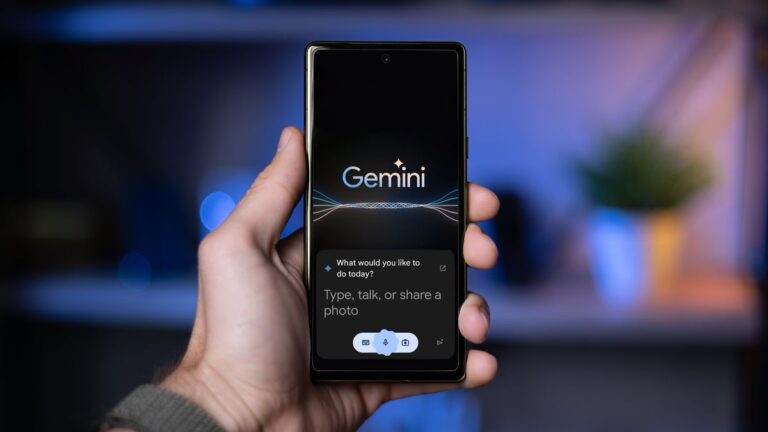
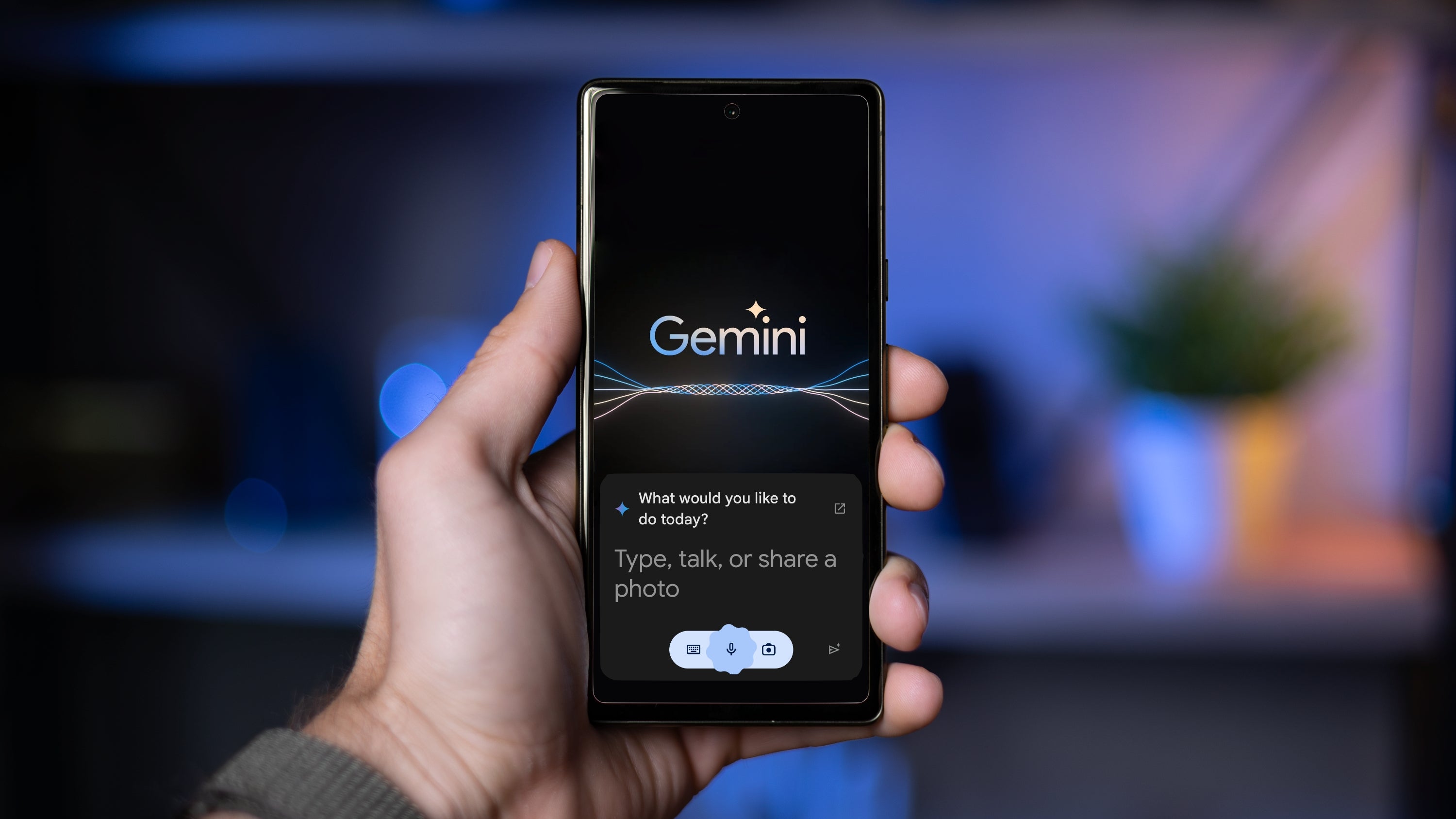
Google’s AI assistant, Gemini, can now answer general questions on Android phones without needing to unlock the device. This is a significant improvement as previously, even simple questions, like weather updates, required unlocking the phone.
The update has been noted onGoogle’s support page, stating Gemini can now “help you with answers to general questions” when the phone is locked. Additionally, users reports have indicated that Gemini can respond to a variety of questions without prompting for unlocking, and the answers are even read aloud.
To continue conversations or access the text input box, Gemini will request user authentication by tapping the screen. A new “Gemini on lock screen” setting will appear in the Gemini Settings if the feature is available on your phone. This setting allows users to disable the lock screen question answering if desired.
Gemini settings for the lock screen | Images credit — 9to5Google
Despite this improvement, Gemini still has a long way to go before it can replace Google Assistant. While Gemini can now handle general questions on the lock screen, and offers voice commands for device control, media playback, and timer settings when “Google Assistant features on lock screen” is enabled, it lacks many other useful features. For example, Google Assistant can read unread messages and emails, as well as make calls, functionalities Gemini doesn’t currently offer.It’s also worth noting that although Gemini is still catching up in terms of features, its ability to answer general questions on the lock screen is a substantial step forward. It adds convenience for users who want quick answers without having to unlock their phones.
As Google continues to develop and improve Gemini, it will be interesting to see how it evolves and competes with other AI assistants in the market. The addition of lock screen question answering may encourage more users to try Gemini and could potentially lead to wider adoption in the future.
Being an audiophile is not an affordable venture. If you want to be a true audiophile, get ready to see headphones that cost upwards of $1,000 at the least. If you think that going for IEMs (in-ear monitors) will let you escape the high prices, you’d be mistaken. There are some monitors that may as well come with a second mortgage on your house attached. So, when a company like Meze Audio showcases a pair of high-quality IEMs for only $159, you take notice quickly. I was given the opportunity to review the new Meze Audio ALBA.
The audiophile industry is just like any other. If you want better quality, you often need to pay more money. So, if you shell out more money, you’d expect some level of quality, but it’s not always cut-and-dry like that. There are companies out there that charge you a premium just because they can. Sure, their headphones might have a metal design or some special drivers that warp time and space to give you .002% crisper audio. However, they’d cost $20,000 when they perform on the level of $1,000 headphones.
Guess what, we also see the opposite. We see companies offering headphones that can go up against pairs twice or three times their price. They bring the audiophile experience down to a more manageable price point. These are the companies that often go unnoticed by the masses. Most companies overcharging for their headphones do so because their name carries a ton of weight.
Meze Audio might not be as popular as Sennheiser, but should it? Let’s find out in this review.
Table of Contents
Meze Audio ALBA Review: Design
A set of IEMs isn’t like a smartphone; you’re not looking at them as often. So, you wouldn’t think that the design matters all that much, but it’s still nice having a good-looking set of IEMs in your ear. This is why companies spend so much time perfecting the shape and overall design of their products.
The ALBA are shaped like no other IEMs I’ve ever seen. They have an all-around curvy aesthetic to them that I like. They manage to stand apart from some of the other IEMs currently on the market. The monitors have this pleasing irregular shape to them which really makes the design sick out.
I’d say that one of the main defining features of these IEMs is the hole in the middle. There’s a circle in the middle that gently curves downward. It has the text “Meze Audio. Designed in Baia Mare” circling it. It’s hard to describe how I feel about this design feature. It’s one of those design features, that are weird, but they add so much character to the overall design. I’ve never seen anything like it before, and it makes the design stand out.
The overall color aesthetic of these IEMs is absolutely gorgeous. The main body of each monitor has a white, almost pearlescent color to it. It’s super slick, and it’s actually glittery. When I catch it in the right light, I can see speckles dotted throughout.
This color is only made better by the silver accents. There’s a silver ring around the cord port, the hole in the middle is silver, and the part that holds the ear tip is silver. This gives these IEMs a beautiful two-tone look to them.
Rounding out the look, there’s the Meze Audio logo printed on the side of each bud.
Don’t forget the cord
The look of the Meze Audio ALBA doesn’t stop at the buds. These come with a detachable cord, and it’s a sight itself. The wires themselves are coated in a silver lining, and they’re encased in a clear plastic housing. The wires coming from the left and right bud twist until they meet in the middle. After that, they take on this complicated braided pattern until they meet the tip.
The clear and silver cord, coupled with the white and silver look of the actual monitors gives the ALBA this cool and pristine look. It’s not the kind of squeaky-clean aesthetic that we associate with Apple. It’s more robust. There’s more of a “show-offy” and rebellious look to them that I really like.
Overall
I think the design of the ALBA is pretty eccentric and design, and that’s the beauty of it. Meze isn’t afraid to be just a bit odd with its design. The company knows how to make a handsome pair of IEMs, and I think that it struck gold with this design. The ALBA aren’t the company’s only IEMs with this shape. We also see this design with the ADVAR, albeit with a different color scheme. In any case, the ALBA are a beautiful-looking pair of IEMs.
Meze Audio ALBA Review: Build Quality
Just like the design, the build quality of a pair of IEMs isn’t as appreciated as much as a phone’s. All of the typical store-shelf headphones and earbuds that I’ve owned were made from plastic, and that was good enough. However, how long do companies plan on you keeping those devices? I can say that I’ve never kept a pair of cheap headphones more than maybe a year and a half. They’re not meant to last you for years.
When you’re talking about audiophile-grade tech, you’re talking about a completely different kind of product. Premium companies design their products to last you years and years. Thus, when it comes to professional and audiophile equipment, plastic parts give way to metal.
This is what happened with the Meze Audio ALBA. When I pick up these IEMs, my hand is greeted with the cool feeling of metal. These monitors are composed of both zinc and anodized aluminum parts. This makes them lightweight while extremely sturdy. While earbuds are small, enough falls can shake something loose or cause the casing to crack. However, the ALBA are designed to take all kinds of abuse and keep going, and I can feel that.
The difference between these IEMs and typical earbuds can be felt. They’re a little bit heavier in the hand. It’s a slight difference, but when you’re talking about devices as small as these, every ounce or gram of difference means a lot. The ALBA sit rather heavy in the hand. This lets me know that they’re made from quality materials. I feel secure when using them. I know if one happens to fall to the ground, I won’t have to worry about getting a new pair of IEMs.
The same thing goes for the caps around the 3.5mm plug and the dongle. These are all made from metal. Everything about these IEMs just feels premium, and that brings some great peace of mind.
The cord will last
Moving onto the actual cord, it also feels sturdy. The braided design of the cord minimizes the wear and tear you get from bending it. The cord will be bent at certain angles; that’s inevitable. However, it’s designed so that the cord doesn’t bend so drastically. This only lets me know that I’m going to be using these IEMs for quite some time, as Meze Audio gave me a spare cord.
Overall
The ALBA aren’t up there in price compared to other audiophile products, but that doesn’t mean that they shouldn’t feel that way. I feel like I’m grabbing a pair of quality IEMs every time I pick them up. I have no complaints about these monitors at all when it comes to the build quality.
Meze Audio ALBA Review: Audio Quality Part 1
Now, we’ve reached that part of the review. Sure, the design and feeling in the hand are nice, but what about the sound? This is usually a pretty tough question to ask, as everyone listens to different types of music. So, I’ll be taking a two-pronged approach to this section.
First, I’ll be taking a pretty clinical approach to the audio quality. I’ll be talking about different aspects of sound. In the next section, I’ll be going through my experience with some of my favorite songs that I listen to. That will be a more personal approach to the audio quality. So, let’s talk about the different aspects of the sound.
Details
These IEMs have a damn fine-tuned set of drivers because the sound is incredibly detailed. I’ve reviewed many pairs of earbuds as a reviewer, and not of them reached the level of detail that I hear with the ALBA. I reviewed the Beyerdynamic FREE BYRD, and I think that the ALBA blow them out of the water in terms of detail. The FREE BYRD cost almost twice as much as the ALBA.
Everything is so crisp. I can hear every fine detail of each instrument being played. I can hear all of the subtle details in a person’s voice. The difference between these IEMs and more consumer-focused earbuds is the difference between just hearing a person playing a Double Bass and hearing the subtle grit of the bow grinding against the string. There’s just another level of detail that I hear with these.
I think that Meze Audio achieved this level of detail with a tasteful boost in the higher tones. There’s just a bit more attention paid to the higher tones than typical earbuds.
Will the sound be as detailed as a pair of $600 IEMs, not likely. However, the ALBA aren’t far off from IEMs that are a couple hundred dollars more than they are.
High tones
Speaking of the high tones, Meze Audio reached a nice balance with the higher tones. You want to have a nice amount of treble in your audio, but it’s tricky, as too much can make the audio sound shrill. Once that happens, I find that it causes the ears to become fatigued easily. This causes you to take the headphones off just for a break. What’s the point of using headphones that you want to take off?
With the ALBA, I hear a nice amount of treble in the sound, which adds to the overall experience. It makes voices stand out and it also adds to the overall detail of the sound.
I don’t think that it sounds shrill, but there are some songs that come close to that point. It’s mostly with 80s music, I think. I hear a lot of emphasis on high tones with 80s music. Gotta love those twinkly 80s synths and synthetic horns! My ears don’t feel fatigued, but I found myself turning the volume down a level or two at points.
Like I said, Meze Audio paid some attention to the higher tones, and it shows. There are some headphones where it was evident that the company didn’t really take the time to perfect the higher tones. I felt that way when I reviewed the Edifier Neo Buds S back in 2022.
I’d say that the treble in the ALBA is exceptional.
Bass
I feel like this is the only part of the sound that I wasn’t blown away with. Firstly, a little about me, I HATE when companies boost the bass of their audio to the point where it sounds muddy. I know that a lot of modern music is more bass-heavy with big bassy thumps. Many modern audio companies make their equipment to appeal to people who listen to that music. While it’s good for that kind of music, again, it makes the sound come out muddy.
So I appreciate it when companies are more cautious about how much bass they add to their sound. That being said, I think that the ALBA could stand for just a bit more bass. I would listen to some songs that have deep and warm bass, but I just wouldn’t hear it with the ALBA. It would wind up sounding pretty light.
It would hinder the experience just a bit, to be honest. I would have liked to have just a bit more bass to really tie the experience together. It would make the overall listening experience just a bit more immersive.
Mids
Just like any part of the sound spectrum, if the mids are too strong, it can throw off the whole listening experience. When the mids are too much, the audio can sound cluttered. When you’re listening to music, you want to feel like you’re in the middle of the action but not like you’re being smothered.
Just like the high tones, the mids were kept well in check. The audio overall was nice and spacious, so the mids were nicely balanced.
When it comes to the overall balance between the bass, mids, and treble, I think that the audio is pretty well-balanced. The bass is definitely weak, I can’t forget about that. However, Meze Audio didn’t compensate by making any other aspect of the audio too powerful.
Sound stage
One thing that really got me with these IEMs is the sound stage. I think that it’s great. One way I got a good idea of these IEMs’ sound stage is by listening to orchestral music. Each section is arranged in a specific spot. Well, I can get a good idea of where each section is situated just by closing my eyes and listening.
I can really hear the instruments in 3D space, and that adds to the overall immersion. Instruments that are far from the microphones sound far, and instruments that are close sound like they’re right next to my ears.
Overall
Looking at the different aspects of the audio separately, these IEMs excel. They have a fantastic and engaging sound that I rather enjoy. They produce a clean and detailed sound that I haven’t heard from any other wearable equipment I’ve ever used. The sound is detailed, spacious, and encompassing.
The only thing that I would have liked to hear was a little more bass in the sound. Not too much as to make it sound muddy, but just enough to hug the ears just a bit more.
EQ recommendation
While I like the sound out of the box, I did throw an EQ on my phone and computer to help add a bit more bass to the sound. Of course, I conducted the testing for this review without the EQ, so I’m judging them based on their out-of-the-box experience.
However, for my casual listening, I actually use a nine-band EQ on my computer called FXSound (available on the Windows Store). This EQ allows you to set the frequency of each band with single Hz precision.
The bands and settings are 120Hz(+3dB), 250Hz (+2dB), 410Hz (+0dB), 630Hz (-1dB), 1.25kHz (-3dB), 2.7kHz (+0dB), 5.3kHz (+0dB), 7.5kHz (+3dB), and 13kHz (+4dB). I think that helps add some bass to the sound and gives the sound a dramatic characteristic.
Meze Audio ALBA Review: Audio Quality Part 2
In this section of the review, I’ll be picking a selection of songs that I think cover a wide range of audio, and I’ll recount my experience with listening to them. These are songs that I listen to often, so this will be a snapshot of my day-to-day experience with listening to the Meze ALBA.
“She’s Gone” by Hall & Oates (1973)
This song, along with being amazing, feels to sum up that character that a lot of 70s music has. It’s rather warm and mellow with enough strings and electric bass. The warmth of the song overall helps pick up some of the bass that the ALBA are missing.
The sound stage overall plays well with this song. There’s a high hat that sounds so crisp and clean. It sounds like it’s right next to my ear.
I think that this is another great song to test these IEMs’ vocal performance. Daryl Hall and John Oates are singing an octave apart. So, we hear both low and high voices, and they both sound amazing. All of the voices project rather nicely, and I can hear some great details in them.
Later on in the song when the energy really picks up, after modulating twice, everything sounds absolutely beautiful. Nothing sounds too loud or out of place.
“This Is It” by Kenny Loggins (1979)
Moving onto the late 70s, this song has more of an emphasis on high-pitched percussion with several cymbals and maracas throughout. Again, they all sound crisp and amazing.
The bass is a little crunchier than in the Hall & Oates song, but it still has some depth. The sound is nice and warm. The overall sound stage remains spacious and clear.
As for Kenny Loggins’ and Michael McDonald’s voices, they all sound amazing. Again, I can hear some amazing detail in their voices. Everything comes together to create a beautiful sound.
“You Win Again” by The BeeGees (1987)
Now, let’s jump into the 80s. Things changed immensely in this era. Overall, I think that the sound became more high-pitched and crunchy, at least in the pop music space. One thing I noticed is that the basses used were much crunchier than what we heard in the 70s.
This next song is a great one to test out the punch. If you’re familiar with this song, you know about the bombastic crashing percussion that pervades the song. It’s the first thing you hear. Also, there’s a fair bit of higher synth along with some acoustic guitar.
The first thing that stuck out to me was the sound stage. The crashy percussion was loud, but it didn’t feel like it was cluttering the sound. It sounded like it was happening in 3D space rather than right at my ears.
As expected, there wasn’t much bass to the sound, and I felt that some of the higher tones overtook the sound just a bit. It felt just a bit cluttered around the higher mids. This is a situation when I think the EQ would help even out the sound.
The great details and sound stage really carry this song… along with the fact that it’s just an amazing song.
“Feelings of Forever” by Tiffany (1987)
Moving onto a song from the same year, this song focuses on a deeper and more intimate sound. So, there’s a bit more low-end than the BeeGees’ song. While that’s the case, it still has the 80s pop shenanigans like high synth and electric drums.
The bass is deeper and more spacious than You Win Again, and it plays well with these IEMs. Once the chorus picks up, the sound really envelops the ears in a pleasing way. It hits a bit of a sweet spot that picks up for the lacking bass performance of the IEMs.
Again, amazing sound stage. One reason I chose a Tiffany song is that the singer has a pleasingly raspy voice. And, the ALBA are able to convey that nicely. I can hear great details in her voice.
“All I Ask” by Kenny Loggins (1997)
Moving back to Kenny Loggins, but in a different decade, we have some deep (and I mean DEEP) and warm R&B. In the 90s, the music industry brought back much of the warmth that we lost in the 80s, and that’s represented by the synthetic basses that we heard.
In the case of this song, it has a very warm and earthy sound to it. That represents the sound of the album as a whole. There’s some extreme bass in this song, and it’s able to really push these IEMs to their limit. The bass sounds warm and pleasant. It’s encompassing, but it still doesn’t smother me. There’s still some distance with it and all of the other components of the song.
Everything else that I mentioned comes into play here: the sound stage, vocal performance, and detailed sound.
“Magnetized” by Jonny Hates Jazz (2013)
Now, for a more modern song. This is a pretty energetic song, but it’s rather engaging. Overall, I feel like the sound profile of more modern songs has a balance between warmth and high-pitched audio. I think that it’s somewhere between 70s music and 80s music.
I can hear that balance with these IEMs, and I think that it reaches a nice sweet spot for the ALBA. There’s a good amount of bass, mids, and highs. As always, the great sound stage, vocal performance, and details work to make the music sound great.
Overall
The Meze Audio ALBA produce an amazing sound. It’s absolutely beautiful, and they play well with a wide range of music. Depending on the genre, the lack of strong bass can be felt more than with some others. However, the other factors help to compensate and create an amazing listening experience.
Meze Audio ALBA Review: Gripes
There are a few little things with these IEMs that didn’t quite sit well with me, but they’re few. Firstly, the cord is a little short for my taste. I think that it’s plenty long for listening to music on my phone. However, I often find myself using these while working on my computer. I wish there was just a little more slack to move it out of the way so that it doesn’t get in the way of my mouse or keyboard.
Secondly, I think it would have been better to see a microphone with these IEMs. I know that these aren’t meant to be your everyday headphones; they’re specialized for listening to audio. However, there are times when I use these with my phone, and I get calls. It’s a bit cumbersome having to unplug them from my phone and take the ALBA out of my ears just to take the call.
Those are my only gripes with these IEMs.
Meze Audio ALBA Review: Final Verdict
There are companies that maintain this mile-high wall between average users and people who can burn 10s of thousands of dollars on a pair of monitors. They’re the ones that make becoming an audiophile a scary road to travel. Well, there are companies standing there with a sledgehammer. These are companies that help provide a graceful on-ramp to being an audiophile.
Sure, their headphones might not have some of the bells and whistles that more premium audio equipment have, but they do the primary job of all audiophile equipment; they provide an experience that’s better than typical headphones.
Meze is one of the companies holding a sledgehammer and a damn-good pair of IEMs. For the price that’s microscopic compared to most other IEMs, the ALBA provide an experience that’s much better than its price would indicate.
For $159, you’re getting a set of IEMs that have an amazingly detailed sound, excellent control of the highs, a great sound stage, and an overall captivating sound. It lacks in the bass department, but a little fine-tuning with an EQ, and you’re good to go. Most of the time, people use the built-in EQs present in apps for Bluetooth headphones. There’s nothing wrong with a little refinement.
If you’re looking to start your journey to being an audiophile, I’ll recommend two things. #1: I recommend that you pick up the Meze Audio ALBA. #2: I recommend that you keep Meze Audio on your radar because this company knows what it’s doing!
Amazon Prime Day sale is in full swing, offering attractive discounts on some of the most sought-after products. The Garmin Venu 2S is selling at a discounted price too. Normally priced at $399.99, this premium smartwatch is available at $259.80. That’s a flat 35% or $140 off the regular price.
Garmin Venu 2S discounted to $259 for the Prime Day sale
Available in a 40mm size, Garmin’s Venu 2S is an ideal smartwatch for people with smaller wrists. The watch has a dimension of 40.4 x 40.4 x 12.1 mm and weighs 38.2 grams. You still get a sizeable 1.1-inch AMOLED display with an always-on mode, 360×360 pixels resolution, and Corning Gorilla Glass 3 protection. The watch has a stainless steel body and lasts up to ten days on a single charge when used in smartwatch mode. With continuous GPS and music, you get a runtime of seven hours.
The Garmin Venu 2S boasts 8GB of storage capacity for offline music storage. It is compatible with Android and iOS, offering smartphone notifications on your wrist. You can control music playback and calls on your phone directly from the watch. But its main strength is activity and health tracking. The Garmin smartwatch can monitor your heart rate and offer alerts for abnormal heart rates. It can also monitor your energy levels, stress, fitness age, respiration rate, sleep, hydration, and more.
Built-in GPS, altimeter, compass, gyroscope, accelerometer, thermometer, and other sensors add to its capabilities. You can accurately track your outdoor run and use the watch to navigate your way. Garmin provides a wide range of activity profiles, so everyone can find customized workout trackers. The Venu 2S has some features tailored for athletes, including golfers, runners, swimmers, and more. At only $259.80, you are getting an unbeatable deal on this amazing Garmin smartwatch.
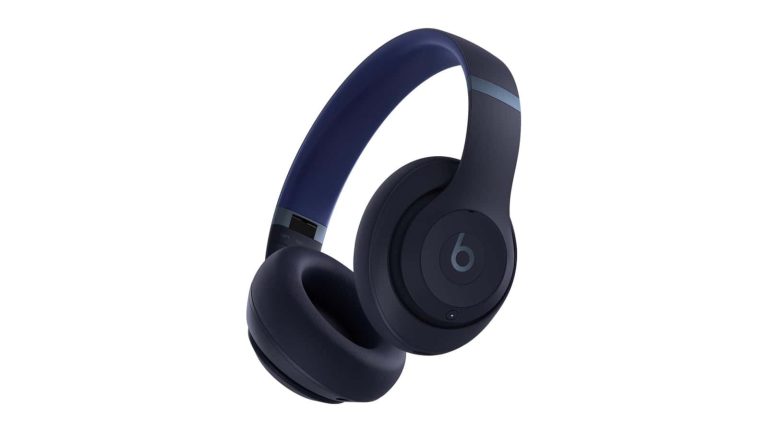
We’re on the second and final day of Prime Day, so you’ll want to act fast on these deals. If you’re looking to up your headphone game, then you’ll want to get the Beats Studio Pro for half off! This brings the price down to $169.95. That’s down from $349.99.
If you want to get more from your Amazon experience, why not try the Amazon Prime free trial? It’s a 30-day free trial that’s only for new members.
There’s no doubt that Beats are some of the most popular headphones on the consumer headphone market. They’ve been popular since they exploded onto the scene more than a decade ago. They’re great, but they’re also pricey, so this is a great deal.
These headphones come with custom-tuned audio drivers that will give you some amazing audio. No matter what you’re listening to, everything will sound great. Adding to the audio experience is spatial audio and head tracking. This will keep you engrossed in the audio.
These are Bluetooth headphones, but they can give you lossless audio through USB-C. This means that you’ll get better audio quality than many of the other headphones on the market.
The Beats Studio Pro come with soft ear pads. This means that they’re comfortable to wear. You’ll be able to wear them for long periods of time.
When it comes to battery life, you should be able to get up to about 40 hours of listening time on a single charge. That means that you’ll be able to use them for days with casual usage. If you find yourself low on battery, a quick 10-minute charge will give you about 4 hours of listening time.
These are amazing headphones to get at their regular price, so this discount makes them one of the best Prime Day deals currently going on.
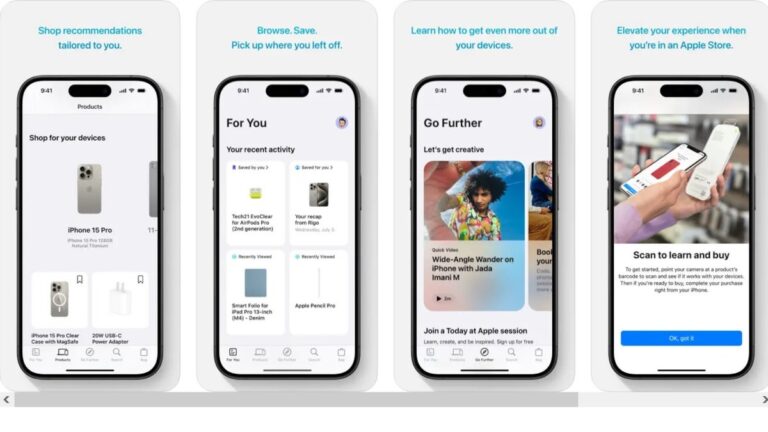
The Apple Store app might be one of the most little-known Apple apps in the App Store. It is number 106 among the top shopping apps in the iOS app storefront but Apple is hoping to see it climb the charts following some UI changes it has made to the app. Some of the revisions have taking place in the navigation bar where Shop and Sessions are being replaced with Products and Go Further respectively.
The Products tab allows you to shop for the latest products in categories such as:
You can also choose accessories to purchase ranging from Cases & Protection to MagSafe, Watch Bands, Charging, Beats by Dr. Dre, and more.
The For You tab includes a list reminding you about some of the free trials that you can take advantage of when you buy a new Apple device. These include the three free months of Apple Music and three free months of Apple TV+ you’d be eligible to receive. The Go Further tab shows you which Today at Apple sessions are taking place at an Apple Store near you. These sessions give Apple device owners a hands-on deep dive into the features of products like the iPhone. A new Today at Apple video series on the app will help teach users how to use certain features available on their Apple devices.
“A fresh, more curated experience that makes it easier to quickly find the most relevant content on the For You tab, shop the latest on the Products tab, and make the most of the devices you already own on the Go Further tab.
Check out the new video series from Today at Apple with featured guests that will inspire you to do more with your devices. New options to customize your privacy settings and preferences give you enhanced control over how Apple will use the data you share with us.”-Apple
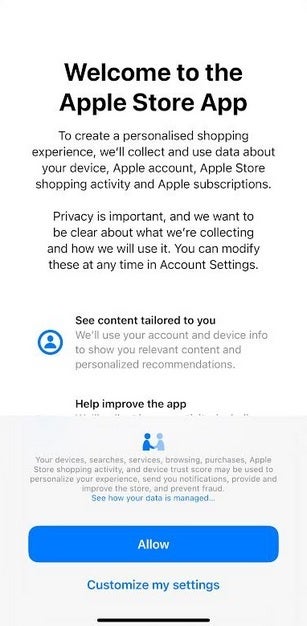
The updated Apple Store app allows you to opt-in so Apple can use personal data to make purchase recommendations. | Image credit-PhoneArena
While the Apple Store app does collect personal data from the user in order to suggest certain purchases, this information about your shopping activity will not be sent to Apple unless you opt-in via Account Settings. You can install the Apple Store app from the App Store by tapping on this link.
The Volcano Demon group has been discovered spreading a new ransomware called LukaLocker, which targets Idealease Inc., a truck leasing company.
The malware targets several security, monitoring, and backup services, including antivirus software like Trend Micro, Malware Bytes, Sophos, and McAfee.
The malware disables the service if any of these are found on the machine.
In recent weeks, Volcano Demon has been claimed to have carried out several profitable cybercrime attacks. It specifically targets the industrial and logistic sectors.
Particularly, the leadership of the victim organization is intimidated and negotiated for payments by the group over the phone.
The malware is coded in C++ and is presented as an x64 binary. By using dynamic API resolution and API obfuscation to conceal its destructive capabilities, the LukaLocker ransomware avoids detection, analysis, and reverse engineering.
A command prompt window that opens when the malware is executed displays a list of the processes that it tries to terminate.
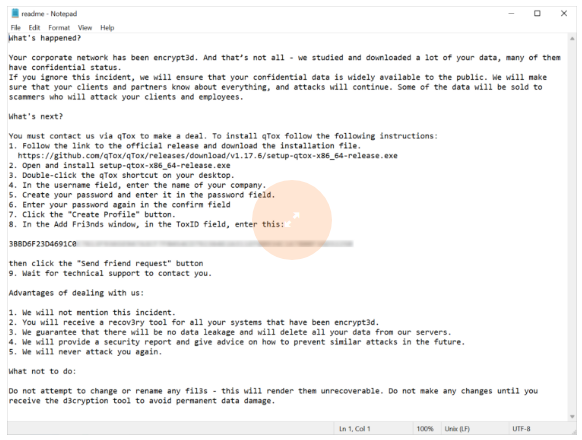
After this operation is completed, the system encrypts files and appends “.NBA” to their filenames. It then saves readme.txt to the desktop.
“Your corporate network has been encrypted. And that’s not all – we studied and downloaded a lot of your data, many of these have confidential status”, reads the ransom note.
Ransom Note
In this case, the ransom note specifies that to retrieve files, you must speak with the operator via the qTox encrypted chat client. An instant chat app called qTox is designed to avoid government surveillance.
“Various security, monitoring and backup services are targeted. This includes antivirus software such as Malware Bytes, Sophos, McAfee and Trend Micro”, reads the SonicWall threats research report.
“If any of these are present on the system, the service is disabled by the malware”.
List of security and backup services to stop
The Volcano Demon operators usually encrypt the data of their victims before reaching out to them. The gang then notifies its victims that their files have been effectively compromised by leaving a ransom note.
After then, the attackers will begin pushing their victims into complying with their requests to commence their extortion scheme. These threat actors will threaten to tell clients and partners and carry out more attacks if their victims don’t address the problem.
The actors would also threaten to sell the employees’ and clients’ data to scammers if the infiltrated organizations don’t comply.
Ransomware operators are shifting their tactics; recently, a large number of new threat actors have emerged and begun targeting different types of enterprises.
Businesses should strengthen their security protocols since malicious actors will always find new ways to get into networks and steal information.
“Is Your System Under Attack? Try Cynet XDR: Automated Detection & Response for Endpoints, Networks, & Users!”- Free Demo