According to Lenovo China’s head of mobile devices, Chen Jin, the Motorola Razr series has a bright future. He said that the Motorola Razr+ (also known as the Motorola Razr 40 Ultra) heir will get a “stunning” new design, and also an AI boost, amongst other things.
Mr. Jin wrote on Weibo, teasing what’s to come from the company. As a side note, Motorola is owned by Lenovo, in case you don’t know that. So, this is official info we’re looking at here.
The Motorola Razr+ heir is said to get a “stunning” new design, AI boost & more
Now, Motorola’s flagship clamshell for 2024 will likely be fueled by the Snapdragon 8 Gen 3. That could explain the AI teaser provided here. A “stunning” new design is also mentioned, which indicates we may see a major change here.
The Motorola Razr+ has been mostly hailed for its design. It has a huge cover display, and it’s very eye-pleasing, well… to most people anyway. Motorola will probably look to polish things out further with the Motorola Razr+ 2024, or whatever the phone’s name ends up being.
As a side note, the Motorola Razr+ actually comes with the Snapdragon 8+ Gen 1 SoC. If its successor gets the Snapdragon 8 Gen 3, that will be quite a leap, and it would certainly be nice to see.
Its specs are still a mystery
What about the phone’s specs? Well, they’re a mystery at this point, as Chen Jin did not reveal any such details. We do presume that quite a few things will remain unchanged, such as the display size, for example.
Motorola will be looking to improve the SoC, of course, and could potentially include more RAM. We could also get better displays, but probably not larger ones, while charging is a complete mystery. We’ll have to wait and see.
Don’t expect the next-gen Motorola Razr+ to arrive soon, though. The Motorola Razr+ launched in June last year, so… we’re in for quite a wait. Well, unless Motorola drastically changes its release cycle.
Samsung plans to enhance its competitiveness in the global tech industry this year through technological excellence and flexibility. The company revealed its strategic priorities in a memo to employees on the occasion of the new year earlier today. The memo, signed by two top-level executives, outlined various strategies to maintain a competitive edge.
Samsung prioritizes tech supremacy and flexibility this year
According to a Korea Bizwire report, Samsung’s New Year memo to employees was jointly signed by its co-CEOs Han Jong-hee and Kyung Kye-hyun. Han is also a Vice Chairman at the company and heads its DX Division, which encompasses the visual display, digital appliances, home appliances, health and medical equipment, mobile experience, and networks businesses.
Kyung, meanwhile, is a President at Samsung and the Director of SAIT (Samsung Advanced Institute of Technology), the Korean behemoth’s research and development unit. He also leads the semiconductor business division. In their joint memo, the two co-CEOs highlighted the need to widen the technological gap with its competitors to stay ahead of the curve.
“We will prioritize strengthening our fundamental competitiveness, including the core values that have guided Samsung Electronics, such as super-gap technologies,” they said. The Samsung executives encouraged the chip division to create a technological advantage. The semiconductor business has been its cash cow for years but suffered massive losses in 2023 due to multiple factors.
Han and Kyung emphasized a customer-first strategy for mobile, home appliances, and software divisions. They urged employees to focus on performance and quality. The Samsung executives further stressed the need to be proactive to quickly adapt to changes in the industry. These include the rapid rise in the use of artificial intelligence (AI) over the past year and growing eco-friendly practices.
AI will be pivotal to all technological advancements this year
“We should revolutionize the way we work and our device experience by applying generative AI to work,” the memo read. “Moving from the passive green response of the past, we should pull off a fundamental shift in thinking and discover the green products of the future.” Samsung’s upcoming Galaxy S24 flagships bring tons of new AI features. The devices are also expected to use more recycled material.
It remains to be seen if these strategic moves bring a change to Samsung’s fortune this year. 2023 has been a forgettable year for it, at least financially. In the first nine months of last year, the company generated a sales revenue of about $147 billion, down over 17 percent from the same period in 2022. Its operating profit tumbled a whopping 90 percent to just $2.9 billion. Samsung will publish its full-year earnings report for 2023 later this month.
DLL hijacking is a technique where a malicious DLL (Dynamic Link Library) is placed in a directory that a vulnerable application searches before the legitimate one.
When the application is launched, it unknowingly loads the malicious DLL instead, allowing attackers to:-
Execute arbitrary code
Compromise the system
Recently, the cybersecurity researchers at a multi-layered incident response company, Security Joes, discovered a new DLL hijacking technique that enables threat actors to bypass Windows mechanisms.
New DLL Hijacking Technique
This new technique exploits trusted WinSxS executables using DLL Search Order Hijacking.
This enables threat actors to execute malicious code within Windows folders, which eliminates the need for extra binaries.
Besides this, it’s compatible with both Windows 10 and 11, as it bypasses high privilege requirements.
The DLL Search Order Hijacking exploits how Windows apps load DLLs, taking advantage of those without specified file paths.
Threat actors manipulate apps depending on predefined search orders that place a malicious DLL in a prioritized directory.
Many methods for this require apps not to specify full paths, often due to development oversights.
Knowing how Windows loads DLLs and executables is one of the key things, and the system follows a sequence during the loading process.
This ensures efficient operation by locating necessary components like DLLs. Not only that even, it also provides an alternative method for finding resources.
Besides this, the Windows OS flow for searching and loading resources includes the following things:-
Application’s launch directory
C:\Windows\System32
C:\Windows\System
C:\Windows
Current working directory
Directories in the system’s
User’s PATH variables
Exploiting the loading process lets threat actors inject unauthorized code into the trusted processes, which helps in deceiving the:-
Security tools
Security experts/analysts
This new malicious technique is completely sophisticated and stealthy as it enables threat actors to achieve several types of malicious goals like:-
Compromise systems
Evade detection
The WinSxS folder is a critical component in Windows OS at “C:\Windows\WinSxS.” This vital component crucially maintains multiple versions of system files.
Not only that even, it also preserves previous versions during updates, which causes the folder to grow with each update for the Windows operating system.
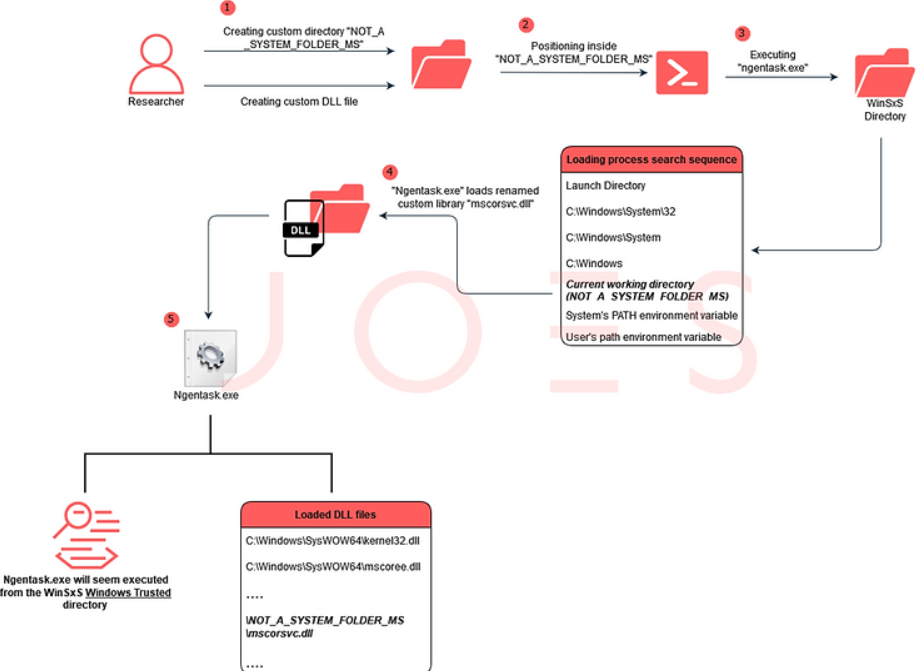
Execution flow of the DLL Search Order Hijacking (Source – Security Joes)
Here below, we have mentioned all the key purposes of the WinSxS folder:-
Version Management
System Integrity
Dynamic Activation
Advantages New DLL hijacking technique
Here below, we have mentioned all the key advantages of this new DLL hijacking technique:-
Circumventing High Privilege Requirements
Eliminating the Need for Additional Binaries
Enhancing Stealth
PoC
Here below, we have mentioned the Proof-of-Concept video:-
A hacker or hacker group, identified as “irleaks” (presumably indicating Iran Leaks), publicly disclosed the Snappfood cyber attack on Breach Forums and Telegram over New Year’s Eve.
Snappfood, a prominent online food delivery service in Iran, has fallen victim to a major data breach, during which cybercriminals stole personal information of millions of customers, Hackread.com can confirm.
Operating similarly to other food delivery platforms, Snappfood facilitates users in Iran to conveniently order food from a diverse range of restaurants through its mobile app or website, subsequently having it delivered to their doorstep. It forms part of the larger Snapp group, which includes Snapp’s ride-hailing services.
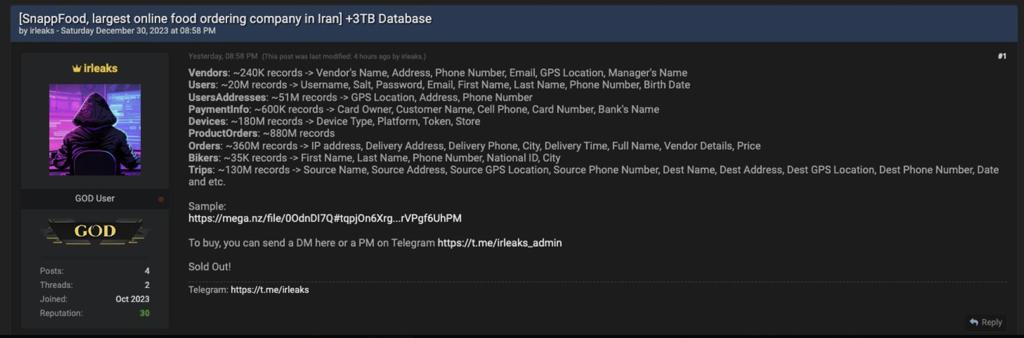
In the wake of this data breach, an individual operating under the alias “irleaks” (presumably indicating Iran Leaks) publicly disclosed a sample of the stolen data on the notorious Breach Forums, indicating the specifics of the compromised information.
As seen by Hackread.com, the hacker claimed to have acquired an extensive trove of data exceeding 3TB. Allegedly, the stolen records include:
Customer Information: Details of over 20 million customers, including usernames, password hashes, email addresses, full names, dates of birth, and phone numbers.
Vendor Records: Records of 240,000 vendors, featuring names, addresses, phone numbers, email addresses, GPS locations, and managers’ names.
Payment Information: Payment details of over 600,000 customers, incorporating card owner names, customer full names, phone numbers, card numbers, and bank names.
Device Data: Data from 180 million devices, including device types, platforms, tokens, and store names.
Product Orders: The hacker alleges to have accessed more than 880 million product order records.
Orders: Apparently, 360 million order details, encompassing IP addresses, delivery addresses, delivery phone numbers, city, time, customer full names, vendor details, and prices, were compromised.
Biker/Rider Details: The breach also affected the details of the bikers or riders responsible for order delivery, with 35,000 records, including full names, phone numbers, national ID card details, and cities, being stolen.
Trip Details: The breach allowed “irleaks” to extract trip-related information, comprising 130 million records containing source names, addresses, GPS locations, phone numbers, destinations, and addresses.
irleaks’ post on Breach Forums (Screenshot credit: Hackread.com)
Snappfood Acknowledges the Data Breach
While the official Snappfood Iran website was inaccessible at the time of writing this article, on December 31, 2023, the company publicly acknowledged the breach on Twitter (now X), acknowledging the issue. Snappfood’s social media representative disclosed that Iran’s Cyber Police (FATA) is actively working to identify the breach’s source.
However, the company maintains that customers’ payment data, especially card security codes (CCV), passwords, and expiration dates, remain secure and were not accessed by hackers.
Agreement between Snappfood and “irleaks”?
In a subsequent tweet on January 1, 2024, Snappfood claimed that an agreement had been reached with the hacker group, preventing the sale or leakage of the data online. While the specifics of the agreement remain undisclosed, Snappfood’s claim appears substantial, given that the hacker group had deleted their post from Breach Forums and removed the sample link previously shared on the forum and their Telegram channel at the time of writing.
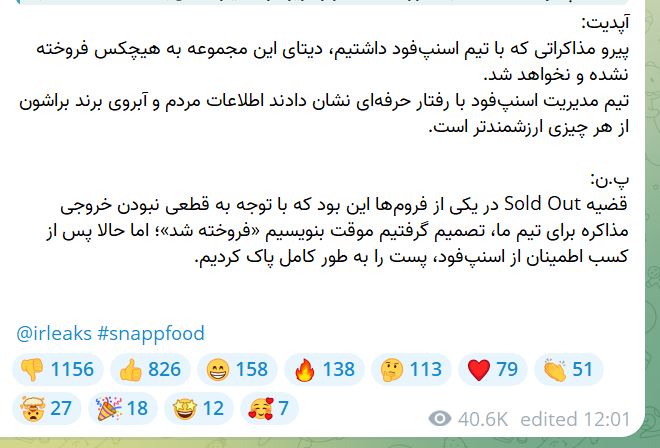
Additionally, a post from the hackers on their Telegram channel confirms the agreement and outlines the next steps for the affected company and customers. The following content has been translated using Google Translate:
The issue of Sold Out in one of the forums was that due to the uncertainty of the negotiation outcome for our team, we decided to temporarily write “sold”; But now after getting confirmation from Snapfood, we deleted the post completely.
Following the negotiations we had with the Snapfood team, the data of this collection has not and will not be sold to anyone. Snapfood’s management team showed that people’s information and brand reputation are more valuable to them than anything else.
irleaks
Telegram post by irleaks confirming the agreement – Screenshot credit: Hackread.com
Nevertheless, if both parties adhere to their agreement, it could be deemed a positive outcome for the company and its customers. Hackread.com has reached out to the hackers for a potential interview about the data breach, and this article will be updated accordingly if they respond.
Who is “irleaks”?
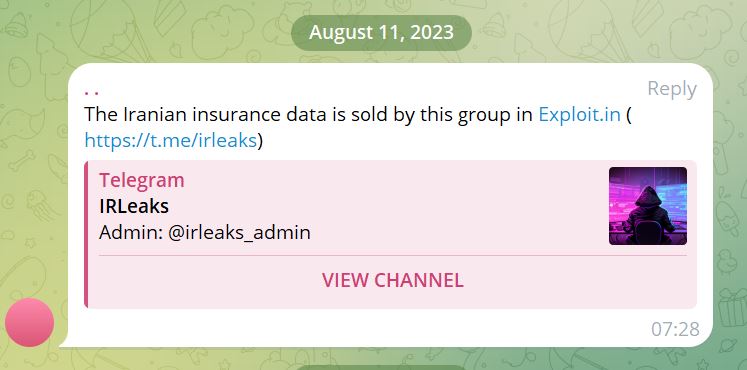
The identity of “irleaks” remains unknown, but the group is known for communicating in the Persian language. This is the same group that, in August 2023, was selling insurance data of Iranian citizens on the well-known private Russian hacker forum Exploit.in.
Screenshot credit: Hackread.com
Iran and Cyber Attacks
This incident is not the first instance of a high-profile company like Snappfood falling victim to a data breach. In April 2019, TAP30 (now TAPSI) exposed its database, revealing the personal details of millions of drivers and customers. Additionally, in May 2021, the Raychat app, a popular Iranian social and business messaging platform, was hacked, resulting in the leakage of data from more than 150 million users.
Telegram’s latest update, version 10.5.0, has an updated look, especially when you use it for voice and video calls. It also brings the “Thanos Snap” animation for deleting messages for Android users. One could say it’s a blend of aesthetics and functionality. These features are now available and rolling out for Android users.
Telegram revamps voice and video calls with the latest update
While messaging remains Telegram’s primary function, the app also emphasizes voice and video calls. With its recent update, Telegram has revamped the user interface for these calls, introducing new animations that provide a modernized appearance. Moreover, the streamlined user interface is more efficient, and this ultimately results in improved performance. So, one could say that the redesign isn’t just eye candy; it’s also kinder to your device because it promises longer battery life and smoother performance even on older phones.
The company announced in a blog post that the latest update brings a fresh look and feel to calls. It comes with dynamic backgrounds that adapt to the call’s status and a redesigned interface that’s easier on your battery and older devices. Call quality has also been boosted, and more improvements are on the horizon for 2024. The popular “Thanos Snap” vaporizing animation is coming to Android. It was previously only available on iOS with last month’s update; however, it is now making its way to Android and becoming the new standard across both platforms.
There’s more to it
While the spotlight shines on the animation revamp and a modernized appearance with the update, it has more to offer. Telegram has introduced numerous enhancements for bots in its latest update. Now, bots can respond to messages, handle reactions, manage quotes and links, and even send replies across various chats and topics.
Over the last few months, Telegram has been on a roll. The app has consistently brought a slew of new features. These include options to personalize profile colors, free audio transcription for everyone, and more.
After Elon Musk and his social media company, X Corp, filed a lawsuit against California’s AB 587 legislation, a federal judge has denied the request, The Verge reports. According to the court’s ruling, X’s request for a preliminary injunction of the law is rejected, adding that “the plaintiff has failed to establish the likelihood of success on the merits.”
Following the Elon Musk takeover, X, formerly known as Twitter, made some radical changes to its content moderation policies. Besides laying off most of the moderators, it even let some controversial figures like Andrew Tate and Alex Jones return to the platform.
While X never elaborated on its new content moderation policies, it sued California’s AB 587 in September. The social media firm alleged that the legislation curbs freedom of speech and violates the First Amendment right.
X failed at halting California AB 587 moderation law
The AB 587 asks social media platforms to share their content moderation policies and describe how they moderate content containing materials like hate speech or racism, extremism or radicalization, disinformation, harassment, and more.
However, US District Judge William Shubb denied X’s motion to halt the legislation in the state. “While the reporting requirement does appear to place a substantial compliance burden on social medial companies, it does not appear that the requirement is unjustified or unduly burdensome within the context of First Amendment law,” the judge wrote.
Shubb added that the required disclosures are “uncontroversial.” Also, the connection with some controversial issues doesn’t make the whole report controversial. “The reports required by AB 587 are purely factual. The reporting requirement merely requires social media companies to identify their existing content moderation policies, if any, related to the specified categories.” Shubb noted.
As expected, X/Twitter didn’t respond to the request for comment. But it alleged in its complaint that AB 587 forces social platforms to “eliminate’ certain constitutionally-protected content.”
The X’s new method to moderate content also became a source of controversy for the firm amid the Israel and Hamas war. The European officials accuse X of becoming a platform to spread misinformation and hateful content. In October, the EU launched a probe into X to see if it has violated the Digital Services Act (DSA).
Google Kubernetes Engine (GEK) has been detected with two flaws that a threat actor can utilize to create significant damage in case the threat actor already has access inside the Kubernetes cluster.
The first issue was associated with FluentBit with default configuration. FluentBit is GKE’s logging agent that runs by default on all the clusters.
The second issue was linked to Anthos Service Mesh (ASM), which has default privileges. ASM controls the service-to-service communication within the GKE environment.
Multiple Flaws in Google Kubernetes Engine
If an attacker gains enough privilege inside a FluentBit container, which also has ASM installed, the threat actor can create an attack chain that could result in complete control over the Kubernetes cluster.
DocumentFree Webinar
Compounding the problem are zero-day vulnerabilities like the MOVEit SQLi, Zimbra XSS, and 300+ such vulnerabilities that get discovered each month. Delays in fixing these vulnerabilities lead to compliance issues, these delay can be minimized with a unique feature on AppTrana that helps you to get “Zero vulnerability report” within 72 hours.
Post this, the threat actor can perform various actions such as data theft, deployment of malicious pods, or even disruption of the Kubernetes cluster’s operations. However, Google fixed this configuration issue in mid-December 2023.
Exploitation of FluentBit Permissions
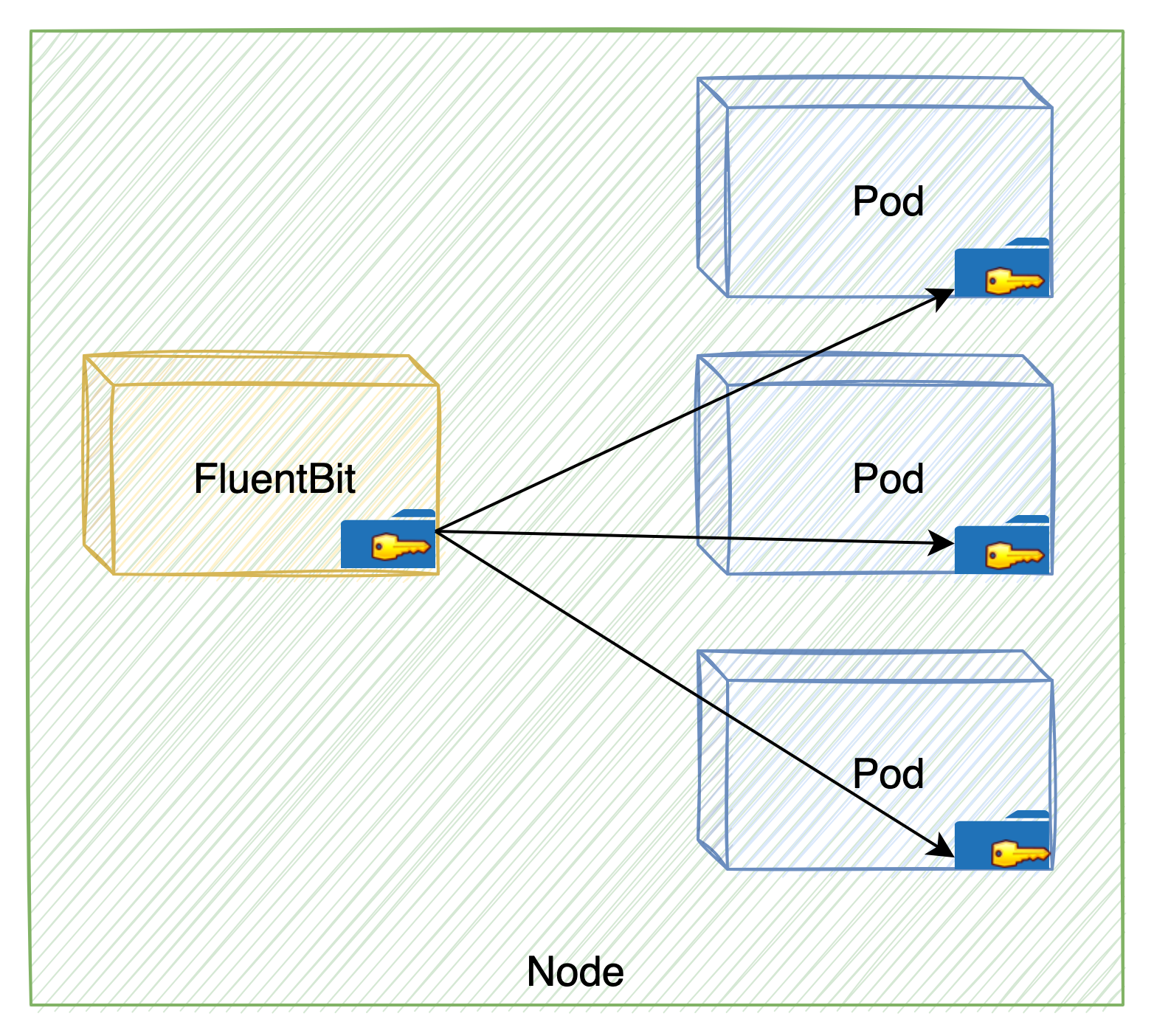
In this step, each pod inside the FluentBit mounted volume contains a kube-api-access volume that has the projected service account token. This token is used to communicate with the Kubernetes API, which is sensitive information.
FluentBit misconfiguration (Source: Unit 42)
If the FluentBit pod is compromised, the threat actor can use any token of any pod on the node. After this, the threat actor can also impersonate a pod and gain privileged access inside the Kubernetes API server, followed by several malicious actions such as mapping the entire cluster, listing all the running pods, etc.
Second Step: Exploitation of Istio Post-Installation Permissions
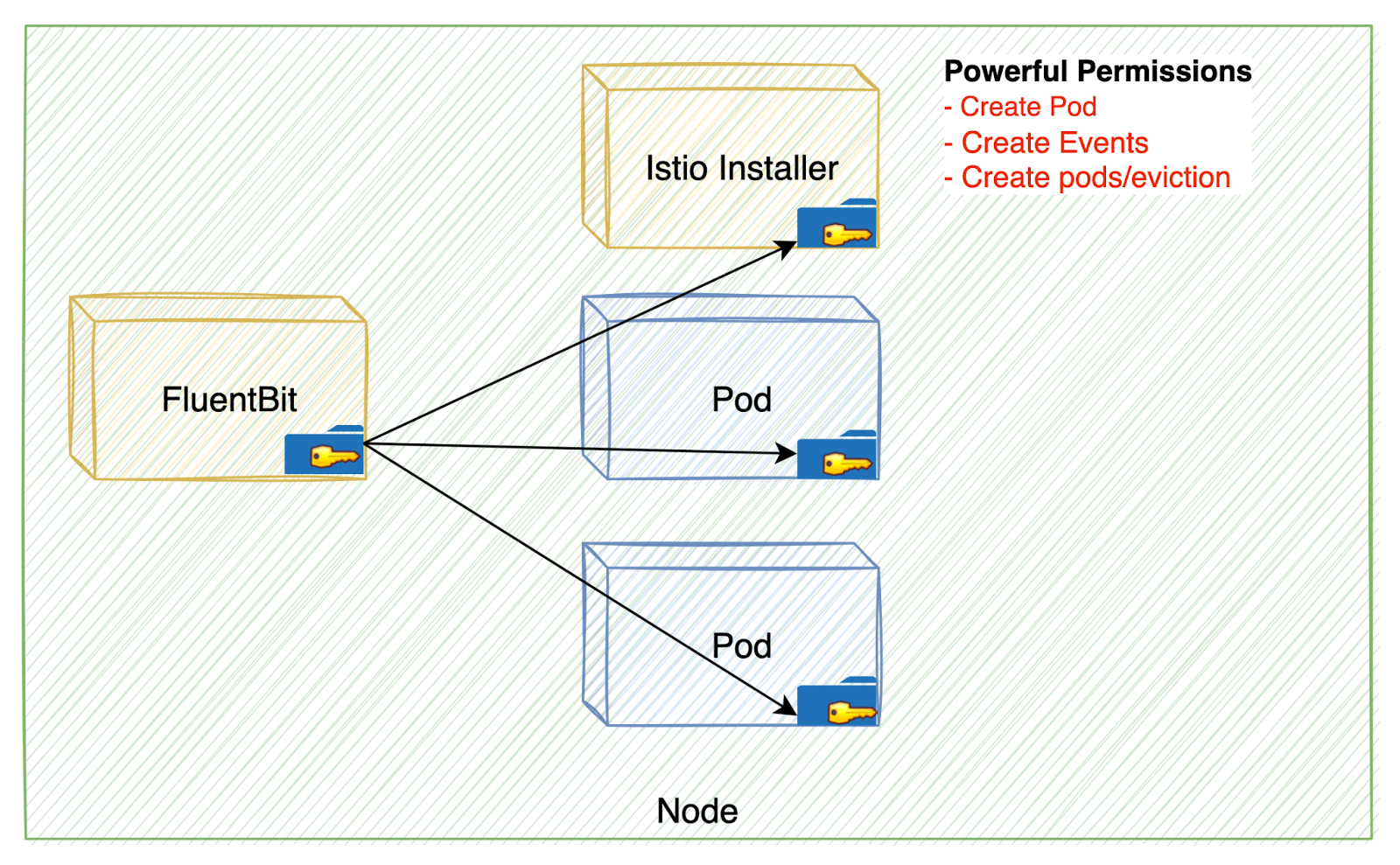
This step involves the exploitation of ASM’s Container Network Interface (CNI) DaemonSet, which keeps excessive privileges after installation. While ASM is enabled, Istio-cni-node DaemonSet is also installed in the cluster.
Anthos Service Mesh misconfiguration (Source: Unit 42)
This Daemonset is used for installing and configuring the Istio CNI plugin on each node in the cluster, and it also has higher permissions to perform tasks. However, once it starts to run, it does not require higher permissions.
There are two roles for this Daemonset; one of them is to install the CNI plugin, which does not require RBAC (Role-based access control), and the other is “repair” mode, which detects if pods have started without configuration, which requires some level of RBAC privileges.
Chaining these Exploits
To chain these exploits, the pod must have an ASM feature installed, and the threat actor must gain privileged access inside the Kubernetes cluster. Once these two prerequisites are fulfilled, the threat actor can chain these exploits.
The threat actor can perform a task after taking control of the FluentBit container by exploiting the default configuration. Once after this, the threat actor can have access to the kube-api-access-<random-suffix> directory that has all the tokens from all the pods in the node.
From there, the threat actor can perform any malicious actions and gain complete control over the Kubernetes cluster.
A complete report about these two issues has been published by Palo Alto, providing detailed information about the privileges, concepts, exploitation, and other information.
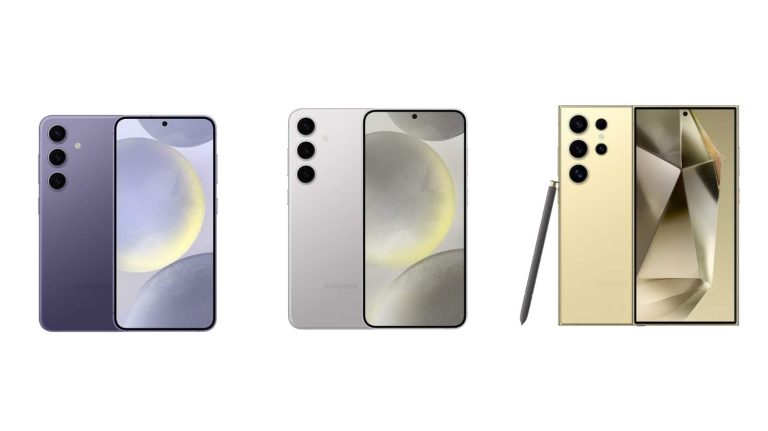
With just two weeks remaining before the launch, more details about Samsung‘s Galaxy S24 flagships have started surfacing online. Recent leaks have revealed the official tagline for the devices, pre-order benefits, and some interesting pieces of information about the display and cameras.
The Galaxy S24 will be epic, just like that
According to X tipster Roland Quandt, Samsung’s official tagline for the Galaxy S24 series is, “Epic, just like that.” The company has associated the term “Epic” with its S series flagships since the Galaxy S21 in 2021. It is sticking to that for another year. The upcoming flagships build on the well-received Galaxy S23 lineup. The design and hardware only see a minor refinement but Samsung may have redefined the software experience with AI.
Leaks have revealed tons of AI features for the Galaxy S24 series. AI will help enhance the photo and video quality in all lighting conditions. After you capture the shot, you can use AI-powered editing tools to refine the output. You can move or remove objects from photos and videos or expand the shot by generating non-existent details. The devices also boast AI-generated wallpapers, AI battery health monitoring, and many other tools.
Rumors are that Samsung will unveil the AI-laden Galaxy S24 lineup on January 17. Pre-orders will be open in most parts of the world immediately after the launch event. In South Korea, pre-orders will be eligible for a free storage upgrade and discount coupons for the Galaxy Watch and Galaxy Buds FE. Pre-order benefits will vary according to the market but a free storage upgrade is expected in other regions too.
The Galaxy S24 Ultra may record 4K videos at high frame rates
The camera hardware of the Galaxy S24 series isn’t changing much from the Galaxy S23. The Ultra model is replacing the 10x zoom camera with a 5x lens and that’s about it. The rest of the setup is expected to remain the same across the lineup. However, as said earlier, we are expecting quality enhancements through AI and software processing. A new leak says the Galaxy S24 Ultra can record 4K videos at high frame rates.
According to noted tipster Ice Universe, the upcoming Ultra can capture 4K videos at a whopping 120fps (frames per second). That’s double the 6fps maximum frame rate supported by the Galaxy S23 Ultra for 4K videos. Samsung is still testing this upgrade, though. It’s unclear if the feature will make it into the retail units. Meanwhile, the Galaxy S24 series adds support for the HDR display of photos. Just a couple of weeks of wait now.
Google Cloud has swiftly responded to a medium-severity security flaw in its platform that could pose a risk to Kubernetes clusters. The vulnerability, discovered and reported by Palo Alto Networks Unit 42, has the potential to be exploited by an attacker who already has access to a Kubernetes cluster, specifically targeting the Fluent Bit logging container.
This flaw, if abused, could allow the attacker to escalate their privileges within the cluster, leading to potential threats such as data theft, deploying malicious pods, and disrupting cluster operations. Google Cloud has solved the issue in the latest versions of Google Kubernetes Engine (GKE) and Anthos Service Mesh (ASM), eliminating the risk associated with this vulnerability.
An attacker with access to a compromised Fluent Bit logging container could have escalated privileges in the cluster
Google Cloud disclosed the security flaw in an advisory released on December 14, 2023, providing details on the potential exploitation scenario. According to the advisory, an attacker who has compromised the Fluent Bit logging container can leverage this access along with the high privileges required by Anthos Service Mesh (on enabled clusters) to escalate their privileges within the Kubernetes cluster.
This could open the door to various bad activities, that not only include data theft but also disruptions to the normal operations of the cluster. There is currently no evidence of a bad actor abusing then flaw in the wild. However, besides providing more cloud storage to Workspace users, Google Cloud has taken proactive measures to rectify the issue in the affected versions of Google Kubernetes Engine and Anthos Service Mesh.
The versions 1.25.16-gke.1020000, 1.26.10-gke.1235000, 1.27.7-gke.1293000, 1.28.4-gke.1083000 for GKE, and 1.17.8-asm.8, 1.18.6-asm.2, 1.19.5-asm.4 for ASM address the security vulnerability.
Google Cloud has removed Fluent Bit’s access to service account tokens and has eliminated RBAC, addressing the security flaw
Google Cloud explained that the developers had configured Fluent Bit on GKE to collect logs for Cloud Run workloads. This arrangement granted Fluent Bit access to Kubernetes service account tokens for other pods on the node, as reported by TheHackerNews. It provided a potential entry point for attackers.
To address the security flaw, Google Cloud has removed Fluent Bit’s access to service account tokens and re-architected Anthos Service Mesh’s utility to eliminate excessive role-based access control (RBAC) permissions. The fix aims to enhance the overall security posture of Kubernetes clusters on Google Cloud by turning aside potential privilege escalation scenarios.
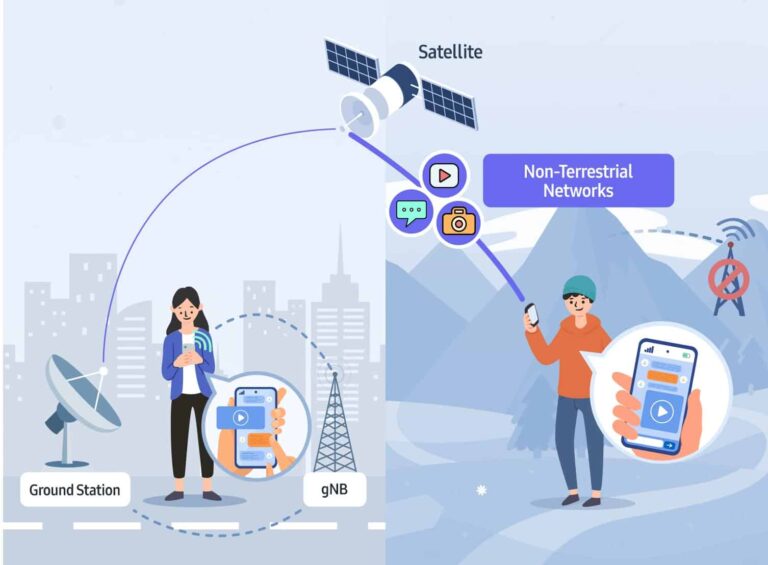
Samsung‘s upcoming Galaxy S24 series, scheduled for its global launch next month, has been expected to support satellite connectivity since the beginning of its development. Actually, the predecessor, the Galaxy S23 series was expected to boast this feature following the footsteps of Apple and Huawei.
However, the units Samsung has provided to the communication companies for network testing in Korea appear to miss the feature entirely, once again. The Galaxy S24 Ultra is sent to three major communication companies for pre-launch testing – SK Telecom, KT, and LG Uplus – to conduct network linkage tests. This crucial step evaluates the smartphone’s compatibility with domestic networks and ensures that it functions seamlessly.
The Galaxy S24 series includes Gauss AI integration and camera upgrades, but Satellite Connectivity remains on hold
One standout feature of the Galaxy S24 series is the integration of Samsung’s own ChatGPT alternative, Gauss AI positioning it as an “AI phone” with generative AI capabilities throughout its UI. Additionally, Google’s AI chatbot ‘Bard’ is expected to make a partial appearance in the series.
Samsung seems to be opting for a more comprehensive and advanced two-way satellite communication in future models. This choice contrasts with Apple’s implementation. However, Huawei has already implemented two-way connectivity with the Huawei Mate 60 series. It functions through China’s “Tiantong-1” satellite mobile communication network. This device from Huawei enables users to make and receive calls via satellite. It is a feature unavailable on the latest iPhone or the upcoming Galaxy flagships.
Nonetheless, the Galaxy S24 Ultra promises substantial upgrades in other aspects. The rear camera setup, for instance, includes five vertically arranged cameras. The 50MP telephoto facilitates a 5x optical zoom function and enables 8k recording at 5x level.