Just in time for the holiday vibe, a federal judge ruled that X/Twitter violated contracts by failing to pay millions of dollars in bonuses that the social media company had promised its employees.
Reuters is reporting on the story of Mark Schobinger, Twitter’s senior director of compensation before leaving Elon Musk’s company in May. Mark sued X/Twitter the very next month, claiming breach of contract. His problem is that before and after billionaire Musk bought Twitter last year, the company promised employees 50% of their 2022 target bonuses – and never made those payments.
Now, US District Judge Vince Chhabria denied Twitter’s motion to dismiss the case, ruling that Schobinger plausibly stated a breach of contract claim under California law and he was covered by a bonus plan. “Once Schobinger did what Twitter asked, Twitter’s offer to pay him a bonus in return became a binding contract under California law. And by allegedly refusing to pay Schobinger his promised bonus, Twitter violated that contract”, the judge wrote.The counterpart – that’s X/Twitter – and their lawyers argued that the company made only an oral promise that was not a contract and that Texas law should govern the case.
Meanwhile, Meta gets fined in Italy
Meanwhile, Meta is not too far back, bringing its fair share of holiday scandals as well. The Facebook, Instagram parent company was just fined in Italy for breaches of a ban on the advertising of gambling.
Meta has been fined €5.85 million ($6.45 million) in connection with profiles and accounts on Facebook and Instagram, as well as sponsored content that promoted either betting or games with cash prizes, communications watchdog AGCOM said in a statement on Friday.
Similar fines were set aside for YouTube (€2.25 million) and Twitch (€900,000) recently.
It’s been more than a month since the last time we talked about one much-needed feature for the Gmail app: an Unsubscribe button that’s convenient and spares you the need to scroll and poke around in menus.
Back in November, it became known that the Gmail team was testing a tweak for Android users to let them unsubscribe from unwanted mail quickly and easily – now, it’s not Android phones that get it.
Instead, the iOS users get it first (via Android Authority) and the solution is quietly rolling out.
There’s a prominent “Unsubscribe” button in Gmail for iOS and users are seeing it right below the email’s subject line and above the email content. The report has some screenshots to get a better idea of the updated user interface, here they are:
Instead of tapping the 3-dot menu icon at the top of the message window and then searching for “Unsubscribe” (or scrolling to the bottom of the email and looking for the sender’s “Unsubscribe” button), this new solution is far more convenient and time-saving. No scrolling, no searching, just a single tap on the button and you’re ready to go. This iOS Gmail app addition is similar to the web version’s unsubscribe button, which is placed below the subject line and next to the sender’s details.
So far, the new unsubscribe button is not yet to be found on Android devices. Quite the irony in the light of the fact that Android is Google’s own platform, but that’s not the first time Google has brought features to iOS before Android – like the option to delete the last 15 minutes of the browsing history in the Google app, and the ability to crop videos in Google Photos.
The WhatsApp beta for Android (v.2.24.1.6) update brings a new interface when sharing channel updates to Status.
For now, the feature is available to some beta testers, but it’ll be rolled out to more people in the coming weeks (via WABetaInfo).
As seen above, those who have received the v.2.24.1.6 update may explore a new interface that enhances the way users view a channel update from a status update. Specifically, WhatsApp will create a dedicated layout for the channel update, with the aim of providing clarity that the content posted on Status originates from a channel.
Those who want to check it out and see if this feature is already available to their accounts, can simply share a channel update to their status (the quickest method to do this is by forwarding a channel update). It’s also important to note that WhatsApp has recently introduced another entry point within the status subtitle, allowing users to promptly access and view the content from the associated channel.The WhatsApp experts at WABetaInfo say that the refreshed interface offers an intuitive layout, “making it easier for users to interact and access shared channel updates”. They also note that this interface aligns with contemporary design trends – “it’s very similar to the layout offered by Instagram when sharing posts as Instagram Stories”.
The ransomware extortion landscape is evolving with threat actors adopting new methods to blackmail and threaten their victims. Single-extortion, where cyber criminals demand payment to decrypt locked data or systems is quickly becoming less frequent with ransomware groups increasingly adopting double-extortion – where threat actors demand a ransom payment to decrypt victim data/systems and then threaten to publish stolen data unless the ransom is paid. Triple-extortion is also on the rise, such as distributed denial-of-service (DDoS) attacks or further intimidation of the victim/their customers, employees and stakeholders into paying a ransom.
This played out recently when notorious ransomware group BlackCat/APLHV filed a US Securities and Exchange Commission (SEC) complaint against one of its alleged victims for failing to comply with a four-day cyber attack disclosure rule. The unprecedented move took the threat group’s extortion efforts to a new level after it claimed to have recently breached and stolen data from the software company MeridianLink.
Cyber Security Hub spoke with Dr Jason Nurse, Institute of Cyber Security for Society at the University of Kent, and a co-lead of the Royal United Services Institute’s (RUSI) Ransomware Harms and the Victim Experience project, about the changing ransomware extortion landscape and the threats it poses to businesses.
Cyber Security Hub: In what ways are ransomware extortion methods evolving?
Dr Jason Nurse: Ransomware attacks have evolved significantly, displaying increased sophistication and harm-potential. In the past, cyber criminals sought to paralyze an organization’s systems and extort a ransom for access to be restored. In response to businesses enhancing their recovery capabilities and resisting payment, our research has discovered that attackers have adapted their methods to inflict a wider variety of harms.
CSH: What impact are evolving extortion methods having on the ransomware threats faced by organizations?
JN: The evolution of extortion methods means that the ransomware threat is pervasive and a persistent challenge for organizations. We found an extensive range of harms in our recent analysis of impacts from ransomware attacks. As businesses respond to the threat by bolstering their defenses – through measures like improving intrusion prevention systems, employee training and reinforcing backup strategies – cyber criminals promptly adjust their strategies to up the ante.
The significance of this threat has prompted increased government involvement. The Counter Ransomware Initiative (CRI) is an excellent example of such an effort and the recent agreement by CRI member states not to pay ransoms using government funds is certainly a powerful step forward in addressing this complex issue.
CSH: What do evolving extortion trends signify about today’s ransomware threat actors?
JN: The evolving trends in ransomware extortion mechanisms highlight a significant characteristic of today’s threat actors – their unwavering determination. These actors exhibit a remarkable readiness to adapt in any manner necessary to heighten the prospects of securing a ransom payment. Naming and shaming victim organizations on dark web notice boards, contacting individuals who do business with those organizations and disclosing sensitive corporate data all highlight a surprising level of resolve.
What has undoubtedly shocked most of the security community, however, has been the engagement of one cyber criminal group with the SEC. In this instance, the group filed a complaint alleging a business’s failure to disclose a purported data breach instigated by the hackers. This places an organization in a challenging position, considering reporting obligations, notification procedures and the broader implications of negative publicity.
CSH: What’s your advice to any organization being extorted following a ransomware attack?
JN: Payment is not the only option – and should certainly not be the first option. The organization must recognize that ransomware groups will employ various tactics to push for a payment. If an organization is being extorted, the initial step should involve isolating all infected systems from the central network or shutting them down altogether. The organization can then engage with law enforcement, regulatory bodies, cyber insurance providers and, depending on the expertise internally, incident response firms for support in their response.
Some of these services may have access to decryption keys (e.g. No More Ransom), offer threat intelligence about the attacker, provide insights into the repercussions of payment and furnish information about the attacker’s affiliations with other entities. Such resources prove invaluable as the organization deliberates on the most effective response to the extortion attempt.
CSH: How can security stay ahead of ransomware extortion?
JN: This is very much an arms race. Cyber attackers are constantly exploring ways to increase the effectiveness of their ransomware extortion tactics. Conversely, defenders are continually preparing and responding to the best of their ability. A proactive strategy for cyber security to get ahead of the threat of ransomware involves developing a better understanding of all its facets – the attackers, the attack vectors, the harms, the payment mechanism, etc. – and tackling each of them directly.
For instance, there have been cases where law enforcement has tracked down attackers and regained extorted funds and apprehended those responsible for attacks. Our research is driven by the conviction that only through a nuanced understanding of the diverse harms stemming from ransomware extortion can we formulate improved policies and mechanisms to address this pervasive threat.
RomCom ransomware is being spread via poisoned Google adverts for legitimate software companies including Chat-GPT, PDF Reader Pro and Devolutions’ Remote Desktop Manager.
According to researchers at IT security company Trend Micro, malicious actors are using Google advertisements for trusted companies to entice people into clicking on the advert and downloading RomCom ransomware onto their devices. The malicious actors are doing this through the use of fake sites set up to look like legitimate ones with poisoned uploads that execute the malware on victims’ devices once it is downloaded.
By using paid advertisements slots and SEO tactics, malicious actors can ensure that the poisoned uploads remain at the top of Google’s search results, meaning that more people are likely to fall victim to these trojanized adverts.
RomCom ransomware has been linked to a Cuban ransomware affiliate dubbed ‘Tropical Scorpius’ by Trend Micro. The malware is responsible for a number of attacks across the globe, including those against Ukrainian government agencies in October 2022.
Once it is downloaded onto a device, the backdoor malware can cause damage to victims in a number of ways, including executing more malicious files on the infected device, running malicious programs and exfiltrating data from the compromised devices. It can also run spyware in hidden windows, set up proxy servers for malicious activities and even compress and send files on the infected device to servers owned by the malicious actors.
RomCom ransomware also has the ability to take screenshots on the device, meaning that any confidential, personal or compromising information entered into the device can be used by the hackers for their own means. This includes gaining access to financial services like banks, cryptocurrency wallets and other payment services, access chat messages stored on the device and steal all login credentials entered into the device.
Bumblebee ransomware spread via poisoned Google ads
In April of this year, it was found that malicious actors were employing SEO tactics and paying for targeted advertisements to entice victims into clicking on malware.
Cyber security company Secureworks found malicious actors had been using poisoned ad installers as trojans to spread Bumblebee malware. These ad installers were associated with a number of well-known companies including Zoom, Citrix Workspace, Cisco AnyConnect and OpenAI’s ChatGPT. For example, Secureworks researchers found that a malicious actor had not only created a poisoned ad installer for Cisco AnyConnect, but a fake download page for the malware as well. They were able to do this by exploiting a compromised WordPress site.
Once Bumblebee malware is downloaded, malicious actors most often use it to launch ransomware within the infected device. In one case, Secureworks researchers found that the malicious actor moved laterally across the device, downloading and launching a number of applications and software programs including legitimate remote access tools AnyDesk and Dameware as well as penetration testing malware Colbalt Strike.
In the current high-tech age, consumer data is a business’s most important asset as they progressively shifts towards digital transformation. Consumers want tailored experiences from brands and businesses that meet their specific needs. In these conditions, companies need to gather, examine, and utilize consumer data much more efficiently than they did in the past. In addition, Adobe Experience Cloud Products like Adobe Real-Time CDP are available to assist.
A revolutionary solution called Adobe Real-Time Customer Data Platform was created to assist companies in realizing the whole value of their customer data. It offers a single, accessible place for real-time information management, organization, and activation. This post delves deeply into Adobe Real-Time CDP, showing you how to use it to enhance marketing ROI, provide individualized customer experiences, and propel company expansion.
Describe CDP
A customer data platform (CDP) is a solution that compiles client information into a single database, giving marketing teams the vital information they need to start a campaign. The primary objective of a CDP is to gather information from offline and online sources to provide a complete picture of a customer. With this data, a CDP system might help businesses anticipate the best course of action with a certain customer.
Furthermore, customer support teams may use CDPs to provide more individualized customer support. Data warehousing solutions and marketing automation are two more application areas.
CDPs are often separated into many categories. The most popular method for combining customer data to create a single consumer profile is data CDP. Conversely, campaign CDPs provide cross-channel and multichannel marketing centres in addition to campaign management. Additionally, analytics CDPs are proficient in data analysis.
But it’s critical to understand the differences between CDPs and data management platforms, data warehouses, and CRM systems. Unlike CRMs, CDPs collect a wide variety of data from many sources without requiring any human upkeep. While CRMs, which collect customer transaction data and are usually maintained by salespeople, also concentrate on finding segmented audience profiles.
So what exactly is Adobe Real-Time CDP?
Adobe Real-Time CDP: What is it?
Adobe Real-Time CDP allows you to deal with customer data, much like the majority of conventional customer data solutions. One significant benefit, however, is that you get information as soon as it becomes available. Adobe Real-Time CDP depends on the following four pillars to do this:
Gathering of Data: The platform gathers information from a variety of sources, such as physical channels, smartphone applications, and e-commerce websites.
Unification of Data: Adobe Real-Time CDP creates a single customer view by combining consumer data gathered from several contact points.
Instantaneous Activation: As soon as new data enters the system, the platform uses it to activate client data in real-time to create tailored experiences and adjust them across channels.
Division: To provide more individualized customer experiences, Adobe Real-Time CDP divides your clientele into groups according to their demographics, actions, and other factors.
Adobe Real-Time CDP can generate a single, cohesive picture of each client with the use of these capabilities. Real-time data allows you to create relevant and tailored customer experiences that increase engagement and win over new clients as devoted ones. Adobe’s capacity to activate data across several channels also leads to increased customer satisfaction and marketing return on investment.
How Does Real-Time CDP from Adobe Work?
To put it simply, managing client data in Adobe Real-Time CDP is rather easy. Ingestion, unification, and activation make up its components:
swallowing. To begin with, Adobe Real-Time CDP pulls data from several sources, including mobile applications, e-commerce websites, POS systems, CRM systems, and outside sources. The platform supports many formats and manages massive data volumes.
fusion. Next, a variety of identity resolution methods are used by Adobe Real-Time CDP to unify the imported customer data. The platform creates a single, cohesive picture of each prospect by connecting consumer profiles from many data sources.
Turning on. In the last phase, customer data activation across email, online, mobile, and advertising channels is carried out via Adobe Real-Time CDP. As a result, it enables you to provide tailored experiences across the whole consumer journey and bridge any gaps between various marketing initiatives.
Adobe Real-Time CDP gathers and combines client data from several sources using a real-time data processing engine. It is noteworthy to add that machine learning techniques are used for these and other operations by the platform. For example, it utilizes the most recent technological advancements to evaluate client data and provide cohesive consumer profiles.
After client data has been gathered and consolidated, you can use Adobe Real-Time CDP to make the information that has been ingested available via a variety of channels. Measuring the effectiveness of your customized marketing initiatives is simple with the platform’s real-time analytics and reporting features.
Let’s now examine how obtaining a comprehensive customer perspective using Adobe Real-Time CDP enables you to completely reconstruct a customer journey. The platform can standardize and integrate cross-channel data, as we have previously said, giving you a single source of truth that incorporates all contact points (both online and offline). Next, Adobe Real-Time CDP builds customer categories that may be customized as additional data is gathered, based on specific journey stages, purchase behaviour, timing, and user status.
Through easy procedures and a straightforward admin experience, everyone can access all of the data and insights. You get several tools that provide a steady stream of data that your team may access. Another noteworthy enhancement that elevates Adobe Real-Time CDP to a significant tool that offers privacy-centric identity resolution is first-party monitoring across all touchpoints. Without creating a single line of code, the platform guarantees that everyone who requires it can manage omnichannel data.
In terms of AI and machine learning, Adobe Real-Time CDP makes use of cutting-edge technology to calculate the effectiveness of your marketing across various client journeys. Predictive qualities, audiences, and actions may all be streamlined to provide you with more information and help you decide on your plans.
Right now, things can seem confusing, but there’s nothing to be concerned about. Everything becomes obvious the first time you work with the real interface. The five easily navigable areas of Adobe Real-Time CDP are Sources, Destinations, Identities, Segments, and Profiles.
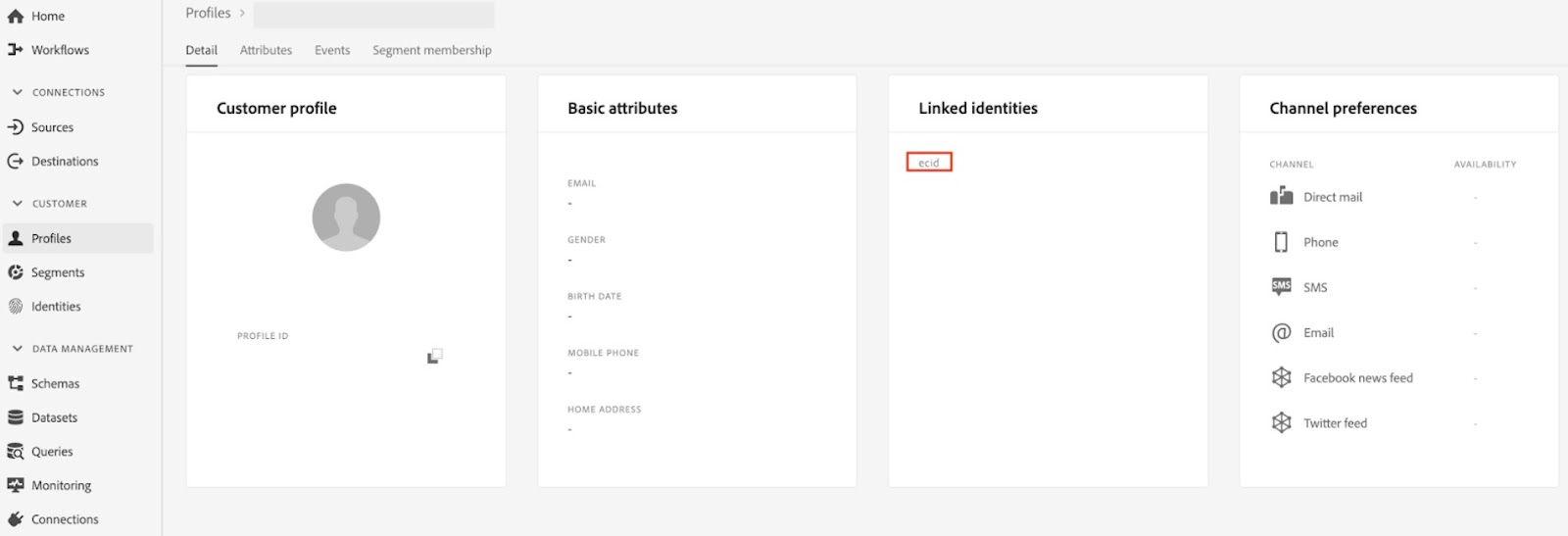
Tab for Real-Time CDP profiles
Profiles: A profile is an assortment of data that may be used to uniquely identify a person or other entity. Although the profile in this example is associated with the ECID identity, this profile can have other identities as well, such as an email address or phone number.
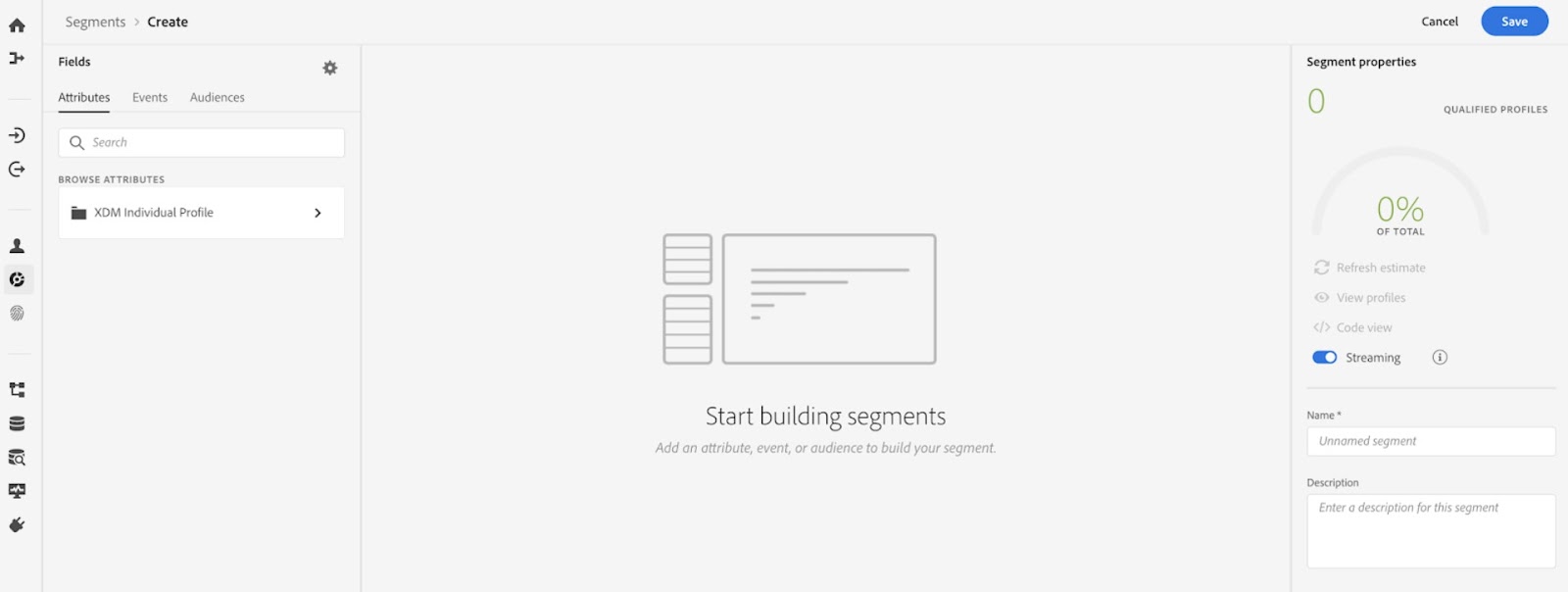
Sections: You may divide profiles into groups based on a variety of criteria by using segments. Real-Time CDP segments like those in other Adobe products.
Tab for Real-Time CDP Segments
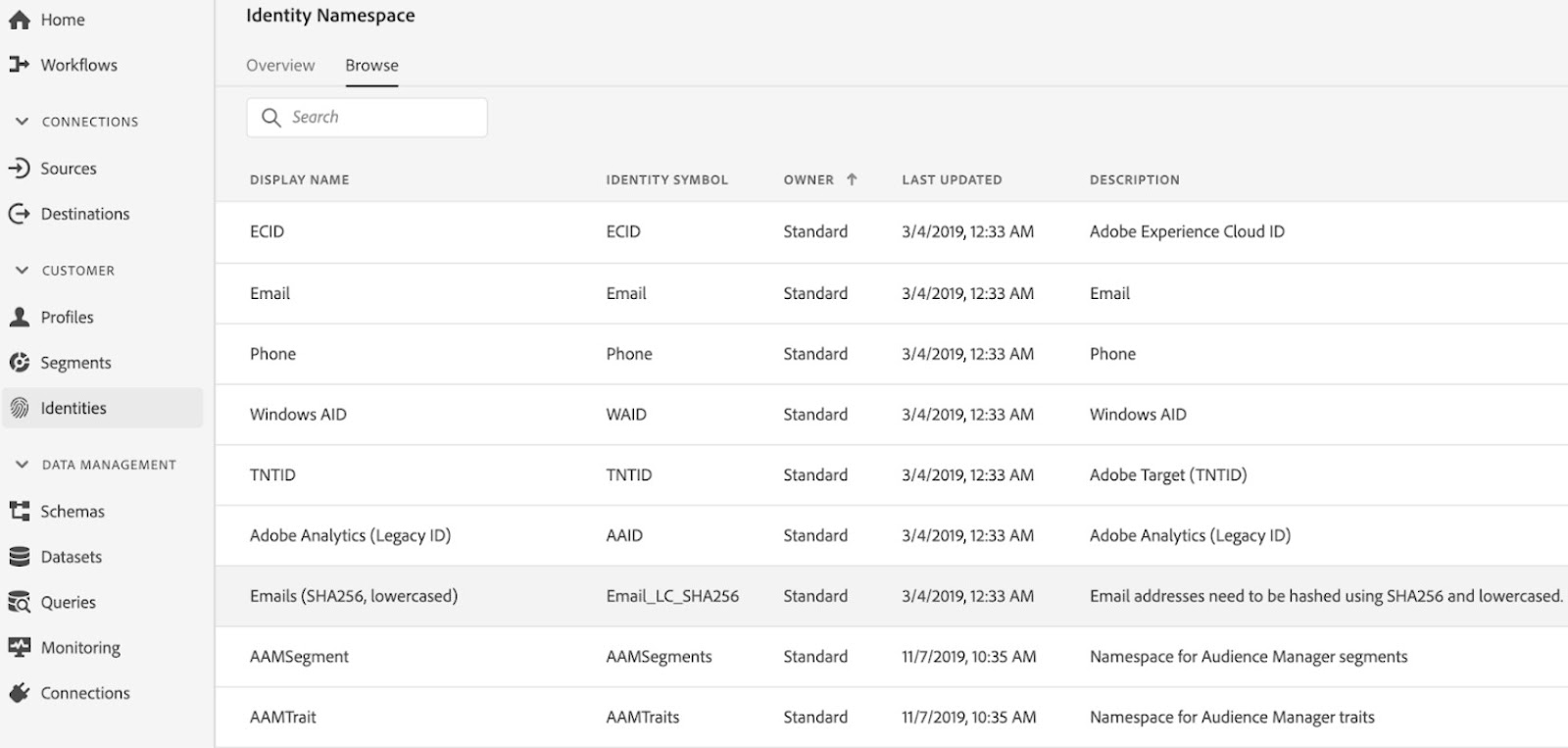
Personas. Identity namespaces containing distinctive personal data, such as address, phone number, email address, etc., are stored on the identity page.
Real-time identification of CDPs tab
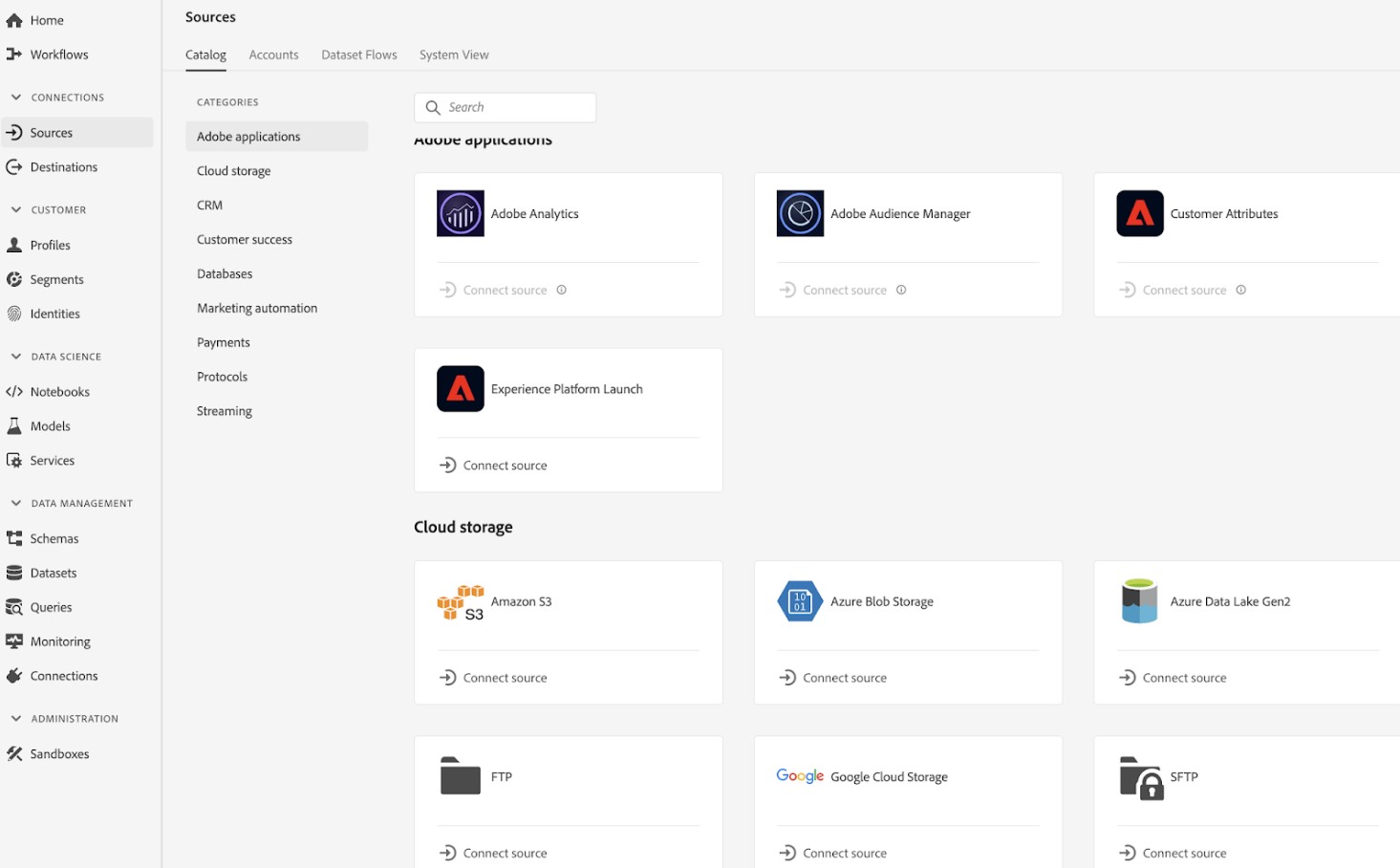
References: You may find several sources for data in this area. You may find them under the Sources -> Catalog section. Here is where you may link your Real-Time CDP to other sources, CRM programs, and Adobe apps.
Tab for Real-Time CDP sources
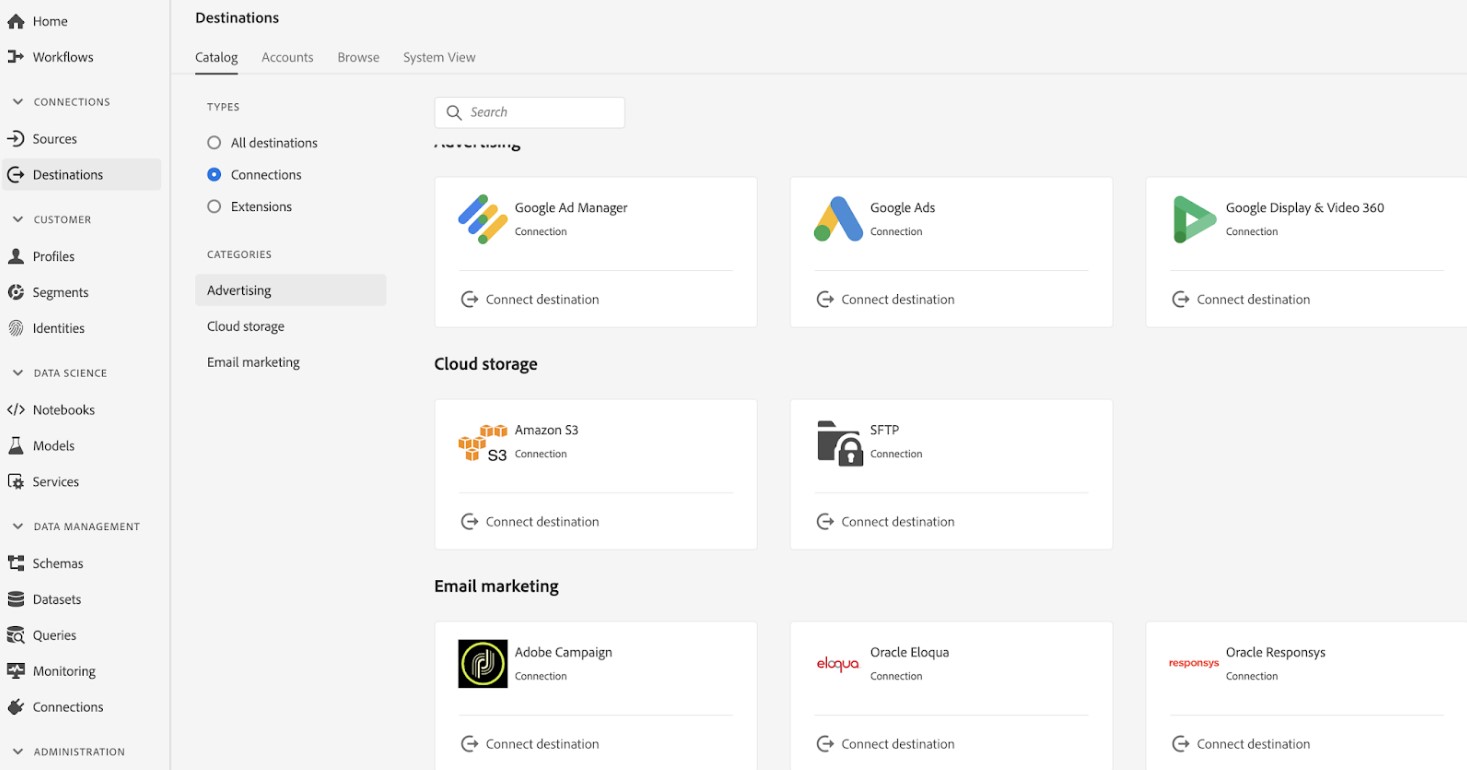
Locations: The Sources and Destinations sections are comparable. Here is where you may turn on the audiences and share them with other systems that need specific consumer information. You may export segments or profiles using Real-Time CDP.
Tab for Real-Time CDP Destinations
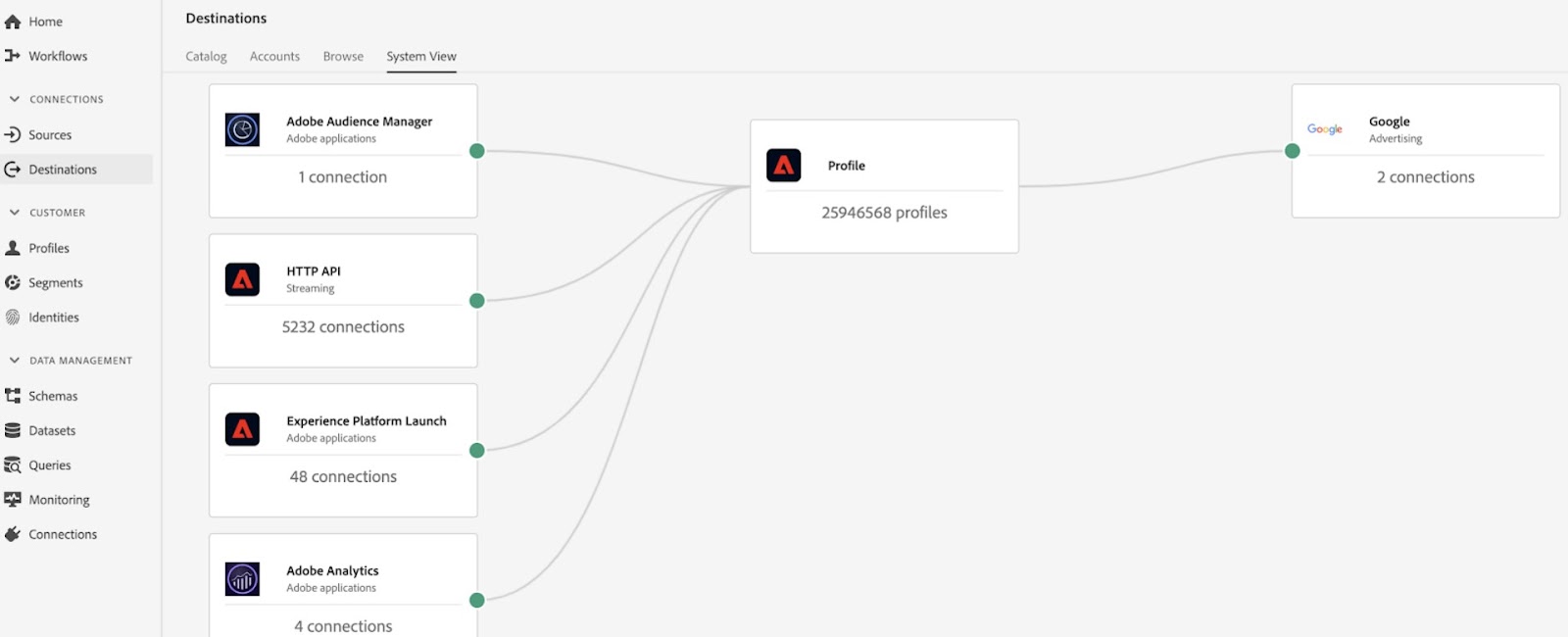
In Adobe Real-Time CDP, the process of connecting profiles to sources and sending them to a destination is shown in the following graphic representation:
CDP connectivity in real-time tab
All pictures were obtained from this article: Overview of Real-Time CDP. To understand more about the platform, check the video below to see how connections are made in Adobe RT CDP.
Adobe Real-Time CDP: Advantages
You may wonder what advantages Adobe Real-Time CDP offers. In addition to the functionality seen on rival platforms, the platform provides several significant competitive advantages. The advantages of Adobe Real-Time CDP are as follows:
Instantaneous Understanding: With Adobe Real-Time CDP, you can enhance your marketing strategy and make data-driven choices by getting real-time insights into customer behaviour.
Multichannel Advertising. By gathering information via a variety of channels, the platform makes sure that every touchpoint offers a consistent and tailored experience. To create a cohesive picture of every consumer, it connects customer profiles from various data sources using identity resolution algorithms.
Individualization: As we’ve previously shown, Adobe Real-Time CDP may be used to provide unprecedented levels of customisation. Businesses may design tailored customer experiences using the platform that meets customers’ expectations. Delivering tailored communications that connect with your customers may be made easier with the flow of real-time consumer data integrated across all channels.
You can increase customer engagement and happiness by using Adobe Real-Time CDP. When your customers participate in experiences that align with their wants and preferences, they are more inclined to interact with your brand.
Increased ROI: With all these benefits of Adobe Real-Time CDP, you may raise the return on investment (ROI) of your marketing initiatives, resulting in increased sales and profitability.
Flexibility: Large data quantities may be handled with Adobe Real-Time CDP, which is a highly scalable solution. You may use the platform as a market giant with thousands of clients across several channels, or you can start small and expand.
The rivals of Adobe Real-Time CDP include, among others, Insider, Klaviyo, Insightly, Bloomreach, and Planhat.
How Can Adobe Real-Time CDP Be Implemented?
To put Adobe Real-Time CDP into practice, follow these easy steps:
Establish Business goals: Before identifying the primary use cases for Adobe Real-Time CDP, you must establish your business goals.
Determine Data Sources: The next step is to decide which data sources to include in Adobe Real-Time CDP.
Define Data Model: Next, you may specify the properties, events, and interactions of each customer in Adobe Real-Time CDP to build a unified view of them all.
Set Up Data Ingestion: This time, data ingestion is in turn. To import data from several sources into Adobe Real-Time CDP, you may use APIs, batch processing, or real-time streaming.
Configure Data Unification: Data unification is the subject of the next step. To connect client profiles across many data sources, you must set up this procedure.
Set Up Data Activation: Lastly, data activation configuration is possible. Customer data will be activated across many channels as a result.
Adobe CDP Industries in Real-Time
Adobe Real-Time CDP applies to a variety of sectors. The most often-used business features for the platform are listed below:
E-commerce: You may utilize Adobe Real-Time CDP as an e-commerce retailer to give targeted discounts, abandoned cart reminders, and tailored product suggestions. When used with Adobe Commerce, it gains much more potency.
Financial Services: Adobe Real-Time CDP may assist you in providing individualized loan offers, investment advice, and financial planning suggestions if you own a financial services business.
Healthcare: Adobe Real-Time CDP may help by sending out customized appointment reminders and instructions for follow-up treatment.
Travel: Businesses in the travel sector may give individualized trip suggestions, loyalty programs, and real-time flight information by using Adobe Real-Time CDP.
Retail: Use Adobe Real-Time CDP to tailor in-store experiences, product suggestions, and promotions if you are a retailer.
Marketing: By providing real-time insights on customer behaviour, Adobe Real-Time CDP may assist marketing teams. They may thus improve ads with more individualized experiences thanks to it.
Customer service: By providing individualized help and suggestions with Adobe Real-Time CDP, customer service teams may increase customer happiness and retention.
Keep in mind that these are just a few sectors in which Adobe Real-Time CDP may be used.
Use Cases for Adobe Real-Time CDP
Let’s now examine a couple of the previously listed Adobe Real-Time CDP use cases:
Personalized Product Suggestions: Let’s say that you are employed in the retail apparel industry. With Adobe Real-Time CDP, you can gather client information and provide tailored product suggestions according to their browsing habits, prior purchases, and preferences.
Abandoned Cart Reminders: Use Adobe Real-Time CDP to deliver customized abandoned cart reminders if your company has an e-commerce website.
In the meantime, you may use Adobe Real-Time CDP to send loyalty incentives to clients who regularly make purchases from your company. It applies to several sectors.
Real-Time Marketing Campaigns: As a marketer, you may make real-time adjustments to your campaigns by using Adobe Real-Time CDP. Personalized offers and communications may be sent to customers based on their ever-changing interests and behaviour.
Personalized Health Care Reminders: If you work in the medical field, you can use Adobe Real-Time CDP to send patients customized reminders that are tailored to their preferences and medical history. You may even use this information to provide individualized health advice.
Examples of Adobe Real-Time CDP
Real-Time CDP seamlessly integrates with other Adobe Experience Cloud products, such as Customer Journey Analytics, as we’ve previously shown. Let’s examine re-engaging customers via the use of both technologies.
Without a complete understanding of the client experience, it is difficult to predict when a client will go. The issue is that it’s unclear what steps your prospects take to leave the party. To get more clarity, you may utilize Adobe’s Customer Journey Analytics. Applying filters to flow and fallout graphs on the platform enables you to delve further into various customer-associated paths.
Then, by contrasting the actions of a disengaged audience with those of a committed audience, you may ascertain the experiences that were overlooked. Send an audience to Real-Time CDP to activate in the relevant channels where they encounter win-back experiences once they have been identified as a high-potential re-engagement candidate.
The length of a customer’s trip may vary depending on the kind of transaction they are seeking. Longer purchase cycles may make it challenging to understand where customers get stuck and all of the cross-channel touchpoints that play a role in the decision-making process. Nonetheless, integrating your offline and internet data offers a comprehensive viewpoint.
This implies that you may begin dissecting trips to identify the trouble spots that want improvement. You may find these spots and reorganize customer journeys with tested experiences utilizing AI, machine learning, a simple drag-and-drop interface, and rich visualizations with Real-Time CDP and Customer Journey Analytics.
These tools provide you with many methods to analyze conversion rates. As a result, you may discover more about your strong and weak places, which would improve the experience at every touchpoint.
Assume you manage a plant-selling e-commerce website. You want to increase profitability and customer engagement by giving your customers individualized experiences.
To start, you may gather customer activity data from your online business by integrating Adobe Real-Time CDP. This data includes browsing and purchase histories as well as preferences. Following the unification and processing of this data, Adobe Real-Time CDP creates a comprehensive customer profile for every single purchase.
Afterwards, you might use this information to deliver customers personalized product recommendations based on their browsing and past purchases. For instance, if a customer has already bought a succulent, you may recommend other plants that go well with it, such as cactus or another succulent.
Additionally, customers who add items to their shopping cart but abandon them may get abandoned cart alerts from Adobe Real-Time CDP. You may encourage customers to finish their purchases and increase your conversion rate by giving them a personalized message that includes the specific items they still have in their cart.
Furthermore, you may create loyalty programs for customers who make frequent purchases from your business, which could provide exclusive access to new products or discounts. You may use Adobe Real-Time CDP to help you find these customers and provide customized offers that will entice them to make more purchases from your business.
To be more precise, let’s examine The Home Depot as an example. To provide a consistent online and in-store customer experience, the business used Real-Time CDP and Customer Journey Analytics. Their goal was to rethink the whole customer experience, so they put in place a customer-based approach that was journey-focused.
By combining information from many sources, such as internet use, in-store sales, contact centre data, etc., the business was able to construct cohesive client profiles. With this data, it was possible to segregate high-value clients into hundreds of distinct groups according to certain travel routes.
Additionally, understanding how consumers interacted before making a purchase was aided by the integration of Customer Journey Analytics and Real-Time CDP. The most significant touchpoints across the whole client journey were found by this observation.
Home Depot was able to propose suitable items and in-store locations by optimizing its marketing and customization efforts. It caused tailored experiences to be delivered up to ten times quicker, a notable rise in personalized marketing (62%), and a notable increase in online purchases that were picked up in-store (55%).
In summary
As you can see, Adobe Real-Time CDP might help you provide your customers with customized experiences. This platform is unquestionably the best option if you’re seeking a way to increase revenue and engagement. It can assist you in creating a comprehensive customer profile that incorporates data from many sources. Afterwards, you may use this information to create customized offers, reminders, and recommendations that entice customers to return.
The platform’s suitability for a range of industries, such as e-commerce, healthcare, banking, etc., is another fantastic feature. Adobe Real-Time CDP may assist you in obtaining the most comprehensive information, regardless of where your company is located.
As a result, in the current digital age, it is an essential tool for companies looking to remain competitive. With the help of its powerful data processing engine, machine learning algorithms, and real-time analytics capabilities, businesses can outperform their rivals and not just survive.
FAQ for Adobe Real-Time CDP
Adobe Real-Time CDP: What is it?
A customer data platform called Adobe Real-Time CDP is made to combine data from several sources into a single, cohesive customer picture. As a user, you can make use of Real-Time CDP to provide individualized experiences by getting to know each customer’s preferences, actions, and past.
What are the main characteristics of Adobe Real-Time CDP?
Activation across multiple channels, scalability, unified customer profiles, and real-time data access are some of the primary benefits of Adobe Real-Time CDP.
In comparison to other CDPs, how does Adobe Real-Time CDP fare?
Adobe Real-Time CDP has several benefits over other CDPs, such as scalability, support for various channels, and real-time data access.
How is Adobe Real-Time CDP implemented?
To put Adobe Real-Time CDP into practice, follow these steps:
Specify company goals.
Establish the data model.
Determine the sources of the data.
Set up data activation, data unification, and data intake.
Is Adobe Real-Time CDP appropriate for small companies to use?
It is, indeed. All sizes of organizations may benefit from using Adobe Real-Time CDP. Because of its exceptional scalability, you may start small and expand to manage massive amounts of data.
What advantages can Adobe Real-Time CDP offer?
Benefits of using Adobe Real-Time CDP include more customer interaction, higher marketing return on investment, company expansion, and more customized experiences.
Does Adobe Real-Time CDP adhere to laws governing data privacy?
There’s no need to fret if you’re worried about problems related to data privacy requirements since Adobe Real-Time CDP complies with laws like the CCPA and GDPR. To guarantee adherence to important criteria, the platform offers functions including access requests, deletion, and management of data consent.
What type of Adobe Real-Time CDP support is available?
For Adobe Real-Time CDP, Adobe provides a range of support options, including as technical assistance, instruction, and consulting services. To help you start, there are also community forums, documentation, and a knowledge base available.
What is the price of Adobe Real-Time CDP?
The quantity of data, the number of data sources, and the degree of support needed all affect how much Adobe Real-Time CDP costs. For information about prices, get in touch with Adobe.
Is it simple to utilize Adobe Real-Time CDP?
Adobe Real-Time CDP is simple to use because of its intuitive UI. Additionally, the platform offers several pre-built connectors and templates to aid in a business’s rapid startup.
Comcast Cable Communications, doing business as Xfinity, has disclosed a data breach affecting more than 35 million people. The firm said that, during a routine cyber security exercise in October, it discovered suspicious activity on its internal systems. It subsequently determined that, between October 16 and October 19, 2023, there was unauthorized access to systems via a Citrix software vulnerability known as Citrix Bleed.
Xfinity determined that information was likely acquired, with the customer data in scope including usernames and hashed passwords, contact information, last four digits of social security numbers, dates of birth and/or secret questions and answers. The data analysis is continuing, the firm said. Xfinity has notified federal law enforcement and initiated an investigation into the nature and scope of the incident.
In a statement shared with Bleeping Computer, a Comcast spokesperson said the company’s operations were not impacted and that it received no ransom demand after the incident.
Xfinity customers advised to reset passwords and use MFA
Xfinity has required customers to reset their passwords to protect affected accounts. The company has strongly recommended that customers enable two-factor or multi-factor authentication (MFA) to secure their Xfinity account and also advised them to change passwords for other accounts for which they use the same username and password or security question.
“This breach is particularly alarming as the type of data that has been declared stolen indicates that passwords and answers to identifying secret questions and answers have been lost,” commented Darren James, senior manager at Specops Software, an Outpost24 company. Many people re-use the same password and security questions across many platforms, so if this data has been exposed, then it’s not just the Xfinity account that is vulnerable. It’s potentially many other services as well, he added.
“Even though the passwords may have been hashed, depending on the hashing algorithm used and the length of the password, it is still relatively easy to brute force these hashes back to clear text very quickly using relatively inexpensive hardware. It does not appear that the secret questions and answers were hashed at all.”
Citrix Bleed vulnerability actively exploited
The Citrix Bleed vulnerability (CVE-2023-4966) affects Netscaler Gateway and Netscaler ADC products. It allows threat actors to exploit and bypass password requirements and MFA to hijack legitimate user sessions and acquire elevated permissions to harvest credentials, move laterally and access data and resources.
Citrix released a patch for the flaw on October 10, 2023, but attackers have been abusing it as a zero-day vulnerability since late August 2023.
“The Citrix Bleed vulnerability is particularly concerning because it allows unauthenticated remote attackers to gain sensitive information from the servers, such as session authentication tokens,” said Thomas Richards, principal security consultant at Synopsys Software Integrity Group. Once an attacker gains access to the session tokens, they can impersonate the authenticated user and perform actions as that user.
In the instance of Comcast, the attackers were able to hijack a session of an employee and gain access to the same systems that employee has access to, he added. “Buffer overflow vulnerabilities such as this are less common nowadays due to better secure design practices, however, when they occur they are always damaging. Organizations can protect themselves from these threats by installing critical patches by vendors as soon as they are released and monitoring critical systems for malicious traffic.”
The Asia-Pacific (APAC) region has long been at the forefront of technological advancement and digital transformation. However, the relentless threat of malware looms larger than ever, necessitating robust strategies and measures for organizations to protect their systems and networks.
Malware – encompassing malicious software such as viruses, ransomware, spyware and other threats – poses a significant threat to the integrity and safety of sensitive data across the APAC region. The consequences of a successful malware attack can be severe, leading to financial losses, reputational damage and compromised customer trust.
Malware attacks – the threat to APAC
The evolving nature of malware and the sophisticated tactics employed by cybercriminals mean it is imperative for APAC organizations to implement comprehensive strategies that encompass preventive, detective and responsive measures.
According to IBM Security’s X-Force Threat Intelligence Index 2023, Asia-Pacific was the most attacked area in 2022 – the second year in a row the region topped the charts – accounting for 31 percent of global incidents (a five percent increase on 2021).
IBM Security found Japan was by far the worst hit country in APAC, accounting for 91 percent of cases. The Philippines suffered five percent of the region’s attacks, with Australia, India and Vietnam each accounting for 1.5 percent.
Backdoor attacks emerged as the most common modus operandi of cybercriminals targeting APAC, occurring in 31 percent of cases across the region. Ransomware ranks were second at 13 percent, while malicious documents (maldocs) claimed the third spot with 10 percent.
Among the observed impacts of malware attacks, extortion topped the list with 28 percent, followed by significant implications for brand reputation at 22 percent, while data theft held the third position at 19 percent.
APAC malware attacks
The malware threat to organizations in the APAC region was underlined in February 2023 when cyber security firm Symantec uncovered a campaign targeting entities in Asia’s medical and shipping industries.
The attackers – named ‘Hydrochasma’ by Symantec – used a range of phishing lure documents tailored to the victim organizations, with email subject lines carefully designed to be relevant to the target.
With the campaign dating back to October 2022, malware used by the Hydrochasma attackers includes commonly used tools such as Meterpreter, Procdump Sysinternals, BrowserGhost and Cobalt Strike.
According to Symantec, the lack of custom malware used in the campaign is notable as “publicly available tools can help make an attack stealthier, while also making attribution more difficult”.
APAC organizations fight back against malware
In the face of such malware threats and attacks, there are some notable examples of APAC organizations taking decisive action.
For example, in autumn 2022, Singapore Telecommunications (Singtel) suffered a double whammy when its Australian unit Optus was hit by two cyber attacks within weeks, compromising data of former and current employees, clients and millions of customers.
In response, Singtel CEO Yuen Kuan Moon immediately set aside A$140m to deal with the problem.
“We want to make sure we focus on this at a group level,” he told CNBC, revealing that the funds would be used to set up an external independent review, provide a credit monitoring service for affected customers and replace identification documents where needed.
“We are working with federal and state government agencies to address concerns, to learn from this and to share the learnings with the business community and public to improve cyber awareness,” the CEO added.
Cyber security recruitment and training in APAC
Other APAC organizations are focusing on training and recruitment to address cyber security. For example, Japan-based tech giant Rakuten is focusing on developing cyber security professionals for the future.
Under the guidance of Yoshinari Fukumoto, CISO Advisor and general manager of the cyber security defense department at Rakuten Group, the company has forged a partnership with the Tokyo Institute of Technology, resulting in an annual cyber security attack and defense intensive program based on practical cyber security knowledge from a real-world security team.
The Rakuten cyber security defense department’s internship program also offers students the opportunity to explore cyber security as a career path. The focus on developing talent is timely, as demand for cyber security professionals in APAC is surging, according to the 2022 (ISC)2 cyber security Workforce Study. The report found that 71 percent of APAC respondents expected their cyber security staff to increase somewhat or significantly within the next 12 months.
Organizations in APAC territories are also readying their existing staff for action against the threat of malware, as well as covering themselves for future breaches. A Statista survey on cyber security conducted among companies in the Asia-Pacific region in 2022 found that 68 percent of respondents favored regular training exercises as their primary measure to combat cyber incidents, while 52 percent of participants opted to purchase cyber insurance as a response measure.
Protection against malware in APAC
Meanwhile, a number of tech giants are taking significant steps to help APAC companies address the need for greater cyber security.
In 2022, IBM opened a new security command center in India to help Asia-Pacific organizations increase their cyber resilience.
In the previous year, Microsoft announced a raft of new products and guidance to enhance security in hybrid work environments across APAC.
Malware protection guidance in APAC
The need for APAC organizations to be vigilant against malware is clear. A recent report by the Cyber Security Agency of Singapore (CSA) noted an increase in phishing scam campaigns and ransomware.
The organisation’s guidance for guarding against such attacks includes:
Ensuring appropriate security controls are implemented.
Implementing network segmentation within the environment and limiting communications between different network zones.
Enhancing monitoring and detection capabilities to identify anomalous activities.
Mapping out dependencies between operations and business flows and developing appropriate contingency plans.
Similarly, the Australian Cyber Security Center offers organizations – including small businesses – comprehensive guidance on malware threats, as well as resources to report incidents and recover from them.
Staying one step ahead of malware in APAC
By understanding the evolving malware threat, staying abreast of emerging technologies, and implementing proactive security measures, APAC organizations can fortify their cyber security and ensure a safer and more resilient digital future for the entire region.
Have you ever found yourself in a situation where you wanted to cancel a subscription before the deadline so that you wouldn’t have to pay for the next month’s service? What often happens is that the directions explaining how to cancel a current subscription can’t be found and there is no way to get in touch with the company. And you end up paying monthly for something you don’t want and/or don’t use.
SiriusXM is accused of “trapping subscribers” who want to cancel their subscriptions
According to Variety, New York Attorney General Letitia James has filed a lawsuit against radio and audio streamer SiriusXM. Check out this phrase that James uses to describe what SiriusXM allegedly did. She accused the company of “trapping consumers” in paid subscriptions by “maintaining deliberately long and burdensome cancellation processes.” If you’ve ever been in this situation, you’ll understand how apt those words are.
SiriusXM listing in the App Store
Canceling a free trial or a paid subscription shouldn’t require the consumer to get on his knees to plead his case with the company. Yet, James wrote in the complaint that SiriusXM “forces its subscribers to call or chat online with an agent to cancel a subscription, then deliberately draws out those interactions as part of its strategy to prevent subscribers from canceling.”
The court filing states that SiriusXM violated both state and federal laws by not offering subscribers a “simple, timely and easy to use” process to cancel a subscription. Additionally, James’ office said that SiriusXM used fraudulent and deceptive actions to mislead subscribers who wanted to cancel their subscriptions.
The lawsuit says that “When customers decline the offers, agents are trained not to take ‘no’ for an answer and to keep bombarding customers with questions or offers until they either relent or become frustrated.” SiriusXM data cited by the court filing shows that it takes 11.5 minutes for a customer to cancel a subscription over the phone and 30 minutes to cancel online. In one situation mentioned in the complaint, a SiriusXM agent kept a subscriber in a chat for 40 minutes ” even though the subscriber made repeated requests clearly asking to cancel his subscription.
The court documents go into further detail. “Sirius’s strategy for frustrating cancellations includes forcing most subscribers to interact with a live customer service agent, even though Sirius has the ability to process cancellations without the involvement of live agents. Sirius trains its agents to put subscribers through a lengthy, six-part script, and to refuse cancellation until either the agent reaches the end of the script, or the subscriber’s frustration reaches a point that they become openly agitated by the process—or give up altogether.”
“As part of its cancellation process, Sirius requires its live agents to present a series of renewal offers to retain the consumer as a subscriber. But when a consumer declines an offer, or refuses to hear further offers, Sirius instructs its agents not to take ‘no’ for an answer. Instead, agents are instructed to think of every ‘no’ simply as a request for more information!—and to press forward until the consumer accepts an offer or abandons the cancellation effort, hounding them with additional questions and information.”
The lawsuit demands that SiriusXM make “full monetary restitution”
In a statement, James said, “Having to endure a lengthy and frustrating process to cancel a subscription is a stressful burden no one looks forward to, and when companies make it hard to cancel subscriptions, it’s illegal. SiriusXM responded by saying, “Like a number of consumer businesses, we offer a variety of options for customers to sign up for or cancel their SiriusXM subscription and, upon receiving and reviewing the complaint, we intend to vigorously defend against these baseless allegations that grossly mischaracterize SiriusXM’s practices.”
The lawsuit seeks to force SiriusXM “to make full monetary restitution and pay damages to all aggrieved consumers, known and unknown” and to disgorge all profits generated by the fraudulent, illegal, and deceptive actions. The suit seeks to impose a $5,000 fine for each violation of New York State law prohibiting deceptive acts and practices.
SiriusXM has approximately 34 million subscribers with nearly 2 million of them living in the state of New York.
From phishing links to malware attacks, these crypto drainers or cryptocurrency stealers have been exploiting Google Ads and Twitter Advertising features (formerly known as X).
Wallet or cryptocurrency drainers have been a significant threat to users. These malicious programs illegally transfer cryptocurrency from victims’ wallets using various techniques, including campaign launches, deceptive websites, wallet connections, smart contract interaction, asset transfer, and obscuration.
For your information, a crypto drainer or cryptocurrency stealer is a type of malicious program designed to steal cryptocurrency from your wallet. They work by tricking you into approving transactions that allow the attacker to transfer your funds away, often without your knowledge or consent.
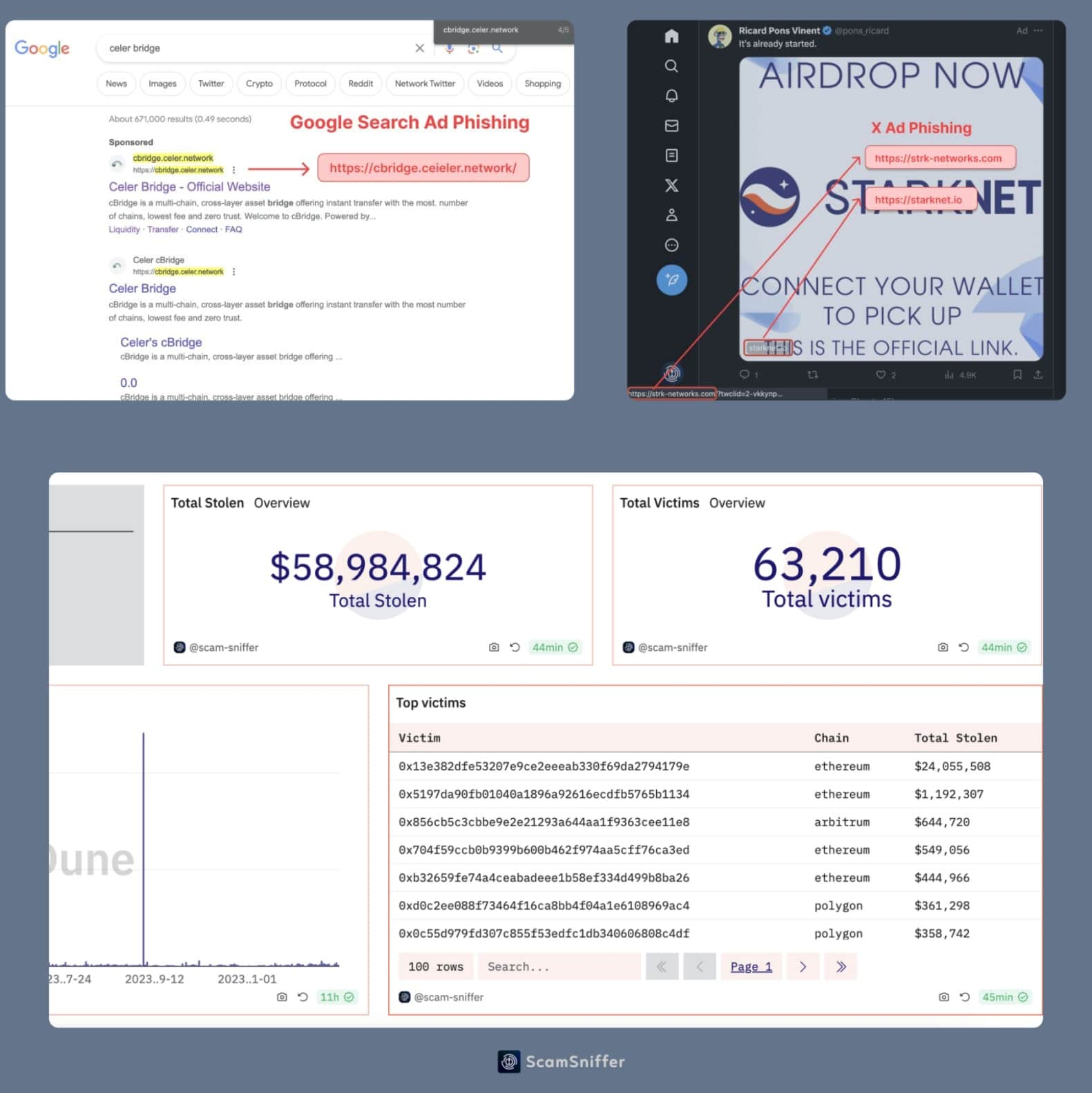
Anti-scam solutions provider Scam Sniffer has discovered a series of crypto drainer malware attacks stealing approximately $59 million from 63,210 victims by embedding a wallet drainer dubbed MS Drainer in Google search and X (formally Twitter) ads. The attack campaign leverages malicious ads on Google and X to redirect users to phishing pages.
Screenshot: Scam Sniffer
Unsuspecting users click on the ads linked to common keywords from the DeFi world. These ads can bypass ad audits and use redirect deception, targeting specific regions. Thousands of phishing sites were found using drainers between March 2023 and today, with spikes in activity in May, June, and November.
These sites were promoted in Google Search by exploiting Google’s tracking template. Ads on X were more prevalent, promoting NFT airdrops and new token launches on sites with drainers that steal funds from users’ wallets.
Researchers monitored 10,072 phishing websites and found that 60% of ads on X directed users to malware designed to steal cryptocurrency. MS Drainer is available on a Dark Web forum, and unlike other malware where developers charge a 20% fee, its source code is sold directly to customers.
On December 22, Check Point Research (CPR) published research highlighting an alarming increase in sophisticated phishing attacks targeting various blockchain networks using crypto wallet-draining techniques, targeting Ethereum, Binance Smart Chain, Polygon, Avalanche, and almost 20 other networks.
CPR linked the attacks to Angel Drainer, a group known for its involvement in cyberattacks in the cryptocurrency space. Despite the shutdown of similar groups like Inferno Drainer, which helped steal over $80 million in cryptocurrency, Angel Drainer continues to operate. Attackers create fake airdrops or phishing campaigns, offering free tokens to lure users. They redirect users to a fraudulent website, requiring wallet connections.
Users are lured into interacting with smart contracts designed to steal tokens. Unknowingly, users grant attackers access to their funds, enabling token theft. Attackers use methods like mixers or multiple transfers to liquidate stolen assets. Permit in ERC-20 tokens allows token holders to approve spenders to transfer tokens without conducting on-chain transactions. However, if a user is tricked, the attacker can transfer funds without logging a trace to the blockchain.
CPR and Scam Sniffer recommend that the advertising industry prevent malicious ads from reaching innocent users and urge consumers and users to exercise caution when opening links in online ads.
“Ad platforms need to enhance their verification processes to prevent malicious actors from exploiting their services,” Scam Sniffer noted.