The foldable phone has come a long way since the dog days of $2,000 devices being destroyed by grains of sand. From gimmick to glory, the foldable phone, thanks to innovations from companies like Samsung, Oppo, Motorola, etc., has become a mainstay in the smartphone industry. Now, several companies on the market have added their take on the foldable phone, and that list includes Chinese company Vivo. I was given the opportunity to review the new Vivo X Fold3 Pro.
Right now, the foldable phone market is prime for a new king. At the time of writing this review, Samsung just held its latest Galaxy Unpacked event where it announced the Galaxy Z Fold 6. That announcement was a testament to Samsung’s laziness with its smartphone launches recently. This is why we’re looking to companies like Vivo to breathe life into this still fledgling market.
We’ve already seen how other companies have been able to lap Samsung in terms of overall innovation in the foldable smartphone market. Why is this important? Well, Vivo is one of the companies putting Samsung to shame. Its foldable phones have been turning heads throughout the market and making some users consider abandoning their cart on Samsung.com.
So, is the Vivo X Fold3 Pro the book-style foldable you should get, or is this a book that’s better left unread? Let’s find out in this review.
Vivo X Fold3 Pro Review: Design
It’s a bit ironic that I was just talking smack about Samsung because the Vivo X Fold3 Pro takes a few notes from Samsung’s book. Some notes come from the design. Starting off, this is a gorgeous phone!
It’s a pretty svelte device as far as foldables go. While not quite as thin as the Honor Magic foldables, the X Fold3 Pro isn’t exactly a chonk. When closed, it feels like I’m holding a thicker slab phone. I feel it just a bit more in the pocket, and it’s just a bit more significant in the hand, but it’s not to the point where it’s uncomfortable.

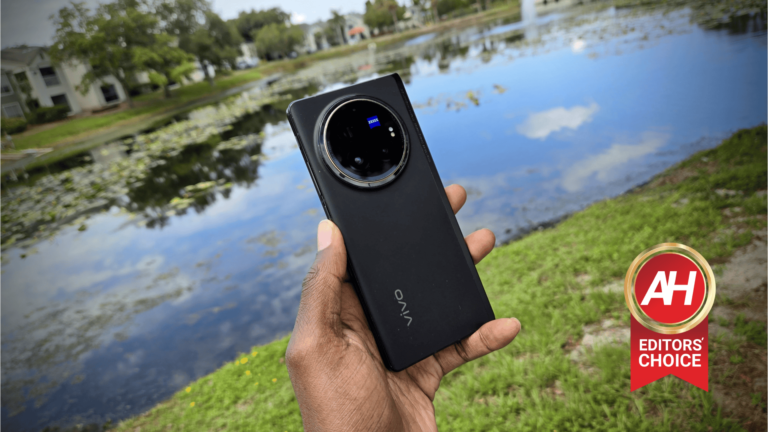
On the back of the phone (while closed), there’s that large circular camera bump. I’m personally not a huge fan of that aesthetic, but I don’t think it looks bad. There’s a textured ring circling the camera package that I think adds a distinguished flair to the phone.
The back has a matte glass texture that I rather like. That section of the back is encased within the metal frame which almost gives it a two-tone look. Lastly, the frame is chamfered which I really like. This adds a sort of an elegant industrial look to it and, it actually makes it appear a bit thinner than it is.
Lastly, the outer screen has a slight curve to it. It adds some nice dimension to the device.
Outer screen aspect ratio
The Samsung influence comes with the aspect ratio of the display. Companies like Oppo, OnePlus, and Google have opted for a wider aspect ratio. This is so that they feel better when you’re using them closed. However, the Vivo X Fold3 Pro’s outer display is on the narrow side just like the Galaxy Z Fold phones.
I wouldn’t say that it’s bad; I came to this phone straight off of the Galaxy S24+. So, using this phone closed was a bit jarring at first. Some things are just a little bit cramped on the screen and text throughout the UI. I feel it more when I’m typing on the keyboard.
I wouldn’t say that the screen is useless. All of the apps I typically use are perfectly usable on the outer display. I never found myself NEEDING to unfold the phone to use apps regularly. One thing I’d say is that I find myself unfolding the phone to watch videos. Watching videos on the outer display is okay, but opening it up just ups the experience.
Overall
Honestly, there isn’t a foldable phone on the market that I don’t think is good-looking. I know that we all talk about how Samsung recycles its design, but we have to admit that they’re damn good-looking devices. While I don’t have a look that I prefer, I think that the Vivo X Fold3 Pro is among my favorites. It’s a beautiful phone in all definitions of the word.
Vivo X Fold3 Pro Review: Build quality
Ah yes, the most critical point of any foldable device’s review, the build quality! Well, I’ll be honest, that hasn’t been the case for a few years. Foldable phones aren’t quite as durable as the slab phones lining shelves. However, they’ve come a long way since 2019. Companies have been making them more durable over the years, and it’s to the point where you can comfortably use a foldable without needing to baby it.
The Vivo X Fold3 Pro is proof of this. This is a solid-feeling phone in every way. When I pick it up, it feels like I’m holding a very sturdy and well-built phone. I can comfortably slip it into my pocket and use it out in the world without feeling like I’m holding a delicate piece of pottery.
This goes for unfolding it. I admit that I was walking on eggshells when I first used the phone. I had to literally practice the art of opening the phone to avoid having it slip out of my hand, opening it too far, or scratching the display. However, that only lasted a few days.
After getting used to using the phone, I found that it’s really sturdy. When open, this phone is notably thin. While that’s the case, it was still sturdy. I don’t feel like I need to handle it like I’m holding a newborn. I can sit back, watch videos, read books, type messages, and play games just like I’m using a regular tablet. The keyword here is “Comfortable.” I have peace of mind when using the phone unfolded, and that’s one of the most important parts of the experience. Why use a foldable if you don’t want to unfold it?
When I first got the phone, I would fold it and unfold it at about .05mph. I was so precious about how quickly I’d open it. Now, I’m not scared to open and close it with a bit of haste. It doesn’t feel like I’m damaging the phone when I open it with a bit of speed.
The peace of mind could be more peaceful
There’s one gripe that I have with how this device was built. It’s too slippery! The matte glass is nice, but it’s about the most slippery material I’ve used on a phone. I feel comfortable when using the Vivo X Fold3 Pro, but I still have to tip-toe just a bit. Whenever I take the phone out of my pocket or pick it up, I always fear that it will slip right out of my hand.

Thankfully, the smooth glass on the outer display helps add some grip. I think that Vivo could have opted for a material with more traction like faux leather. I sometimes pop on the included case just to add some grip to the phone. The case, unfortunately, adds some bulk to the device.
Lastly, when opening and closing the phone, I do hear a little bit of noise from the hinge. It’s not bad, and it doesn’t sound like it’s going to break on me. It’s just something to keep in mind.
Overall
I didn’t think that, in five years’ time, the foldable phone would be where it is now. When using the Vivo X Fold3 Pro, I had some worries, but they weren’t the kind of worries that come with using a foldable. I didn’t worry about the hinge, opening it, or using it while open.
The only concern that I had was one that I had about any phone. It’s so slippery that I feel like I’m going to drop it. However, it’s still a very solid and well-built phone.
Vivo X Fold3 Pro Review: Display
Okay… I thought I saw the best that smartphone displays could offer. I used the Galaxy S24+ along with some of the most beautiful displays from Tecno phones. So, I thought that I was done with being blown away by a smartphone’s display.
However, I’ve never used a Vivo device before, so I didn’t know what to expect. I know that the display is a big part of the foldable phone experience, so I know that fitting some quality panels in the phone was a priority. Let’s see if this display surpasses expectations.
Brightness
I’d say that the display brightness is the only low point of the display, and it’s not all that low. The phone performs decently out in the daylight. I can see everything clearly even in the bright sunlight. This goes for navigating the UI, watching videos, and playing games.

The reason I say that it’s the lowest point is because it’s not the brightest I’ve seen. I’m met with my reflection just a little more than I would have liked. I wouldn’t say that it’s not great, but still pretty good.
This goes for both the inner and outer displays. That’s good because I wouldn’t want to see the brightness diminish between screens.
Colors
This is one of the only displays that I didn’t need to boost the colors for a great experience. In fact, I was actually surprised to know that I was looking at the standard color setting out of the box. When I review devices, I review them based on the out-of-the-box settings. For this phone, I’ll be talking about the out-of-the-box settings along with the Bright color mode.
Starting off with the standard mode, I think that the colors were pretty nice. While they’re toned down, they still have a little bit of punch to them. They’re pleasant overall, with just a dash of saturation. They certainly make the UI and app icons look really nice. Out of the box, I’d say that they’re similar to what you’d get from the Poco F6 series.

I would be happy to use this phone on the standard setting, but I opted for the Bright color mode. This mode gives the colors more of that trademark OLED saturation. So, everything’s just a bit more colorful. What I like is the fact that the colors are boosted, but the system doesn’t push them too far. They just get a little boost to make everything a little more lively.
Crease
The dreaded crease! When I first started using the phone, I didn’t really notice the crease at all. After using it for more than a week, I’d say that I notice the crease just a little bit more, but it’s still not bad. It’s nowhere near as bad as Samsung’s foldables.
Overall
The Vivo X Fold3 Pro has one of my favorite screens on a smartphone. I absolutely love the color calibration. That, along with the sharp resolution and fluid 120Hz refresh rate make it just a joy to look at. The brightness is pretty good, but nothing really special. Vivo knocked it out of the park with this phone!
Vivo X Fold3 Pro Review: Speakers
Great speakers and small spaces don’t typically go together, but smartphone makers have been able to impress us over the years. The thing about book-style foldables is that the available space is getting smaller. Companies are trying to make phones that are as thick as a regular smartphone when closed. This means that they only have about half as much real estate because they have to live on one side of the phone.
So, I didn’t really expect much from the speakers in the Vivo X Fold3 Pro. It’s just one of those things you’d have to compromise on when moving over to a foldable. It’s like the battery life and durability. However, Vivo has surpassed expectations so far. Let’s see how the speakers fared.
I’m going to split this part of the review into two sections. Firstly, I ran the speakers through a set of six test pieces specifically designed to emphasize different aspects of a speaker’s performance: Volume, Bass, Treble, Balance, Vocals, and Immersion.
After that, I’ll review the day-to-day experience of just casually watching content and listening to music.
Part 1: Scientific
Starting off with the Volume, these aren’t the loudest speakers I’ve heard. The volume test piece that I used is a loud rock song, and I wasn’t able to get too much power from them. They’re not the worst offenders, but I’d say that they’re on the lower end. Again, I understand because they had to be crammed into a tighter space.

As for the Bass, this is an area where I was a bit surprised. The second I picked up this phone and felt how thin it was, I assumed that the speakers would be pretty tinny. However, that’s not the case. The speakers produce a pretty warm and deep sound. The second test piece really accentuates the lower-end audio, and I was pleased with the results. The sound wasn’t only bassy, it was also pretty open.
Moving onto the Treble, I was pleased with the sound, but I wasn’t quite as impressed as I was with the bass. The test piece had a lot of high-pitched notes, but it wasn’t as crisp as I would have wanted. It’s not bad, but not game-changing.
In terms of overall Balance, I think that the sound leans more toward the low-end. The audio seems to have an all-around bassy profile.
The Vocal performance is important for any set of speakers, especially if you’re planning on listening to music with them. When it comes to the vocal performance of these speakers, they do a commendable job. I can hear voices rather clearly over the rest of the music. There are some nice details, and it makes for an overall great listening experience. I feel like it could be just a bit better, but it’s not bad at all.
Wrapping it all up, the overall Immersion is extremely important, especially if you’re looking to watch some movies or TV shows using this phone. You’ll want a sound that’s lush and immersive; a sound to suck you into the action. Well, I think that these speakers do the job. The test piece was a very lush and immersive orchestral piece, and I think that these speakers projected the audio nicely.
So, as for the scientific test, I think that these speakers definitely get a passing score.
Part 2: Real-world use
Next up, I’m going to give you my experience using these speakers in my day-to-day life. I used the speakers mostly for watching videos on YouTube. All of the elements from the scientific tests came together to make it a nice video-watching experience. I found myself having to turn the speakers up to near-max when the AC would kick on. That’s the only drawback I’d say I experienced. When taking the phone outside, the ambient noise of the outside world made them a little bit hard to hear.
Obviously, with a screen this good, you know that I watched some movies and shows on the phone. The speakers are great for this. That punchy and immersive sound really makes it great for this kind of media. I also listened to a bit of music from different genres, and it all sounds nice.
Just using the Vivo X Fold3 Pro, I can say that these are some of my favorite speakers. I don’t know if the low volume is because of the lack of space, but that was the only area where I wasn’t impressed with the speakers.
Overall
I was thoroughly impressed with these speakers’ performance. After all of the scientific tests were done, I found that I just enjoyed using them. The speakers’ performance is one of the strongest aspects of this phone.
Vivo X Fold3 Pro Review: Performance
This being the latest and greatest from a major smartphone brand, I had no doubts about the performance. And, you know what, I was not disappointed. Being a person who mostly reviews mid-rangers, I’ve run into my fair share of phones that lag here and there. However, I’ve used some speed demons that run as smooth as buttered silk, and the Vivo X Fold3 Pro is one of them.

There’s not much to say about navigating the interface. There are no dropped frames, stutters, or hesitations. Everything glides. It’s using the Qualcomm Snapdragon 8 Gen 3, so that should come as no surprise.
Being a person who doesn’t shy away from a little pizzazz on his screen, I don’t mind live wallpapers. This phone comes with some Kinetic wallpapers that react when I fold and unfold it. Well, those animations always play smoothly without dropping any frames. That’s important because, at that point, the phone is literally changing its entire interface, and sometimes changes orientation. This is where weaker phones would lag at some point. However, the Vivo X Fold3 Pro maintained its smooth performance.
This goes for navigating the interface, going between apps, using said apps, etc. Sure, this just means that it can run the software that came loaded onto it, which isn’t really much of an achievement when put into words. However, no matter how powerful the chip is, if the software isn’t properly optimized, then you’ll see stutters. I won’t go too in-depth with the software just yet, but I can say that the software is nicely optimized.
As a side note, the ultrasonic fingerprint scanner is extremely fast and accurate. Up until I used the Galaxy S24+, the only under-display fingerprint scanners I used were optical. The ones from Tecno were pretty good, but they were still bested by a good back/side-mounted scanner. The one in the Galaxy was amazing, and I think that the one in the Vivo X Fold3 Pro is a bit of a step-up from the Galaxy’s. Honestly, it’s the best one that I’ve used. Both the one on the outer display and the inner display are great.
On a personal note, I’m happy that Vivo went for an under-display fingerprint scanner and not a side-mounted one. I’m more of a fan of under-display scanners. I always find myself accidentally unlocking phones with side-mounted scanners.
Benchmarks
As part of the review, I ran this phone through some benchmark programs just to get some on-paper-performance metrics. Of course, they’re not an objective indicator of the day-to-day performance, but they’re here for you if you want them.
Starting off with Geekbench 6, the results were actually some of the best on the market. Again, it’s not just because of the hardware. Other companies have plopped the Snapdragon 8 Gen 3 into their phones. However, they all handle the hardware differently, creating different results. What were the results for the Vivo X Fold3 Pro? For the single-core performance, it scored a blazing 2111. To put that into perspective, the highest score on the app belongs to the Galaxy S24 Ultra, and it only beat this phone by 61 points (2172). It’s in second place, and it only missed it by an inch.
Moving onto the multi-core score, this story is similar. However, this time around, it’s in third place. It scored 6332, which is a fair bit behind the Galaxy S24+ (6661) and the Galaxy S24 Ultra (6782). While it’s further from first place than with the single-core score, it’s still one of the most powerful phones on the market.

Lastly, I ran the phone through 3D Mark. It got a Best Loop Score of 4467 and a Lowest Loop Score of 2486. Lastly, it got a Stability rating of 55.6%.
Overall
There’s not much more to say about this phone other than it’s FAST! It has some of the top hardware on the Android phone market and its software is optimized for it. You won’t have any performance issues while using this phone.
Vivo X Fold3 Pro Review: Gaming performance
Sometimes, the general and gaming performance go hand in hand. If the phone lags when opening Gmail, it doesn’t stand a chance at running Genshin Impact. However, that’s not always the case. There are phones that perform like crap but game like a champ. Sometimes, it’s the opposite. So, it’s important to take both aspects as separate parts of the performance.
2D games
Starting off my testing, I went for the low-end. I loaded up some 2D games. It should come as no surprise, but the phone ran them like a dream. I used Survivor.IO. This is a 2D game, but what makes it a good game to test on a phone is the fact that it can have hundreds of sprites on the screen at a time. That can cause some beefy phones to stutter. I didn’t experience any stutters whatsoever while playing that game.
Another 2D game I played is called Last Cloudia. It’s a pixelated RPG that has a ton of battles and animations. Again, it’s deceptively taxing. However, the Vivo X Fold3 Pro tackled it like a pro.
Mid-range 3D games
Moving into 3D games, I went for two tried and true titles. Sky: Children of The Light and Asphalt 9. These are two games that are graphically intensive in their own rights. I turned them up to their highest graphic settings and played them both for a while. Again, the gameplay was super smooth.
Sky is a game that has a ton of wide-open spaces, and it’s a beautiful-looking game all around. As for Asphalt, anyone familiar with the series should know how intense those races can get. So, they’re definitely able to slow down some weaker hardware.
The Hoyo Titans
Now, rounding out the testing, I ran two of the most graphically intensive games on the Play Store. These are Genshin Impact and Honkai Star Rail. I didn’t really think that the X Fold3 Pro would break a sweat with these games, and I wasn’t disappointed (for the most part). Starting off with Star Rail, the phone ran this game rather well at its highest graphical setting. With everything maxed out, it ran smoothly, but there were some instances of stopped frames and stutters. This happened with some of the attacks. The game would lock up for just a fraction of a second. That also happened during transition screens.
It’s not something that would hinder the overall experience, however. These instances aren’t so common that they slow down the gameplay. While there are more stutters than I would have liked to see, it’s not bad. I’d personally take the occasional hiccup if it means that I can play that gorgeous game at its maximum settings.

Moving onto Genshin, this game tends to be better optimized than Star Rail. Where Star Rail typically dips in performance, Genshin soars. Just like with Star Rail, I cranked all of the graphical settings to their max.
Whereas Star Rail choked at a few points, Genshin ran perfectly smooth. It didn’t matter if I was in a town or doing battle, the game ran smoothly. I ran it for a while, even after the phone got a bit hot, and it still maintained its top-tier performance.
Overall
If you want to use the Vivo X Fold3 Pro as your pocket gaming device, then you won’t have any issues doing so. This phone was able to run all of the games that I threw at it smoothly. Playing Star Rail does give you some dropped frames, but the overall performance of that game is smooth.
The gaming performance is only delivering on the promise established by its general performance.
Vivo X Fold3 Pro Review: Camera
Ah, the dreaded camera section! Foldable phones don’t typically fare too well in this part of the review. The companies making these phones have two choices. They could either skimp on the camera tech in order to save space or give their thin foldable a half-inch thick camera bump. Vivo managed to fit this phone with some pretty impressive camera sensors for how thin it is. The thing is that the camera bump has some thickness to it. Vivo was able to fit a telephoto camera in it. So, the company was able to find a nice sweet spot in between.
Exposure/contrast
In terms of overall exposure, I didn’t have any issues with it. In fact, I was quite impressed. This is a first for me. Vivo produced some of the most balanced pictures in terms of exposure of any phone I’ve reviewed. With most other cameras, I find that they lean either toward overexposure or underexposure en route to reaching a good balance. This camera managed to create perfectly balanced images while keeping shadows and highlights in check. This image below was exposed beautifully.

As for the contrast, I was also impressed with this camera. A lot of the time, cameras would have trouble with crushing the shadows in contrasty shots. With the X Fold3, some of the shadows were a bit dark, but I could make out details in them. The superior contrast of the images makes them look that much better, and it goes hand in hand with the great exposure.
Colors
The color reproduction of this camera is a bit of a weird story. The colors this camera produces are more saturated than they are in real life, but they’re handled in a way that makes them pleasing to look at. Restraint and balance are two of the most important things to keep in mind here. Without them, you wind up getting pictures like those produced by the Motorola Edge 2023. My eyes are still burning from how saturated those pictures were.
Vivo, on the other hand, was able to give me images that look like they were edited by a human being. By that, I mean that it looks like a human added just enough saturation to the images to give them a nice artistic pop without going overboard. They’re responsibly saturated, and I love them. A great example would be this image of the crepe-myrtle.


When it comes to reds, I think that they do suffer a bit from the saturation. Looking at the picture of this red pipe, the color dips a bit into oversaturation. The pipe almost has this candy-pink color to it.

Low light
Vivo is one of the best companies when it comes to low-light performance and the X Fold3 Pro continues to impress. Bringing down the lights, the images this phone produces are still very detailed and bright. The picture of the mouse was taken in a dimly lit living room, and it looked like it was taken during the mid-afternoon.

The images of the flowers in the corner had even less light, but the camera was still able to pull some nice details from the wall. I was actually shocked.
This is the same thing for the Amazon suitcase. I was surprised about how much contrast this camera was able to pull from the image.

It did a good job of exposing the image of the dog. Again, there was barely any light in the image, but it was able to pull some fine details from his fur. Also, I was surprised by how well it was able to draw details from the sheet.

I know that Vivo has a good reputation for its low-light performance, and I can see why. This is a fantastic low-light shooter.
Here are more samples:
Zooming
When it comes to the zooming performance, I think this phone does a good job overall. It has a 3x telephoto camera, and the camera can zoom up to 10x digitally. Testing out the zooming capabilities, I was able to get some nice shots. Here are some shots of some flowers with the 3x and the 10x zoom.
Next, here are some images of some ducks by our pond at 10x. I think that they came out nice, especially for being handheld.

Overall
The camera on the Vivo X Fold3 Pro is one of the best cameras on a foldable today. You’re getting some great exposure, contrast, colors, and low-light performance. The colors are tastefully saturated, and the low-light is second to none. I commend the company for fitting this phone with such an amazing camera.
Vivo X Fold3 Pro Review: Battery
Just like the camera, the battery is an area where foldable phones have had some difficulty over the years. Companies have had to compromise on battery capacity so that they can fit in the thinner phones. Believe me, I felt that when reviewing the Tecno Phantom V Flip.
However, despite the compromises, the Vivo X Fold3 Pro… has some of the best battery life of any phone I’ve reviewed. This has been an all-day phone, and I never charge it fully. I charged it all the way to 100% to do the battery test. After that, I would charge it to about 60% – 80%, and I never find myself reaching for the charger before the day is finished.
This is while using it both open and closed about half of the time. I typically use it to watch videos, play some games, scroll on social media, and notetaking.

As for the battery test, I charged it all the way to 100%, put on a 24-hour video, and ran it at full brightness and resolution until it died. This was with the phone closed. I tested it to see the longest it could possibly last.
Most phones last between 10 and 15 hours, and these are mostly all-day phones. Until this phone, the best performer that I used was the Galaxy S24+ (north of 21 hours). The Vivo X Fold3 Pro lasted about 22 and a half hours before dying. This foldable has outlasted all of the regular slab phones that I reviewed.
I wasn’t only impressed, I was also surprised! Battery life shouldn’t be a worry when using this phone.
Vivo X Fold3 Pro Review: Software
The software plays a major role in a phone’s experience, and that goes double for a foldable. It has to be able to facilitate both a phone’s user experience and a tablet’s. As such, it just might be the most important aspect of the user experience.
One thing that stood out about this software is the inspiration. I’ve reviewed several phones from Chinese OEMs, and many of them take some inspiration from iOS in terms of software. This is true for HiOS/XOS (both from companies owned by the same company) and HyperOS. However Vivo’s Funtouch OS is closer to Samsung’s OneUI. Certain aspects like the notification shade, Quick Settings, settings app, and overall appearance are similar to Samsugn’s skin.
In terms of the software, I don’t have any complaints. Whenever I unfold the phone, it swiftly changes to tablet format. Also, it maintains the same orientation it was in when it was folded. There are features like a video mode that pushes the video you’re watching over to one half of the screen and puts controls on the other half. The phone enters this mode when the phone is half folded.

The only issue I had with the software is this weird bug that happens when I summon the notifications shade when the phone is folded. Everything is out of place. It’s like the phone thinks that it’s unfolded when it’s not. To fix this, I just have to unfold it and summon the notification shade. Then it will right itself.
Vivo X Fold3 Pro Review: Final verdict
From the moment that phones like the first-gen Galaxy Z Fold and Huawei Mate X started failing, it looked like the foldable phone was just another short-lived gimmick. People looked at images of broken foldables on social media and said “Well, so much for that.”
However, smartphone companies like Samsung and Motorola pulled this form factor out of the ashes, and companies like Oppo and Vivo helped push it forward. The foldable phone has come a long way, and the Vivo X Fold3 Pro is a testament to this. This phone shows just how far this form factor has come in the last five years. It excels in so many areas from the display to the design to the build quality to the speakers, and so on. It’s a fantastic phone and it’s honestly one of my favorite devices that I’ve reviewed. I can’t recommend the Vivo X Fold3 Pro enough!
[ad_2]
Source link