At the time of the Galaxy S10 launch in February 2019, Samsung announced a partnership with Instagram to bring Instagram Mode to the phone’s stock camera app. It gives you access to Instagram editing tools and effects and lets you post photos and videos directly to Instagram Stories. The two firms appear to be expanding this partnership with the Galaxy S24 series next year. The upcoming flagships may let you access Instagram Camera from the lockscreen.
Galaxy S24 lockscreen may let you keep an Instagram Camera shortcut
App developer and researcher Alessandro Paluzzi, who is known for uncovering unreleased features in apps through reverse engineering, recently shared a piece of interesting news. He posted a screenshot from Instagram on X (embedded below), showing a new feature that is still in development. The feature is specific to Samsung’s next-gen flagships, the Galaxy S24 series, which are about two months away now.
The screenshot reveals that Galaxy S24 users will be able to access Instagram Camera directly from their phone’s lockscreen. The shortcut can be added via Settings, though it’s unclear whether Samsung will bake it into the phone settings or you have to do that through Instagram settings. From what it appears, users may be introduced to this feature with a pop-up when they first open the app. A “Try it” button will take them to the setup menu.
No other information about this “shortcut” feature is available at the moment. However, we expect it to be available out of the box on the Galaxy S24, Galaxy S24+, and Galaxy S24 Ultra. Samsung will probably talk about it at the launch event in January, as it did for Instagram Mode during the Galaxy S10 launch. Instagram head Adam Moserri came to the stage to introduce it.
Samsung is trying to up the social media game of its phones
Samsung has always worked closely with Google, Microsoft, and Meta to make its Galaxy phones play better with their products. Simultaneously, it is trying to up the social media game of its phones. The company has teamed up with Instagram, Snapchat, TikTok, and others to improve the quality of photos and videos captured using the in-app cameras.
An Instagram Camera shortcut for the Galaxy S24 may be part of this effort. Since iPhones usually work better with social media apps, Samsung appears to be working on giving Apple some competition there. Time will tell if the Korean firm has more such tricks up its sleeves. The new flagships will go official in mid-January, reportedly on January 17. We will let you know as soon as we have more information.
A survey reveals that an overwhelming 87% of American teens own an iPhone, and an even more staggering 88% plan to purchase an iPhone as their next smartphone. These findings paint a grim picture for Google and Android phone manufacturers.
This survey was conducted between September 4th and September 27th by investment firm Piper Sandler. It also found out where these teens live. 36% live in the South, 29% live in the Midwest, 21% live in the West, and the other 14% live in the North.
FaceTime and iMessage are the key reasons behind iPhone obsession
The blue bubble versus green bubble debate is a real phenomenon, not a mere fantasy. While Android is the most popular mobile OS worldwide, iOS tops all charts in the U.S.
The reason why teens prefer an iPhone over Android could also be FaceTime and iMessage. American teens want to be part of the blue bubble ride on iMessage(s). Because when a non-iOS user joins a group chat consisting of iOS users, all those cool features of iMessage go away.
For example, features like end-to-end encryption, read receipts, typing indicators, high-quality image and video sharing, and the ability to send large messages are exclusive to iMessage. That’s why American teens want to be part of the blue bubble ride on iMessage(s). Notably, while Android users have some features like RCS, teens still prefer iPhones.
The ecosystem has an equal role in attracting teens
Another factor that plays a role in the choice between Android and iOS is Apple’s ecosystem. Samsung and others have done the job brilliantly, too. But, still, it’s that Apple people can’t praise enough. The Apple ecosystem promises seamless integration between AirPods, iPads, MacBooks, Apple Watch, and more.
Eventually, many teens end up with an iPhone, whether it’s a refurbished model, an iPhone SE, or part of a carrier deal. Regardless of how they acquire it, the teen iPhone ownership rate remains high. It contributes to the 87% of teens who prefer iOS over Android.
When it comes to gaming laptops there’s a lot to choose from that can give you what you need to enjoy gaming to its fullest. And really that’s what it all comes down to when you’re considering a gaming laptop. Will you enjoy playing games on a portable PC? Do you want something powerful enough to play games at the highest settings? These are great questions and whatever you decide the answer is, we’ve got you covered on some excellent gaming laptops that will deliver on the experience.
With the holidays coming up, gaming laptops can make really great gifts and if you’re getting ready to shop for that special person in your life, or maybe just some family or friends (or even yourself!) then this list will help you narrow down your choices. We’ve put together a comprehensive guide on the best gaming laptops out there. While trying to ensure that gamers of every budget have something they can consider. With all of that said, you can find our picks below along with some honorable mentions.
Best Budget Gaming Laptop: Acer Nitro 5 AN515
A price that showcases no gamer should be left behind
Just hearing the words “budget gaming laptop” can make some people’s hairs stand up on end. But I can assure you that a budget gaming laptop is nothing to scoff at. In fact they can be quite nice. It’s really all just about managing expectations and thinking about what you really want out of a gaming laptop experience. Or maybe you just don’t have the means to pick up something pricey and extravagant, filled to the brim with powerful components and extra features.
That’s totally fine! And let me tell you, gaming on a budget gaming laptop is not a bad experience. With that in mind, our pick for the best budget gaming laptop is the Acer Nitro 5 (specifically the AN515-58-57Y8 model). I was lucky enough to test this for a bit to see how things shape up and it reminds me of a much more pleasant experience of my early gaming days.
Back when I was just a wee lad dipping a toe in the waters of PC gaming, I had a pretty inexpensive HP laptop. It was capable of playing games like World of Warcraft and the occasional random title I might pick up on Steam. But by no means could I max out the graphics. And yet, I enjoyed gaming on it all the same. Because at the end of the day I was doing what I enjoyed. With a laptop like the Nitro 5 things are so much better. While admittedly it costs a little bit more than I paid for my laptop in those days, it’s still within that realm of not costing a lot compared to some of the other options on this list.
It’s also much more well equipped to handle today’s demanding games. With an NVIDIA GeForce RTX 3050 Ti GPU inside, plus an Intel Core i5-12500H CPU for most computing processes, the Nitro 5 has been more than capable for gaming at 1080P with decent frame rates. Now let’s be realistic. No, some of today’s modern games won’t look as pretty and glamorous as they would if there were some more powerful components in here. But don’t get hung up on that. Games will still look good and more importantly they’ll run smoothly.
During my testing I quite often noticed that the laptop never really ended up getting too warm to the touch. Which is partly due to Acer’s implementation of thermals here. And partly due to the fact that it isn’t housing a monster of a graphics card and processor that output a ton more heat. And with decent thermal management the Nitro 5 seemed to continuously perform well for longer periods. Granted I still would recommend giving it a break now and then. But that’s the case with any gaming laptop. And even desktops.
Don’t leave it running 24/7. That being said, thermals don’t seem to be an issue here at all. At least they weren’t for me. Thermals aside the Nitro 5 also delivers on having a suitable amount of ports. This includes ethernet should you want to jack into your home internet with a wired connection. As well as multiple USB-A ports, USB Type-C, and even HDMI 2.1 for those sweet gaming moments on a bigger screen. All-in-all this is just a really solid pick for a more affordable gaming laptop. As it’s not going to compromise on quality at this price. And for around $800 (currently $780.99), there’s little to complain about.
For about $200 more you can get a step up to a slightly more premium budget gaming laptop. Gigabyte has been around in the game of gaming laptops for years and they make some excellent machines. And this particular model fits neatly into the budget category at $999. While not as affordable as our main pick for a budget option, it has some really solid components and a quality build. Not to mention an aesthetically pleasing design.
That extra money gets you a bump to an NVIDIA GeForce RTX 4050 GPU (which also gets you access to DLSS 3 features), and a newer 13th Gen Intel CPU. You get the same amount of storage at 512GB and a 144Hz display which the Nitro 5 also has. However you do get only 8GB of RAM whereas the Nitro 5 has 16GB. When it comes down to it, both are good choices if you’re looking to get a gaming laptop but spend less money at the same time. But you will spend a significant amount less on the Nitro 5 which could leave you room to throw in a few games for whoever the laptop is a gift for.
Small but mighty, the ROG Zephyrus G14 is a gamer on the go’s dream
You might think of a smaller gaming laptop as something you should avoid. Perhaps because the fact they’re smaller means there’s less room for powerful components. And thus you will get lower performance in your games, and overall enjoy them less. If that was ever a worry for you it’s time to put that worry to rest. Small gaming laptops can be equally as powerful as those with bigger screens. And the ASUS ROG Zephyrus G14 is our pick for the best small form factor gaming laptop.
It’s 14-inch screen makes it incredibly portable as it can fit in almost any backpack and many other types of bags. And because it only weighs around 3.6 pounds it won’t feel too heavy if you cart it around all day. It’s by no means the lightest gaming laptop in its size category. But it’s not too far off and is arguably going to offer better options for components that will result in better performance.
In the time I had to briefly check out ASUS’s ROG Zephyrus G14 it was considerably powerful for its size. I surprisingly had less issues with heat dissipation than I had expected. Another testament to ASUS’s mastery of cooling engineering when it comes to gaming laptops. You might also be hard-pressed to find many gaming laptops in the 14-inch display category that are as thin as the ROG Zephyrus G14.
And that will ultimately play well with anyone who needs a laptop that is easy to carry around. Whether it be for school, work, or both. Personally I used it when traveling back home to visit family and it was a godsend. Taking up almost no space in my travel backpack and being relatively light when moving around with it.
This particular model runs on an NVIDIA GeForce RTX 4060 GPU. Though it is possible to get it with other GPUs in the 40-series. This enables the access to DLSS 3 for much better performance boosts in terms of frame rates without degrading the graphics too much. Allowing you to run games at higher settings and still getting decent frame rates and overall performance. It’s also worth mentioning that the display comes with a 165Hz display so it’s well equipped to handle high frame rates where available. Now the model with the RTX 4060 inside will run you about $1,599.99. So this is by no means a budget laptop. But it is packed with powerful specs.
For the money you also get a QHD screen with 512GB of PCIe Gen4 SSD storage and 16GB of DDR5 RAM. Compare that to the Razer Blade Blade 14 with the RTX 4060 in it and you’re spending considerably more. So ASUS is really offering a bargain here. At the end of the day if you’re looking to spend this much money you want something that will perform well and that is something the ROG Zephyrus G14 definitely does.
This would honestly be our pick for best small gaming laptop but when you compare the price of this laptop with what ASUS offers, it’s a no-brainer. The ROG Zephyrus G14 is just too good and offers too much for less money. Ultimately it’s the better laptop. But that doesn’t mean the Razer Blade 14 is bad. On the contrary it’s quite good and when I used one for testing it was just as good as I remember a Blade laptop being.
You’ll spend a little more money with the Blade 14 as it’s set at a price of $2,399.99 for the same GPU but with the same RAM and more SSD storage capacity. You do also get that sleek matte black chassis that generally only Razer can give you. And if you’re a Razer fan already you might as well spend the extra money. It’ll still be a good gaming laptop.
Best high-end gaming laptop: Acer Predator Triton 17 X
What a gaming laptop looks like when it has the power of a god
When you think about a high-end gaming PC you probably aren’t necessarily thinking about a gaming laptop. But let me assure you if you want a high-end gaming PC that’s also a laptop, the Predator Triton 17 X from Acer is that laptop. This thing is so packed to the gills with performance specs you’ll start to wonder if there’s a game out there that will ever live up to its prowess. That is to say Acer built a gaming laptop that has absolutely zero trouble playing any game you can throw its way. Even Cyberpunk 2077: Phantom Liberty. With max settings, and with 4K resolution on a large external monitor. While getting frame rates of 60 frames per second pretty consistently.
I’ve been spending some time testing this laptop out for some of today’s most demanding games including Starfield, Diablo IV, and the Cyberpunk 2077 expansion. The short takeaway is that I was able to crank the graphics on each of these games and turning on everything imaginable. Leaving no stone unturned when it comes to visual enhancement features. And I experienced nothing more than the slightest hitch in any of those titles. Really the only time I ever noticed any sort of issue at all was after those games had been running on the laptop for most of the day.
Even then, several hours of high-activity and high-heat barely made a difference to the Triton 17 X. The one side effect of this is the laptop subsequently turns into a mini jet engine from the fans whirring at full blast. They’re so loud you’d be forgiven for thinking the laptop might just take off and break the sound barrier. I’m not kidding either. The fans are so loud you’ll need to wear headphones if you want to hear the game audio to the point where you can really enjoy it. That’s the trade-off. Those fans need to run at that capacity to ensure the system can stay cool enough to prevent performance dips.
Acer also makes it really easy to manage the cooling system. You can open up a piece of software that lets you set the fans to different modes. I would typically set it to be managed by the system automatically for general work, browsing, and gaming purposes. But if I knew I was going to go straight to gaming in a title like Cyberpunk 2077 I could swap the mode directly over to turbo and the fans would kick into high gear immediately. It’s actually a very intuitive app. And it’s the first thing I would launch every time I would boot up the laptop.
What’s really great though are the speakers and the collection of ports. While I would almost always plug the laptop into a monitor using the HDMI out, the times I did play using the laptop screen and the fans weren’t going full blast the speakers sound quite good. And honestly they need to in order to compete with the fan noise. As for ports, there’s more than enough to plug in a few devices. When using the laptop with an external monitor I could easily plug in a keyboard, mouse, and a headset if I wanted and still have another USB or USB-C port to spare.
And there’s a port for ethernet and wired headphones too if I wanted it. You could even forgo plugging in a wireless headset adapter if you have a pair that supports Bluetooth. Now the display on the laptop isn’t 4K but that’s perfectly fine. Because without 4K when playing games with higher graphics settings you’ll end up with better frame rates than I did in most cases. Overall this is a beast of a gaming laptop that oozes high-end. It has a price tag to match at $3,799.99. But if you’re looking for something high-end and had planned to spend this amount of money, I’d argue this is the laptop to go for.
The ROG Strix Scar 18 is another high-end gaming laptop that will deliver a similar experience to the Predator Triton 17 X. There are some notable differences though. The most obvious is that it comes with an 18-inch display. So you get more screen real estate to work with when playing games. But it’s also going to be heavier which will make it less portable. It comes with 32GB of RAM instead of 64GB too so there’s less memory.
But even then 32GB is still plenty for any gaming. On this particular model SSD storage capacity and the GPU are the same. Even the CPU is fairly similar as it’s a 13th Gen Core i9 chip from Intel. It features ROG’s intelligent cooling system which is quite good at maintaining lower temperatures for optimal performance. Again, you’ll spend a lot here but it’ll deliver a high-end gaming experience. Keep in mind you will spend about $100 more for this than the Acer laptop though.
The dual-mode display sets this apart from other gaming laptops
Lots of laptops can do what the Razer Blade 16 can do with regard to gaming performance as a whole, but what they can’t do is deliver a two-for-one special kind of gaming experience that you get with the Blade 16’s dual-mode display. This unique feature lets you have your cake and eat it too. You want glorious, vibrant 4K games with smooth performance? The Razer Blade 16 can do that. If you want rapid-fire frame rates that are well-suited to first-person and third-person shooters, well… the Razer Blade 16 can do that too.
The beauty, so to speak, is the laptop’s dual-mode display that lets you flip between both a 1080p mode and a 4K mode. Though you can certainly leave it in one or the other all the time if you prefer it. That being said Razer baked this in for a reason. It’s intended to allow for optimal gaming sessions that are more of a fit for one resolution or the other. And it works great if you want to get the most out of your games. The one downside is that you have to reboot the PC in between swaps.
So if you start in 4K mode playing something like, let’s say Ori and the Will of the Wisps, and want to swap to 1080p to play a shooter at a frame rate of 240 frames per second, the PC requires you to restart. It’s minor but will definitely bother some gamers. Though admittedly it’s not as annoying as you might think. And the payoff is certainly worth the time it takes to make this swap.
Aside from the dual-mode display the Razer Blade 16 has that familiar sleek design that you can only get with Razer. The thin, boxy shape of the Blade line’s frame because the chassis is machined from a single piece of aluminum. It help’s Razer’s laptops keep their minimal design that just works so well. And this is only helped by the fact that the Blade 16 only weighs around 5.5 lbs. An impressive accomplishment considering you can get one with a GeForce RTX 4090 GPU inside of it.
This is also a full pound less than something like the Predator Triton 17 X. Which has the same GPU and a slightly larger 17.6-inch display. So all things considered it’s a design that you’ll be fine with carrying around when you have to. You also have a decent amount of ports with three USB-A ports and two USB Type-C ports. As well as a port for wired headphones and an HDMI out port as well. The only thing it’s really missing is a port for ethernet. But you won’t get that until you bump up to the Blade 17 that’s noticeably larger and heftier.
When it comes to performance the Blade 16 unsurprisingly shines. And you would expect it to with the kind of specs it offers. Which include the above-mentioned RTX 4090 GPU, a 13th Gen Intel Core i9-13950HX CPU, and 32GB of RAM alongside a 2TB SSD for storage. You can of course get it with different configs there. Performance will vary slightly of course from game to game. Overall it’s a solid laptop that is definitely a great pickup if you can stomach Razer’s high prices. But if you want the best for 4K gaming in a laptop, you really won’t find better than the Blade 16.
If you don’t care about the dual-mode display or the 40-series GPU, you can save quite a lot of money by going with something like last year’s Blade 17. It comes with a larger 17-inch display and it’s still 4K resolution. You’ll get bumped down to the RTX 3070 Ti GPU but this is still an excellent graphics card for gaming. You also bump down to a 1TB SSD from 2TB and you get a 12th Gen Intel Core i9 CPU. But like we said, you save a lot. As the price goes down to $2,299.99 whereas the Blade 16 above is $4,299.99. We’d say saving $2,000 is well worth having the slightly lower performance specs.
Best Overall Gaming Laptop: ASUS ROG Strix Scar 16
The most well-rounded experience currently available
Across the board, ASUS has delivered the best overall gaming laptop that you can currently buy with the ROG Strix Scar 16. Whether it’s the NVIDIA Advanced Optimus-enabled display or the excellent keyboard that feels great to type on, this laptop gets high marks for its many wonderful features. What’s most impressive about it is the fact that you can get it with either an RTX 4080 GPU or an RTX 4090 GPU for less than other similar laptops with the same specs.
It’s using Intel’s blazing fast Core i9-13980HX CPU which is the same CPU we’ve been using in Acer’s Predator Triton 17 X. You also get 1TB of SSD storage and 32GB of RAM which could be higher, but then you’d be looking at a higher price tag as well. The bottom line is you can now pick this thing up for around $2,599.99 for the RTX 4080 model. Don’t get me wrong this is by no means inexpensive. But the price is reasonable for what you’re getting. Especially when factoring in other laptops with these specs can cost considerably more.
Ok so it has powerful components. What else makes this the best gaming laptop overall? Well for one the fans are surprisingly quiet when working at full power to keep the laptop cool. Which by the way is another standout trait. You won’t have to worry about this laptop getting uncomfortably warm in certain areas where your hands might accidentally drift over too. Speaking of the fans, the ROG Strix Scar 16 is quieter than most of the competition with a dB of 49.
We’re not saying you won’t hear it. But it’ll be less obtrusive and should make it easier to enjoy the game audio. Without having to wear a pair of headphones mind you. And for some that’s going to make a big difference. Headphones are great. And they can amplify the immersion in a game with stellar audio design. But you don’t always want to wear a pair of headphones.
The display is top notch as well. Featuring support for NVIDIA G-Sync and Dolby Vision. What’s likely going to make the most difference for you though is that the display is made of a Mini-LED panel for really, really, deep contrast and vivid colors. This is going to make your games look amazing and with a peak brightness of 1,100 nits glare should rarely be an issue. If it’s ever an issue at all. Remember how we talked about the 1TB SSD and the 32GB of RAM? Well if that’s not enough you can always swap out those components.
And that’s another reason the ROG Strix Scar 16 pushes ahead of the competition. It has fully upgradeable RAM and Storage. Now you’ll still need to know how to replace those components if you want more storage and more RAM. But not all laptops allow you to swap this stuff out. So this makes the ROG Strix Scar extremely consumer-friendly. That being said ASUS is certainly not the only manufacturer that lets you upgrade these parts. But in conjunction with all the other great features, this is the laptop to beat and for the current sale price of $2,599.99, beating it won’t be easy.
Alienware has come a long way in delivering powerhouse gaming laptops that look just as good as they perform. And the x16 R1 is among the newest offerings from the company. This model has comparable specs to the ROG Strix Scar and offers a good mix of desirable features and great aesthetics. That being said it’s also noticeably more expensive. At $3,099.99 for the x16 R1, the Strix Scar 16 is just the better bang for your buck. But if you prefer Alienware’s design you won’t be disappointed with either the features or performance on this laptop.
Google has rolled out an experimental feature through Search Labs for Android and IOS users in the US and India. This innovative addition introduces a “Notes” section beneath webpage search results, enabling users to provide comments on the presented content. Highlighted by 9to5Google, Google envisions the “Notes” feature as a platform offering “helpful tips about an article or topic from both experts and everyday people.”
In the latest round of Google updates, search results now prioritize content from Reddit. This was in response to Google’s analysis showing a growing trend among users to include “reddit” in their search queries. The data underscores a preference for concise, human-written answers. While the new Notes feature doesn’t replicate Reddit’s dialogue, it serves a similar purpose by allowing users to quickly gauge others’ opinions on an article.
Google’s new Notes feature lets users share quick tips and insights directly on webpage search results
The introduction of the Notes feature effectively establishes a comment section beneath web pages. Users can now utilize this as a reference point to assess the usefulness of a webpage’s content. Google adds, “Notes might help you uncover tips about which neighborhoods might be best for you in an article about a new city, or how to tone down the spice level on a recipe. Or maybe a baking guide helped you create the perfect color frosting — you can leave a note to help other people avoid first-timer mistakes.”
Crucially, Google clarifies that the Notes feature is not intended to replace existing content or compete with native comment systems. It is designed as a value-adding feature rather than a type of social media platform. Certain restrictions, such as disallowing links and direct replies in the Notes section, aim to maintain the feature’s simplicity.
The Notes feature aims to enhance web pages’ usefulness through human interaction. Users can engage with notes by liking, sharing, and saving them. The engagement data from Notes will be utilized to rank them based on their relevance to search terms.
The Notes feature is part of a Google Labs experimental trial and not a permanent addition. Google will analyze user feedback and assess the feature’s contribution to the platform before deciding on its future. In related news, Google plans to launch a feature in the coming weeks that allows users to follow specific searches and receive updates through app notifications.
Amazon’s Prime Gaming division is undergoing a significant overhaul, marking the second major shift in strategy within a year. Following the initial restructuring in April, which resulted in the elimination of 100 jobs, the latest move involves cutting around 180 positions. This time, the focus is on reshaping the gaming landscape by shutting down its Twitch channel and game creator marketplace. Prime Gaming is redirecting its efforts toward the development of new and free games.
In an email obtained by The Verge, Christoph Hartmann, the vice president of Amazon Games, emphasized the need to concentrate resources on areas with the highest potential for business growth. Hartmann stated, “After our initial restructuring in April, it became clear that we needed to focus our resources even more on the areas that are growing with the highest potential to drive our business forward.”
Prime Gaming, which provides various gaming services, is undergoing significant transformations. As part of Prime Gaming, Amazon offered a platform that assisted game creators in global marketing efforts called Game Growth platform. Amazon’s Crown channel, a source of gaming content on Twitch, and the Game Growth platform are shutting down, as reiterated by Hartmann.
Prime Gaming is actively recruiting to fill essential positions for the development of new games on the platform
Despite these closures, he expressed pride in the team’s work, acknowledging their efforts to explore new avenues with weekly content on the Crown Channel and supporting publishers in reaching broader audiences with Game Growth. Hartmann clarified, “it became clear that we need focus our resources and efforts to deliver great games to players now and in the future.”
As part of the restructuring, Amazon is refining its Prime Gaming benefit. The $139 annual Prime membership, known for free shipping and streaming video services, will now place a heightened focus on delivering free games monthly, aligning with customer preferences. Hartmann stated, “we’ve listened to our customers and we know delivering free games every month is what they want most, so we are refining our Prime benefit to increase our focus there.”
Looking ahead, Hartmann shared exciting news about upcoming releases. He writes, “We are focused on our upcoming publishing launches for Throne and Liberty and Blue Protocol, as well as future projects like our TombRaider and The Lord of the Rings games, and our projects with Glowmade and Disruptive Games. Our internal studios are actively recruiting and hiring to fill critical roles as they develop new IP, while Prime Gaming continues to secure deals and deliver compelling content for members every month.”
Another important update round for this month’s Patch Tuesday. Microsoft has patched a total of 63 vulnerabilities in its operating systems. Five of these vulnerabilities qualify as zero-days, with three listed as being actively exploited. Microsoft considers a vulnerability to be a zero-day if it is publicly disclosed or actively exploited with no official fix available.
The Common Vulnerabilities and Exposures (CVE) database lists publicly disclosed computer security flaws. The zero-days patched in these updates are listed as:
CVE-2023-36025: a Windows SmartScreen security feature bypass vulnerability that would allow an attacker to bypass Windows Defender SmartScreen checks and their associated prompts. SmartScreen is a built-in Windows component designed to detect and block known malicious websites and files.
It requires user interaction since the user would have to click on a specially crafted Internet Shortcut (.URL) or a hyperlink pointing to an Internet Shortcut file to be compromised by the attacker. Microsoft listed this vulnerability with the remark “Exploitation Detected.”
CVE-2023-36033: a Windows Desktop Window Manager (DWM) Core Library elevation of privilege (EoP) vulnerability. An attacker who successfully exploited this vulnerability could gain SYSTEM privileges. This vulnerability is also listed with the remark “Exploitation Detected.”
CVE-2023-36036: a Windows Cloud Files Mini Filter Driver EoP vulnerability. An attacker who successfully exploited this vulnerability could gain SYSTEM privileges. This vulnerability is also listed with the remark “Exploitation Detected.”
EoP type of vulnerabilities are typically used in attack chains. Once the attacker has gained entrance, the vulnerabilities allow them to increase their permission level.
CVE-2023-36413: a Microsoft Office security feature bypass vulnerability. Successful exploitation of this vulnerability would allow an attacker to bypass the Office Protected View and open in editing mode rather than protected mode. Full exploitation requires that the attacker sends the target a malicious file and convince them to open it. This is a publicly disclosed vulnerability but there are no known cases of exploitation.
CVE-2023-36038: a vulnerability in ASP.NET that could lead to core denial of service. This vulnerability could be exploited if http requests to .NET 8 RC 1 running on IIS InProcess hosting model are cancelled. Threads counts would increase and an OutOfMemoryException is possible. A successful exploitation might result in a total loss of availability. So, basically an attacker would send requests and then cancel them until the program runs out of memory and crashes. Microsoft notes that this vulnerability was publicly disclosed, however no in-the-wild exploitation has been observed, which is not likely to happen either if the denial of service is the best achievable goal for an attacker.
An extra warning for organizations running Microsoft Exchange Server: Prioritize several new Exchange patches, including CVE-2023-36439, which is a vulnerability that enables attackers to install malicious software on an Exchange server.
Other vendors
Other organizations have synchronized their periodic updates with Microsoft. Here are few major ones that you may find in your environment.
Adobe has released security updates to address vulnerabilities affecting multiple Adobe products:
The At a Glance feature on the Pixel line of devices is one of its smaller staple features, and it will finally have a toggle that will let you disable it. On phones like the Pixel 8 and Pixel 8 Pro which Google launched earlier this Fall, At a Glance is a small widget that sits in the top left corner of the display.
It’s used to give you glimpses at helpful information across a wide range of categories. Say you have a package coming in from FedEx and it’s the day the shipment is supposed to arrive. At a Glance would put this information in that top left corner. More commonly though it shows things like persistent weather details. Things like how hot or cold it is and what the conditions are like. It’s certainly a useful feature. But one that can be an annoying hinderance if you prefer to customize the look of your home screen.
As of right now the only way to get rid of this is to install another launcher. Like Nova Launcher for example. But that won’t be the case for very long.
Pixel At a Glance toggle will come with a future update
Details of the new toggle for this feature come from Mishaal Rahman on X. It’s part of a series of changes that were added to Android 14 in the recent Android 14 QPR2 Beta 1 update. Rahman says the toggle isn’t yet visible so it had to be manually activated. But in the screenshot below you can see the toggle clear as day. And the fact that Rahman could manually activate the toggle suggests Google plans to enable this soon. Perhaps in an upcoming feature drop for Pixel owners running on Android 14.
The toggle appears to be located in Home Settings and when disabled it does indeed get rid of the widget. Which thereby allows you room to put different widgets or shortcuts in its place. Or if you like things really simplistic you could finally have a blank home screen save for the app dock at the bottom.
OpenAI launched ChatGPT nearly a year ago. It has ever since been in the headlines. The app once held the record for the fastest time to reach 1 million users, but Threads quickly took over the title. The latest update is that it is not accepting sign-ups for its paid ChatGPT Plus amid a surge in usage.
OpenAI halts new sign-ups for ChatGPT Plus
OpenAI has temporarily suspended new sign-ups for its ChatGPT Plus subscription service, announced CEO Sam Altman. He wrote on X (formerly, Twitter), “We are pausing new ChatGPT Plus sign-ups for a bit.” He added that this is due to the “surge in usage”. However, users can still join a waitlist and will be notified when subscriptions reopen. The ChatGPT Plus subscription costs $20 per month.
Just last week, OpenAI held its first developer conference. The company unveiled major advancements and new features for its widely used chatbot. The new GPT 4 empowers users to create personalized ChatGPT versions tailored to particular tasks. This has reportedly spurred a surge in demand for OpenAI’s ChatGPT Plus.
The demand for chatbots is high, but so is the operating cost
Sam Altman mentioned the same in the post on X amid the surge in users. He wrote that the surge “has exceeded our capacity, and we want to make sure everyone has a great experience.”
The company is facing a dilemma: it needs more funds to operate its popular chatbot ChatGPT. And most importantly, it also needs to upgrade its servers to host more paying subscribers.
Sam Altman has admitted to the Financial Times that the costs of operating and training ChatGPT are “punishingly high.” He hopes that Microsoft, a long-time partner of OpenAI, will continue to invest in the company. Microsoft has already invested $10 billion in OpenAI, and Altman is hoping that the company will provide additional funding to help OpenAI overcome its current challenges.
This article is based on research by Marcelo Rivero, Malwarebytes’ ransomware specialist, who monitors information published by ransomware gangs on their Dark Web sites. In this report, “known attacks” are those where the victim did not pay a ransom. This provides the best overall picture of ransomware activity, but the true number of attacks is far higher.
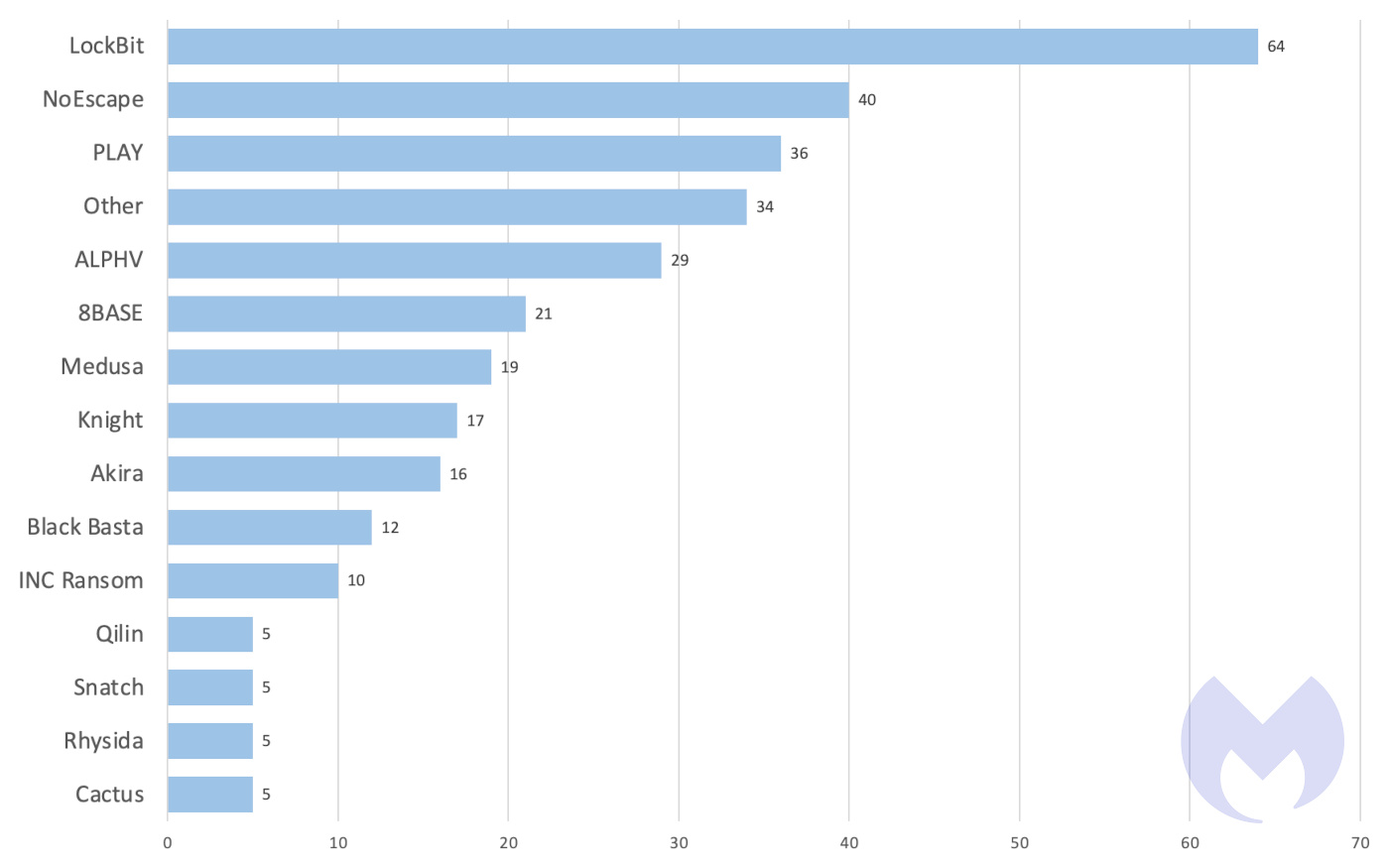
In October, 318 new victims were posted on ransomware leak sites. The top active gangs were LockBit (64), NoEscape (40), and PLAY (36). Major stories for the month included the takedown of several high-profile groups, including alleged Sony Systems attacker RansomedVC, new data shedding light on Cl0p’s education sector bias, and a deep-dive revealing the danger of the group behind September’s infamous casino attacks.
Last month three major ransomware groups—RansomedVC, Ragnar, and Trigona—were shut down, the first two by law enforcement and the third by Ukrainian hacktivists. Let’s dive into RansomedVC, a group which burst onto the scene in August and quickly gained notoriety for allegedly breaching several well-known companies. In late October, the lead hacker behind the group was seen on Telegram trying to sell the operation. Just days later, the account announced that it was “putting an end to” the group after learning that six of its affiliates may have been arrested. The group had posted 42 victims on their leak site at the time of their take down.
While law enforcement is yet to come forward confirming the RansomedVC arrests, the same is not true for RagnarLocker group, which Europol and Eurojust announced they had taken down last month. RagnarLocker started in 2019 and was responsible for numerous high-profile attacks against municipalities and critical infrastructure across the world. At the time of the takedown action, the group had posted a total of 42 victims on their leak site.
Trigona’s demise, on the other hand, was not at the hands of investigators but activists, highlighting the impact that broader geopolitical struggles can have on the ransomware landscape. In mid-October, the Ukrainian Cyber Alliance (UCA) breached the Trigona Confluence server and completely deleted and defaced their sites. Formed around 2016 to defend Ukraine’s cyberspace against Russian interference, the UCA used a public exploit for CVE-2023-22515 to gain access to Trigona infrastructure. Trigona is responsible for at least 30 attacks across various sectors since first emerging in October 2022.
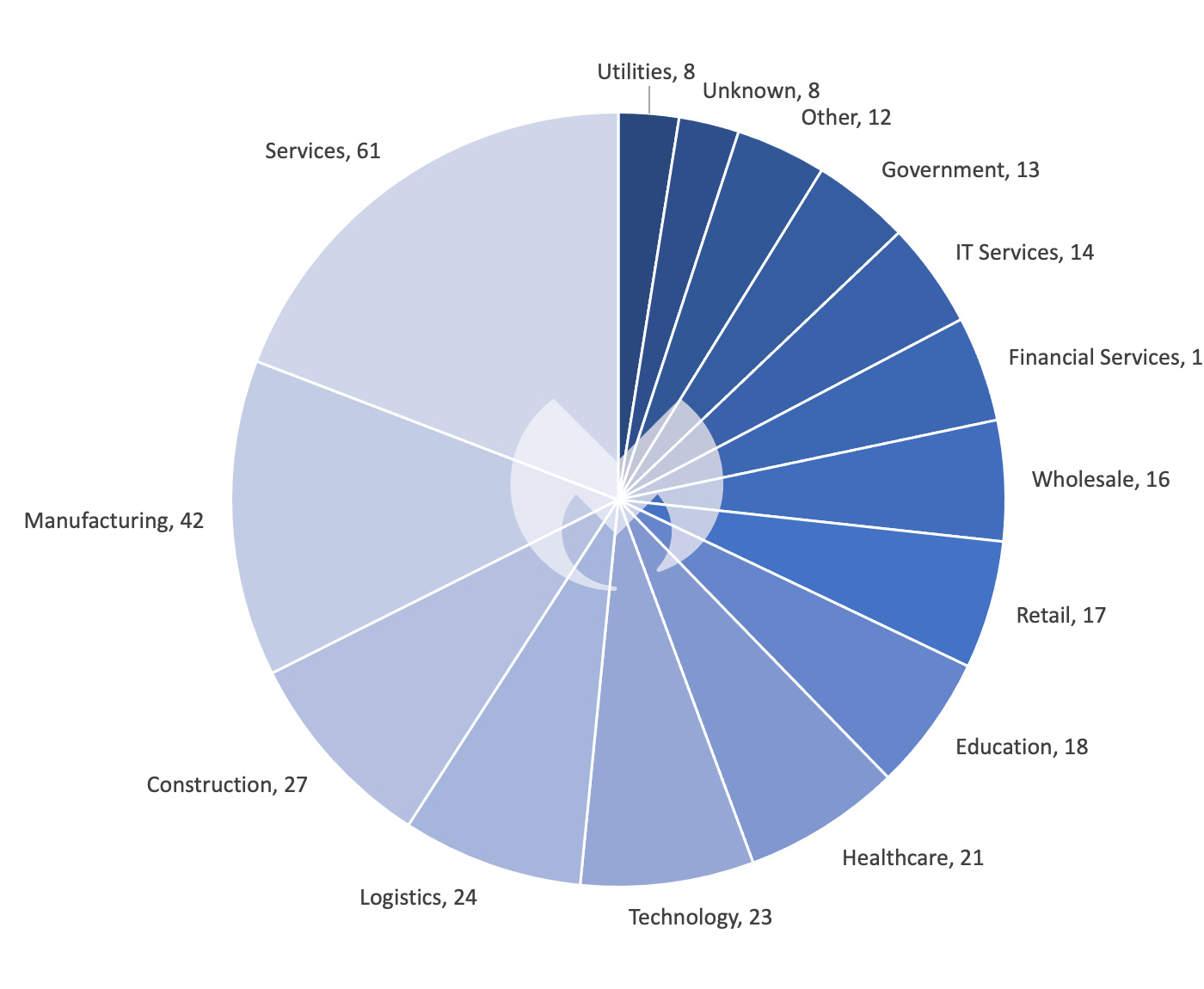
Known ransomware attacks by ransomware group, October 2023Known ransomware attacks by country, October 2023Known ransomware attacks by industry sector, October 2023
In other October news, Resilience, a cyber insurance company, reported that 48% of all MOVEit cyberattack victims in its client base during the first half of 2023 were from the education sector. This suggests a possible targeting preference of the Cl0p campaign towards educational institutions. However, this figure might not fully represent the situation.
For instance, if Resilience has a higher proportion of clients in the education sector, it could bias the data towards that sector. On the other hand, data from Malwarebytes indeed indicates that while the education sector comprises only 3% of all MOVEit hosts, they account for 6% of the victims. However, this trend is likely not due to a deliberate focus by Cl0p, whose attacks were more opportunistic in scope, but rather because educational sectors often have fewer resources to promptly address vulnerabilities like those in MOVEit. Thus, the bias observed is more circumstantial than intentional. At any rate, given that the education sector frequently relies on third-party applications like MOVEit, the impact of Cl0p’s activities serves as a stark reminder for these institutions to adopt robust third-party security best practices.
Microsoft’s deep dive into Scattered Spider last month shed new light on the relatively new, albeit dangerous, ransomware gang who made headlines in September for attacking MGM Resorts and Caesar Entertainment. For small security teams, one of the most important findings about the group is their use of Living Of The Land (LOTL) techniques to avoid detection: Scattered Spider employs everyday tools like PowerShell for reconnaissance and stealthily alters network settings to bypass security measures. They also exploit identity providers and modify security systems, blending their malicious activities with normal network operations.
With the success of groups like Scattered Spider increasingly relying on LOTL attacks, it’s vital for defenders to focus on detecting anomalous activities within legitimate tools and network configurations. Strengthening monitoring and analysis capabilities can help identify and counter the subtle, sophisticated techniques employed by these ransomware gangs.
New(?) player: Hunters International
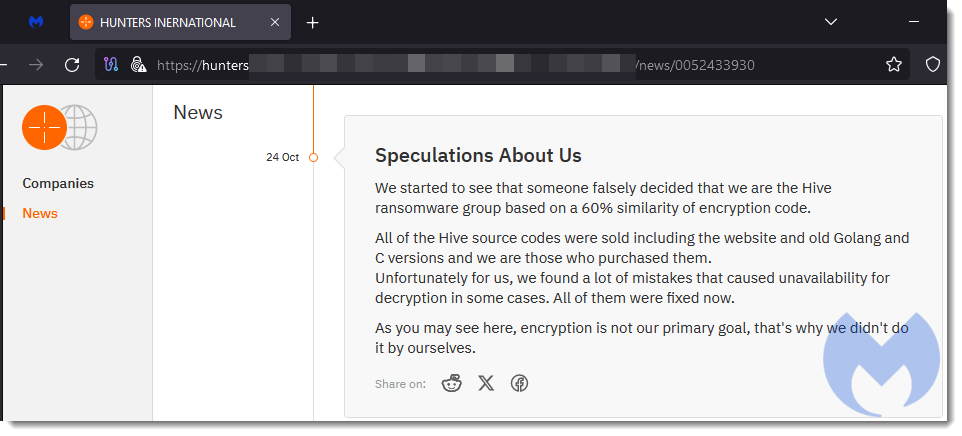
Hunters International is a new ransomware player suspected to be a rebrand of the Hive ransomware, which was shutdown in January 2023 by law enforcement. Despite Hunters International’s denial, claiming they are a distinct entity that purchased Hive’s source code, the overlap in their malware’s coding and functionality suggests a direct lineage from Hive.
Their activity, though limited, includes a notable attack on a UK school.
Prevent intrusions. Stop threats early before they can even infiltrate or infect your endpoints. Use endpoint security software that can prevent exploits and malware used to deliver ransomware.
Detect intrusions. Make it harder for intruders to operate inside your organization by segmenting networks and assigning access rights prudently. Use EDR or MDR to detect unusual activity before an attack occurs.
Stop malicious encryption. Deploy Endpoint Detection and Response software like Malwarebytes EDR that uses multiple different detection techniques to identify ransomware, and ransomware rollback to restore damaged system files.
Create offsite, offline backups. Keep backups offsite and offline, beyond the reach of attackers. Test them regularly to make sure you can restore essential business functions swiftly.
Don’t get attacked twice. Once you’ve isolated the outbreak and stopped the first attack, you must remove every trace of the attackers, their malware, their tools, and their methods of entry, to avoid being attacked again.
Our business solutions remove all remnants of ransomware and prevent you from getting reinfected. Want to learn more about how we can help protect your business? Get a free trial below.
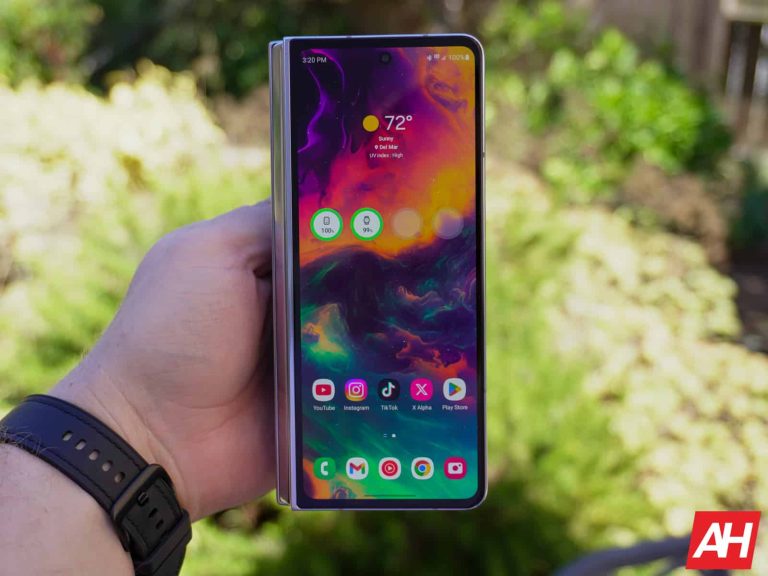
Samsung has released new updates for a bunch of Galaxy smartphones. The Galaxy Z Fold 5, Galaxy Z Fold 4, Galaxy Z Fold 3, Galaxy S20 FE, and Galaxy Note 10 Lite are all picking up new updates. While none are getting Android 14, the company is pushing the latest security patch to them. The November SMR (Security Maintenance Release) patches more than 60 vulnerabilities.
Samsung’s November update reaches Galaxy Z Fold 5 and more devices
A few days back, Samsung released the November security update for its recent foldables in the US. The Galaxy Z Fold 5, Flip 5, Fold 4, and Flip 4 all picked up the new security fixes. The firm later expanded the update for the Flip 5 to international markets. The Fold 5 and Fold 4 are now following suit. The former is getting the update globally with firmware version F946BXXS1AWJ2, while the latter is picking it up in Europe with build version F936BXXS4DWJ2.
Additionally, Samsung has released the latest security update for the Galaxy Z Fold 3. The 2021 foldable is getting the latest security fixes in Hong Kong and Taiwan with the firmware build number F9260ZSS4GWK2. The company will bring the update to other markets, including the US, in the coming weeks. Like its newer siblings, the Galaxy Z Fold 3 isn’t receiving anything more than the November SMR here.
The Galaxy S20 FE and Galaxy Note 10 Lite are the other two Samsung smartphones that recently started picking up this month’s security update. The 4G/LTE model of the former is receiving the new SMR in Latin America with the build number G780FXXSDFWJ8 (via SamMobile). That for the latter is N770FXXS9HWJ1, with the update available widely in Europe, the UK, Hong Kong, and Taiwan. The changelog is more or less the same as the foldables.
These two Galaxy phones won’t get Android 14
As of this writing, Samsung’s November update isn’t available for the Galaxy S20 FE 5G. However, it shouldn’t be long before the Korean behemoth covers all eligible units globally. The phone (including the LTE model) isn’t eligible for Android 14 though, nor is the Galaxy Note 10 Lite. The five foldable smartphones mentioned above will all get the new Android version along with Samsung’s One UI 6.0 custom skin.
The Korean firm is expected to push the big update to these phones and more before the end of the year. Newer models tend to get updates before the older ones, but this isn’t a hard-and-fast rule. As usual, you can check for new updates from the Settings app. We at Android Headlines will also keep you posted with Samsung’s Android 14 rollouts, so stay tuned.