After being apprehended by the US government, a Serbian citizen confessed to placing multiple orders on the Monopoly drugs market, which operates on the darknet.
The individual in question has admitted to engaging in the illicit purchase of drugs through this platform.
As per the evidence presented by the government, it has been revealed that Desnica, hailing from Smederevska Palanka, Serbia, conspired in 2019 to create and manage a website that would facilitate the sale of illegal drugs.
This website, which came to be known as Monopoly Market, gradually evolved into a massive online marketplace for peddling illicit narcotics products.
During the year 2021, law enforcement agencies in the United States placed several orders for drugs through the popular board game, Monopoly. These orders were made to various suppliers and totaled more than 100 grams in quantity.
DocumentProtect Your Storage With SafeGuard
StorageGuard scans, detects, and fixes security misconfigurations and vulnerabilities across hundreds of storage and backup devices.
According to the FBI’s investigation, Monopoly was involved in facilitating the illegal sale of drugs worth more than $18 million to customers all around the world.
Shockingly, the banned drugs weighing over 30 kilos were also sold to consumers in the US.
After conducting a thorough investigation, it was discovered that a woman named Desnica was operating a monopoly.
Further information revealed that Desnica was extradited from Austria to the United States on June 23, 2023, to face charges relating to her involvement in narcotics trafficking.
The Justice Department’s Office of International Affairs went to great lengths to provide significant assistance and support in the efforts to ensure Desnica’s arrest and extradition from Austria.
Their unwavering commitment to justice and cooperation with international authorities played a crucial role in the successful resolution of this case.
Patch Manager Plus, the one-stop solution for automated updates of over 850 third-party applications:Try Free Trial.
Cambodian government entities were discovered to be targeted and compromised by Chinese APT actors.
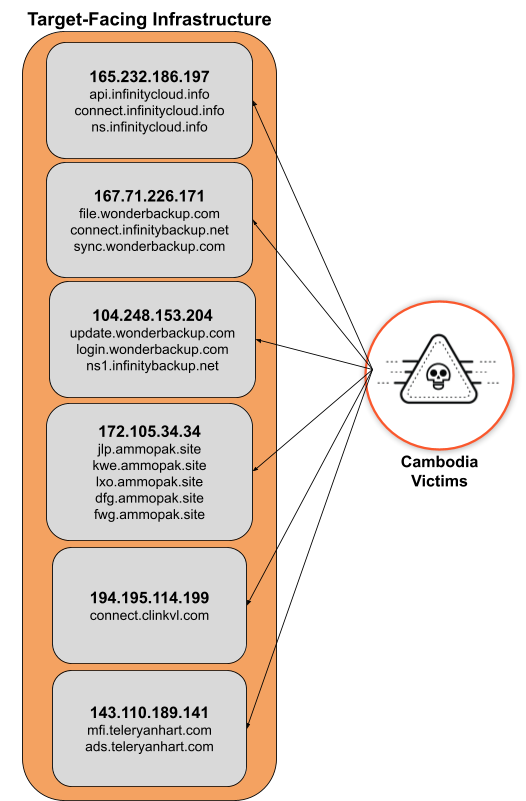
The threat actors are using the infrastructure to masquerade as a cloud backup service. The infrastructure also exhibits several malicious nature and persistent connections.
China has recently invested in a project to modernize Cambodia’s Ream Naval base, which was initially stopped by both countries. This created a controversy among the Western Nations.
Chinese APT Mimics Cloud Backup
A malicious SSL certificate was found to be used by six facing IP addresses, each of which had several host domains linked with six domains.
On further analyzing the names of the domains, they were found to be masquerading as cloud storage services.
Since these domains provide a sense of legitimacy to their names, they draw an unusual amount of traffic during high levels of activities like data exfiltration from the victim network.
Source: Palo Alto Unit 42
Nearly 24 Cambodian government organizations were found to be regularly communicating with this infrastructure between September and October 2023.
DocumentProtect Your Storage With SafeGuard
StorageGuard scans, detects, and fixes security misconfigurations and vulnerabilities across hundreds of storage and backup devices.
These organizations provide critical services, which include National Defense, Election oversight, Human rights, National treasury and finance, Commerce, Politics, Natural resources, and Telecommunications.
Golden Week in China
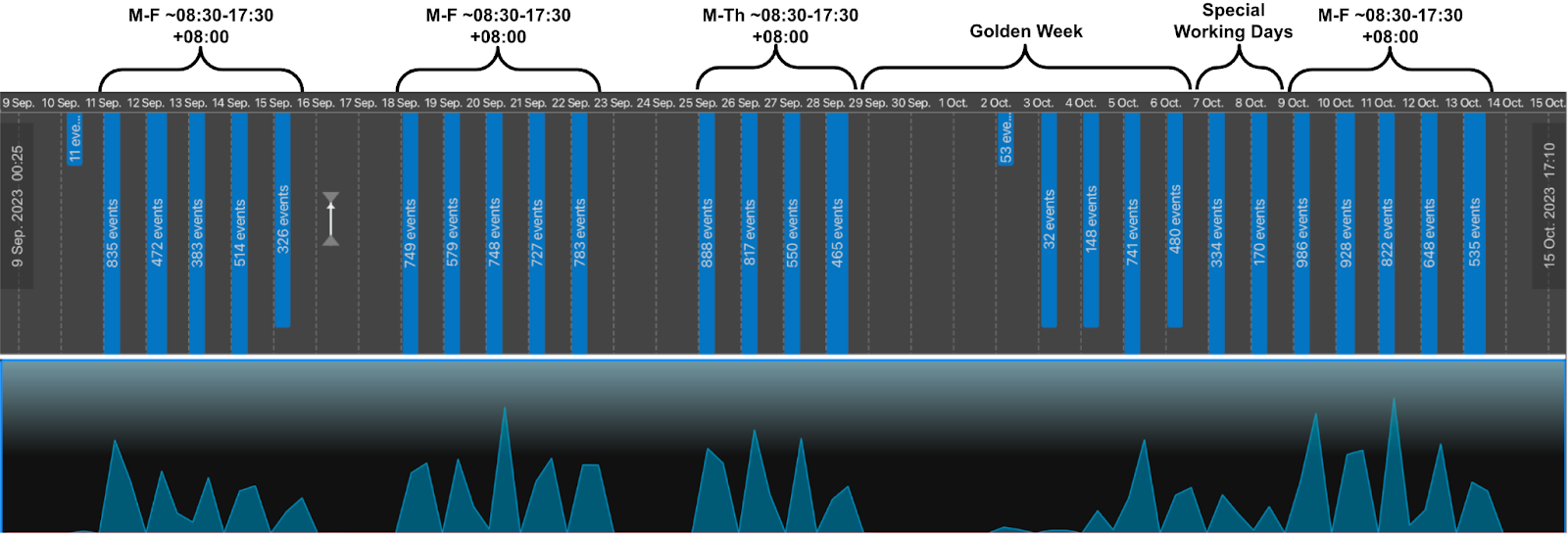
Further investigating the infrastructure, the threat actor was found to be doing their activities between 8:30 and 17:30 UTC +08:00 (China Standard Time) on Weekdays (Mon to Fri). There is also a suspicion that the threat actor is trying to blend in with Cambodian business hours.
However, the threat actor’s activity between September 29 and October 8, 2023, confirmed that the threat actor is based out of China.
China’s Golden Week starts on September 29 and ends on October 6, 2023, whereas Oct 7 and 8 are designated as “Special Working Days”. These days were aligned with low amounts of activity through the week of Oct. 2-8 from the threat actor confirmed the suspicion.
Source: Palo Alto Unit 42
A complete report about the threat actors’ activities has been published, providing detailed information about the compromise, Cambodian government entities, and other information.
IBM has recently announced the launch of its Cloud-Native SIEM solution, which is designed to enhance the scale, speed, and flexibility of security teams.
With this new offering, organizations can benefit from improved threat detection and response capabilities, empowering them to better protect their digital assets and stay ahead of potential cyber-attacks.
IBM Security helps secure the world’s largest enterprises and governments with an integrated portfolio of security products and services infused with dynamic AI and automation capabilities.
With an extensive security research, development, and delivery organization, IBM has established itself as a leading global player in the security domain. Its worldwide presence enables it to monitor over 150 billion security events each day across 130+ countries, keeping a vigilant eye on potential threats.
IBM’s commitment to innovation is reflected in its impressive portfolio of 10,000+ security patents that have been granted worldwide.
The report highlights the challenges of securing the cloud, which has a complex attack surface to defend against. The IT industry faces difficulty in detecting and identifying threats in this environment, making it a challenging task.
DocumentProtect Your Storage With SafeGuard
StorageGuard scans, detects, and fixes security misconfigurations and vulnerabilities across hundreds of storage and backup devices.
In reality, a recent global survey found that less than half (49%) of the alerts that SOC specialists are expected to check during a typical workday are reviewed.
Cloud-Native QRadar SIEM
With the aid of the new cloud-native QRadar SIEM, security teams can optimize their resources to the fullest extent, efficiently identifying and responding to security threats in real-time.
It’s meant to design and improve the job of security analysts by using artificial intelligence to do repetitive tasks so that they may focus on finding and responding to critical security issues.
“Our new cloud-native SIEM is a core element of IBM’s mission to usher in the next generation of security operations, built for the hybrid cloud and AI era,” said Kevin Skapinetz, Vice President of Strategy and Product Management, IBM Security.
Notably, it is designed to reduce the complexity of security technology and simplify the user experience.
Additionally, it is designed by the Red Hat OpenShift and QRadar SIEM, allowing deeper interoperability to Harness security community detections and investigate across data sources, Deep Partner Network.
IBM also plans to release Generative AI in early 2024 to advance SOC productivity to better security and perform higher work like:
Apple has always been against allowing iPhone users to sideload apps on the iPhone. Sideloading is when apps from a third-party app store are downloaded on a phone. Google allows Android users to do this, but Apple has not thus earning it the “walled garden” nickname. Apple claims that apps installed on the iPhone from a third-party app store could contain malware or other security issues and since Apple can’t vet apps not downloaded from the App Store, it believes that it is better to just not allow it.
Another reason why Apple doesn’t want to allow sideloading on the iPhone is to prevent developers from listing their iOS apps on a third-party app store as a way to get around paying Apple as much as 30% of their in-app revenue. Since the App Store is the only official iOS app storefront, there is no way to escape the so-called “Apple Tax” unless a developer stops accepting in-app purchases.
Third-party Amazon Appstore for Android
The EU’s Digital Markets Act (DMA) says that mobile device users should be able to install apps from third-party stores. Earlier this year, Bloomberg’s man on the Apple beat Mark Gurman said that Apple would allow sideloading but only in the 27 countries that are members of the EU which would limit any damage caused by malicious apps. It would also provide Apple with some real-life data to see whether it should allow sideloading in other markets.
9to5Mac has discovered that the iOS 17.2 beta contains internal code that would give third-party apps permission to have other apps installed. With this capability, developers would be able to create their own third-party iOS app storefront. The code also has a region lock which would allow Apple to restrict sideloading to specific countries. This makes sense if Apple is forced to allow sideloading by the DMA.
Burp Suite 2023.10.3.4 is the name of the newest version of Burp Suite, which was just published by the PortSwigger developers.
The Burp Suite is a cybersecurity tool that is used for evaluating the security of online applications. It performs the role of an intercepting proxy and enables users to see and alter the traffic between a web browser and the application that focuses their attention.
Burp Suite helps identify and address security vulnerabilities, such as:-
It also helps identify other common web application flaws, making it an essential tool for ethical hackers and security professionals.
DocumentProtect Your Storage With SafeGuard
StorageGuard scans, detects, and fixes security misconfigurations and vulnerabilities across hundreds of storage and backup devices.
What’s New?
The latest version of Burp Suite includes Bambdas, a filter for HTTP requests that can be customized using Java code snippets. Additionally, subdomains may be added to the target scope, TLS passthrough can be enabled for out-of-scope objects, and BChecks can be exported.
Here below, we have mentioned all the new additions:-
Advanced HTTP history filtering using Bambdas: Customize Burp Suite with Bambdas with the help of small Java code snippets now available in Proxy > HTTP history. Filter your HTTP history for precise results, eliminating noise. Try Bambdas in Proxy > HTTP history tab for a tailored experience.
Exporting BChecks: Easily share BChecks across Burp instances by exporting selected ones. See their GitHub repository for BChecks from PortSwigger and the Burp Suite community.
Increased support for notes throughout Burp: PortSwigger expands notes, allowing you to record key info on tabs for easy access later. Notes copy between tabs and tools for seamless use. Use the sidebar’s Notes panel to add and access notes efficiently.
TLS passthrough for out-of-scope items: Optimize performance by applying TLS passthrough for out-of-scope items in the target scope settings. It’s enabled automatically when choosing to Stop logging out-of-scope items.
Include subdomains in target scope: Expand target scope by including subdomains of selected hosts. Check ‘Include subdomains’ in Target > Scope settings to activate.
Improved Task details dialog:
Replaced the Details tab with Summary for easier navigation.
Includes critical vulnerabilities, task progress, and real-time task log.
New Issues tab lists all scan findings.
Renamed Issue activity to Audit log.
Easily view further details in the Event log with a single click.
Checks Grammar Enhancements:
A removing query_string action that removes an entire query string from a request.
A new variable that returns Burp’s User-Agent header.
A new pre-defined variable called insertion_point_base_value contains the base value of the current insertion point.
A new per-path BCheck template that you can base your checks on.
BChecks can now return more than one issue.
Developers have also updated the grammar version to v2-beta.
Other Improvements
After a scan, the Burp Scanner checks the Collaborator server every minute for 10 minutes, then reverts to 10-minute intervals.
Besides this, the instant out-of-band interactions are now reported faster. Burp’s built-in browser upgraded to version:-
119.0.6045.123 on Mac/Linux
119.0.6045.123/.124 on Windows
You can download the lastest version of Burp Suite Here.
Patch Manager Plus, the one-stop solution for automated updates of over 850 third-party applications:Try Free Trial.
The Google vs Epic trial has been an insightful peek into Google’s business, and now it looks like Google CEO Sundar Pichai is set to testify in the trial starting next week. The trial has been going on for just the past few days and already the public has learned quite a bit. Most recently Epic’s rejection of a nine-figure deal offered by Google. The deal Epic claims was an attempt by Google to stall what it thought would be a mass exodus of other big publishers. Following Epic’s choice to avoid launching Fortnite on Google Play.
Epic also claims that Google has repeatedly destroyed evidence to keep that evidence out of the courtroom. This could be a topic brought up when Pichai takes the stand. In addition to Epic’s claim about destroying evidence, Google has been accused by the US Justice Department of setting internal chats to automatically delete conversations when finished. The claim by the DOJ is part of a separate trial focused on Google’s alleged operation of an illegal monopoly over the search market.
Whereas the trial with Epic is about Google operating an illegal monopoly through Google Play.
Google CEO Sundar Pichai expected to testify on Tuesday
According to a report by The Verge, Pichai is set to take the stand on Tuesday. Google hasn’t confirmed Pichai’s involvement in the trial via testimony. However, it’s noted that Google requested the use of a podium for Tuesday which suggests that Pichai will be testifying. As he had need of one in a previous testimony during the trial with the DOJ.
Pichai is also on Epic’s witness list. So it was already suspected that he may end up taking the stand at some point before Epic’s side of the trial was finished. It’s not entirely clear if Pichai will be called to testify next week. But it seems likely. And it would make sense given his role as CEO. Not to mention how much he would have been involved in decisions that could have led to this trial.
Epic has been lobbying against Google’s Play Store efforts for years now. Claiming the company has used its money and means to prevent healthy competition for another app store on Android. A big part of Epic’s complaint is Google’s 30% cut of in-app purchase fees. Which it has argued are no longer the industry standard.
In early 2022, multiple companies joined forces to challenge the “app store tax” imposed by Google and Apple. Epic Games, the brains behind Fortnite, is currently battling Google in court. They claim that the Google Play Store is a monopoly. Epic is demanding that Google permit payment processing from sources other than Google and reduce the burden of paying nearly 30% of earnings to the tech giant. Recent disclosures from Google’s attorney, Glenn Pomerantz, show that Google has been playing favorites in regard to its app store fees. Pomerantz disclosed Google has a secret agreement with Spotify, enabling the music streaming giant to pay less than other apps.
This legal battle is the culmination of numerous companies urging Apple and Google to slash the fees they levy on app revenues. Google unveiled a pilot program with Spotify in early 2022, named User Choice Billing, that allowed circumvention of Google Play billing on Android. With this, apps gain the flexibility to handle payments independently. Currently operational in 35 countries, Bumble was the second major app to join the program. However, the exact amount Google still pockets from User Choice Billing remains unknown.
Initially, developers were led to believe that User Choice Billing would lower rates by a flat four percent
During the Epic Games vs. Google trial, Google’s attorney pleaded with the judge to withhold the Spotify figures in an upcoming exhibit, citing potential harm to ongoing negotiations with other parties. Pomerantz emphasized, “Disclosure of the Spotify deal would be very, very detrimental for the negotiation we’d be having with those other parties.”
Epic Games’ attorney countered, asserting, “There is a rate set much much lower than the rates you’ve been hearing about at trial, and that is going to be an important part of what you’re going to be hearing about.” The exact figures, however, have yet to be publicly disclosed.
Epic initiated the lawsuit before the User Choice Billing program kicked off but remains adamant that the program is a “sham.” They contend, “The economic terms of the proposal that we are aware of based on public information — in our view, this is not a real option for developers.”
Reports indicate that Bumble, the second major adopter of User Choice Billing, did not secure any secret agreement with Google. Their Q3 2023 earnings call revealed, “As a percentage of revenue, cost of revenue was 29 percent versus 27 percent in the year-ago period, mostly due to higher App Store fees as a result of compliance with the Google Play mandate.”
As the Epic vs. Google lawsuit unfolds, the jury will determine whether Google’s fees are monopolistic and unjust. However, it should not be shocking that big tech players are making behind-the-scenes deals. Unfortunately, it leaves smaller developers stuck with the high fees set by Google.
The OnePlus 12’s release is getting closer every day and a new rumor suggests the camera could be similar to the one on the OnePlus Open. The OnePlus Open has been well-received by critics and consumers alike, and it has given the Samsung Galaxy Z Fold 5 some serious competition.
One of the things that makes the OnePlus Open so impressive is its camera. Notably, a similar sensor is expected to be used in OnePlus 12 camera setup.
OnePlus 12 camera could be similar to OnePlus Open, Oppo Find N3
OnePlus joined hands with Sony for the latter’s camera sensors for its flagship phones, including the OnePlus Open. The debut foldable comes with an LYT-T808 sensor for its primary camera. Similarly, the next flagship— the OnePlus 12 is likely to feature a similar Sony-manufactured lens.
The Chinese phone maker has shared more details about the OnePlus 12 camera setup on Weibo. The sensor is dubbed “LYT-808” and it is expected to power up the next flagship.
OnePlus notes that the LYT-808 and LYT-T808 sensors are essentially the same, but the LYT-T808 is designed specifically for foldable smartphones. Notably, both, the OnePlus Open and Oppo Find N3 sport an LYT-T808 camera sensor. Both sensors are said to have excellent imaging capabilities.
Additionally, OnePlus has also shared other key details of the OnePlus 12’s camera. Aside from the new Sony LYT-808 sensor, it will also feature a 64MP periscope camera with a ½-inch sensor, OIS, f/2.6 aperture, and 3x optical zoom. The rear cameras also come equipped with Hasselblad.
What else to expect from OnePlus 12
The OnePlus 12 will most likely house a Snapdragon 8 Gen 3 chip. It could also include a Pro XDR display with 2K resolution and previous reports suggest that BOE could produce it. The peak brightness could be 2,600 units.
GSMArena recently reported that it could also equip at least 12GB RAM and up to 24GB models. Subsequently, it will run Android 14-based Oxygen OS 14 out of the box. Other rumors point to a 5,400mAh battery with support for 100W wired and 50W wireless charging.
With the leaked specifications and never-ending rumors, the upcoming flagship looks promising. The OnePlus 12 is expected to launch in early January 2024, with China likely to see it first. Other markets would follow shortly after most likely.
When it comes to keeping an online presence, privacy and security is paramount. But you might be unaware of how much of your personal information and data is actually floating around online. And all it takes for someone to get a hold of that data is for them to purchase that information from data brokers, such as people search sites. Luckily, the folks at Incogni are here to help ensure that that doesn’t happen. Ultimately helping you take back control and remove your personal information from the internet so you can keep your data private and secure. Before we get into how you can remove your personal information from the internet though let’s break down what’s actually happening.
Who or what are data brokers?
Data brokers are individuals or sometimes organizations who acquire loads of personal information and then sell it off to other unknown organizations for profit. This information can be gathered through a number of different means. Some of your data is freely available online through social media sites. Of course this all depends on what and how much of that information you share. The less you share then potentially the less there is to snatch up.
Data brokers can also acquire your personal information from publicly available sources. Or by purchasing it. And that information can be gathered by simply using other sites where you do give the information freely. So even if you share less information openly, that doesn’t necessarily mean that it isn’t still online for brokers to get their hands on.
The reality is that if you use any sort of websites or services online, there is a chance that one or some of them may be selling your data off to brokers. Who can then turn around and sell it to someone else. Which is likely something you wouldn’t consent to if you were asked. This is where Incogni comes in. They deal with data brokers on your behalf and get your information back.
What are people search sites?
These are just a type of data broker. People search sites will scrape the internet for information that can be acquired publicly as a means to help build profiles on you. Once they have compiled enough personal information they then sell those records to people who want to purchase it from them. There are tons of sites out there like this. Especially in the US as there aren’t any federal laws on data protection. Sites like BeenVerified and Intelius are two good examples of a people search site.
What do data brokers do with your data?
Lots of things. The possibilities aren’t endless but there are multiple opportunities for brokers to make a profit off of your personal information. Perhaps the biggest opportunity would be selling your information to marketing or advertising agencies. Where you then get bombarded with targeted ads.
Another possibility is selling that information off to people search sites. You may or may not have heard of or encountered these personally before. But they’re out there. And people can then pay a fee to find information about you for whatever reason. Data brokers can sell your information to these sites who then charge a fee to strangers. Basically anyone who might have an interest in getting a hold of your personal information.
A worrying thought. Another possibility is gathering your information for Human Resources teams for a company you may be applying for a job at. You get the picture. And the point is your data should be yours and yours alone unless you have consented to having it made available.
What kinds of data or information do brokers acquire?
Unfortunately, all kinds. This can include but isn’t limited to your name, address or addresses, email, phone number, age, gender, education, financial details, your employment history, relatives, and even social security number. Essentially all kinds of information you don’t want just anybody having access to.
How to remove your personal information from the internet
Believe it or not it is possible to do this without any outside parties. More specifically you can get this all done by yourself. But the process might not be that simple or it may take more time than you’re willing to put in. If you’re the type of person who will stick it out then here’s what you can do.
For starters, you’ll need to figure out every search site or broker that has your information. You can usually do this by searching your name on Google and adding other pieces of identifying information to the query to narrow things down. That’s where the time commitment comes in. And depending on how many places your information is available, the time needed to locate every search site or broker may be a while.
Naturally the next thing you would need to do is make a request from those places to take your information offline. Which you may or may not be successful in depending on how willing these places are to work with you. Then you have to worry about whether or not your information is reacquired down the line.
Let Incogni handle the headache
You could do all the above yourself if you’re diligent. Or you could take the easy route and let Incogni do the work for you.
The fact of the matter is there isn’t really much that can be done about keeping your information off of people search sites or other data broker datacenters for good. At least not in the way that you may think. As mentioned earlier data brokers and people search sites can reacquire your information in the future. Very likely using the same methods as before. However, Incogni will routinely check to make sure your information is left off of these sites.
Incogni is a subscription service, and what the service gets you is making sure your personal information stays private. As long as your subscription is active, Incogni will check these sites periodically to make sure that the information hasn’t been put back up. If it has, it’ll ensure it gets taken back offline.
Even better is that right now Incogni is offering a 55% discount on the annual subscription for Black Friday by using the code “ANDROID” at checkout. Moreover, with the added benefit of a 30-day money-back guarantee, there’s no downside to giving it a shot and experiencing firsthand what Incogni can offer you.
How to protect your personal information going forward
There are lots of things you can do but one that people may not think of a lot is just to be more aware of what it is you’re putting online. With social media being so prevalent in people’s lives these days it’s not surprising that a lot of users will share all kinds of details about their personal lives. So your first step to protecting your personal information going forward should be to just share less information. Or at the very least share less important personal information.
You could also consider using a VPN service like Surfshark to ensure that your browsing is secure and kept private. A VPN or virtual private network essentially paves you a special highway for your data to travel on as you use the internet. Your data is also encrypted so it stays safe. And it hides your IP address so you can browse with more peace of mind. Coincidentally, they’re also great for accessing region-specific content on services like Disney+.
In addition to these things it’s important to be more aware of possible phishing scams via email or text messages. Don’t click links from unknown sources. On the same token, don’t download files from contacts or sources you don’t trust. As these can lead to phishing your personal information.
The OnePlus Open managed to impress a lot of people since its launch, and that includes us. This is one of the best foldable smartphones around at the moment, and we’ve already compared it to the best Samsung and Google have to offer. What about Xiaomi, though? In this article, we’ll compare the OnePlus Open vs Xiaomi MIX Fold 3. These two devices are the best foldable smartphones OnePlus and Xiaomi have to offer at the moment.
One thing to note, before we get started, is that the Xiaomi MIX Fold 3 was not released globally. If you want to use it, you’ll need to import it from China, and sideload Google services, which is fairly easy. Having said that, we’ll first list the specs of both smartphones, and will then move to compare them across a number of different categories. Including their designs, displays, and more.
Both of these have frames made out of aluminum, and they also come in a couple of different backplate variants. The OnePlus Open is available with glass and vegan leather backplates. The Xiaomi MIX Fold 3 utilizes glass and aramid fiber, depending on the model. Non-glass models of both smartphones are grippier, needless to say. Both of these devices are book-style foldables, and both of them are quite thin.
The OnePlus Open is shorter than the Xiaomi MIX Fold 3, while the two phones are about equally as wide in both folded and unfolded states. The Xiaomi MIX Fold 3 does have slightly larger displays, just for comparison’s sake. Xiaomi’s handset is also slightly thinner than OnePlus’, but not by much. The two variants of the OnePlus Open weigh 239 and 245 grams, while the Xiaomi MIX Fold 3 is available in 255 and 259-gram variants, depending on the model. So they’re actually not that heavy, considering these are book-style foldables we’re talking about.
There is a single display camera hole on all displays here, all four of them. The bezels around the displays are rather thin on both smartphones. The real design difference is visible on the back. The OnePlus Open has a large camera oreo back there, while the Xiaomi MIX Fold 3 includes a rectangular camera module. The hinge is hidden on both smartphones when they’re unfolded.
Both devices feel good in the hand, but have different in-hand feel. The OnePlus Open is IPX4 rated for splash resistance, while you won’t find any such rating on the Xiaomi MIX Fold 3. Both smartphones do feel premium, and offer a good folding/unfolding experience, though we prefer the one on the OnePlus Open.
OnePlus Open vs Xiaomi MIX Fold 3: Display
The OnePlus Open features a 7.82-inch 2268 x 2240 Foldable LTPO3 Flexi-fluid AMOLED display on the inside. That is the phone’s foldable panel. It can project up to 1 billion colors, and has Dolby Vision support. It also supports a 120Hz refresh rate. This panel goes up to 2,800 nits at its peak. The cover panel on the phone measures 6.31 inches, and it’s a 2484 x 1116 LTPO3 Super Fluid OLED display. This display also projects up to 1 billion colors, has Dolby Vision support, and has the same peak brightness as the main one. It also supports a 120Hz refresh rate. The cover panel on the phone is protected by the Ceramic Guard.
On the flip side, the Xiaomi MIX Fold 3 features an 8.03-inch 1916 x 2160 Foldable LTPO OLED+ panel. That display has a 120Hz refresh rate, and can project up to 1 billion colors. It also supports HDR10+ content, and Dolby Vision too. The peak brightness on this panel is 1,300 nits. The cover display measures 6.56 inches, and has a resolution of 2520 x 1080. This is an AMOLED panel with a 120Hz refresh rate, and supports HDR10+ content, and Dolby Vision. The peak brightness on this panel is 2,600 nits, and this display is protected by the Gorilla Glass Victus 2.
All four of these displays look great on paper, and the same goes for actual real-life usage. They’re very vivid, very sharp, and have good viewing angles. The blacks are also quite deep, as you’d expect them to be. Neither panel is too reflective either. The OnePlus Open does have one glaring advantage here, though. Its main display gets a lot brighter than the one on the Xiaomi MIX Fold 3. Yes, you will notice that difference, easily, especially when using the device outdoors in direct sunlight.
OnePlus Open vs Xiaomi MIX Fold 3: Performance
Both of these phones are fueled by the same chip, the Snapdragon 8 Gen 2 by Qualcomm. The Snapdragon 8 Gen 3 is out, technically, but it launched just recently (based on the time of publishing this comparison), and the Snapdragon 8 Gen 2 is still immensely powerful. It was the best chip on offer at the time these two phones were made. The OnePlus Open includes 16GB of LPDDR5X RAM and 512GB of UFS 4.0 flash storage. That’s the only model. The Xiaomi MIX Fold 3, on the flip side, includes 12GB or 16GB of RAM, and has several different UFS 4.0 storage options.
So, on paper, both of these smartphones are immensely powerful. Do they show it in day-to-day performance? Well, yes, very much so. You’ll get a very smooth experience on both smartphones, as you’d expect from flagship devices. Their software iterations are immensely different, though, so take note of that. Neither is close to stock Android, but both are full of customization options and work well. Both smartphones can multitask without a problem, and even have some special features for foldables. We do prefer the OnePlus Open’s implementation of multitasking, though.
When it comes to games, you can run pretty much any game from the Google Play Store on these two phones. They’ll handle those games without a problem, and won’t even get too hot while at it.
OnePlus Open vs Xiaomi MIX Fold 3: Battery
A 4,805mAh battery sits inside the OnePlus Open, while a 4,800mAh battery is included in the Xiaomi MIX Fold 3. Thanks to the Snapdragon 8 Gen 3, and whatever optimizations the two companies did, both smartphones do offer great battery life. Getting over the 7.5-8 screen-on-time mark is possible, that’s for sure. It will, of course, depend on how you use your phone, your signal strength, and so on.
In our experience, though, getting over the aforementioned limit is not a problem at all. That is achievable with mixed usage of the main and cover display, and without gaming, at least that was the case for us. Plenty of browsing, messaging, multimedia consumption, emailing, image editing, and so on, was included in that usage. They do offer good battery life, but your mileage may vary, of course.
What about charging? Well, the OnePlus Open supports 67W wired charging, and reverse wired charging too. It does include a charger in the box. The Xiaomi MIX Fold 3, on the other hand, supports 67W wired, and 50W wireless charging, while it also includes a charger in the box. Xiaomi’s handset has the upper hand here, due to wireless charging. If you don’t care much about it, however, the OnePlus Open is on the same level in terms of wired charging speed. You can get a full charge on either side in about 40 minutes.
OnePlus Open vs Xiaomi MIX Fold 3: Cameras
The OnePlus Open includes three cameras on the back, while the Xiaomi MIX Fold 3 has four. A 48-megapixel main camera sits on the back of the OnePlus Open, along with a 48-megapixel ultrawide unit (114-degree FoV), and a 64-megapixel periscope telephoto camera (3x optical zoom, 6x hybrid zoom). The Xiaomi MIX Fold 3, on the other hand, has a 50-megapixel main camera, a 12-megapixel ultrawide unit (120-degree FoV), and two 10-megapixel telephoto units (one offers 3.2x optical zoom, the other 5x optical zoom).
OnePlus also has a partnership going on with Hasselblad, while Xiaomi partnered up with Leica. Their expertise is visible in the pictures provided from both smartphones. Both camera setups are really good, and both do provide great results. The OnePlus Open loves to take contrasty shots, and it has outstanding colors in them, which is where Hasselblad’s influence is visible. The Xiaomi MIX Fold 3 does saturate images, but not too much, just enough to make them look nice and sharp. The styles are different here, and you can also choose to shoot in Leica Authentic mode on the Xiaomi MIX Fold 3, which will bring that vignetting effect to images, and make them look rather unique. Both smartphones handle HDR situations really well, and the same goes for low light.
That quality does transfer over to ultrawide and telephoto shots too, though we prefer those from the OnePlus Open. They do seem to provide more details, more often than not, while we do like the colors more as well. Both smartphones are quite capable in the video department too, though they’re not the best out there.
Audio
Both smartphones do have stereo speakers. The ones on the OnePlus Open are Dolby Atmos enhanced, while the Xiaomi MIX Fold 3 includes Harman Kardon-tuned speakers. The sound coming from both smartphones is quite pleasing and balanced, but the speakers on the Xiaomi MIX Fold 3 are a bit louder.
You will, however, not find an audio jack on either of these two smartphones. You’ll have to utilize their Type-C ports in order to achieve wired audio connections. Alternatively, both smartphones offer Bluetooth 5.3 for wireless connectivity.