Top 10 SaaS Security Checklist in 2023

0
[ad_1]

Software as a Service (SaaS) security refers to the measures and practices employed to protect SaaS solutions’ data, applications, and infrastructure.

SaaS is a cloud computing model where software applications are hosted and delivered over the internet, rather than installed and run on individual devices or servers.

While SaaS offers numerous benefits, such as scalability and accessibility, it also introduces security challenges that organizations must address to safeguard their data and maintain compliance with regulatory requirements.

The software under this architecture is hosted centrally, with the service provider responsible for everything from database management to network administration to availability checks and infrastructure maintenance.

Data is often kept on centralized servers spread across numerous data centers and accessed by users via a web interface.

SaaS typically employs multi-tenancy, a deployment model in which a single software instance serves numerous customers whose data and settings are isolated.

Virtualization, load balancing, and backup storage are all part of this architecture’s strategy for delivering scalable, dependable, and readily available software solutions on demand.

Following the SaaS security checklist helps you understand the blind spots and focus on securing your SaaS apps and data.

Why is SaaS Security important?

Software as a service (SaaS) applications frequently deal with sensitive data, ranging from personal information to confidential corporate details, making SaaS security essential. 

Due to their internet-based nature, these apps are vulnerable to data theft and denial-of-service attacks.

 Data loss, financial consequences, legal issues, and reputational harm are all possible outcomes of a hacked SaaS service. 

In addition, due to the shared nature of SaaS’s basic infrastructure, a single vulnerability might affect several users. 

Moreover, while convenient, attackers may easily exploit SaaS due to its reliance on centralized data storage. Robust security for SaaS protects users and inspires confidence in the digital economy overall.

 It’s also a legal need for many businesses. Therefore, SaaS providers must place a premium on security to preserve credibility, safeguard customers, and guarantee the smooth running of operations.

To Protect Your SaaS Apps and data, Download the free Enterprise SaaS Security Technical Guide here.

Challenges and Risks for Security in SaaS

SaaS’s cloud-based, sharing nature (Software as a Service) raises security concerns and hazards. 

SaaS security checklist – Challenges and Risks
Data breach risk is significant since SaaS services are easily breached due to centralized storage. 
The multi-tenancy framework might cause data leakage if clients are not adequately segregated.
Data breaches might occur due to insufficient access restrictions, and when using third-party infrastructure, you have to put your faith in their safety precautions. 
SaaS Insecure Application Programming Interfaces APIs, which might open them to cyberattacks if they are not properly secured. 
Due to an increasing number of off-site data storage, often in separate countries, ensuring continued regulatory compliance is a challenging task.
Document
Get a Free Demo

DoControl provides a unified, automated and risk-aware SaaS Security Platform (SSP) that secures business-critical applications and data.

Top SaaS Security Checklist 2023

  • Deploy a trusted SaaS Security Vendor
  • Data Encryption
  • Regular Security Audits
  • Multi-factor Authentication (MFA)
  • Set Identity and Access Management Rules
  • Data Backups and Disaster Recovery
  • Secure Application Development
  • Endpoint Security
  • Training and Awareness
  • Monitor and Alert

Deploy a trusted SaaS Security Solutions

 DoControl SaaS Security Platform

Employee Leading SaaS security vendors such as DoControl offer a SaaS Security Platform (SSP) that protects business-critical apps and data by being unified, automatic, and aware of the risk.

By working with DoControl, you can reduce risk, stop data breaches, and deal with insider threats without slowing down business support.

Businesses of all sizes frequently rely on DoControl to secure their most sensitive SaaS apps and data.

Through OAuth, oControl compiles a complete list of authorized and unauthorized SaaS applications, users, external collaborators, assets, third-party websites, and more.

Full visibility and data are provided for security audits, off-boarding suppliers, proving compliance, and responding to incidents.

DoControl’s 2023 SaaS Security Threat Landscape Report(Download) finds that 50% of enterprises and 75% of mid-market organizations have exposed public SaaS assets.

Short Features:

  • Unified Data Access Controls: DoControl uses a centralized system to regulate access to all your data across all your SaaS applications, and high-risk actions and events in SaaS can activate an automated Workflow.
  • Prevent Data Loss in SaaS Ecosystems: All files stored in a SaaS service are scanned and identified in real-time for sensitive data categories like PII, PCI, and PHI. 
  • Cloud Access Security Broker (CASB): Explore the complete SaaS attack surface, evaluate leading threat models, remediate in bulk, and repeat the process automatically.
  • Protect SaaS-to-SaaS: DoControl scans and monitors critical SaaS application data activity, performs end-user behavioral analytics to avoid insider threats, and automatically initiates safe procedures to protect sensitive enterprise data.
  • Incident Response: Discover all the SaaS apps that integrate into the mainframe, identify the ones that aren’t complying, and give them a risk score to authorize or cancel access to use an application.

2. Data Encryption

Encryption plays an essential part in the security of SaaS data by transforming it into a code that unauthorized parties can’t decode. 

It may be used both “at-rest,” to protect information while it remains in storage like a database or a file, and “in-transit,” to keep data safe while it is being transmitted across a network. 

Protecting encryption keys and using robust encryption algorithms are two of the most critical features of any encryption system. 

By performing so, firms establish a solid barrier against data breaches and leaks, guaranteeing that essential information for SaaS settings stays unreadable and safe even if intercepted. To avoid illegal decryption, proper data management is necessary.

Short Checklist

  • Encrypt data both in transit and at rest.
  • Implement access controls and least privilege principles to restrict data access.
  • Regularly audit and review user access to data.
  • Use data loss prevention (DLP) tools to prevent the unauthorized sharing of sensitive.

3. Regular Security Audits

The security posture of a SaaS application is routinely and systematically assessed as part of best practices for SaaS (Software as a Service) security. 

During these inspections, vulnerabilities in the system’s software, hardware, or operational processes and violations of regulatory standards will be sought out and fixed.

 The primary objective is to guarantee the SaaS service has a reliable firewall to prevent cyberattacks.

 In most cases, external organizations or internal security departments are the ones to do audits to ensure the safety of a system. 

These audits help find mistakes, reduce risks, and strengthen security by assessing, testing, and analyzing the system.

 Regular audits are crucial for guaranteeing ongoing security awareness in SaaS settings, especially given the ever-changing nature of cyber threats.

Short Checklist

  • Ensure you follow your business’s rules, such as GDPR, HIPAA, and PCI DSS.
  • Audits and reports of compliance should be kept on file.
  • Follow the rules about how long to keep data and how to get rid of it.

4. Enforce Strong Authentication

SaaS (Software as a Service) security best practice that uses several authentication aspects to determine a user’s identity is called multi-factor authentication (MFA). 

To validate user authenticity, multi-factor authentication (MFA) involves knowledge (password) and possession (security token or smartphone app) or identification (fingerprint or facial recognition).

 MFA drastically minimizes the danger of unauthorized access, even if an attacker obtains one of the authentication elements, by employing several levels of authentication. 

Multi-factor authentication (MFA) is essential in SaaS settings because it strengthens security by preventing unauthorized access to systems due to compromised credentials.

Short Checklist

  • Use robust and multi-factor authentication (MFA) for all users.
  • Use role-based access control (RBAC) to handle user permissions.
  • Immediately close accounts that aren’t being used.
  • Review and change user access rights often.

5. Set Identity and Access Management Rules

The term “Identity and Access Management” (IAM) is used to describe a set of procedures for controlling who may access what data in a SaaS (Software as a Service) environment.

 Identity and access management (IAM) is a broad term that includes features like user authentication, role-based access control, and auditing. 

IAM rules that specify who has access and under what circumstances control access to apps, data, or features in a SaaS environment.

 The danger of unauthorized access or accidental data breaches may be reduced by implementing strict IAM rules that allow enterprises to manage user access based on roles, responsibilities, and business demands.

 Only authenticated, authorized users can access a SaaS platform’s resources if IAM is appropriately deployed.

Short Checklist

  • Use an identity and access management (IAM) system that is controlled.
  • Automate the process of adding and removing users.
  • Set up single sign-on (SSO) to make entry easier.
  • Teach people how important it is to have strong, unique passwords.

6. Data Backups and Disaster Recovery

When discussing SaaS (Software as a Service) security practices, terms like “data backups” and “disaster recovery” are frequently used to describe measures taken to prevent data loss, corruption, or interruption in the case of an emergency. 

Data backups allow for rapidly restoring vital information in a system breakdown or cyberattack.

 However, disaster recovery plans provide a thorough strategy for restarting operations after a significant disruption, such as failovers to secondary systems.

 In SaaS settings, combining these procedures is a crucial first line of defense for protecting the organization’s honesty and its constituents’ confidence.

  • Ensure regular, automated backups of SaaS data.
  • Test data recovery processes to verify data integrity.
  • Maintain a disaster recovery plan for SaaS application outages.

7. Secure Application Development

Construction of Safe Software-as-a-Service (SaaS) Applications The Security Practices Guide highlights the significance of including security measures throughout the SDLC. 

Developers no longer consider security a secondary concern; instead, it is a primary concern from the start. 

This method comprises regularly performing code reviews, vulnerability assessments, and penetration testing to detect and fix security vulnerabilities as soon as possible. 

Also essential are developer education and training in secure coding methods and CI/CD pipelines that include security tests. 

If SaaS providers prioritize security from the outset, they can safeguard their consumers effectively from cyberattacks and earn their trust and confidence.

Short Checklist

  • Stay up to date on security changes and patches for SaaS apps.
  • Apply fixes quickly to close security holes.
  • Before patches are put into use, they are tested in a non-production setting.

8. Endpoint Security

The importance of endpoint security for SaaS (or cloud computing) The phrase “security practice” describes the process of protecting the various endpoints used to access the SaaS program.

Networked PCs, tablets, cellphones, and anything else are all examples of endpoints. Antivirus programs, firewalls, and encrypted VPNs are just a few tools to keep data safe online.

This procedure prevents attacks on the SaaS infrastructure from unauthorized devices or networks.

Endpoint security helps businesses protect their SaaS applications and the data they store by blocking unauthorized users and decreasing the possibility of malware attacks.

Short Checklist

  • Protect the computers and mobile devices that are used to access SaaS apps.
  • Use antivirus and antimalware tools to protect your computer.
  • Set up the device so it can be locked or erased remotely if lost or stolen.

9. Training and Awareness

Training and Awareness of SaaS (Software as a Service) Employee and user education on security risks and effective practices is emphasized in security policies and procedures. 

Human mistake is still a significant risk, even with the most innovative technical protections. Employees who receive regular training are better prepared to identify and respond to threats like phishing and malware attacks. 

Campaigns to raise the public’s awareness stress the need for constant alert and caution in the face of evolving risks.

 By encouraging a security-aware company culture, SaaS vendors may reduce the probability of accidental insider attacks, promote more secure usage patterns, and strengthen the safety of their products.

SHort Checklist

  • Train your staff frequently on security awareness.
  • User education on phishing and social engineering is essential.
  • Foster an environment where safety is prioritized.

10. Monitor and Alert

SaaS security best practices “Monitor and Alert” involves constantly monitoring system activity and creating alerts for unusual occurrences. 

System logs, human activity, and network traffic are some of the data monitored by monitoring programs. When the system identifies a possible danger or suspicious conduct, it immediately notifies the appropriate administrators. 

This preventative method shortens the window of opportunity that attackers might exploit in case of a security breach or system breakdown.

 Such monitoring management is essential in the framework of SaaS for protecting user information, keeping the system running smoothly, and preventing disruption.

Conclusion

Using SaaS (Software as a Service) industry standards Data integrity, availability, and privacy can never be guaranteed without security.

Strong identity and access management, multi-factor authentication, and routine security audits are just some of the many tactics included in this category.

 Further, they highlight the value of education and training in creating a culture of security awareness. Businesses can protect themselves and their customers from cybercriminals by taking a precautionary, comprehensive approach that considers both technological and responsible governance measures. 

Get the free Enterprise SaaS Security Technical Guide here to learn how to keep your SaaS apps and data safe.

Also Read:

No Coding, No Compromise: A Breach Prevention SaaS Security Guide – 2023

What is Zero Trust Data Access? – Zero Trust in the SaaS Guide


[ad_2]
Source link

Future OPPO flagships will use Sony’s Lytia image sensors

0
[ad_1]

Future OPPO flagship smartphones will get to use Sony’s Lytia image sensors. OPPO and Sony have just announced a strategic partnership regarding that.

Future OPPO flagships are set to use Sony’s Lytia image sensors

Sony’s Lytia image sensors are dual-layer stacked sensors, and they show a lot of promise. OPPO says that these sensors will “unlock the next era of computational photography”.

In such sensors, the transistors and photodiode layers are separated. That basically allows for physically larger diodes, and thus such sensors can capture more light and allow for better low-light performance.

As a reminder, Vivo announced a similar partnership with Sony earlier this summer. The upcoming Vivo X100 flagship (series) will utilize custom Sony stacked CMOS sensors. In regards to OPPO we don’t know which phone will be the first to use such a sensor. Perhaps the OPPO Find X7 (Pro)? It’s anyone’s guess.

Vivo has a similar agreement with Sony

Vivo and OPPO, as many of you know, are sister companies. Both companies are owned by BBK Electronics, and have a tendency to share tech. So… this is not really all that surprising.

The Sony Xperia 1 V flagship that was announced earlier this year uses one such sensor, actually. The ExymorT IMX888 is a stacked CMOS sensor with 2-layer transistor pixel technology. Sony is planning to release two additional sensors with such a design, the IMX903 and IMX907.

Both of those sensors are expected to trump the IMX888, so chances are that OPPO and Vivo aim to use one of those two. We’ll have to wait and see. These are great news for smartphone photography, though.

Smartphone photography keeps moving forward

Every time we start to think that smartphone photography tech has reached its peak, or at least came to a temporary halt, new tech rears its head. 1-inch camera sensors made the difference with the right software, and so have multi-stop variable aperture setups.

Xiaomi even combined the two in the Xiaomi 13 Ultra, though sadly only a 2-stop variable aperture setup was implemented. Huawei offers a 10-stop setup, but without a 1-inch camera sensor.

It will be interesting to see these Lytia image sensors in smartphones from other companies, which are well-known for excellent smartphone photography, such as OPPO and Vivo.

OPPO Sony Lytia partnership


[ad_2]
Source link

Lithium-ion batteries could soon be made from recycled materials in the US

0
[ad_1]

Lithium-ion batteries are the driving force in this increasingly electric economy. However, as lithium production reaches an all-time high, the problem of recycling these batteries to make new ones becomes even more prevalent. Now, in an effort to solve this issue, four leading battery companies—BASF, a global battery manufacturer; Nanotech Energy, a Florida-based specialist in graphene energy storage; American Battery Technology Company (ABTC), a Nevada-based expert in lithium-ion battery recycling; and TODA Advanced Materials, an Ontario-based producer of metal hydroxide materials—have joined forces to produce lithium-ion batteries using recycled materials.

How would the recycling work?

The recycling process will first begin with ABTC taking charge of recycling battery scrap and off-spec materials generated at Nanotech’s Chico, California facility. Once ABTC processes these materials, they will be handed over to TODA for the production of new precursors, marking the final stage before cathode production. Finally, BASF will take on the role of creating cathode-active materials at its new facility in Battle Creek, Michigan.

“Our partnership with Nanotech, ABTC, and TODA marks an important step for BASF’s global battery recycling business. Now, we are establishing the first closed-loop system in North America. This enables BASF and Nanotech to produce lithium-ion batteries with locally recycled materials,” said Daniel Schönfelder, BASF’s vice president of battery base metals and recycling.

Challenges surrounding battery production

As electric vehicle (EV) production continues to expand rapidly, the challenges associated with battery production become increasingly evident. These challenges include the substantial demand for minerals like lithium, nickel, cobalt, and manganese, as well as the e-waste crisis resulting from ageing EV batteries.

While this closed-loop system won’t be fully operational until 2024, this agreement marks a significant stride towards sustainable battery production. This is because incorporating recycled metals into new lithium-ion EV battery production could reduce the carbon dioxide (CO2) footprint of these batteries by an impressive 25%. Additionally, this process will alleviate the strain on finite mineral resources, diminishing the need for extensive mining and extraction.


[ad_2]
Source link

Huawei planning major return to global smartphone market

0
[ad_1]

Huawei is still very much present in the markets outside of China, but nowhere near the level it was before. The US ban managed to derail the company in that regard. Well, based on multiple reports from China, Huawei is actually planning a major return to the global smartphone market.

Huawei is seemingly planning its return to the global smartphone market

What does that mean, exactly? Well, Huawei smartphones were available in a number of markets outside of China, but not to the capacity of some other brands. Also, even though they were available in Europe, for example, the availability was not balanced, nor were the phones available in all markets.

Huawei is seemingly planning to change that. The company launched three Huawei Mate 60 series phones in the last couple of weeks, and also its Mate X5 book-style foldable handset.

All of those devices are fueled by Huawei’s very own Kirin 9000s processor. That chip managed to create a lot of controversy, as Huawei and SMIC somehow managed to make it without US tech, and it supports 5G. That pushed the US to react, as it wants to know how’s that possible.

In any case, sources from China claim that the Mate 60 devices are the first step towards a new global offensive for Huawei smartphones. IT Home actually quoted insiders who claim that will be the case.

At least some Mate 60 models are expected to launch globally, based on reports

Unfortunately, no exact timeline was shared, nor anything like that. Based on this, however, at least some Mate 60 models will become available outside of China. That goes against what Huawei said not long ago. Huawei said that the Mate 60 Pro will remain exclusive to China. Truth be said, that confirmation was regarding only one of three Mate 60 phones, so… there’s still hope.

With the Kirin 9000s, Huawei kind of solved one of its problems. It managed to secure a rather modern chip with 5G support, that the US cannot block. Still, this chip is on a similar level as the Snapdragon 888 in terms of power, and that processor is not exactly the most modern.

Huawei allegedly managed to optimize this processor (and its phones) really well, however, and the Mate 60 series runs great. Besides, the Snapdragon 888 may be a couple of years old now, but it’s still quite powerful, so… the Kirin 9000s may not be the most powerful chip out there, but it does the job.

It remains to be seen what will happen next. It would be nice to see Huawei’s latest high-end offerings in more markets, though.


[ad_2]
Source link

Elon Musk’s X sues California over moderation reporting bill

0
[ad_1]


Elon Musk’s X Corp. filed a lawsuit against the state of California, alleging that AB 587, a state bill, infringes upon X Corp.’s free speech rights. The bill compels companies to define murky terms.

In this lawsuit, X Corp. states that the bill violates federal and state free speech laws. It forces companies, like X Corp., to engage in speech against their will as they must establish definitions for politically-charged issues, such as hate speech and racism, as mandated by the bill.

Elon Musk’s X Corp.’s complaint highlights the difficulty in reliably defining terms like hate speech, misinformation, and political interference. These definitions often carry political bias due to the absence of a consensus within the public sphere, according to X Corp. The company argues that by defining these terms, it compels itself to take a position on them.

Elon Musk’s X Corp. more lawsuit details

The lawsuit further alleges that AB 587 aims to coerce social media companies into eliminating constitutionally-protected content that the state deems problematic. Governor Gavin Newsom’s administration promoted the bill as a pioneering social media transparency measure when he signed it into law in September last year. Laws regulating social media moderation have been enacted in both Texas and Florida, with pending legal challenges before the Supreme Court.

The challenge of social media moderation persists. X Corp. employs tools like automated systems and community flagging for moderation and fact-checking. Recently, the company introduced Community Notes for videos, allowing “Top Writers” to provide context for potentially misleading videos, though this feature also carries the risk of contributing to misinformation. Reddit faced criticism for replacing longtime moderators with potentially less experienced ones. Bluesky’s moderation manifesto even acknowledged that its approach might suppress fact-checking on the site.

In summary, X Corp.’s lawsuit against California’s AB 587 raises significant concerns about the impact of legislation on free speech rights and the complexities of moderating online content. These issues remain subjects of intense debate and legal scrutiny in various states.


[ad_2]
Source link

Researchers uncover Gamaredon’s Infrastructure that Uses Word Docs

0
[ad_1]
Gamaredon's Infrastructure uncovered

Gamaredon, also known as Primitive Bear, Actinium, or Shuckworm, is a Russian Advanced Persistent Threat (APT) group active since at least 2013.

It is a very aggressive threat group that employs prolonged attacks that are highly disguised and particularly aggressive.

The gang distributes malware disguised in MS Word documents via spear phishing and social engineering attacks.

Silent Push investigates the Gamaredon Group’s rapid flux operation. Over 300 new apex domain IOCs were found in just one Gamaredon domain.

Document
Get a Demo

With DoControl, you can keep your SaaS applications and data safe and secure by creating workflows tailored to your needs. It’s an easy and efficient way to identify and manage risks. You can mitigate the risk and exposure of your organization’s SaaS applications in just a few simple steps.

Using Weaponized MS Word Documents

When the document is accessed, and the user has satisfied one or more requirements – such as geographic location, device type, and system specification – before delivery, the payload is hosted on a template downloaded from an attacker-controlled site.

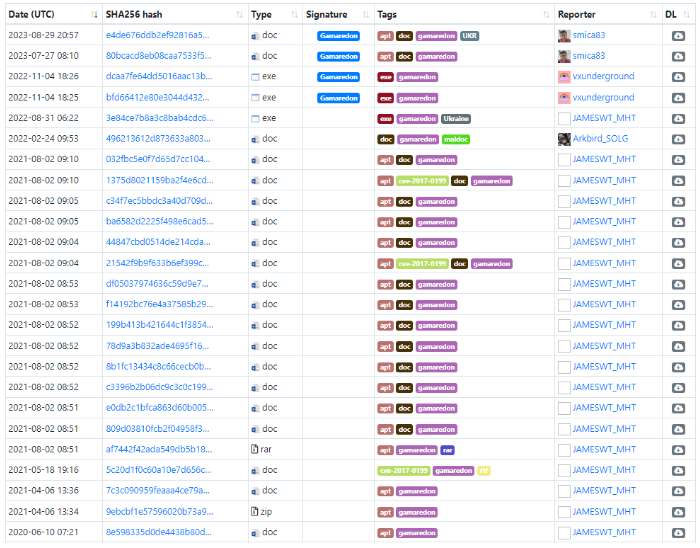
MalwareBazaar directory of Gamaredon MS Word malware

“A large amount of Gamaredon subdomains used in spear phishing attacks are linked to the TLD .ru, registered via REGRU-RU, and contain the number 71”, according to the information shared with Cyber Security News.

Gamaredon employs infinite IP addresses to avoid discovery and uses wildcard A records instead of specified subdomains in fast fluxing.

APT groups utilize fast fluxing to avoid standard threat detection methods that rely on threat feeds providing entire domain names, including subdomains.

Several websites have reported recent efforts by Gamaredon to inject malware from the following URLs using an MS Word template:

  • http://encyclopedia83.samiseto[.]ru/HOME-PC/registry/amiable/prick/sorry[.]83glf
  • http://relation46.samiseto[.]ru/DESKTOP-UVHG99D/percy[.]46rra

“We discovered 98 A records associated with *samiseto[.]ru, that were used in constant rotation”, researchers said.

Additional research showed that IP addresses are only utilized for up to 4 days before being replaced by new IPs (together with new subdomains), which helps threat actors avoid detection and renders the majority of isolated IOCs useless upon discovery.

In the past, there have been documented attacks against Western government institutions across the US, the Indian Subcontinent, and more recently in Ukraine.

Gamaredon's Infrastructure
Number of Victims 

Recommendation

Organizations should implement countermeasures that track the underlying infrastructure that backs up attacks, such as apex domains, ASNs, registrars, authoritative nameservers, etc., rather than relying on lists of isolated IOCs.

They should also apply correlative datasets that allow security teams to identify patterns in attacker behavior, such as ASN and IP diversity data, naming conventions, etc.

Organizations must recognize and block apex domains regardless of the subdomain to protect themselves from quick flux TTPs.

Keep informed about the latest Cyber Security News by following us on Google News, Linkedin, Twitter, and Facebook.


[ad_2]
Source link

HONOR V Purse will become an actual product on September 19

0
[ad_1]

The HONOR V Purse will become an actual product on September 19. This smartphone was presented as a concept device at IFA, earlier this month. At the time, we were not sure if it would launch as an actual product, but that has just been confirmed.

The HONOR V Purse will become an actual product later this month

HONOR will present this device in China on September 19. The press event will kick off at 7:30, and yes, the device will be available to purchase in HONOR’s homeland. We still don’t know if it’ll come to global markets, though.

The HONOR Magic V2 is expected to hit markets outside of China at some point, but the HONOR V Purse’s availability is still questionable. It will, however, be available in China, that much is clear now.

When the company presented the phone in Berlin, it did not share any spec info whatsoever. The device was shown off as a fashion accessory, and the entire focus was on that.

The HONOR V Purse is an outwards-folding smartphone, which does resemble the Huawei Mate Xs 2. It is not identical to it, though, not at all. This phone can actually transform into a bag of sorts.

This phone transforms into a handbag/purse of sorts

You can attach various straps to it, to essentially transform it into a handbag. The display plays a part in it too, as various AOD styles have been presented, which can complete the fashion statement. The vast majority of this phone’s outside is covered by the display (when folded), so… it makes sense.

When it comes to specs, we can only guess at this point. We’d say that the phone is quite powerful, though. The Magic V2 is basically a flagship-grade product, and this one could be as well.

The Snapdragon 8 Gen 2 inclusion is a possibility, though we’re only guessing. That display is almost certainly an AMOLED display with a high resolution and a 120Hz refresh rate. We still don’t know how much the phone will cost, however. We’ll have to wait a bit longer to find out.

HONOR V Purse launch event announcement


[ad_2]
Source link

iPhone 15 Pro’s Action Button confirmed ahead of launch

0
[ad_1]

The iPhone 15 Pro will feature an Action Button, that much has just been confirmed. We’ve heard a ton of rumors suggesting this will happen, and now a confirmation came from Spigen, of all companies.

The iPhone 15 Pro’s Action Button gets confirmed by Spigen

The accessory maker shared an image via X, showing us what seems to be a new case, with a focus on the volume rocker and an action button. If you check out the image below, you’ll know what we’re talking about.

Spigen iPhone 15 Pro Action Button teaser

You can clearly see that the Action Button sits above the volume rocker. Spigen used the “something’s different” caption, and also the ‘AppleEvent’ hashtag. It’s quite obvious what they’re showing here, though.

The ‘Action Button’ will replace the mute switch on the iPhone 15 Pro and iPhone 15 Pro Max. The regular iPhone 15 and iPhone 15 Plus models will retain the mute switch, based on rumors.

The ‘Pro’ models were also supposed to get solid-state buttons in general, but that seemingly won’t happen. Apple ran into some issues at one point, and decided to stick to regular buttons for one more cycle.

That Action Button will be customizable

This Action Button will be customizable. You’ll be able to choose what to use it for, and it will likely have more than one triggerable action. Chances are it’ll react to a single press, long press, and maybe double tap, etc. We’ll have to wait and see.

As many of you know at this point, the entire iPhone 15 series will launch later today. The press event is starting at 10 AM PST / 1 PM EST / 7 PM CET / 6 PM BST.

All iPhone 15 models will include a Dynamic Island this time around, and a Type-C USB port too. These will actually be the first iPhones ever to offer a Type-C USB port.

The ‘Pro’ models will also come with a titanium frame, and thinner bezels than last year’s models. The ‘Pro Max’ variant will include a periscope camera, and be the only model that will see a price hike, based on reports.


[ad_2]
Source link

Beware of Fake Browser Updates that Install Malware on Systems

0
[ad_1]

In recent times, it’s been observed that fake malware-loaded browser updates are gaining rapid growth in the threat landscape.

Rapid7 researchers recently identified a Fake Browser Update lure that tricks users into running malicious binaries, using a new loader to deploy the following info stealers on compromised systems:-

Rapid7 discovered the IDAT loader in July 2023, initially disguised as a 7-zip installer for SecTop RAT. It’s now distributing the above-mentioned info stealers using the following evasion methods:-

  • Process Doppelganging
  • DLL Search Order Hijacking
  • Heaven’s Gate

However, besides this, the name of the IDAT loader comes from reserving the payload in the IDAT piece of PNG files. Before this technique, threat actors used malicious JavaScript files to connect to C2 servers or deploy the Net Support RAT.

Attack Flow

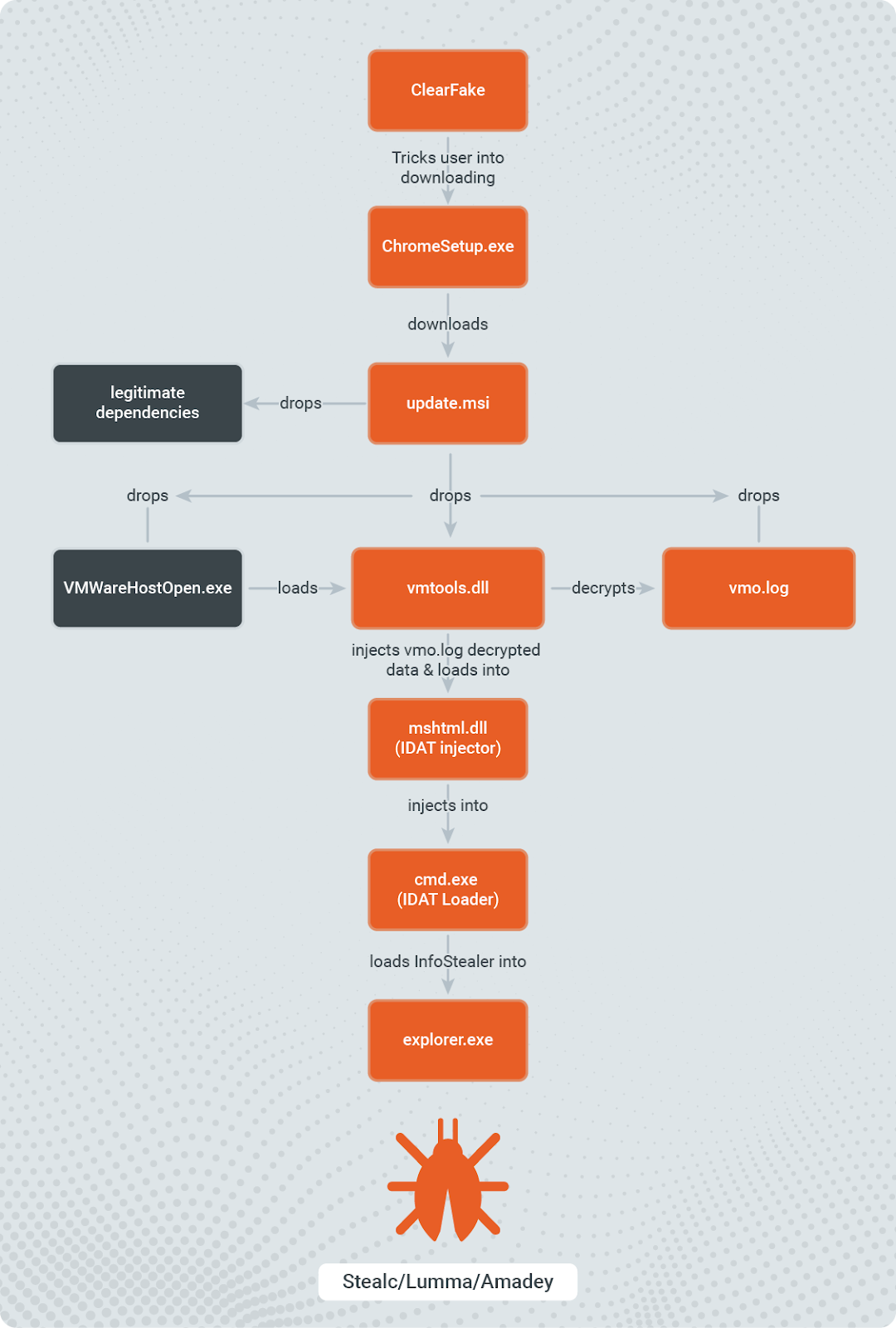
Threat actors strive to evade detection and prevent security research in their attack strategies. To do so, they always stage their in different stages or segments to make it more complex.

Fake Browser Updates
Attack flow (Source – Rapid7)
Document
FREE Demo

Implementing AI-Powered Email security solutions “Trustifi” can secure your business from today’s most dangerous email threats, such as Email Tracking, Blocking, Modifying, Phishing, Account Take Over, Business Email Compromise, Malware & Ransomware

Attack Stages

Here below, we have mentioned all the attack stages:-

Stage 1 – ClearFake: ClearFake is a recently discovered malware linked to an IDAT loader distribution starting on July 19, 2023. It’s less sophisticated than SocGolish, using base64 for obfuscation. 

Notably, it doesn’t track visits by IP or cookies, allowing repeated access from the same IP without clearing the cache.

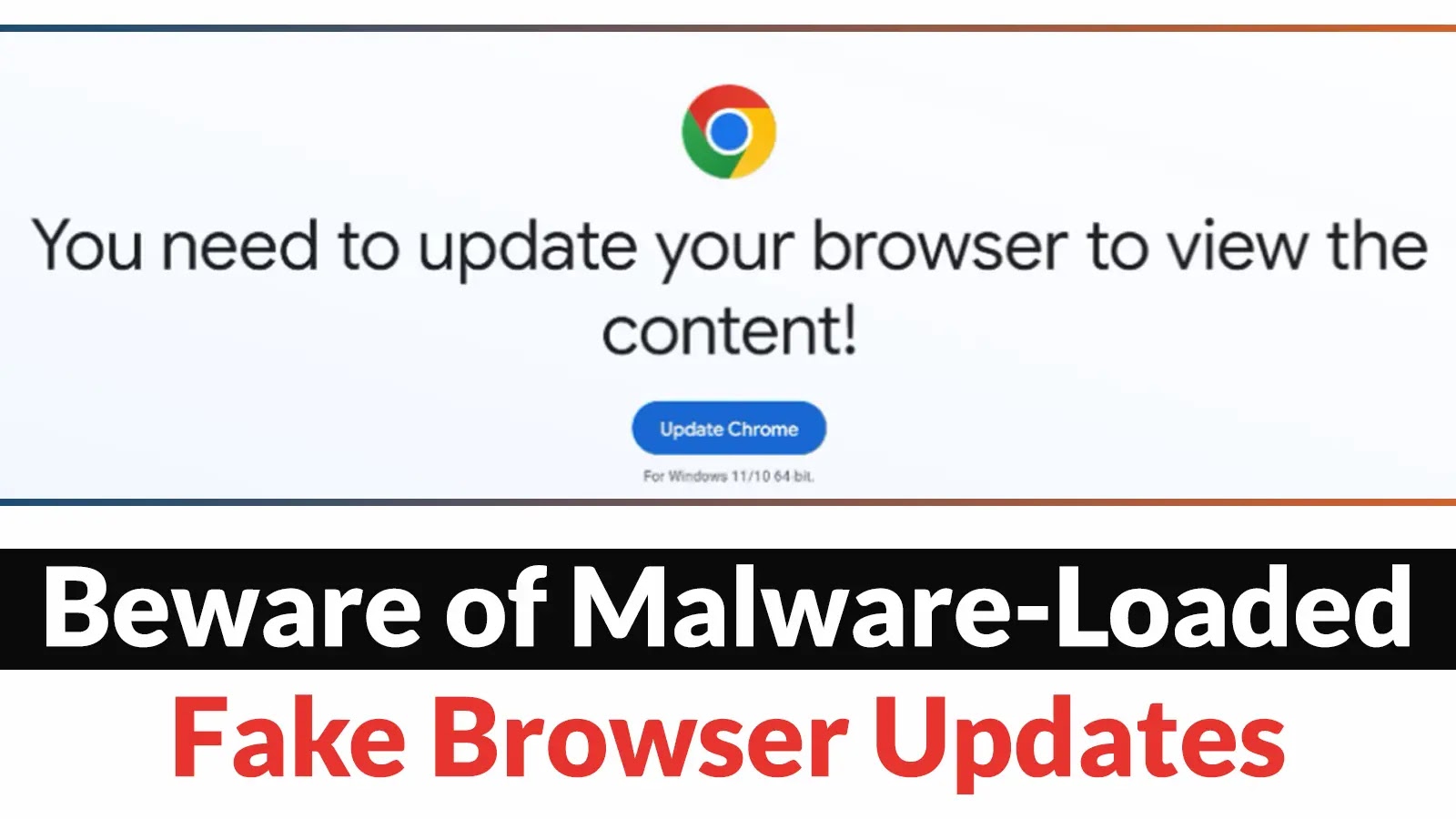
The prompt masquerades as a genuine browser update and redirects the user to download a binary named ChromeSetup.exe, previously used in SocGholish attacks and now by Clearfake.

Fake Browser Updates
Prompting the User to Update their Browser (Source – Rapid7)

Stage 2 – MSI Downloader: ChromeSetup.exe downloads an MSI package that writes legitimate files, a malicious DLL, and an encrypted log file decrypted by the malicious DLL. Another attack version drops legitimate files and uses a different encrypted log file.

Fake Browser Updates
vmo.log content (Source – Rapid7)

Stage 3 – Decryptor: The legitimate VMWareHostOpen.exe employs DLL Search Order Hijacking to load the malicious vmtools.dll from the same directory. This DLL uses XOR encryption, extracts data from vmo.log, and decompresses it using LZNT1. It then loads mshtml.dll and executes the decompressed code.

Stage 4 – IDAT Injector: IDAT loader uses dynamic imports and expands environment variables to create folders for copied files. It employs the Heaven’s Gate evasion technique, allowing a 32-bit process to run in a 64-bit process. It also sets environment variables and injects code into cmd.exe using NtCreateSection + NtMapViewOfSection Code Injection.

Stage 5 – IDAT Loader: The injected loader code uses Heaven’s Gate evasion, decrypts configuration data, deletes vmtools.dll, and injects the infostealer using Process Doppelganging. The payload injected is identified as Lumma Stealer, and the malware delays execution with NtDelayExecution.

The IDAT Loader is one of the latest and most sophisticated loaders actively used by threat actors to execute InfoStealers and RATs. 

It’s packaged into DLLs loaded by legitimate programs like VMWarehost, Python, and Windows Defender in the Fake Update campaign.

IOCs

Fake Browser Updates
IOCs (Source – Rapid7)

Keep informed about the latest Cyber Security News by following us on Google News, Linkedin, Twitter, and Facebook.


[ad_2]
Source link

Nothing OS 2.0.3 brings various improvements to Nothing Phone (2)

0
[ad_1]

Nothing OS 2.0.3 has started rolling out to the Nothing Phone (2), with new features in tow. Several new features have been added, smaller ones, but the focus here is mostly on improvements and bug fixes.

Nothing OS 2.0.3 brings new features & various improvements to the Nothing Phone (2)

This update weighs 99.39MB, and it’s rolling out as we speak. Do note that it’s a staged rollout, so you may not get the update immediately. You may have to wait for days, but it’ll get there, don’t worry.

Let’s talk about new features first, shall we? Nothing added a Compass widget to the phone. You can swipe down over it to get more information. A new UI element has been added too, to show when the device is in pocket mode.

Nothing has also added support for Zomato in Glyph Progress. The last addition to the features category is an improved ‘OTG Compatibility’ toggle in Settings -> Connected devices -> Connection preferences.

7 different improvements are listed

Now, when it comes to improvements and bug fixes, there are 7 entries here. So, quite a few. Nothing is working hard to make the OS as smooth as possible, and as bug-free as possible. So, let’s see what’s changed.

Nothing increased the Screen Recorder capture resolution. The company also adjusted the animation speed of the keyboard, the pop-up speed. The haptic feedback has been improved in general, and the same goes for NFC stability.

The Bluetooth connection stability has been improved in various scenarios, while other minor UI adjustments have been made. The last entry on this list says that Nothing also pushed out minor bug fixes.

The Nothing Phone (2) is the company’s latest smartphone, and second overall. It was announced back in July, and it is quite smooth, but things could always be better, so… there you have it.


[ad_2]
Source link