The Xiaomi MIX Fold 3 will launch this year, and its image has just appeared, along with the phone’s retail box. The Xiaomi MIX Fold 3 will become the company’s third-gen book-style foldable.
Do note that the first and second-gen products were exclusive to China. We’re hoping things will change this time around, as Samsung does need more competition in global markets. If that does end up happening, Xiaomi will still launch the phone in China first, though.
The Xiaomi MIX Fold 3 image just appeared, along with the phone’s retail packaging
In any case, if you check out the two images shown below the article, you’ll see the phone itself and its box. Unfortunately, though, we only get to see the phone’s front side when folded. This seems to be a screenshot from the phone’s ‘About device’ section.
What we can see here is that the device will have a centered display camera hole on its cover display. You can also see its physical buttons, and its slightly curved glass that sits on the display.
The second image shows the phone’s retail packaging. It’s exactly what you’d expect, actually. The box is larger than the Xiaomi 13 Ultra’s, but the design element is the same. You’ll notice Xiaomi’s branding, the phone’s name here, and of course Leica’s logo too. The box itself has a dark gray color.
It will likely launch at some point this month
The Xiaomi MIX Fold 2 arrived on August 11 last year. That means that the MIX Fold 3 launch is likely not far off at this point. We don’t have a lot of information about the device just yet, but we do know what to expect.
The Xiaomi MIX Fold 2 was quite thin and compact for a book-style foldable. For a while, it was the thinnest book-style foldable out there. It’ll be interesting to see whether Xiaomi will be able to trump the HONOR Magic V2 in that regard.
Qualcomm’s Snapdragon 8 Gen 2 SoC will fuel this smartphone, while we’re expecting LPDDR5X RAM and UFS 4.0 flash storage to be included. Both of its displays will offer a 120Hz refresh rate, while we’ll also get truly fast charging here.
Google has shut down its AI Test Kitchen mobile apps. It removed both Android and iOS versions of the app from their respective app stores (Google Play Store and Apple App Store) on Monday. The apps themselves stopped working a few hours later, prompting users to access the platform on the web.
“AI Test Kitchen has moved to the web,” a banner on the discontinued mobile apps reads. “This allows us to deliver more demos faster,” Google further explains. The banner contains a link to the web interface of the company’s AI experiment hub. In a statement to 9to5Google, a Google spokesperson reiterated that the apps have been shut down to ensure faster and easier updates for all users. It no longer needs to separately update the platform on Android, iOS, and the web.
AI Test Kitchen lets you try out Google’s AI experiments
Announced at Google I/O 2022 in May, AI Test Kitchen debuted in August of that year. The company described it as a public platform to “learn about, experience, and give feedback on emerging AI technology.” At launch, it offered three AI experiments powered by Google’s LaMDA (Language Model for Dialogue Applications): Imagine It, List It, and Talk About It (Dogs Edition).
Along with the web interface, Google also launched dedicated mobile apps for AI Test Kitchen on Android and iOS. It even announced a “Season 2” for the app in November. The company touted new AI experiments such as City Dreamer and Wobble, both of which were text-to-image generation tools. The former would let you build a city of your imagination, while the latter used AI to make an imaginary monster dance.
However, Google seemingly scrapped those plans as the new tools never arrived. Meanwhile, At Google I/O 2023 in May, the company added its AI music creation tool MusicLM to the AI Test Kitchen and simultaneously removed the existing experiments from the platform. MusicLM, which lets you create music using text prompts, is the only experimental tool currently available on Google’s AI Test Kitchen.
Google will likely add more new AI tools to the platform in the coming months. But you won’t be able to access them through mobile apps. You must visit the web interface to try the latest AI innovations from the tech giant. You can sign up for AI Test Kitchen here. “Our goal is to learn, improve, and innovate responsibly on AI together,” Google says.
Recently, Meta and Microsoft joined forces to introduce the new Llama 2 – a next-generation large language AI model, resulting in Mark Zuckerberg’s company working on several generative AI tools for Instagram, including one that helps identify AI-generated content. Such a tool might be more needed than we thought, as Meta has now introduced its latest project.
In a blog post, Meta introduced its latest AI tool, AudioCraft, which generates, according to the company, high-quality, realistic audio and music from text. The company says this tool would help, for example, “a small business owner add a soundtrack to their latest video ad on Instagram with ease.”
So this might also mean no more browsing through different songs for hours before uploading a Reel. You might just have to write down what type of music you need, and the AI tool will generate it. Not sure how artists would feel about that, though.
AudioCraft is still not rolled out on any of the Meta-owned social media platforms, but maybe it is just a matter of time before the AI tool becomes just another feature we can use daily. For now, Meta is releasing AudioCraft as open-source code. The company says that the goal is to allow researchers and practitioners to train their own models with their own datasets and help advance the field of AI-generated audio and music.
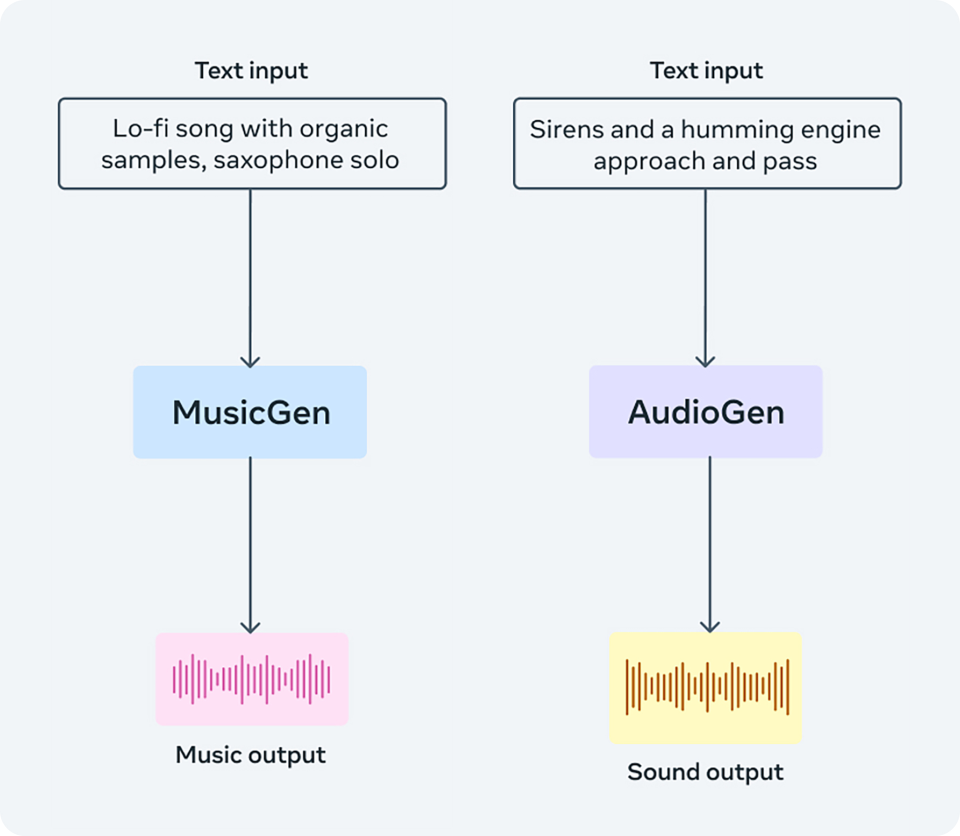
AudioCraft is a collection of three models: MusicGen, AudioGen, and an improved version of EnCodec. MusicGen is an audio generation model designed for creating music. It was trained on a large dataset of around 400,000 music recordings, including text descriptions and metadata, totaling 20,000 hours of music owned by Meta or licensed for this specific purpose.
Image Credit–Meta
AudioGen is an AI model capable of text-to-audio generation. By providing a written description of an acoustic scene, the model can produce realistic environmental sounds that match the description, complete with complex scene context and lifelike recording conditions. The EnCodec decoder ensures higher-quality music generation with fewer issues.
According to Meta, “responsible innovation can’t happen in isolation.” The tech giant also says that its models’ training datasets lack diversity, especially in terms of music styles and language. By sharing the code for AudioCraft, Meta aims to enable other researchers to test new methods to reduce bias and misuse in generative models.
The tech giant also shares that it is excited to see the creative outcomes people will produce using its method. You can already hear hundreds of samples that the AI tool generated, from 80s disco through jazz instrumentals to, for example, a male speaking with many people cheering in the background.
If you’ve not heard of the Lemokey L3, you might want to sit up and take notice of this gaming keyboard. It’s being made by Keychron and will be the company’s first proper gaming keyboard under its new premium gaming division. While you can’t get the Lemokey L3 just yet, it’s up for pre-order now through Kickstarter and is worth a look. Keychron is best known for its collection of mechanical keyboards offering great customization options, hot swappable switches and more.
And while it does have some gaming keyboards available, none of them are like the Lemokey L3. At first glance it just looks like another cool keyboard from Keychron. But give it longer than a glance and you’ll start to pick up on all the neat little details. Like the programmable knob and macro column on the left side.
The L3 also features hot-swappable switches, and it’s built using a double gasket design for added durability. Of course, the full aluminum frame certainly helps with that. These features are just the tip of the iceberg too.
The Lemokey L3 gaming keyboard features 2.4GHz wireless with a 1000Hz polling rate
Wireless gaming keyboards aren’t as bad as they used to be. Far from it actually. But that doesn’t mean any company making them can start slacking on giving them the best connection capabilities possible. Keychron is promising a 1000Hz polling rate with the Lemokey L3 that “ensures seamless and ultra-responsive gaming.”
If the keyboard is able to live up that, then this is an important factor. Because the last thing you want is your keyboard lagging right at the most critical moments in games. Additional features include a sound dampening layer to keep the keys from sounding too loud and the ability to connect it to up to three different devices.
It also comes in three different color options, which are Space Silver, Carbon Black, and Navy Blue, and don’t worry about RGB backlist keys because it has those as well. Keychron says the keyboard is estimated to ship around October of this year. The project has already earned more than double its funding goal too, so those who back the project should expect it to arrive on time.
Ever since its introduction late last year, generative AI has quickly found its way into a lot of industries. Now, in line with these efforts, YouTube has begun the testing of a new AI-generated video summaries feature which, as the name suggests, will provide a brief overview of a video’s content without replacing the existing descriptions written by humans.
Although currently limited to only a few English-language videos and similar to the web page summaries of the Bing AI chatbot, the feature primarily aims to help viewers quickly assess whether a video aligns with their interests, thereby saving valuable time. However, it is important to note that this feature will be exclusive to YouTube Premium members.
“We are testing a new feature for viewers that uses generative AI to create summaries for YouTube videos. We frequently test new features before they are officially launched so that we can build and refine the best experience for our viewers and creators,” said Jamie, a Google spokesperson, in a statement to TheVerge.
Broader plans to integrate AI
Google says their primary motivation behind leveraging AI was the sheer volume of content people upload on YouTube, which made it impossible to use manpower in order to summarize every video. Additionally, as the testing phase continues, YouTube is likely to gather valuable insights from user participation and feedback, further enhancing its recommendation algorithm. Moreover, Google is also planning to use this generative AI to summarize user reviews for apps on the Play Store.
While this development in AI-generated video summaries is exciting and could prove beneficial to YouTube users, AI systems still face reliability issues and are prone to generating false information. Therefore, for this new feature to succeed, Google will need to address these concerns and ensure that misinformation does not affect a video’s performance.
Google announced this week that improvements to search features are rolling out to Chrome mobile. Some of these new features will only be available on Android, while others will be available on both iOS and Android devices.
The most important one is related to search. Depending on whether or not a website is compatible with this new Chrome feature, you’ll be able to see relevant search suggestions when you click on the browser’s address bar. A new section called “Related to this page” shows up when you click on Chrome’s address bar to provide you with suggestions for other searches related to the page you’re currently reading.
It makes searching for more information about what you’re reading much easier and completely removes the need to open a new page and type new search words that might or might not give you the answers you need.
If you love knowing what’s trending at any given time and you own an Android device, you can now see trending Google searches directly in the Chrome address bar. You can just simply open a new tab in the browser, tap the address bar and scroll down to see what’s trending.
Clicking on a trending search will allow you to see search results for that topic and even learn more about it. Although this feature is not yet available for iOS users, Google says that it will release it later this year.
Another useful addition to Chrome is not really a new feature but an improvement to an existing one. Touch to Search, a feature that allows users to quickly search a word or phrase directly from a webpage, is getting a small upgrade.
Android users can now find related searches using Touch to Search. When you now tap and hold on a word, you’ll get a carousel at the bottom of the webpage that shows related searches. This is only available on Android.
Finally, the search suggestions feature on Chrome for iOS is getting a small upgrade too. Instead of six suggestions showing up when you start typing in the Chrome address bar, you’ll now be given 10. Of course, the most relevant will appear at the top, but you can scroll down for more options if you’re not content with what you get. This feature is already available on Android, but iOS users can now enjoy it too.
A critical remote code execution (RCE) vulnerability identified as CVE-2023-3519 has been the subject of several attacks, which have already compromised and backdoored hundreds of Citrix Netscaler ADC and Gateway servers.
Attackers used web shells on at least 640 Citrix servers in these attacks, according to security experts from the Shadowserver Foundation, a nonprofit organization focused on advancing internet security.
Previously, the vulnerability was used as a zero-day attack on the network of a critical infrastructure organization in the United States.
“We can say it’s fairly standard China Chopper, but we do not want to disclose more under the circumstances.
I can say the amount we detect is much lower than the amount we believe to be out there, unfortunately,” Shadowserver CEO Piotr Kijewski said.
”We report on compromised appliances with webshells in your network (640 for 2023-07-30).
We are aware of widespread exploitation happening July 20th already,” Shadowserver said on their public mailing list.
“If you did not patch by then please assume compromise. We believe the actual amount of CVE-2023-3519 related web shells to be much higher than 640.”
Around 15,000 Citrix appliances were CVE-2023-3519 attack-vulnerable as of around two weeks ago.
That number has now decreased to below 10,000, showing some improvement in the vulnerability’s mitigation. Most of the servers are located in the United States and Germany.
Map of compromised Citrix servers
Specifics of the Ongoing Attack
Customers were alerted by Citrix last week that the NetScaler Application Delivery Controller (ADC) and Gateway CVE-2023-3519 (CVSS score: 9.8) vulnerability is being actively exploited in the wild.
The issue mostly affects unpatched Netscaler appliances configured as gateways (VPN virtual server, ICA Proxy, CVPN, RDP Proxy) or authentication virtual servers (AAA server).
Threat actors used this vulnerability as a zero-day in June 2023 to install a web shell on a critical infrastructure organization’s NetScaler ADC appliance.
The web shell allowed the actors to find the victim’s active directory (AD) as well as gather and exfiltrate AD data.
The attackers attempted to move laterally to a domain controller, but the appliance’s network-segmentation restrictions prevented them from doing so.
“In June 2023, threat actors exploited this vulnerability as a zero-day to drop a web shell on a critical infrastructure organization’s NetScaler ADC appliance,” CISA said.
“The web shell enabled the actors to perform discovery on the victim’s active directory (AD) and collect and exfiltrate AD data.
The actors attempted to move laterally to a domain controller, but network-segmentation controls for the appliance blocked movement.”
Citrix issued security updates to address the RCE vulnerability on July 18th, confirming that exploits have been seen on susceptible appliances.
“Exploits of CVE-2023-3519 on unmitigated appliances have been observed. Cloud Software Group strongly urges affected customers of NetScaler ADC and NetScaler Gateway to install the relevant updated versions as soon as possible.” reads the report published by Citrix.
Citrix fixed CVE-2023-3519 together with CVE-2023-3466 and CVE-2023-3467, two high-severity flaws that might be used to escalate privileges to root and conduct reflected cross-site scripting (XSS) attacks.
CISA gave U.S. federal agencies until August 9 to safeguard Citrix servers on their networks in response to continuous attacks.
Similar Citrix Netscaler ADC and Gateway vulnerabilities have previously been used by ransomware gangs, such as REvil and DoppelPaymer, to breach corporate networks.
In light of this, the company strongly advises concerned customers to install the necessary updates as soon as feasible.
The Galaxy Tab S9+ is a premium and very powerful Android-powered tablet from Samsung. This is the middle child of the Galaxy Tab S9 series, and it’s no doubt a favorite among people looking for a balance of affordability empower. If you picked up a Galaxy Tab S9+, here’s a list of some of the best cases that you can get for this device.
This list will go down some of the most feature-packed cases that not only protect your tablet from drops, but they also provide additional functionality so that you can get more from your tablet. Be sure to stop back, because this is an ever-updating article, so you may see better options any month or so.
If you haven’t picked up your Galaxy Tab S9+, then you may want to hop on it. Click here to know everything there is to know about this tablet and the other tablets in the Galaxy Tab S9 series. Also, if you’re ready to pull the trigger and order your tablet, click here.
CoBak Case for Samsung Galaxy Tab S9 Plus
This case has multiple layers of protection to keep your tablet safe. For starters, the outside uses a thick waterproof material that keeps the tablet from sustaining damage from a fall. It uses a strong TP material to protect the tablet’s edges, and that means that, in the case of a fall, you won’t have to worry about your screen getting cracked.
However, if you don’t feel like constantly reaching back to grab your S Pen, then you can use the front-facing stylus holder. Right below the display, you can safely put your S Pen in the slot. This also means that, in the case of a fall, the S Pen will not fall off the magnets, and fly any which way.
This case also doubles as a stand. So, if you want to prop up your tablet, you can easily do so using the case’s internal flap. You are able to set the tablet up at different angles to suit your needs.
This is the case to get if you want all-around protection. The Soke Galaxy Tab S9+ Case is built from the bottom up using sturdy materials. The back of the tablet is made from a tough PC material that will protect the tablet’s body in the case of a drop. This extends to the frame of the tablet which is made from a resilient PC plastic. The corners of the tablet are raised so that they will absorb more of the shock during a drop.
This tablet case comes in one of two colors. If you want the elegant all-black color, you can do so. However, if you want a bit more color, there is a dark purple color that you can get. For the purple color, the back of the tablet will be purple while the frame itself will remain Black. That gives it a nice elegant look to it.
This tablet case has a slot right under the tablet to house the S Pen. This means that it will be easily accessible when you are in the mood to write or draw. Also, you won’t have to worry about it getting lost.
Fintie Hybrid Slim Case for Samsung Galaxy Tab S9 Plus
This type of case has one of the more unique designs on this list. This design is achieved with a clear back plate that shows off the tablet more than most cases. Not only that, but this case comes in four different colors. Lilac Purple, Black, Starlight (which is an orange-ish tan color), and Composition (the black and white pattern that you see on composition notebooks).
While this tablet is stylish, it is also protective. The back plate is made from tough plastic. The rest of the frame has bumpers on the edge which are made from a study TPU material. This means that, if the tablet falls on its corner, you should not expect a cracked screen. Also, the front flap will keep the tablet safe from face-down falls.
With this tablet case, you’re able to prop it up. You’re able to stand it up if you’re looking to watch some movies or consume content, or you can lay it down if you’re looking to draw or write.
This tablet has a nice and premium-feeling leather build. It completely wraps around the tablet, and there’s a neat S-shaped pattern near the end of the flap. While it’s mostly made of leather, the internal frame is made from a sturdy PT material. So, this will help keep the tablet protected against drops.
The S Pen connects to the back of the tablet magnetically, but this case comes with an additional strap that will keep the S Pen stationary. This means that, in the case of a fall, the S Pen will not fly out.
Also, this case has an Auto Sleep / Auto Wake function. When you’re using the tablet, you’ll only have to close the case in order to put your tablet to sleep. This will really come in handy in case you accidentally forget to put your tablet to sleep before closing it.
This tablet case is for people looking for a case that’s thinner and lighter. The tablet is tough, but it still manages to keep its low profile. The inner layer is made from a sturdy yet flexible material to keep it safe during falls. Also, the outer shell of the case uses a strong TPU material. This double layer of protection makes this tablet more effective against drops.
Just like some other tablets on this list, this tablet case comes with an S Pen holder. It’s a neat addition to have if you use the S Pen a lot. You can easily set the S Pen inside of the slot right above the tablet. So, you will always know where it is.
This case keeps a low profile, and it’s for people who want a more minimalist design. So, you will definitely save space when you’re trying to pack it away inside of a bag. This case might be thin, but it still protects your device. It has raised edges so that, in the case of a fall, there’s less of a chance of your screen making contact with the ground. Also, the case is raised so that your camera lenses remain safe.
The internal layer is made from a honeycomb mesh using a sturdy TPU material. This is the layer that makes direct contact with the tablet, so it will help absorb the shock of a fall. The outside of the tablet cases is made for study material as well. It’s more rigid, so it’ll absorb a lot of the shock of the Fall. It’s a svelte tablet case, but it still offers ample Protection.
Do you want to have a case for your tablet, but you don’t want to cover up the original tablet’s design? This case is made from a thin, yet sturdy TPU rubber soft skin that will do a great job at absorbing the shock of a fall. The edges of the tablet are slightly raised, so that they can protect it from corner drops.
This case is perfect for people who want the thinnest and lightest case for their tablet. A lot of the time, having a bulky case isn’t the best option. There are people who just like things simple. If you want a different color, there’s also a black color that you can buy.
This case is for people looking for a more stylish aesthetic. It comes in a variety of different colors, and they have a nice leather design to it. It gives it a nice stylish and elegant look to it. There are five color options that you can choose from; there is Blue, Black, Brown, Green, and Red. These all have the same marble pattern on them.
This case will protect your tablet from drops. The outside is made from tough leather, while the internal frame is made from sturdy TPU plastic. It offers 360° protection in the case of a drop. Also, when you close it, the flap will cover the S Pen. This will keep the S Pen from flying out in the event of a drop.
Samsung has reportedly received the go-ahead from Apple to manufacture OLED displays for the iPhone 15 series. The Korean firm will make OLED panels for all four models: iPhone 15, iPhone 15 Plus, iPhone 15 Pro, and iPhone 15 Pro Max. It’s currently the only confirmed supplier of the next-gen iPhone displays, with LG and BOE still awaiting Apple’s approval. BOE currently has quality issues and may lose the contract to Samsung, the Korean media reports.
Samsung is the world’s largest manufacturer of OLED displays for smartphones. It supplies the displays to all major brands, including Apple. However, companies usually diversify their supply chains and source components from multiple suppliers to get competitive prices. This also helps them avoid last-minute shortages of components should one of their suppliers run into some issues. They can quickly award the contract to other suppliers.
This is what Apple does for its iPhone displays. While it primarily uses Samsung-made displays, the company also sources a portion of its display needs from other brands. Last year, Apple used OLED displays from LG in some iPhone 14 Pro Max units. The Korean firm had a bigger order but was forced to hand a portion of it to its compatriot Samsung due to yield issues at the last minute. Samsung eventually overcharged Apple because it had to deploy extra production equipment to meet this urgent need.
This year, Apple is increasing its share of LG displays in the iPhone 15 series. It has given LG a major contract for manufacturing OLED displays for the iPhone 15 Pro and iPhone 15 Pro Max. However, the Korean firm has yet to get the final approval. According to The Elec, it is facing production disruptions, so Apple is waiting for it to fix those issues. If LG doesn’t fix its issues in time, Samsung may once again walk away with a bigger initial order.
Samsung may also benefit from BOE’s struggles
BOE is another name in Apple’s iPhone 15 display supply chain. However, the Chinese firm may soon find itself out of it if it doesn’t fix its technical problems. The company is reportedly struggling to perfect the Dynamic Island design (cutout at the top), which Apple plans to employ on all four iPhone 15 models this year. If BOE fails to solve the issue, the Cupertino giant may hand over the contract to Samsung. The iPhone 15 series should be here next month if Apple sticks to its traditional September launch timeline.
Elon Musk wants creators on X (the social media platform formerly known as Twitter) to keep more of the money they generate on the site for as long as possible. Musk did post on X (via The Verge) about a change he is making in favor of content creators on the platform. He wrote, “While we had previously said that X would keep nothing for the 12 months, then 10%, we are amending that policy to X keeps nothing forever, until payout exceeds $100k, then 10%. First 12 months is still free for all.”Apple, as most know, takes a 15% to 30% cut of in-app purchases made in the App Store and that includes any subscriptions sold by content creators on X. Musk would like Apple to limit its 30% cut to the portion of a payout that is kept by Twitter. And to get Apple to make the change, Musk said on his X post that he will meet with Apple CEO Tim Cook to see if he will make the change.
This isn’t the first time that Musk has complained about the so-called Apple Tax. Last year, the multi-billionaire called Apple’s cut a “hidden 30% tax on the Internet.” Apple threatened to yank his social media platform, known at the time as Twitter, out of the App Store. After visiting Cook in Cupertino, Musk ended up saying “Good conversation. Among other things, we resolved the misunderstanding about Twitter potentially being removed from the App Store. Tim was clear that Apple never considered doing so.”
Musk says that he will meet with Tim Cook in an attempt to modify the Apple Tax
You might recall that around Thanksgiving time last year, rumors swirled about both Apple and Google removing Twitter from the App Store and Play Store respectively. Do you remember what Musk said he was going to do? He said that he would develop his own phone (the Tesla phone?) to spank Apple and Google and to keep Twitter relevant with phone users.
Tim Cook might come off as a folksy, friendly guy with his public persona, but when it comes to the Apple Tax, the man is a fierce, take no prisoners executive who would make Gordon Gekko cower. Musk might hope that he can talk Cook into agreeing to his plan, and yeah, some so-called “Reader apps” are allowed to link to the developer’s own web site to allow subscribers to manage their accounts and bypass the Apple Tax. But Cook allowed this to in order to get lawmakers and attorneys to back away from forcing even deeper changes to the Apple Tax.
We wouldn’t bet on Musk getting his way even if he meets again with Tim Cook.