Keeping up with technology trends, especially focusing on effective business communication with your customers across all platforms, is crucial for your company’s success. Trends in 2024 include integrating omnichannel campaign management solutions to make business communications as effective and efficient as possible.
Integration testing services play a critical role in this context. They ensure that the various components of omnichannel platforms work together flawlessly, providing a consistent and reliable customer experience across all channels.
We will explore the following topics: what makes a successful business, the importance of knowing technology trends, and how a business can benefit from an omnichannel campaign management platform.
What makes a successful business?
Provides high-quality products and services
A successful business provides quality products and services that meet or exceed the customers’ expectations to build customers’ trust and loyalty.
Enhances customer experience through omnichannel campaign management strategy
A good, successful business provides an exceptional, quality customer experience. To grow your business, continue beyond closing a sale. The goal should be to satisfy customers with the products and services you provide and to consistently stay responsive in communicating with your customers to ensure their happiness with their purchase or subscription.
This includes knowing how else you can make customers happy by turning them into repeat buyers and by receiving positive feedback, recommendations, and referrals from them due to your high-quality customer service.
Focuses on customers’ needs
A successful business understands what its customers need, and its goal is to consistently deliver these needs and preferences to ensure customer retention and satisfaction.
Innovates and adapts to current trends in technology
To thrive, a business should innovate and adapt to current trends in technology to stay relevant, capitalize on emerging opportunities, and gain an advantage over existing competitors.
The importance of knowing the trends in Technology
Staying abreast with the latest trends in technology in business communications is crucial for the following reasons:
It sustains competitiveness
Keeping up with technological advancements guarantees that your business stays competitive in the market. Embracing innovative communication tools and tactics enables you to stay aligned with industry norms and fulfil customer demands, giving you a competitive advantage over rivals who may be slower to adopt new technologies.
It enhances customer experience
Trends in technology significantly influence customer experiences. By utilizing cutting-edge communication tools and platforms, businesses can offer smooth, tailored interactions across various channels. This elevates customer satisfaction, nurtures loyalty, and boosts the probability of repeat purchases and favourable recommendations.
It improves productivity and efficiency
Incorporating cutting-edge technology into business communications streamlines operations automates tasks, and boosts overall efficiency and productivity. Advanced collaboration platforms, AI-driven chatbots, and cloud-based communication solutions expedite decision-making, streamline workflows, and reduce turnaround times.
It reduces the risks
Neglecting technological trends in business communications can leave businesses vulnerable to risks. Outdated systems are susceptible to security breaches, compliance issues, and operational inefficiencies. Keeping up with the latest technologies allows businesses to anticipate and address potential risks, protect sensitive information, and stay ahead in an ever-changing digital environment.
It adjusts to evolving consumer behaviour
Adapting to changes in consumer behaviour enables businesses to tailor their communication strategies accordingly. Whether it involves embracing social media marketing, enhancing mobile experiences, or incorporating voice assistants, staying updated allows businesses to connect with customers where they are and effectively engage with them.
How a business can benefit from an omnichannel campaign managing platform
Increase in customer engagement and loyalty
An omnichannel campaign management platform enables businesses to interact with customers through various channels, including email, SMS, social media, etc., ultimately resulting in higher engagement and loyalty.
Improved targeting and segmentation
Enhanced targeting and segmentation enable businesses to customize marketing campaigns for specific customer segments, considering demographics, behaviour, and preferences. This yields more relevant and effective communication, ultimately driving higher conversion rates and ROI.
Streamlined campaign management
It offers businesses a centralized platform for planning, executing, and analyzing marketing campaigns across various channels, simplifying the management process, minimizing manual tasks, and enhancing overall efficiency.
Seamlessly integrates with existing CRM, email marketing, and other business systems
This seamless integration guarantees data coherence and enables personalized communication across different channels.
Achieve a competitive advantage
By utilizing an omnichannel campaign management platform, businesses can achieve a competitive advantage by delivering exceptional customer experiences, boosting revenue, and distinguishing themselves from rivals using conventional marketing approaches.
Conclusion
Staying updated with technology trends in business communications is essential for maintaining competitiveness and achieving success. One way to do this is to leverage omnichannel campaign management platforms. These platforms boost customer engagement, simplify campaign management, and seamlessly integrate with current systems, offering businesses a competitive edge.
There are some great Spotify Podcasts out there. The company is one of the biggest podcasting companies in the world, but that’s not to say that it didn’t have to cut some people loose. Previously, Spotify had to lay off several people in its podcast division, and Max Cutler was one of them. Well, according to a new report, Cutler started the Pave Podcasting network, and it intends to pick up where he left off.
Cutler originally started a company called Parcast, and it was focused on horror and true crime podcasts. It was acquired by Spotify back in 2019 to the tune of $1 billion. After the acquisition, he was promoted to Head of Talk Creator Content and Partnerships at Spotify. He has since departed the company and returned to owning his own business.
Former Spotify VP started the Pave podcasting network
Pave is a network for original audio content. What will the studio specialize in? Well, it’s all in the name. Pave is an acronym for Podcasts, Audiobooks, Videos, and Entertainment. The company already posted its launch trailer. You can see it below.
So, this podcast network will be similar to others. It’ll be a central hub to access original audio/video content.
According to reports, it was already able to sign a couple of creators to produce original shows. These creators include Nicole Lapin (Money Rehab), Mark Hyman (The Doctor’s Farmacy), Ally Lewber (Vanderpump Rules), Jemma Sbeg (Australian self-help podcaster), and Aliza Kelly (celebrity astrologer).
At this point, we don’t know quite the extent of the content that will be available. Since this is a newer company, we don’t expect it to have a library of content comparable to Spotify or YouTube Music. The latter actually improved its podcast game.
However, Pave seems like a network to discover more obscure and more creative forms of audio/video media. You should definitely keep an eye on Pave because it seems poised to take the podcasting world by storm.
OnePlus forayed into the tablet market with the OnePlus Pad last year. The slate arrived as a mid-range offering with a lot of screen real estate and a premium design. The Chinese tech giant is now reportedly working on the successor to the OnePlus Pad. It’s been over a year since the first OnePlus tablet debuted, but still, there weren’t many rumors regarding the successor until now. A fresh leak has revealed some details about the OnePlus Pad 2 processor.
The OnePlus Pad 2 could be a flagship offering with a Snapdragon 8 series processor
According to the source, the OnePlus Pad 2 will be powered by the Qualcomm Snapdragon 8 Gen 3 processor. If that’s true, the next-gen OnePlus tablet could arrive as one of the most powerful devices in its segment. It will be a much more performance-oriented slate than its predecessor, which has the MediaTek Dimensity 9000 chipset under the helm.
The leaked OnePlus Pad 2 processor information suggests that it will be competing with the likes of the Samsung Galaxy Tab S9. Samsung’s premium tablet family utilizes the Snapdragon 8 Gen 2 chipset. The slate will also take on the Galaxy Tab S10 series slates, which are expected to have the latest Snapdragon SoCs.
At the moment, several Android smartphones utilize the Snapdragon 8 Gen 3 processor. However, no tablet in the world offers this flagship chipset at the moment, as far as we know. So, the news regarding the OnePlus Pad 2 packing the Snapdragon 8 Gen 3 SoC should be taken with a pinch of salt.
The next OnePlus tablet’s launch reportedly isn’t too far
The source also suggests that the OnePlus Pad 2 will be launched in the second half of 2024. So, it could be released any time between the July and December period. Once again, since the tipster hasn’t provided any concrete proof, it’s advisable to digest this leak with some skepticism.
If the leak turns out to be true, the Pad 2 could carry a heftier price tag than its predecessor. The first-gen OnePlus Pad tablet is currently retailing for $399. A more powerful chipset could easily push the price up a little. And it wouldn’t be too surprising if that ended up being the case with this upcoming device.
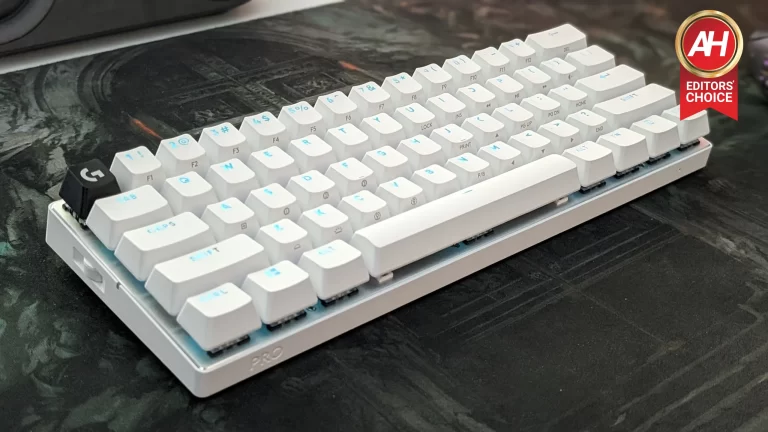
Logitech’s G brand makes some truly excellent gaming accessories, and its latest, the Pro X 60 keyboard, has been a delight to review so far. While I typically don’t like compact 60% form factor keyboards as much, using the Pro X 60 was not as much of a pain as I thought it would be. In fact, using it hasn’t been a pain at all. I’ve genuinely enjoyed my time with it. And that’s saying something when it comes from someone who has been a staunch supporter of the TKL form factor gaming keyboards for quite some time.
Over the past week or two, I have been using the Pro X 60 for everything from typing during the workday to playing my favorite games. I even wrote this review on the Pro X 60. And although there was a tad bit of a learning curve for me, it didn’t take long for me to settle into a groove. That is to say that even though I had to get used to keys with doubled-up functions, the Pro X 60 quickly became something that felt like second nature to me. In all honesty, the most challenging part was getting used to the confined space of all the keys.
I still sometimes find myself hitting the wrong keys because things are closer together than I’m used to on average. But it’s happening a lot less than it was on day one. So all-in-all, a pretty good experience. On top of that, there is so much functionality here to help improve your gaming experience, and potentially your skills, that it’s hard to not overlook the little things. With all of that said, is it worth your hard-earned money? Should you go for something else? Let’s dive into this review and see how the Logitech G Pro X 60 holds up.
Logitech G Pro X 60 Review: Hardware & Design
Logitech’s G brand is a master when it comes to hardware and design for its peripherals. And a big part of that is sitting down to gather input from pro players to see what they like and what can help them play at their best. After gathering feedback, Logitech goes to work to engineer something that a pro player can be proud to use and feel confident that it isn’t going to hinder their chances at victory. In fact, Logitech says it even worked with pro players throughout the entire process. Culminating in what is now the Pro X 60.
Two genius features that greatly improve the gaming experience
I’ve been pretty impressed with loads of details. But two things in particular with the hardware and design capture my attention more than anything else. These are the Game Mode switch and the side placement of the volume roller. On just about every other gaming keyboard that has a volume roller, you’ll see it typically in the top right corner. This is fine and there’s nothing really wrong with putting it in this location. However, Logitech looked at what Pro players do and how they play. And one thing it noticed is that many of them play with the volume up at max.
This isn’t good for your ears and can leave you with hearing problems over time. So what Logitech did is place the volume slider on the left side of the keyboard. Just within range of your pinky so you can adjust it as needed. The idea here was to have it close enough for pro players to turn up the volume at critical moments. Like when needing to hear footsteps to clinch a 1v4 win at the end of a match. Because of this side placement, you can reach the volume and max it out for those few moments. Then turn it back down to a manageable level that isn’t going to contribute to damaging your hearing.
This is such a smart move for anyone who plays competitive PvP games. Because the last thing you want is to move your fingers off of crucial keys. I found this a little hard to reach personally at first. But I got more used to it the more I tried playing with it. I just have shorter fingers. So it wasn’t as easy to hit for me initially. Then there’s the game mode switch. What this does is disable the Windows key so you can’t accidentally hit it and pull yourself out of your active game window. There’s nothing worse than being in the heat of the moment and then hitting the Windows key and messing up your game.
The Game Mode switch, placed on the right side of the keyboard, simply disables the Windows key. And that’s all it needs to do. This is a problem I myself have experienced numerous times. And it’s always such a frustrating thing to have happen. Of course, you can only be mad at yourself. Because it was your mistake. So this was just such a nice thing to have Logitech put attention to detail into. I now have been turning it on every single time I play games and wouldn’t have it any other way.
The cool thing is you can configure other keys in the G Hub app to be disabled when you flip this switch. I didn’t need anything else disabled so I left it as is. But your needs might be different, and I thought this was a thoughtful decision because it’ll be more customizable to tailor to different needs or tastes.
Portability is key here
Since this was made with Pro players in mind, portability was a crucial factor. Logitech wanted to make something that players could easily toss into their bags without taking up too much space. As players expressed liking compact keyboards but some have lacked useful functions. It’s so easy to just stuff this into a backpack if you’re traveling to a tournament and have lots of extra room for other stuff. Beyond that, it’s really put together well. It uses a metal top plate with a nice plastic frame around the edges.
Logitech also packs this with a semi-hard shell case for travel. So you can keep it protected. This is more or less the same kind of case Logitech packed with the Pro X keyboard, and it has spots for not just the keyboard itself, but the USB-C cable and a couple of other little things.
What I really loved is the small little compartment on the underside of the keyboard that holds the Lightspeed USB adapter. This way you don’t have to worry about losing it if you take it places.
Switch options
As with many gaming keyboards Logitech is giving you an option between different types of switches. There are two options with the Pro X 60 and these are GX Optical Tactile switches or the GX Optical Linear switches. Linear switches are going to be quieter and deliver less noise after keystrokes. Whereas tactile will be somewhat quieter than some more traditional mechanical switches, but you’ll still get that satisfying click. Tactile switches also have more instant feedback. I’m reviewing the model with the GX Optical Linear switches and they feel really good.
There’s still a slight click but it’s less pronounced and therefore a little bit quieter. Which is useful when I’m sitting here all day typing away at stuff. This is mostly a preference thing but I like knowing that my clicking and clacking at the keyboard for hours on end during the day isn’t going to bother or annoy anyone else who might be here and within earshot of the noise. That being said, if that isn’t a concern for you and you prefer tactile, go with the tactile. Both are rated for about 50 million keystrokes. And while I am nowhere near hitting that limit, I wouldn’t expect to be for many years to come.
You can’t hot-swap these switches so if you ever needed to replace them, it would take some user-repairable expertise or you’d need to send the keyboard in. Luckily, I don’t foresee that being much of a problem. The only downside that might be here is that people who prefer a specific type of switch can’t put them on this keyboard.
Logitech G Pro X 60 Review: Features
One of the best things Logitech has ever added to its wireless keyboards is the dual connectivity. Just like with my favorite Logitech gaming keyboard, the 915 TKL, the Pro X 60 can connect to both Bluetooth and the Lightspeed wireless adapter. To make things even better, there are buttons on the 915 TKL keyboard to immediately switch between those connections. So you can connect something to the Lightspeed adapter and a different device to Bluetooth, then tap a dedicated button to hop between connected devices on the fly.
The Pro X 60 offers these too, with these buttons placed on the backside of the plastic frame next to the charging port. I don’t use this often but when I do, it’s nice to quickly pop over to the second device. Like when I need a keyboard for my Steam Deck. I can keep the Pro X 60 connected to my PC with the adapter, and then connect to the Steam Deck with Bluetooth. Then move back and forth as needed. The big features, of course, are the G Shift functions and the KEYCONTROL. KEYCONTROL is Logitech’s new feature they’ve built into the Pro X 60.
Because this is a 60% form factor keyboard, there are fewer keys physically. To get around losing those extra keys, Logitech developed KEYCONTROL. This feature allows you to set multiple functions per key so you don’t have to lose all of the functions that you would want access to in your games. You can assign up to 15 functions per key too. So you really do have a lot of customization. This is where G Shift comes in. G Shift lets you swap between the sets of assigned inputs. So you have your main set of functions and then if you need another set, you hit the G Shift key to move to the next set.
For me, this took practice to become familiar with it. As I initially found it challenging to work it into my normal everyday gameplay. But to use a keyboard like this optimally, you need the G Shift. Again, this is designed for pro players. So this is something that more casual gamers, or those that just don’t play games at a professional competitive level, may not use as often. But those who want to up their game will want to spend some time getting to know this feature in the G Hub software. Because it’s going to make all the difference in how the keyboard feels and performs. Which in turn, is going to impact how you perform as well.
I have noticed my gameplay become a little better after using it. Though I have to admit, I do feel like my skills tanked a bit at first while I learned how to use KEYCONTROL and G Shift properly. Once you get past that hump, it’s more or less smooth sailing.
KEYCONTROL and G Shift
For those who put in the time to learn how to use them, these features are game-changing. And honestly, I can see how anyone who perfects them would see their skills increase by a significant amount. If you like to win and you actively seek to improve your gameplay skills, KEYCONTROL and G Shift are how you can improve. You just have to spend the time tinkering with what functions to map to which keys. Then practice playing using those functions. Like most things, practice makes perfect. And Logitech has come up with a really elegant system for helping players play at their best.
That being said, not everyone is going to find these features a cakewalk. For me, I’m not used to flipping between function sets. I have one function per key on my other main keyboard. I just make sure every function I need is set to a specific key. And I’ve been playing like that for so long, it was hard for me to get used to doubling or tripling up functions. What helped me get used to it faster than I probably would have is how Final Fantasy XIV is set up for controller players. In this MMO, you have a specific set of in-game functions on your main set, and then you can switch between sets with the R1 trigger up top.
I was already familiar with the concept of swapping to a new set of functions for the same key. So I just tried to keep this in mind when practicing with KEYCONTROL and G Shift. Again, you’ll set all these up in the G Hub app. So it’s best to become familiar with that software as well.
Logitech G Pro X 60 Review: Battery Life
Battery life is always a concern for me with wireless keyboards, although most tend to have decent enough battery life that I’m not charging it every couple of days. With the Pro X 60 I have typically been getting about 4-5 days out of it. There is potential for some variance though. When I first got it, I charged it all the way up, then began using it and I didn’t have to plug it in for about 5 days. The second week, however, it’s been 3 days and it’s already down to 29%. I have been using it more for PC gaming in this second week so that is contributing to some of the heavier battery drain.
I also have the key lighting at 50% brightness. It goes up to 75%. You should be able to get more battery life out of this keyboard than I did by turning this down to 25% brightness or by just turning the lighting off entirely. What’s cool is that G Hub gives you another way to help manage battery life too. Inside the G Hub software, head into settings where you can adjust the lighting brightness. Just above the brightness level option, there’s an option for setting the lighting to a ‘dim active effect’ after a certain period of time. This is what it should be on by default.
Below the brightness level, there’s the option to set how long you want the keyboard to be inactive before the backlights dim. I have had this set at 5 minutes the entire time. But, you can push this down to 1 minute so the keys aren’t as bright for as long. You can also lessen the time it takes for the lights to turn off completely. For me, this was set at 15 minutes but you can push this down to 1 minute as well. So something like dimming after 1 minute and turning off completely after 5 minutes would be a good balance.
If you ever deplete the battery life (and G Hub will tell you when the battery is low if you have the app running), you can simply plug the keyboard in. You can still continue to use it in this wired state. Additionally, using the keyboard via Bluetooth should extend the battery life as well. This won’t be as latency-free as the Lightspeed connection though, so keep that in mind. Overall, battery life is great and about what I expected. In short, no complaints.
Logitech G Pro X 60 Review: G Hub Software
This is where you control, customize, and adjust all the things that have to do with your Pro X 60 Keyboard. You can set all the familiar stuff that’s here for most of Logitech’s other keyboards. Such as the lighting options I mentioned before that can help with battery life. But specifically for this keyboard, you also use G Hub to set up and manage your KEYCONTROL settings. To find this you’ll open up G Hub, click on the Pro X 60 Keyboard, and then click on the Assignments button which is the second option, just below lighting.
If you’ve never used any of these kinds of functions before, spend some time playing around with this menu. Once you get the hang of it, it’s pretty simple. Now since KEYCONTROL will let you assign up to 15 functions per key, you can imagine that this can get pretty complex. I didn’t take things that far and really only set mine up to have just a couple of functions per key. What I did was use the KEYCONTROL feature to assign my 6-0 keys to my 1-5 keys. So in games like Final Fantasy XIV or other MMOs, all those ability keys up top are now doubled up on just five keys.
This makes it a lot easier to reach everything. Because I didn’t have to move my hand away from the WASD keys. All I had to do was hit the G Shift command to activate my second KEYCONTROL set. This is default to the FN + A keys. This was impossible to reach for me without taking my right hand off the mouse. So I simply mapped one of my mouse buttons to the FN key. This way I could move between sets on the fly and execute abilities quickly without taking my hands off the movement keys or mouse.
I found this feature on the keyboard to be great because now I can hit all ten keys while only reaching just five. Obviously, you can set things up that are way more complex than this. You can even set up KEYCONTROL for non-gaming tasks and issue multiple commands in succession. Again, I didn’t get this deep into it, at least not yet. It is nice that you can do this though. And it’ll be a huge benefit for loads of players. To do things like setting off multiple in-game commands, you’ll need to set up macros. If you’re going this deep into the customization, however, you might as well go the extra mile and make some macros as well.
As always the G Hub software is easy and intuitive and these new features make this a powerful keyboard for players of any skill level. And as an added bonus, the software isn’t bothersome with constant updates. A big win in my book.
Should you buy the Logitech G Pro X 60 keyboard?
Like anything we review, the Logitech G Pro X 60 keyboard isn’t going to be for everyone. Some prefer larger keyboard layouts while some just want something simple to use for casual gaming. There’s no debating though that the Pro X 60 is a powerful keyboard. One that has the capability to help you win more games. If you play multiplayer titles and need an advantage, it’s hard to ignore all the advantages you get with the Pro X 60. I would urge anyone to give this keyboard a shot if they want something to help them level up their skills. Even if they’re not a fan of 60% keyboards.
Logitech has given players the tools to really slay out here. All you have to do is practice with its advanced functions. And trust me, it’s worth it. Even with the simple setup I have begun with.
Buy the Logitech G Pro X 60 if:
You want a keyboard with advanced gaming features
Portability is a huge factor for you
You want a high-quality gaming keyboard
Don’t buy the Logitech G Pro X 60 if:
You want something more affordable
You want something simpler
You’d prefer a larger form factor like TKL or full-size keyboards
Billionaire Elon Musk has been on a crusade against bots on X. Because of this, we got the news that he was thinking of charging a small fee to use the platform. Well, it appears that he’s no longer just thinking about it. According to a new report, new users may have to pay a fee to post or otherwise interact on X. This comes shortly after the news that X was taking away the ability to hide verification checkmarks.
This is something that Elon Musk has been floating for a bit, but never really pulled the trigger on. Ever since before he bought the platform, which was then called Twitter, he has been working to eliminate all of the bots on the platform. So, that’s remained one of his missions ever since the $44 billion check cleared.
New users on X may have to pay a fee to post
Right now, you most likely don’t have to worry about paying the fee to make new posts. Elon Musk is only testing this new fee for the time being. He’s testing this fee in New Zealand and the Philippines. Users in those New Zealand have reportedly been prompted to pay $1.75, which is around $1 USD.
The company isn’t charging them per post, and it’s not arbitrarily charging users who’ve had their accounts for a while. Elon Musk is only imposing this fee on new accounts that are less than three months old. When a person makes an account, in order to start posting, commenting, or even liking posts, they will have to pay the $1 entry fee. This is something that Elon Musk feels will deter bots from coming onto the platform.
At this point, we have no idea if that’s going to work. There are some bots that already pay to use the platform, so this shouldn’t be much of an issue for them. Also, we have to remember that this could also deter new legitimate users from wanting to use X.
There are very specific times when people will pay social media apps. One would be a subscription service to gain extra functionality. However, why pay a fee to use basic functions for a social media platform that has historically been free to use?
We are just going to have to see how this whole situation plays out. This will, undoubtedly, lead to a lot more backlash for Elon Musk.
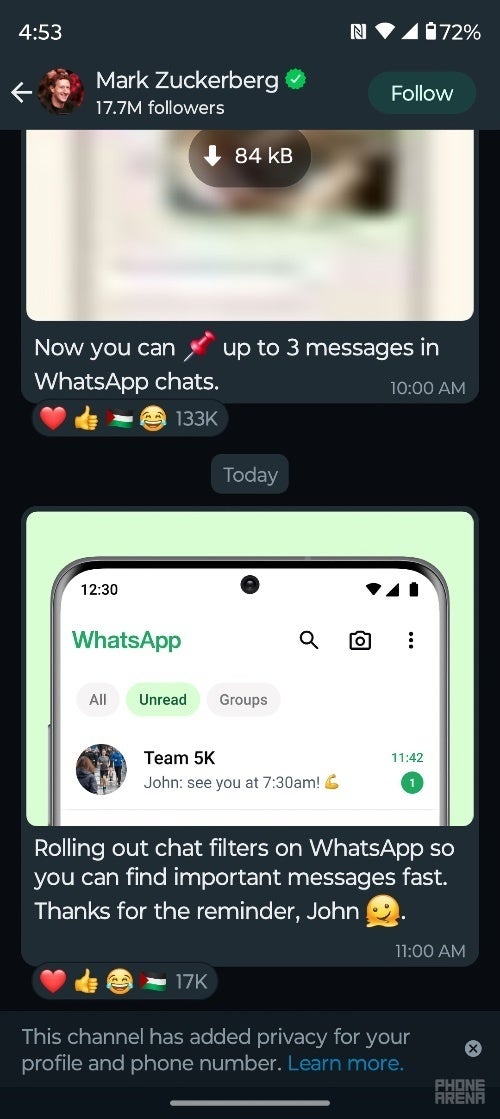
WhatsApp is always evolving to improve the way we connect with others, and its latest update is focused on enhancing organization and search within your chats. Following the recent update that gave us the ability to pin messages, Mark Zuckerberg has announced another exciting feature – dedicated chat filters.
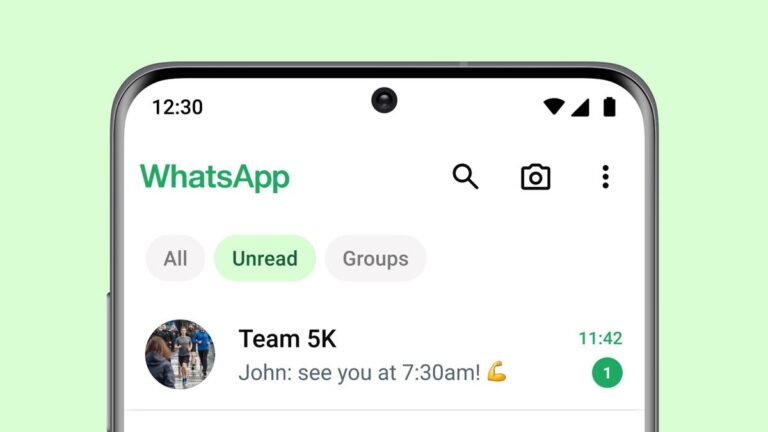
These filters are designed to make it faster and easier to locate specific conversations within your chat history, especially when you have many of them going on. Currently, the below two filters are available:
Unread: Perfect for catching up on messages you might have missed. It displays all your individual chats that contain unread messages, helping you prioritize your responses and clear those notification badges.
Groups: Perfect for finding that important group conversation. With a single tap, you can see all your group chats in one place, allowing you to quickly access discussions with family, friends, colleagues, or any other group you’re a part of. This includes subgroups within Communities, ensuring you have a central location for all your group conversations.
Previously, searching for unread chats involved using the search bar and filtering by message status. This process, while functional, required additional steps. The new dedicated “Unread” filter eliminates these extra steps, placing readily accessible filter options at the forefront of the chat list. This is a significant improvement for users who frequently juggle numerous individual chats and want a quicker way to identify conversations that require their attention.
The “Groups” filter addresses another long-standing pain point for WhatsApp users. For those who participate in a significant number of group chats, navigating through the chat list to find specific groups could be time-consuming and cumbersome. The ability to filter group chats has been a particularly popular request from users, according to WaBetaInfo who first reported on this announcement.
If you are ready to try out this feature, make sure you have the most up-to-date version of WhatsApp installed on your Android or iOS device, which you can grab directly from the App Store or Google Play Store. These filters mark a positive step in response to longstanding user feedback, so seeing them finally implemented is a welcomed treat.
TA558, a financially motivated threat actor identified in 2018, is targeting several countries but with utmost priority in Latin America.
Over 320 attacks have been observed from this particular threat actor, which involve using various tools and malware and compromising legitimate FTP servers and SMTP Servers.
Among the 320 attacks, 45 of them were targeted on Mexico, 38 over Colombia and 26 over Chile.
The sectors of interest seem to be the Industrial sector (22%), Service sector (16%), and Public sector (16%).
In addition, the threat actor has also been using Steganography techniques with images and text files.
TA558 Hackers Compromised 320+ Organizations
The threat actor used the compromised SMTP servers to send phishing emails to victims and also utilized the same SMTP servers for C2 infrastructure.
Phishing email (Source: Positive Technologies)
Some of the SMTP servers used by this threat actor were found to have public directories that contained Malware logs of Stolen data.
DocumentStop Advanced Phishing Attack With AI
Trustifi’s Advanced threat protection prevents the widest spectrum of sophisticated attacks before they reach a user’s mailbox. Stopping 99% of phishing attacks missed by
other email security solutions. .
The log files contained combined logs of credentials from well-known browsers, email accounts, and remote access credentials.
Moreover, these credentials belonged to regular users, public institutions, and various businesses.
In the initial phases of the investigation, researchers discovered an XLAM file in a phishing email from a compromised SMTP server.
When the attachment is opened with Excel, an EXE file named “packedtpodododod.exe” was downloaded from a C2 URL using the Excel macros.
File opened and a GET request is sent (Source: Positive Technologies)
In addition, an RTF file was identified on the same C2 server alongside another EXE file, which is the exploit file for CVE-2017-11882.
When the final EXE file is downloaded and run, the final payload of the relevant malware, say AgentTesla, then uploads exfiltrated data to the C2 via FTP.
VB script file (Source: Positive Technologies)
Further analysis revealed that the threat actor was using multiple malware families such as AgentTesla, Remcos, XWorm, LokiBot, Guloader, Formbook and SnakeKeylogger.
Attack Scenarios
Two attack scenarios were identified by the threat actor. One involves using an Excel document and steganography, and the other involves a Microsoft Word document.
Among these attack scenarios, the attack using an Excel document was the main scenario, which starts with a phishing email sent to the victim from the compromised SMTP server containing a malicious file “Cerere de cotatie.xla”.
When this file is opened, two requests are made to the C2 server for downloading a DOC and an RTF.
Once the RTF file is downloaded, another VBS file is downloaded from a paste[.]ee server.
File from past[.]ee server (Source: Positive Technologies)
Following this, the VBS file proceeds to download and decode two image files that contain a base64 encoded malicious string that points to the next-stage payload.
The VBS file contains a PowerShell script to decode this base64 encoded string and proceeds to download the next-stage payload.
Image with encoded string (Source: Positive Technologies)
Finally, the AgentTesla malware runs on the system which checks the execution environment.
Further, it also checks if the victim’s IP address is real. If these checks are successful, the malware proceeds to steal data from browsers, email clients, and remote access services and uploads it to the C2 server using FTP.
However, the second attack variant involving a Microsoft Word document has a similar methodology, but it does not use steganography techniques using images.
Instead, it directly downloads the AgentTesla malware using the RTF document.
Other variants of the attacks using Remcos, LokiBot, FormBook, Guloader, Snake Keylogger, and XWorm also use the first attack scenario for downloading and executing the malware on the victim system.
Nevertheless, the C2 and download servers differ for every malware and attack variant.
On further investigation, the FTP servers used by the threat actors belonged to legitimate websites that were also compromised for using them as C2 servers for data exfiltration.
There were also several legitimate companies with thousands of followers on social media.
Compromised website for C2 FTP (Source: Positive Technologies)
Furthermore, the indicators of compromise can be viewed on the research blog published by Positive Technologies.
Secure your emails in a heartbeat! To find your ideal email security vendor, Take a Free 30-Second Assessment.
Google’s experimental generative AI search feature within Google Maps seems to be reaching more users. Announced in February, this tool aims to change how people find interesting places by providing personalized recommendations based on a vast database of information. However, early reviews suggest that the feature may still need some polishing.
According to Google, generative AI leverages large language models (LLMs) to understand natural language queries and analyze Google Maps’ massive repository of businesses, photos, reviews, and ratings contributed by the community. This, in theory, allows for tailored results far beyond the capabilities of standard keyword searches. For example, you could ask for “places with a vintage vibe in San Francisco” or “steakhouses for dinner in Monterey,” the results will include follow-up questions and even consider factors like weather.
However, based on early reviews, this is far from the truth. The initial rollout has drawn mixed reactions. Artem Russakovskii, founder of Android Police, expressed disappointment, citing failure to perform simple tasks like planning for a day. Others have also echoed this sentiment on social media, noting that the AI component doesn’t seem fundamentally better than traditional Google Maps or general Google searches. Concerns about AI generating inaccurate or non-existent places have also surfaced.
Speed appears to be a notable weakness, with users like Johanna Romero of Phone Arena reporting slow processing times for recommendations. Some users find the generative AI search results to be limited, potentially missing out on well-reviewed spots compared to a standard Google Maps search.
The potential and Google’s stance
The promise of personalized discovery powered by AI remains exciting. However, given its experimental nature, it is bound to have some of the issues users are experiencing. As more users gain access, their feedback will be crucial to refining its capabilities.
If you’re curious about the future of search within Google Maps, this generative AI experiment is worth exploring. Keep in mind that the feature might be inconsistent in its current form. By providing feedback, you can contribute to shaping the way people discover new places through Google Maps. But before jumping into generative AI search on Google Maps, take note of the following:
Generative AI: This technology can creatively generate text and answers, but results may occasionally be inaccurate or misleading.
Experimental feature: Google is transparent about this being under development. Patience and providing constructive feedback will be key for users who want to see it improve.
Traditional Google Maps: For reliable navigation and well-established search tools, you can always rely on Google Maps’ standard features.
Google Demand Gen will now include Generative AI tools for “creative and visual storytelling”. The tool currently includes the ability to generate images from existing images and text prompts.
Demand Gen platform gets Gen AI tools for image creation
Google introduced Demand Gen last year. It includes a broad spectrum of tools for advertisers. This platform simplifies and accelerates the creation of promotional messages. In other words, Demand Gen helps advertisers create visual stories that can be posted on YouTube, YouTube Shorts, Discover, and Gmail.
Needless to add, Google has some of the most immersive and entertainment-focused touchpoints. Hence, advertisers have highly promising platforms where they must catch user attention and retain the same for the longest possible time.
With Demand Gen getting the power of Gen AI, advertisers get an even more enhanced set of tools. Using these tools, brands can, “tell a compelling and engaging story in a fast-paced, non-linear digital landscape,” Google has indicated in a blog post announcing the feature inclusion.
The Gen AI tools within Demand Gen have Google AI powering them. Similar to Mid-Journey and countless other Gen AI tools, Demand Gen users gain the power of creating and editing high-quality and high-resolution image assets with a few text prompts.
Google is also allowing advertisers to insert their existing images to generate multiple options with an easy-to-use “Generate more like this” feature.
How to use Gen AI tools in Demand Gen?
Gen AI relies heavily on text prompts. Modern tools allow users to be exceptionally specific with their requests. Combined with the power of Google Analytics and other benchmarking tools, Demand Gen users can quickly churn out ad campaigns with highly searched keywords.
Generative AI tools allow users to quickly modify an existing image or create an entirely new one from scratch, in a matter of seconds. However, Google is well aware that its Google AI platform can be only as good as the content that it gets.
Hence, Google is urging Demand Gen users to adopt a “test-and-learn strategy” as they “fine-tune creatives” for their audiences and campaign goals. The search giant has categorically requested users to feed the Gen AI with “high-quality and relevant visuals”.
Ready to drive new demand with stand-out creatives? Our Creative Excellence Guide for Demand Gen Campaigns covers how you can optimize visual storytelling across our immersive surfaces → https://t.co/f5i5bdySZvpic.twitter.com/qS0M34Akum
Google has multiple safeguards that strictly follow its Ads Policies. Moreover, Google AI has “additional technical measures to ensure generative image tools in Google Ads produce novel and unique content,” Google assures.
Google has integrated the Gen AI tool directly within Google Ads campaign creator. Users can start creating their ad campaigns either by adding their images or entering specific text prompts to generate desired visuals.
Simply put, Google has made it easier for Demand Gen users to use Google AI and create captivating visuals without leaving the Google Ads platform. The company has clarified that its engine would never create two identical images. Moreover, all images that its Gen AI tool creates will have open-standard markup or digital watermarks, Google has assured.
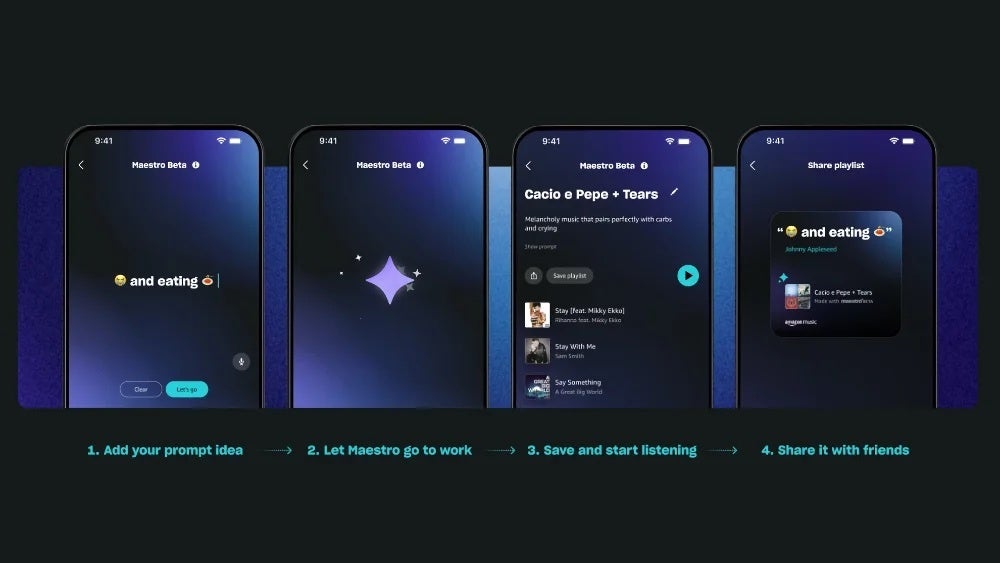
Spotify’s AI DJ raised the bar for music streaming, and now Amazon Music is throwing its hat into the ring with Maestro. This new AI-powered playlist feature is currently rolling out in beta to select Amazon Music users in the US on iOS and Android.
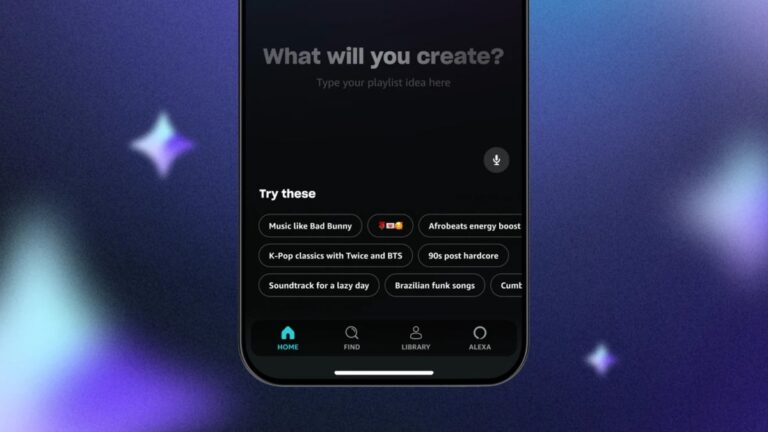
If you’re part of the rollout, you’ll spot Maestro either on your home screen after updating the app, or by hitting the plus button to create a new playlist. However, where things get interesting is how you create them. Maestro uses natural language, meaning you don’t need technical terms to build your playlists.With Maestro, everything starts with a simple prompt telling it what you want to hear. Want a playlist bursting with energy? Type “songs to get me pumped!” or maybe “upbeat summer jams”. Maestro even understands emojis, in case you’re struggling to find the words to best describe your mood.
Image Credit: Amazon
However, Amazon is clear: this is a beta feature. Maestro, like any new AI tool, will probably have some hits and misses as it learns what you like. They’ve even built-in safeguards to try to block offensive language or prompts that are just too inappropriate.
As a brand-new feature, Maestro is currently accessible to a limited number of Amazon Music users across Free, Prime, and Unlimited tiers. If you’re in the beta, you’ll see the option front-and-center in the app. While Unlimited subscribers can instantly listen to and save their generated playlists, Prime and free-tier users get 30-second previews to help them decide if the playlist is a good fit.
The battle for your ears is getting interesting. Spotify jumped ahead with its AI DJ, but Amazon’s Maestro signals that the competition isn’t far behind. Soon, generating playlists based on moods, vibes, or even bizarrely specific requests might become the standard way we listen to music.