If you want additional storage on Google Photos, then you’re going to have to pay. 15GB might be enough for some people, but not for shutterbugs. Google Photos has a Storage Saver function that will help you conserve storage without having to pay. Well, the Google Photos’ Storage Saver could be coming to the mobile app.
Currently, Storage Saver is only available on the web version of Google Photos. This feature will take backed-up media and compress it in order to save storage space. It’s not the preferred method, but it’s still something. If you want additional storage, it starts at $1.99/month. However, if you don’t want to be tied to a monthly subscription fee, then your only options are to either compress your media or start deleting photos.
Google Photos could bring Storage Saver to the mobile app
This news was discovered via an APK deep dive. Because of this, you’re going to want to take this news with a grain of salt. An APK deep dive is when a person digs into the code of the latest version of an app to discover potential new features in the pipeline. However, since this feature has yet to be officially announced, Google could change it or cancel it at any point.
Strings of code within the app allude to the Google Photos app eventually allowing users to use the Storage Saver feature:
<string name=”photos_cloudstorage_ui_compressiondialog_message”>Your eligible photos & videos will be permanently backed up in a reduced size. This step can’t be reversed.</string>
<string name=”photos_cloudstorage_ui_compressiondialog_success_toast_text”>Compressing your existing photos & videos. This may take a couple of days.</string>
<string name=”photos_cloudstorage_ui_compressiondialog_title”>Compressing photos & videos can’t be undone</string></code>
There’s no going back
The strings give us a little bit of insight into what the company plans to do with this feature. Firstly we see the “Yes” text that will be in a button you’ll use to confirm whether or not you want to compress your data. Next, we see the text warning you that compressing your media is permanent. So, if you compress your data, you will not be able to uncompress it and restore it to its original quality.
Depending on the media, you may or may not notice the difference in quality. However, if you’re a photographer who values the quality of the photos you take, then you may want to avoid compressing your backed-up photos.
Also, it appears that you can only compress media once a day. That’s an odd mechanic. In any case, if you are in desperate need of storage space, and there are no other options, you will at least be able to conserve a little bit of space by compression.
MediaTek’s flagship chipsets are becoming increasingly popular for their value proposition. The company even managed to outperform Qualcomm in terms of market share in Q4 2023. MediaTek seems to be currently working on a new flagship SoC for Android, termed MediaTek Dimensity 9400, and it has already started gathering the attention of the crowd. It’s been said that it might have the biggest die size for a smartphone chipset.
MediaTek Dimensity 9400 will have the biggest die size with over 30 billion transistors
MediaTek is working diligently on its upcoming chipset, and the efforts seem to be visible. According to reports, the Dimensity 9400 will have a die size measuring dimensions of 150mm², which is even bigger than NVIDIA’s GT 1030, which measures 74mm². This gives the chipset the largest die size to date on a smartphone chipset, and it’s intriguing to say that being a smartphone chipset, it is very close to a desktop chipset in terms of die size.
Increasing the chipset’s die size is expensive, but it does have its own set of advantages. For example, the chipset can accommodate more transistors, a higher cache, and a bigger neural processing unit.
The Dimensity 9400, owing to the larger die size, will have over 30 billion transistors. This is 32% higher than the total of 22.7 billion transistors found on the Dimensity 9300.
A Bigger die size may cause overheating and other issues
Well, having a bigger die size for a chipset is not all rosy for the MediaTek Dimensity 9400. It can add several additional manufacturing-related costs to the chipset, which would possibly end up giving it the title of MediaTek’s most expensive smartphone chip. On top of this, it is going to build it on a TSMC 3nm fabrication process, and therefore, expecting the chip to be cheaper would be completely pointless.
To add further, there have been reports that the Dimensity 9400 may heat up as it prioritizes the raw performance cores over ARM’s power efficiency cores. This is usually the case with almost all of the chipsets having higher-clocked CPUs. It’s likely not the die size to blame. The heating could be due to the ARM’s Cortex X5 CPU and we should not draw any final conclusion before the commercial release of the chipset.
Update: OnePlus recently pushed out a new update to the OnePlus 11, which is OxygenOS 14.0.0.64.
On Tuesday, February 7, 2023, OnePlus announced the OnePlus 11. This is the latest and greatest flagship from OnePlus, and it does bring back Hasselblad and the Alert Slider, which is a really great thing to see.
Unlike in previous years, there’s just one OnePlus 11 model. There’s no “pro” model this time around. So choosing which phone to buy is a lot easier. But here’s everything you need to know about the OnePlus 11.
OnePlus 11 specs
Here’s the specs of the OnePlus 11, and how it compares to the OnePlus 10 Pro and OnePlus 10T from last year. So you can see if it’s worth it to upgrade or not.
OnePlus 11
OnePlus 10T
OnePlus 10 Pro
Display
6.7-inch FHD+ Fluid AMOLED Adaptive 120Hz
6.7-inch FHD+ Fluid AMOLED Adaptive 120Hz
6.7-inch FHD+ LTPO Fluid2 AMOLED Adaptive 120Hz
Processor
Snapdragon 8 Gen 2
Snapdragon 8+ Gen 1
Snapdragon 8 Gen 1
RAM
8GB/16GB
8GB/16GB
8GB/12GB
Storage
128GB/256GB
128GB/256GB
128GB/256GB
Battery Capacity
5000mAh
4800mAh
5000mAh
Charging Speeds
80W fast wired charging
150W (125W in North America) fast wired charging No wireless charging
80W (65W North America) fast wired charging 50W wireless charging Reverse wireless charging
Software
Android 13, OxygenOS 13
Android 12, OxygenOS 12.1
Android 12, OxygenOS 12
Rear Cameras
50MP wide 48MP ultrawide 32MP telephoto
50MP wide 8MP ultrawide 2MP macro
50MP wide 8MP telephoto 48MP ultrawide
Front Camera
16MP
8MP
32MP
Dimensions
163.1 x 74.1 x 8.53mm
163 x 75.37 x 8.75mm
163 x 73.9 x 8.6mm
Weight
205g
203.5 grams
200.5 grams
Price
$699
$649
$799.99
Colors
Titan Black Eternal Green
Moonstone Black Jade Green
Volcanic Black Forest Emerald
Available
Pre-order on Feb 7
Yes
Yes
How much does the OnePlus 11 cost?
The OnePlus 11 is one of the more affordable flagship smartphones that will launch in 2023. And it is actually launching at a cheaper price than the OnePlus 10 Pro did last year. Starting at just $699. That’s for the 8GB/128GB model, while the 16GB/256GB model is going to be $799.
The 8GB/128GB model will only be available in Titan Black, while the upgraded model will also come in Eternal Green.
This is a pretty competitive price for OnePlus here. Considering the competitors are closer to $800 for a smaller phone, like the new Galaxy S23 that was announced recently. And it’s even undercutting the Pixel 7 Pro.
Where can I buy the OnePlus 11?
Unfortunately, the OnePlus 11 isn’t going to be available from carriers. So you will need to buy it unlocked. Which is a good thing, it means that you can take it pretty much anywhere, and put it on any carrier.
You can buy it from Amazon, Best Buy and OnePlus.com. Pre-orders opened on February 7, with the open sales starting on February 16.
What carriers support the OnePlus 11?
Since none of the carriers are selling the OnePlus 11, you might be wondering what networks will support the OnePlus 11? Well, OnePlus has provided us with that list. Here’s all the networks that the OnePlus 11 will work on:
United States:
T-Mobile 5G
AT&T 5G
Verizon Wireless 5G
Visible Lagacy 5G
Visible VZW Core 5G
Mint Mobile 5G
Google Fi 5G
Ultra Mobile 5G
Simple Wireless 5G
Assurance Wireless 5G
Metro By T-Mobile 5G
Cricket 5G
Viaero 4G only
Altice 5G
Tracfone ATT 5G
Redpocket 5G
Airvoice5G
Puretalk 5G
Republic 5G
Boost Mobile 5G
Ztar (good2go mobile) 5G
Canada:
Bell Mobility 5G
Rogers Wireless 4G only
Telus Mobility 5G
Freedom Mobile 4G only
What colors does the OnePlus 11 come in?
The OnePlus 11 is available in two colors. That’s Titan Black and Eternal Green. The Titan Black is available in both the 8GB/128GB model and the 16GB/256GB models. While the Eternal Green color is limited to just the 16GB/256GB model.
The Titan Black color is a darker black, which has a sandstone look to it. It’s a matte finish, so it doesn’t pick up fingerprints as easily. While the Eternal Green is a semi-darker green, which is also a matte finish. But it’s not as textured as the Titan Black color.
What new features did OnePlus add?
OnePlus hasn’t added a lot of software features to the OnePlus 11, instead, a lot of the features are hardware based. This is because it is launching with OxygenOS 13 the same software that launched last year. So instead, we have some cool features like UFS 4.0 storage, WiFi 7 and even more software updates.
UFS 4.0
OnePlus has always been about the latest bleeding edge technology, and that’s what we’re getting here with the OnePlus 11. It’s sporting UFS 4.0 storage. But that is only on the 256GB model. This is going to improve the power efficiency, wider bandwidth and improved read and write speeds. Which is going to make the OnePlus 11 feel even faster than it actually is.
WiFi 7
OnePlus has also added WiFi 7 to the 11 this year. It’s not the first smartphone to do this, and likely not the last. This is all about future-proofing for OnePlus, since there are very few WiFi 7 devices out there. In fact, there are no WiFi 7 routers available yet. So you won’t be able to use this feature for a bit.
4 years of software updates
OnePlus is promising four years of software updates and 4-5 years of security updates. That’s a bit longer than it had previously promised. That’s definitely good to see. However, the problem here is that OnePlus is generally pretty late with software updates for new versions of Android. So hopefully they can get that ironed out. Still, the OnePlus 11 should see Android 17, which is impressive.
What cases are available?
As usual, OnePlus has a number of first-party cases available for the OnePlus 11. There’s not a lot of third-party ones available just yet. But they will be launching soon. Here’s what OnePlus has available for the 11.
Sandstone Bumper Case
This is OnePlus’ signature case. It’s the same sandstone texture that it used on the original OnePlus One all those years ago. It’s a really good bumper case for your OnePlus 11, that does also add a good amount of grip to the phone. So it’s less likely to fall out of your hands. This case is available for $24.99.
The Aramid Fiber Bumper Case is another popular one. It’s a carbon fiber case that is surprisingly thin, and protective. This one’s a bit more expensive, it’s coming in at $39.
The OnePlus 11 is a pretty amazing smartphone, and at its starting price of $699, it’s really hard to pass it up. It has all of the latest specs, along with an incredible camera, great battery life and a great gaming experience. Of course, we’d recommend getting the 16GB/256GB model, as it is going to be a lot more future-proof. And at $799, it’s still pretty impressive.
Social media continues to evolve, with new platforms entering the fray with novel ideas. However, it is difficult to challenge the established players. The latest research by marketing measurement platform Lifesight.io has just proved that. The firm used data from SEMrush to determine the top 10 most popular social media platforms in 2024 based on total visits last year. The list contains familiar names.
YouTube is unmatched in terms of user visits
According to the report, YouTube was visited 1.35 trillion times in 2023. That’s a staggering 80.49% growth in annual visits from 263.3 billion in 2019. This helped Google’s video platform build a massive lead at the top. Facebook is the next most popular social media platform in 2024, and it had only 216.4 billion visits last year. The Meta-owned platform remained almost flat between 2019 and 2023, growing just 15.33%.
The fact that YouTube’s total visits in 2023 were almost double the next nine most popular social media platforms is a testament to its popularity. Facebook, meanwhile, isn’t under threat despite a stagnation in recent years. It is distantly followed by X (formerly Twitter) with annual visits of 112.9 billion in 2023. Meta should be wary of X’s growth rate, though. The Elon Musk-owned platform saw a 63.19% increase in visits from 41.6 billion in 2019.
Instagram, another Meta-owned platform, registered 87.3 billion visits in 2023, up 62.40% from 32.8 billion in 2019. It is predominantly used on mobile with male users constituting two-thirds (67%) of its total visits. Reddit is right on its heels, though. With a better growth rate between 2019 and 2023 (68.72%), Reddit is threatening to leapfrog Instagram soon. It had 81.0 billion visits last year, making it the fifth most popular social media platform in 2024.
What should be a more concerning stat for Instagram is how Reddit has a similarly male-dominated user base and a high percentage of mobile traffic (72.27%). TikTok, the next platform on this list, is also moble-centric. However, it is equally popular among male and female users. Debuted in 2018, the Chinese app had just 0.7 billion visits in 2019. It reached 41.8 billion in 2023. Started as a shot-form video platform, it has expanded to other areas in recent years.
Most popular social media platforms have a majority male user base
WhatsApp, LinkedIn, Twitch, and Quora made up the top 10 most visited social media platforms last year. All of these platforms registered strong growth in annual visits between 2019 and 2023, ranging between 48% and 68%. While each has its specialty—WhatsApp is used for communication, LinkedIn for building professional networks, Twitch is popular in the gaming community, and Quora is used for knowledge sharing—there is something in common. All of these apps have a majority male user base.
Considering the current social media landscape, the top ten most popular platforms should remain unchanged next year. There may be some changes in the order (unlikely in the top three) but we don’t see a new entrant on the list. The looming nationwide ban on TikTok in the US may cause some shake-ups, though. TikTok had 170 million users in the US last year.
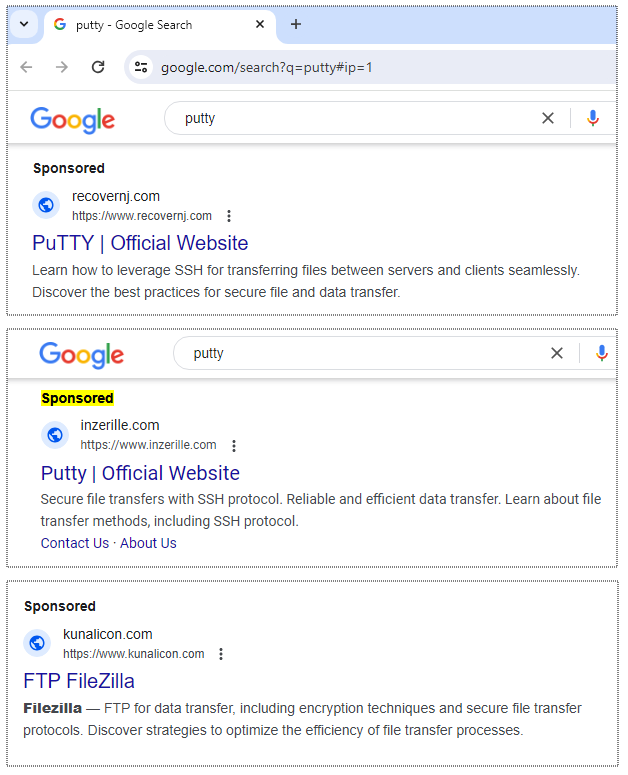
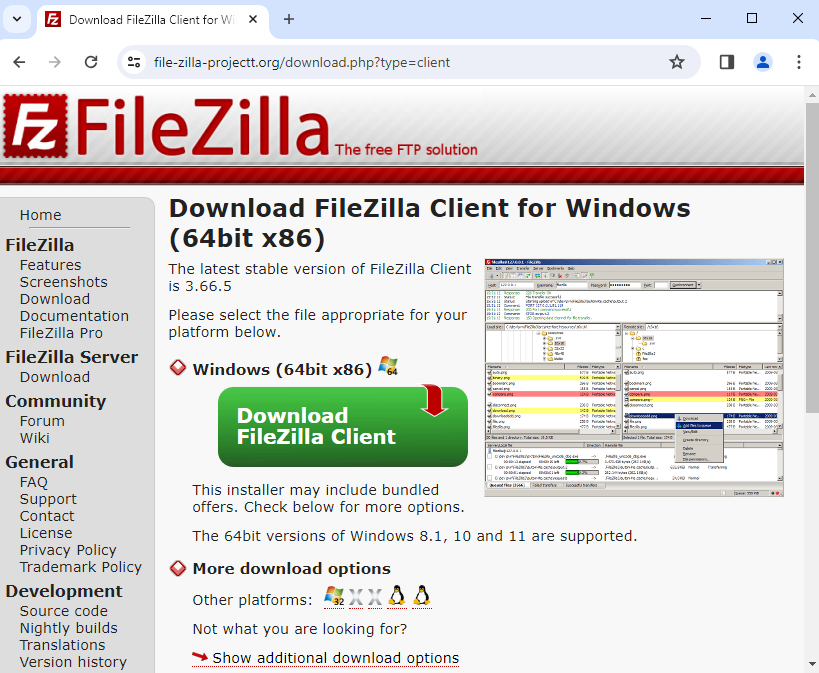
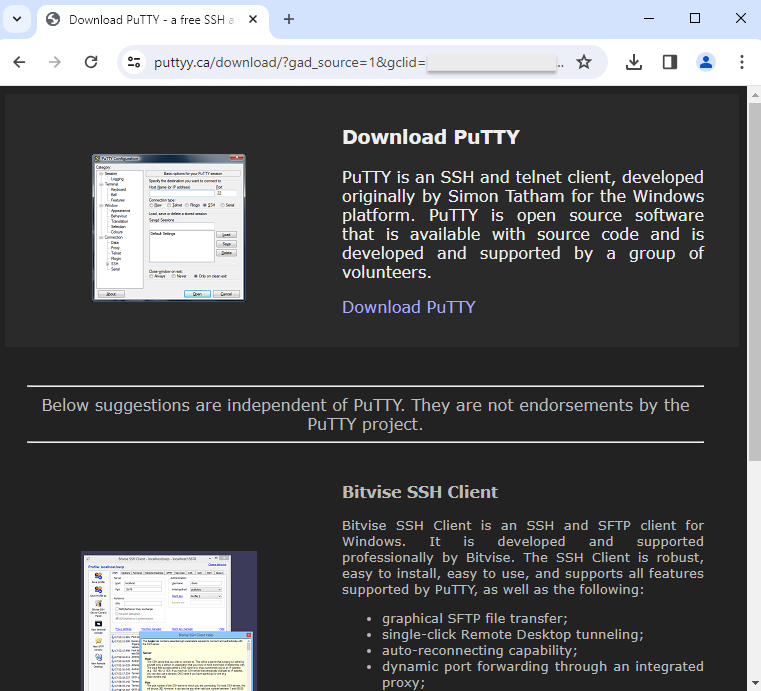
In the past couple of weeks, we have observed an ongoing campaign targeting system administrators with fraudulent ads for popular system utilities. The malicious ads are displayed as sponsored results on Google’s search engine page and localized to North America.
Victims are tricked into downloading and running the Nitrogen malware masquerading as a PuTTY or FileZilla installer. Nitrogen is used by threat actors to gain initial access to private networks, followed by data theft and the deployment of ransomware such as BlackCat/ALPHV.
We have reported this campaign to Google but no action has been taken yet. This blog post aims to share the tactics, techniques and procedures (TTPs) as well as indicators of compromise (IOCs) so defenders can take action.
Step 1: Luring victims in via malicious ads
The initial intrusion starts from a malicious ad displayed via Google search. We have observed several different advertiser accounts which were all reported to Google. The lures are utilities commonly used by IT admins such as PuTTY and FileZilla.
Online ads from search engine result pages are increasingly being used to deliver malware to corporate users. ThreatDown users that have DNS Filtering can enable ad blocking in their console to prevent such malvertising attacks:
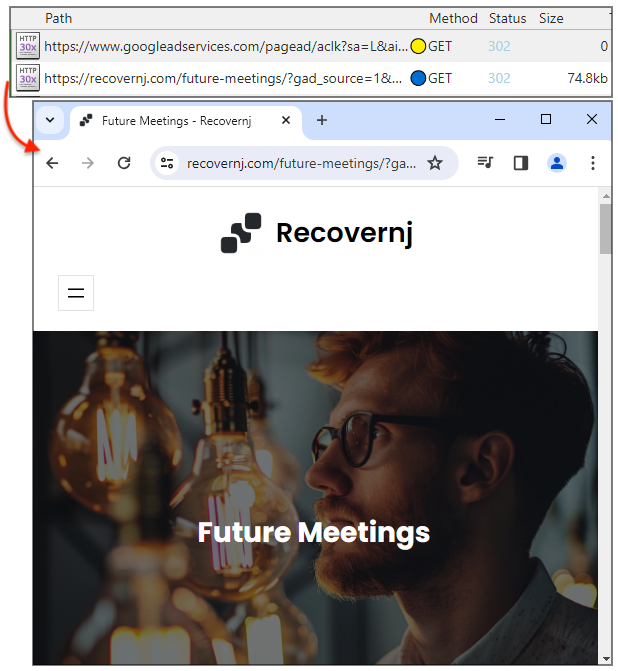
Step 2: Directing users to lookalike sites
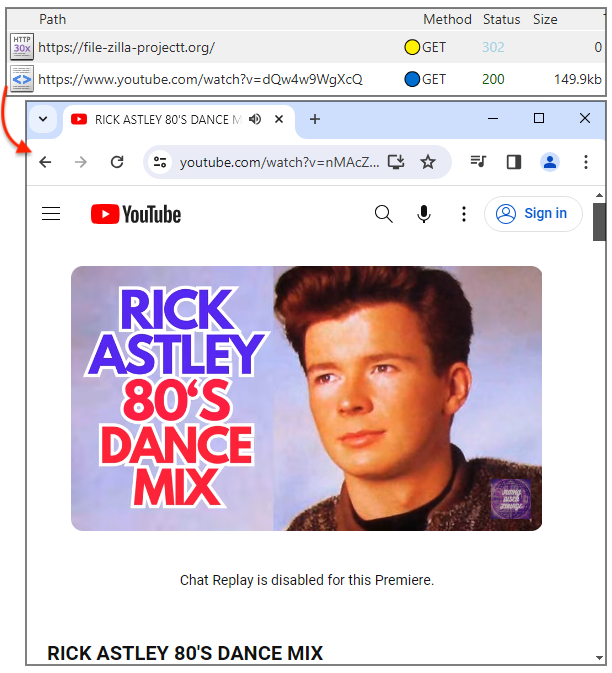
The malvertising infrastructure deployed by Nitrogen threat actors uses a cloaking page that can either redirect to a decoy site or the infamous Rick Astley video. The redirect to a decoy page can be activated if the campaign is not weaponized yet or if the malicious server detects invalid traffic (bot, crawler, etc.).
The Rick Astley redirect is mostly to mock security researchers investigating this campaign:
Actual lookalike pages are meant for potential victims. They are often good-looking copycats which could easily fool just about anyone:
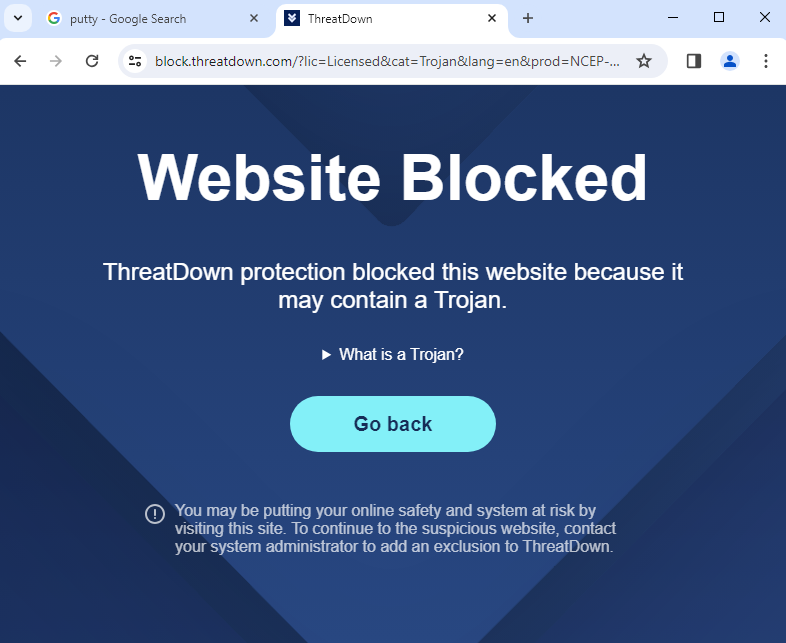
ThreatDown blocks these malicious websites to prevent your users from being social-engineered into downloading malware:
Step 3: Deploying malware via a fraudulent installer
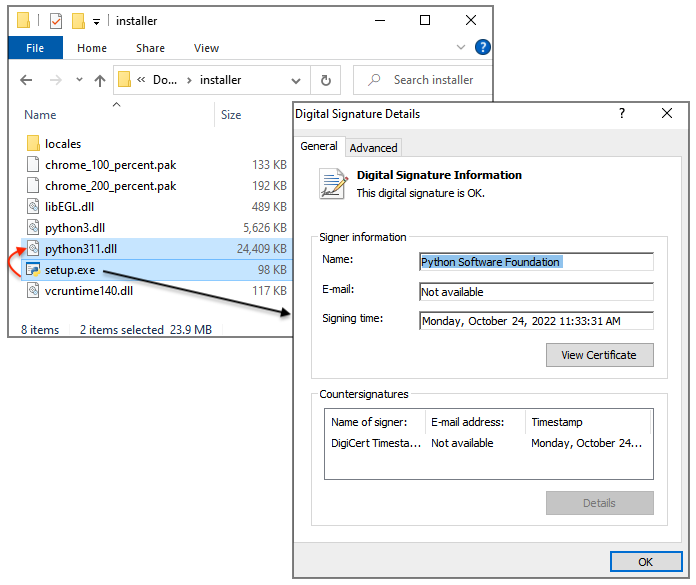
The final step in this malvertising chain consists of downloading and running the malware payload. Nitrogen uses a technique known as DLL sideloading whereby a legitimate and signed executable launches a DLL. In this case, setup.exe (from the Python Software Foundation) sideloads python311.dll (Nitrogen).
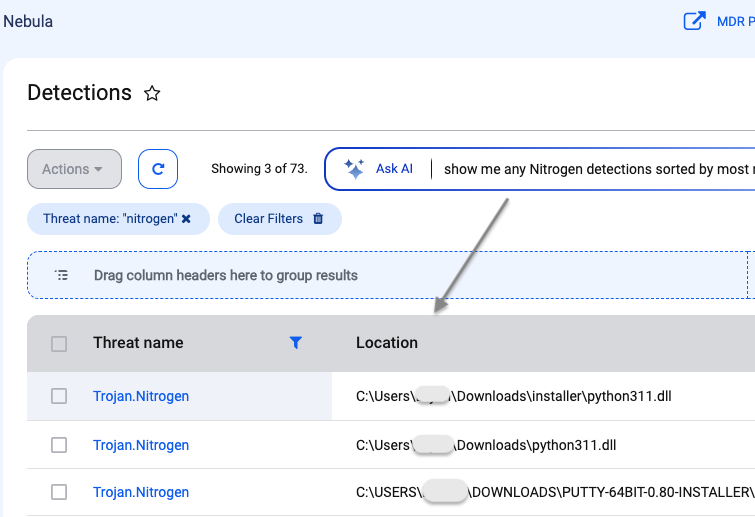
ThreatDown via its EDR engine quarantines the malicious DLL immediately. System administrators can log into their console and use the AI-assisted engine to quickly search and review the detection:
Recommendations
While there are many phishing training simulations for email threats, we aren’t aware of similar trainings for malvertising. Yet, the threat has become prevalent enough to warrant better user education.
Endpoints can be protected from malicious ads via group policies that restrict traffic coming from the main and lesser known ad networks. Click here for more information about DNS filtering via our Nebula platform.
LG decided to end its smartphone production a few years ago due to intense competition. However, the company has found a way to continue generating revenue from its past efforts – patent licensing deals.
In 2022, LG signed an agreement with Apple to license part of its mobile patent portfolio. This provided ongoing revenue even after the company exited handset manufacturing. More recently, LG sold 48 patents to Chinese technology manufacturer Oppo in another deal.
LG sells its mobile patent portfolio to Oppo
According to The Elec, LG’s sale of 48 patents to Oppo included technologies essential to modern mobile devices. Specifically, 34 of the patents are related to codecs – the software needed to compress digital video and audio into popular formats such as MP4 and AAC. The remaining 14 patents in this category are still pending with the USPTO.
LG retained a large portfolio of over 24,000 patents spanning technologies like 4G, 5G, Wi-Fi, and other core smartphone capabilities. Since the company now relies heavily on Samsung and Apple for component supply, directly challenging their patents was not a viable option. This made Oppo an attractive partner. Meanwhile, Oppo is expanding globally and it wants to strengthen its own patent portfolio.
The financial terms of the deal between Oppo and LG were not disclosed. However, it is believed that the Chinese company paid a premium for the LG patents, recognizing their strategic importance. The deal provides both immediate funds for LG during its transition away from phones. For Oppo, it strengthens its capabilities in streaming technologies.
LG Mobile suffered an operating loss from 2015 until its closure
LG Mobile just could not generate a profit during its last six years of operation. The company tried to change that for a long time, but it did not succeed in the attempt. It released quite a few interesting smartphones over the years, like the LG Wing, for example.
The company was also planning to release another futuristic phone soon, its rollable smartphone. That phone will never see the light of day, though, it seems, which is quite unfortunate.
Google Workspace is a productivity suite for business-focused individuals. As such, streamlining productivity is a very important aspect. Google has a new tool that will help users communicate with their colleagues more efficiently. Google Vids is a platform to quickly create videos using AI technology.
No, this is not Google’s answer to OpenAI’s Sora. It’s not quite as generative, and it’s for completely different purposes. We’re pretty sure that Google is going to unveil its own video generation platform to take on Sora at some point. The company has not stated so, but knowing Google, it is inevitable.
Google Vids will help you create videos using AI
Nowadays, we hear a ton of scary stories about AI technology and how it could possibly have a negative effect on humanity. However, there are also simple tools that people can use to save a few minutes of their day. Google Vids is one of them. This is a platform that allows people to quickly create videos that they can share with their colleagues. Being business-focused, it’s not meant to create a trending video or generate footage from scratch.
Vids can be thought of as a tool to help you better communicate with your colleagues instead of a slide presentation or an email. Businesses rely on communication between workers. Sometimes, executives have to distribute long messages amongst the workers.
This could either be in the form of long emails keeping workers in the loop, lengthy presentations explaining changes to the company, multi-page documents explaining company policy, Etc. Crafting and sending these messages can be very time-consuming, and not many people want to spend time doing that when they could be doing other important tasks. So, this is where Google Vids comes in.
This is a platform where you can quickly produce videos. You will be able to use videos from sources including Google Drive, and put them on a timeline. You will be able to add voiceovers and other assets to properly get your point across.
If you don’t have all of the assets you need, you shouldn’t have to worry. Google has a library of stock video and audio that you can use in your Vids. So, with very basic video editing skills, you’re able to put together a great video presentation for your colleagues.
Where does AI fit into this?
This is a Google product, so you should expect the typical AI shenanigans. Right off the bat, Google will let you use Gemini to help augment your video. If you don’t feel like editing your video, Gemini can provide assistance. It has the ability to make storyboards, generate AI voiceovers, and even create the first draft of the video for you. You will have powerful generative AI tools at your disposal, so there’s a high chance that each Vid you make will be high quality.
When you’re finished with your video, you have the ability to export it as an mp4 file and share it with your colleagues. So, this is not Google’s powerful generative AI video generator. It is a helpful business tool to help Google Workspace users better communicate with their colleagues.
Automattic, the company behind WordPress and Texts.com, has acquired Beeper, the startup that offers a unified chat experience across various messaging services. This acquisition was completed for a reported $126 million, prompting a merger between the two existing messaging apps.
Even though Beeper has been in the news quite a bit lately, mostly because of its highly publicized dispute with Apple over iMessage integration on the platform, the app has been technically in beta status. This ends today as Beeper has announced in its blog along with the acquisition announcement. Beeper is now available to everyone without a waitlist and continues to put a lot of emphasis on user privacy and data control, which fits in well with Automattic’s focus on free open-source software.
Beeper will continue to run on its own under Automattic’s “Other Bets” section after the purchase. This means that everyone will still be able to use the Beeper app, and the company will still protect customer privacy. The business plan of giving away a free app with paid premium features is also likely to stay the same.
Eric Migicovsky, Beeper’s founder, is hyped on the potential of merging Beeper’s tech with the desktop-centric strengths of Texts.com. Looks like they’re taking the “best of both worlds” approach here. He also gave a shoutout to Texts.com founder Kishan Bagaria, mentioning a long history of collaboration between them. That said, Migicovsky will be replacing Bagaria as “Head of Messaging” in the newly merged version of Beeper — since the Beeper branding will prevail — leaving some uncertainty as to what Bagaria’s new role will be.
Both Beeper and Texts.com users have nothing to fear so far. Migicovsky assures that nothing will change for either product today, except for Beeper’s apps coming out of beta. Additionally, Beeper’s privacy policy and ToS will remain the same for now.
As both teams merge, we shall see how they work towards building “the best chat app on earth,” as Migicovsky has so often said. The potential for an open-source messaging platform is certainly intriguing, and it looks like Beeper is one step closer to achieving that goal.
WordPress, a widely used content management system, owes a great deal of its flexibility to plugins. These small software components effortlessly improve the functionality of your website. Having the right resources and tools is crucial for developers venturing into WordPress development services. Let’s explore the essential elements that can facilitate and enhance your journey in this field.
Essential Tools for WordPress Development
WordPress powers millions of websites worldwide (472 million), from personal blogs to enterprise-level e-commerce platforms. Developers face challenges in such a diverse ecosystem, from writing clean and efficient code to ensuring seamless website deployment and maintenance. The right tools act as enablers, empowering developers to navigate these challenges easily and precisely.
Code Editors
Choosing a suitable code editor is akin to selecting the right brush for an artist. Versatile editors like Visual Studio Code or Sublime Text provide many features such as syntax highlighting, auto-completion, and Git integration. These features enhance productivity and foster a conducive environment for writing clean, maintainable code.
Local Development Environments
Developing and testing WordPress websites on a live server can be risky and inefficient. Local development environments, facilitated by tools like XAMPP, MAMP, or Docker, provide a safe and controlled environment for experimentation and iteration. Developers can test new features, plugins, and themes without fearing disrupting the live website, ensuring a seamless user experience upon deployment.
Version Control Systems
Version control systems like Git are the backbone of efficient teamwork in a collaborative development environment. Paired with platforms like GitHub or Bitbucket, these systems enable developers to manage code changes seamlessly, collaborate with team members in real time, and maintain a comprehensive project history. This fosters a cohesive and organized development environment, ensuring everyone is on the same page throughout the development lifecycle.
Debugging Tools
No code is perfect, and debugging is inevitable in the development process. Specialized debugging tools like Query Monitor or Debug Bar provide developers with invaluable insights into the inner workings of their WordPress projects. These tools are indispensable for maintaining a robust and efficient website, from identifying and troubleshooting issues to monitoring performance and optimizing the codebase.
Must-Have Plugins for WordPress Development
WordPress’s flexibility and extensibility are key factors contributing to its popularity among developers worldwide. However, the sheer volume of available plugins can be overwhelming, making it essential for developers to discern and integrate the most suitable ones into their projects. Here’s why selecting the right plugins is imperative for effective WordPress development:
SEO Plugins
Optimizing websites for search engines is essential for driving organic traffic and enhancing visibility. SEO plugins like Yoast SEO or Rank Math provide developers with robust tools to optimize their WordPress sites effectively. Features such as XML sitemap generation, meta tag optimization, and comprehensive content analysis empower developers to bolster their site’s visibility and relevance in search engine results, increasing organic traffic and user engagement.
Performance Optimization Plugins
User experience is paramount in retaining visitors and fostering engagement on WordPress websites. Performance optimization plugins such as WP Rocket or W3 Total Cache offer many optimization features to improve site speed and performance. From caching mechanisms to asset minification and lazy loading, these plugins ensure a snappier and more responsive user experience, leading to higher user satisfaction and retention.
Security Plugins
Protecting WordPress websites against security threats is a top priority for developers. Security plugins like Wordfence or Sucuri Security fortify the site’s defences with features such as firewall protection, malware scanning, and enhanced login security. By implementing these plugins, developers can ensure peace of mind against potential threats and vulnerabilities, safeguarding their websites and user data from malicious attacks.
Development & Debugging Plugins
Efficient development workflows are essential for maintaining productivity and delivering high-quality WordPress projects. Development and debugging plugins such as Query Monitor or Debug Bar streamline debugging and optimization by providing critical insights into database queries, PHP errors, and HTTP requests. By leveraging these plugins, developers can identify and address issues swiftly, ensuring the seamless operation of WordPress projects and minimizing development time.
Elevate Your WordPress Development Experience
Integrating these indispensable tools and plugins into your WordPress development arsenal empowers you to transcend boundaries, streamline processes, and unlock the full potential of your projects. By staying abreast of the latest advancements in the WordPress ecosystem, you can continually refine and optimize your development practices, fostering innovation and excellence in your endeavours.
These days, scams are everywhere. It’s happening to everyone, seemingly every single day. Now, we’re learning about a new scam that is targeting T-Mobile customers, thanks to Reddit user u/mgahs.
The user details the scam in his Reddit post, and it seems the scam is pretty complex. After ignoring the call twice, the scammers called back a third time, so they answered. The scammers say they “are calling because someone ordered two iPhone 15 Pro Max phones on your account but then changed the address on the account, and we wanted to confirm before processing the order.” The user hung up immediately.
The scammers called back of course, saying they must have gotten disconnected. The user says that he had not ordered any phones. So the scammers say, “Ah, that’s very suspicious. I’ll go ahead and cancel the order, and we’ll put a security freeze on your account.”
After a bit more talking, the scammers say they need to reset the password on his T-Mobile account. This is fine, except the user already logged in and did this. He told the scammers he already changed it, but they were adamant that they still needed to change it. What really tipped him off here is that the scammer said he was going to send him a text, and they need to respond “YES” and then read back the code it provides you. But, actual password change texts from T-Mobile literally say “T-Mobile will never contact you to ask for your code”.
The user read back a made-up code to the scammers, who then said thanks and that the account is now locked down. After that he hung up, called T-Mobile by dialing 611 on his phone.
The good news is, no damage was done, no phones were purchased on his account. But that is a really elaborate scam.
If it smells fishy, chances are it’s a scam
Unfortunately, these days we all have to be very cognizant about scams. So if something sounds or reads fishy, it’s probably a scam or a phishing attempt. Phishing is where people try and get your information, so it’s different from regular spam.
The scary part here is that the scammers were able to make it look like T-Mobile was calling and texting him.