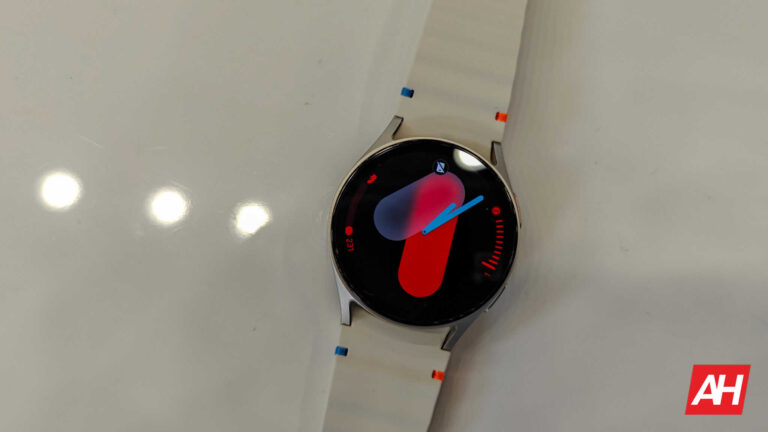
Samsung today held its Unpacked 2024 event and made some major announcements. The company introduced its latest foldable smartphones including the Galaxy Z Flip 6 and Z Fold 6, apart from the Galaxy Ring. In addition, the company also took the wraps off its latest smartwatches. The new Galaxy Watch 7 and Watch Ultra have arrived as the first wearables powered by the Wear OS 5 version.
The Galaxy Watch 7 and Galaxy Watch Ultra offer Wear OS 5, even before Google’s own smartwatches
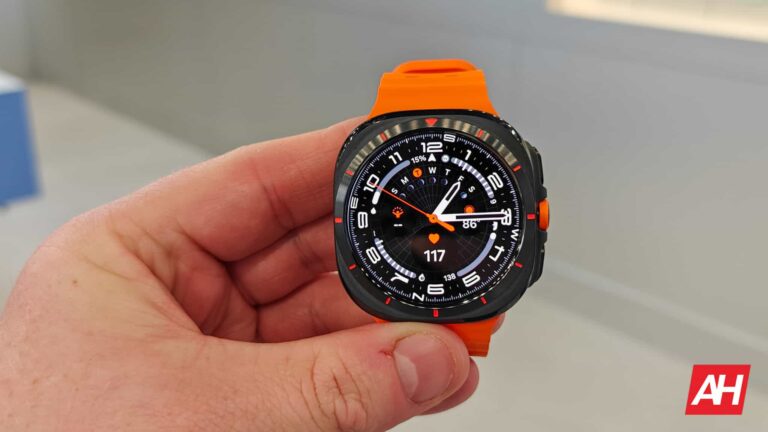
The Galaxy Watch 7 and Galaxy Watch Ultra are the first smartwatches in the world to offer Wear OS 5, even before Google devices. Notably, a similar thing happened with the Wear OS 4 version. It was first delivered to the public with the Galaxy Watch 6 series, before being included in the Pixel Watch 2. The new OS likely won’t be available on other smartwatches, until next month when Google may unveil the Pixel Watch 3.
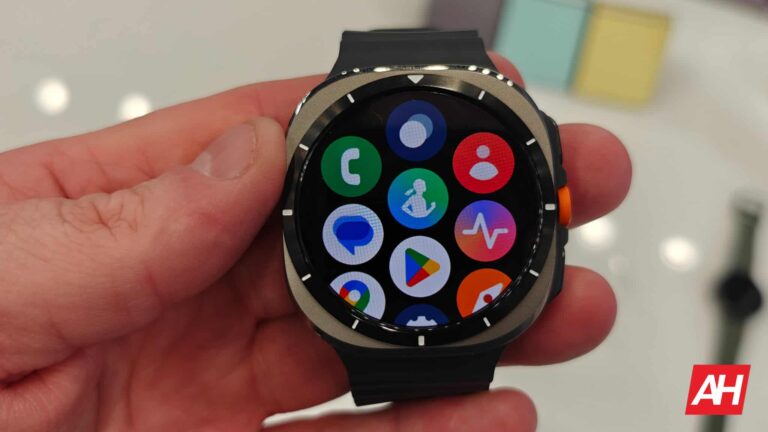
The latest version of Google’s OS for smartwatches was introduced two months ago at the Google I/O 2024 event. Wear OS 5 offers a similar UI to its predecessor, but gets many changes under the hood. As per Google, the Wear OS 5 version is optimized to deliver better battery life and enhanced performance. There are many new health features, apart from access to more data types. It also offers additional options for watch faces, a new grid-based app launcher, and more.
As of now, it’s not clear if Wear OS 5 will be available for the previous Samsung smartwatches. That said, the latest Samsung wearables will have exclusive access to the latest Wear OS version for some time. Notably, the Galaxy Watch 7 and Galaxy Watch Ultra will get four years of updates.
Samsung’s latest smartwatches with Wear OS 5 are available to pre-order
Samsung’s new Galaxy Watch 7 and Watch Ultra smartwatches are available to pre-order starting today. The new wearables can be pre-ordered in multiple variants from the company’s website. As for the pricing, the Galaxy Watch 7 is available starting at a competitive price tag of $299. The Galaxy Watch Ultra is the brand’s most expensive smartwatch to date with a starting price of $649.
It’s been a little while since Samsung announced a new pair of earbuds. It has two series, which are the base Buds and the Buds Pro. The company announced new iterations of both today, and they bring a new…. if familiar design. Let’s not mince words, they have some design traits we see with the Apple AirPods.
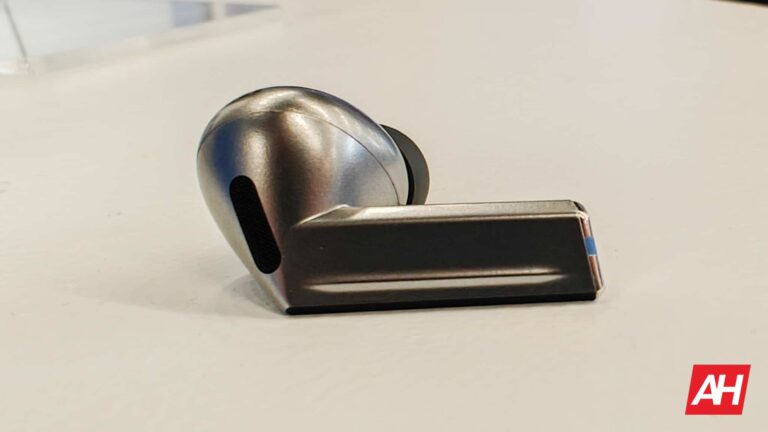
Regardless, they do stand out with the angled bottoms of the stems. This gives them a bit of an edgier design. Also, there’s an LED strip that runs up the stem. They add to the overall aesthetic.
The Galaxy Buds 3 Pro are for the true audio lovers, as it comes with Samsung two-way speakers, and dual amplifiers. They have separate controls for the woofer and the tweeter. Also, these earbuds come with a new high-quality codec that can stream audio at up to 24-bit/96kHz, which is double the sample rate of the previous Galaxy Buds Pro.
How to pre-order the Galaxy Buds 3
Whether you’re planning on ordering the Galaxy Buds 3 or the Pro, the process is the same. Firstly, it’s important to know the prices. The Galaxy Buds 3 cost $179.99, and the Galaxy Buds 3 Pro cost $249.99. However, if you order through the pre-order period, then you can get them at a discount (the Buds 3 will cost $129.99 and the Pro will cost $199.99). Go to the pre-order links below.
When on the page, the first thing you want to do is make sure that you selected the right model you want. It’s easy to click on the wrong link by mistake. You can flip through the carousel of points up top. You’ll see some of the stand-out features like the battery life, real-time translation, etc.
The first step to customizing your order will be selecting the color. You have an option between White and Silver. The price will remain the same for both colors.
Trade-in
Next, is the trade-in section. If you have a pair of earbuds to trade in, you can get a discount on your order. The Yes, trade-in option will be selected by default. If you don’t have a trade-in, just click on the No option.
If you do have an old pair of earbuds lying around that you want to trade in, leave it on the first option. Under the options, click on the Brand dropdown. You’ll be able to select Samsung or Other. If you have a pair of Galaxy Buds that you can trade in, then select Samsung.
Depending on the earbuds you trade-in, you’ll get a different discount. For example, if you have a pair of Galaxy Buds 2 Pro, you’ll get $100 off of your order. The other eligible models are the Galaxy Buds 2 ($50 off), Galaxy Buds Pro ($50 off), Galaxy Buds Live ($40 off), and Galaxy Buds+ ($40).
If you have a pair from another company, leave it on Other and go to the Select a Device option. You’ll have two options, but they will both net you a $20 discount only.
When you select the model you want to trade in, you’ll want to agree to the trade-in terms. Be sure to read them if you have any questions.
Samsung Care+
The next section will give you the option to add a Samsung Care+ plan. This will offer you mail-in repair and replacement services, 24/7 phone/online support, and genuine parts for repairs.
The plan costs $19 for two years. If you trade in a pair of old headphones for $20, that covers the cost of the plan. This is for the Care+ Essential plan.
Right below that section, you’ll see the Additional plans button. This will expand the standard Samsung Care+ section. The standard plan offers all of the aforementioned perks along with protection against drops, spills, and mechanical breakdown.
Also, if you don’t want a plan, you can click the No Coverage button.
Exclusive offers
Samsung often has exclusive offers available for people ordering from the Samsung website. There’s only one offer, and that’s an extra charging case. It’s a $29.99 value, but you can get it for free.
Payment plans
You can make a one-time payment, but there are also some payment plans that you can use. There’s a monthly plan that will split the price up into 24 payments. It’ll be like getting a two-year contract on them. If you don’t want to pay over the course of two years, you can split the cost into four payments, and pay every two weeks. The latter option can either be done through Klarna or Affirm.
Just know that financing options may require a credit check. If you don’t have the best credit, there’s a chance that it will be rejected.
Finalizing your order
Once you’re all done, it’s time to pledge your money to Samsung. Look over the sub-total and total. Make sure you know how much you’re paying, that you didn’t add any services you didn’t want, and that you didn’t choose a trade-in offer when you don’t have one.
Once you’re sure, click the Pre-order button. When you do that, you’ll be taken to the page where you’ll put in your payment information and address.
Samsung is promising a respectable amount of time for updates on its new Galaxy Watch 7 and Galaxy Watch Ultra, and that’s good news for anyone planning to invest money in either of the new smartwatches. Which, by the way, you can already pre-order. Samsung officially announced the Galaxy Watch 7 and Galaxy Watch Ultra today at its Galaxy Unpacked event.
And while there are lots of exciting new features to talk about, there’s another important area that users are going to want to pay attention to. The timing of software updates. The last thing you want is to buy a new smart device and have it become obsolete in a couple of years. Even at the reasonable $299 starting price of the Galaxy Watch 7, that’s still a lot of money to spend for the device to kick the bucket two years down the road.
You can certainly keep your old smartwatches for longer than that. I have, and it’s not posed a major issue thus far. Having said that, the longer you can receive updates for a smartwatch, the better. As these software updates can bring not only new features but improved security and stability too.
The Galaxy Watch 7 and Galaxy Watch Ultra will get updates for 4 years
Samsung has confirmed that both watches will get updates for 4 years. So you can rest assured that any important improvements will be available to you for a while should you decide to buy one. The company doesn’t specify what these updates will include. Chances are though, this means security and feature updates throughout this time period.
It’s also likely that there will be at least one major Wear OS revision during the 4-year update lifespan. However, this isn’t something Samsung specifically stated. What’s more, is that any major Wear OS version updates could depend on whether or not either watch will have the hardware to support them. As has been the case with some smartwatches that didn’t get the updates to Wear OS 3 or Wear OS 4.
Some features may not be available at launch
Another thing to consider with regard to the 4 years of updates is new features. Specifically, some might not be available right at launch. In the past, Samsung had announced new smartwatches coming with features that weren’t available out of the box. The Galaxy Watch 4 series comes to mind, which would go through some months post-launch before seeing things like Google Assistant and Google Wallet access.
This could very well be the case with the Galaxy Watch 7 and Galaxy Watch Ultra. Although Samsung may end up holding back on announcing certain features to avoid users hoping to get them before they’re ready. Whatever the case, 4 years of updates is a good thing. Because it means buyers can keep their watches fresh and continue to use them for longer periods of time. And that means not having to spend hundreds of dollars more on a new watch in half that time.
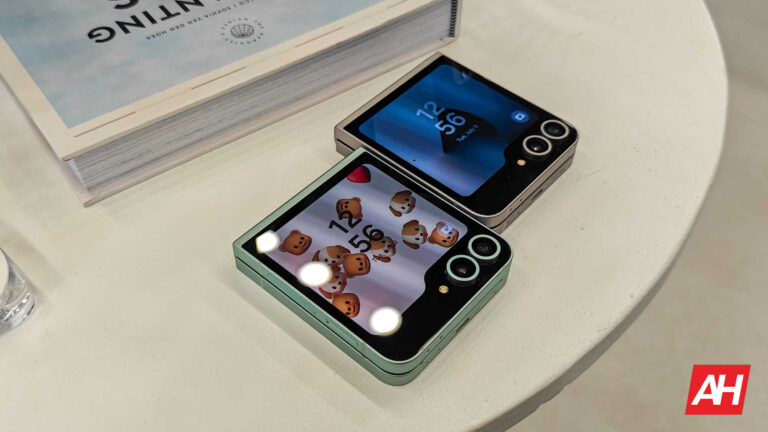
The Galaxy Z Flip 6 is poised to be the more popular foldable in Samsung’s 2024 foldable lineup, just as it has been in the past few years. Despite a $100 price increase. That’s right, the rumors and leaks were indeed true. The Galaxy Z Flip 6 is going up in price this year, starting at $1,099 for the 256GB model. It’ll be an extra $120 for the 512GB model – making it $1,219.
Pre-orders for the Galaxy Z Flip 6 start today, and we expect it to ship out by July 24. That puts it out at the same time as the Motorola Razr and Razr+ (2024), and ahead of the new Pixel devices.
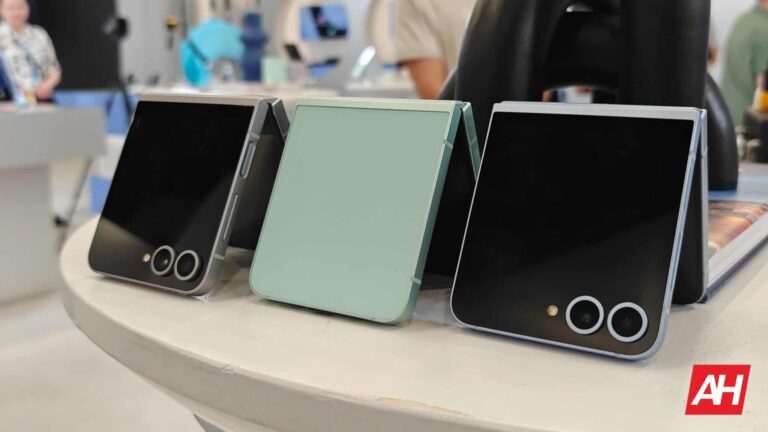
Samsung is selling the Galaxy Z Flip 6 in four colors: Silver Shadow, Yellow, Blue and Mint. Along with three more colors available exclusively at Samsung.com. These include Crafted Black, Peach and White. Like the Galaxy Z Fold 6, the “Crafted Black” color of the Flip 6 is going to have a nice Carbon Fiber look. Making it pretty unique.
Verizon, T-Mobile and AT&T will be selling the Galaxy Z Flip 6, however right now we only have pricing and promo offers from Verizon. Rest assured we will be updating this post as we get more information from other carriers and retailers. Verizon is offering up to $800 in trade-in credit when you trade in any Samsung phone in any condition. That’s $800 for new customers on Unlimited Ultimate, Unlimited Plus or Business Unlimited plans or $400 for new customers on Unlimited Welcome. For upgrades, that’s $400 for those on Unlimited Ultimate, Unlimited Plus or Business Unlimited plans, and $200 on Unlimited Welcome.
The Galaxy Z Flip 6 gets a major camera upgrade
This year, Samsung is giving the major camera upgrade to the Galaxy Z Flip 6. It’s gaining a 50-megapixel primary camera, along with a new 12-megapixel ultrawide camera. With Samsung moving the primary camera to 50-megapixels, this means that you’ll get lossless 2x optical zoom, since it can crop into the sensor.
Samsung is also adding in a larger battery this year, bringing it up to 4,000mAh, matching the new Razr+ (2024). It also is a 8% increase over the previous model, paired with the more energy efficient Snapdragon 8 Gen 3 for Galaxy, we should see some pretty good battery life this year.
Samsung has been doing a special Olympic Edition version of its Galaxy flagships for years now and that isn’t going to stop with the Galaxy Z Flip 6. Following today’s announcement of the Galaxy Z Flip 6 and Galaxy Z Fold 6 at the company’s Unpacked event, Samsung has officially confirmed this exclusive new version of one of its latest phones.
As with past devices, it comes in its own unique color that’s different from everything available to consumers. However, the color does look fairly similar to the Yellow color of the standard version of the phone. Albeit with some Olympic and Paralympic logo detailing on the back. This exclusive device carries a long tradition that Samsung has had in partnering with the Olympic games. But it also carries some firsts.
Samsung says this is the first time that it’s ever passed these phones out to athletes before they were available to consumers. They also “come with a full suite of services and useful apps” the company says. Additionally, all the phones come preinstalled with a few different services to make the athlete’s lives easier while in Paris for the games. This includes Live Translation, Interpreter, Composer, Instant Slow-mo, and Photo Assist.
Samsung will hand out 17,000 Galaxy Z Flip 6 Olympic Edition phones to athletes
If you were hoping to get your hands on one of these special edition phones, sadly, you’ll have to admire it from afar. Samsung is exclusively handing these out to Olympic athletes. That being said, if you happen to be an Olympic athlete then you should be expecting to receive one of these once you arrive in Paris to compete.
In addition to the phone, Samsung has packed in some other goodies. For instance, the Olympic Edition comes with a special Flipsuit Case made of Venezia leather. It features a unique patina that was designed to represent the colors of the Olympic rings. On top of this, the phone comes preloaded with an in-app pass in Samsung Wallet that gives athletes even more benefits.
This includes free beverages at vending machines throughout the Olympic and Paralympic Village in partnership with Coca-Cola. Additionally, there’s an unlimited public transport access card for traveling around the city.
You can pre-order the normal Galaxy Z Flip 6 from Samsung
You might not be able to get your hands on one of these Olympic Edition phones. However, you can pre-order the normal version from Samsung starting today. The Yellow color on offer is even fairly close to the color of this model that athletes get.
Plus, Samsung is offering at least a few different promotions to help you save money when you pre-order the device, including trade-in discounts. If the Flip isn’t really to your liking, then the Galaxy Z Fold 6 is on offer too.
The Galaxy Watch 7 and Galaxy Watch Ultra are finally official, and if you’re like us, you probably want to know when you can pre-order either or both of them. Both of these new watches usher in a new age of wearables with best-in-class features, some of them new and some of them features you’ve probably come to love from Samsung’s past wearables.
Things like Galaxy AI will deliver new possibilities that past Galaxy smartwatches haven’t. While trusty features like sleep tracking and analysis have improved capabilities and accuracy. Now that each watch has been officially announced, the clock is ticking on when you can put your very own on your wrist. The good news is that the wait won’t be too long. As they’ll be arriving just in time to finish out the Summer.
You can pre-order the Galaxy Watch 7 and Galaxy Watch Ultra on July 10
If you want to get a head start on securing your new watch, you can do so right away. Samsung has confirmed that pre-orders for both begin today, July 10. So if you’re looking to buy one, you can reserve yours now and be ready for when it starts to ship out to customers.
As for costs, the Galaxy Watch 7 will start at a very reasonable and competitive price of $299. This has been a standard for Samsung in the last few smartwatch generations. So there’s nothing really new here in terms of cost. What is new is the price tag of the Galaxy Watch Ultra, which is starting at $649. The cost is certainly higher, but the more durable design and added functionality may warrant the price.
Where to place your pre-order
When it comes to securing your Galaxy Watch 7 and/or Galaxy Watch Ultra, the usual places will apply. You can pre-order the watch directly from Samsung starting today, through Samsung’s website. It should also be available to pre-order in physical retailer locations that sell smartwatches and other fitness trackers. Especially if they already sell Samsung wearable products and smart devices.
Additionally, you’ll be able to pre-order both watches from places like Amazon, Best Buy, and other similar retailers online. On top of that, the LTE variants of either watch should be available from major US carriers like Verizon, AT&T, and T-Mobile as well. However, the timing on pre-orders may not be the same as with Samsung directly.
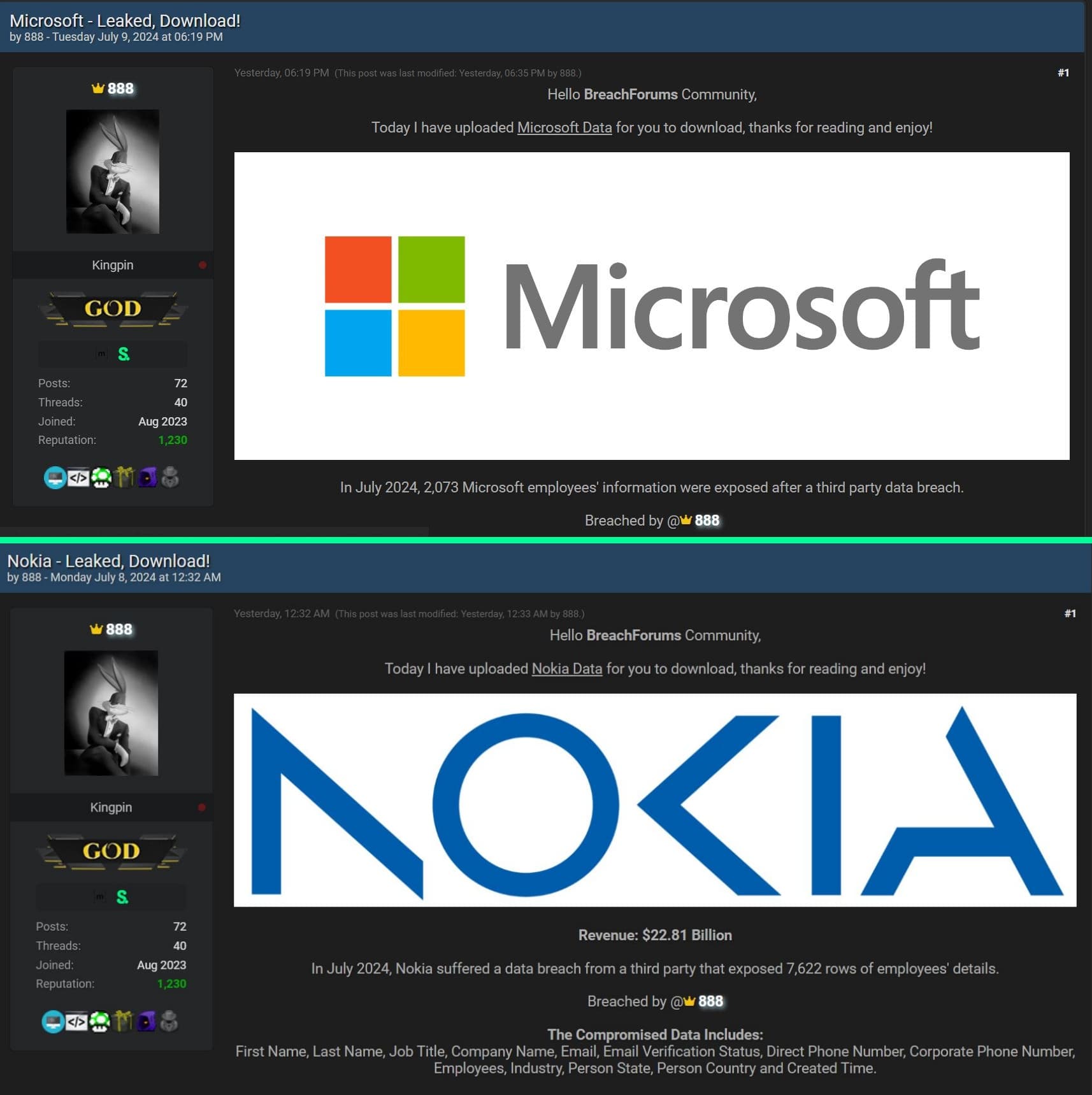
Hacker “888” leaks personal data of Nokia and Microsoft employees on Breach Forums. Data breaches at third-party contractors exposed contact details, posing identity theft and phishing risks.
A hacker known as “888” has leaked the personal and contact details of thousands of Nokia and Microsoft employees on the notorious cybercrime platform, Breach Forums. According to the hacker, both leaks resulted from data breaches at a third-party contractor, meaning neither Nokia’s nor Microsoft’s servers were breached or accessed directly.
888 on Breach Forums (Credit: Hackread.com)
Nokia Employee Data
The Hackread.com research team discovered that “888” leaked a CSV file on Breach Forums. After analyzing the file, it was concluded that it contains personal and business contact data of over 7,258 Nokia employees, including:
Job title
Full name
Company name
Country and State
Direct and corporate phone numbers
7,258 email addresses, all hosted on @Nokia.com
It is important to note that this is not a global Nokia data breach and does not contain data of all Nokia employees. The data includes information on 7,258 employees based in the US and Finland.
It is also worth noting that as of 2024, Nokia employs approximately 86,900 people globally, with locations including the United States, Ireland, Finland, UAE, India, France, Denmark, Portugal, Tunisia, and the Philippines. Additionally, it remains unclear whether this data is related to current or former employees, though the data ranges between June 2022 and February 2023.
Microsoft Employee Data
On Tuesday, July 9, 2024, Hackread.com’s research team observed “888” announcing another data leak, this time involving Microsoft employees. The total number of individuals impacted by this leak is 2,047. According to the hacker, this breach also stemmed from a third-party contractor. The leaked data includes:
Job title
Full name
City, State, and Country
Links to LinkedIn profiles
Company phone number
Direct and corporate phone numbers
2,047 email addresses, all hosted on @Microsoft.com
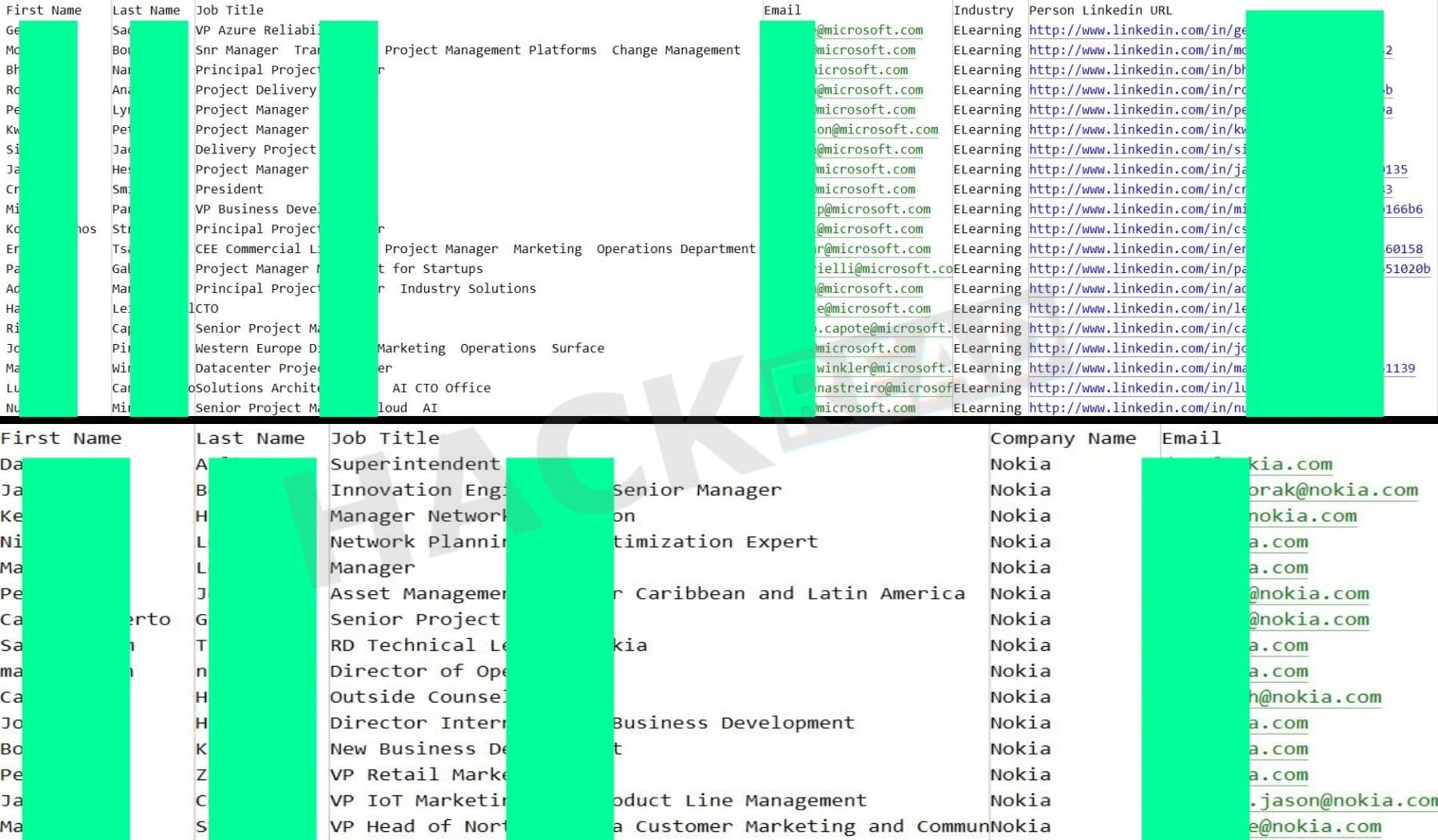
Screenshot from the leaked data (Credit: Hackread.com)
While no passwords or payment data were included in this leak, the presence of LinkedIn profiles poses a significant risk. State-backed actors and other malicious threat actors can use this information for identity theft, social engineering scams, and phishing attacks against employees. This tactic has proven to be quite successful in recent times, especially given Microsoft’s recent history of being targeted by Russian and Chinese hackers.
Implications and Threats
Although the absence of passwords and payment data might suggest a less severe impact, the potential threats remain substantial. The leaked information can be exploited for various malicious activities, including identity theft and targeted phishing attacks. Both Nokia and Microsoft, as well as their employees, should be alert and take necessary precautions to mitigate these risks.
Samsung has just announced its latest foldable smartphones the Galaxy Z Fold 6 and Galaxy Z Flip 6, and Xfinity is giving its customers a chance to upgrade to these new phones with hundreds of dollars in savings. The best part is that this offer is available all the way until mid-August. So you have a little bit of time to pick up either of these new devices and still save money.
Additionally, Xfinity Mobile is selling both the Galaxy Watch 7 and Galaxy Watch Ultra. As well as the Galaxy Buds 3 as optional pairings for the new device. So those who are truly excited about Samsung’s latest tech can scoop up all of it from Xfinity. That being said, there are a few different offers available from the carrier as part of its “Break Free From the Big Three” promotion.
And since we should all be about saving as much money as we can where it counts, these are definitely offers that Xfinity Mobile customers are going to want to take a look at.
Xfinity will give you up to $800 off on the Galaxy Z Fold 6 and Galaxy Z Flip 6
As you may have guessed, because it’s always the same with these kinds of offers, you’ll need to trade in an old device if you want to get the most amount of money taken off the price tag. So here’s what that looks like.
If you just go in and upgrade to either the Galaxy Z Fold 6 or Galaxy Z Flip 6, or buy them with a new line activation, you can get $500 off during the promotion period. You’ll also have to split the phone up into monthly bill payments to get the $500 savings. That discount is applied directly to the monthly payments too. So you end up paying less for the phone this way as opposed to buying it at full price upfront.
If you have an old phone to trade in, then you can save up to $300 more. Making this up to $800 in savings altogether.
The offer only lasts until August 12
There is potential here to save quite a bit if you’re looking to get one of Samsung’s new phones. So long as you pre-order or buy the device before August 12. Because that’s when Xfinity’s offer ends. The phones are available for pre-order starting today, and they officially launch on July 24. Pre-orders can be placed directly through Xfinity Mobile’s website. Alternatively, you can pick up the Galaxy Z Fold 6 and/or Galaxy Z Flip 6 directly through Samsung in the unlocked model and use them on Xfinity Mobile as well.
This might be worth looking into also as you could end up with a better promotional offer.
Samsung Galaxy Unpacked just happened, and the company showed off some exciting stuff. It unveiled its new foldable phones, the Galaxy Z Fold 6 and Galaxy Z Flip 6. Are you looking to get these phones at a good price? Well, T-Mobile is offering some killer deals on the new Galaxy foldables.
What’s that? You didn’t know that there was an event today? Samsung just had its latest Galaxy Unpacked event. During the event, we finally got our look at the Galaxy Watch. Along with that, the company unveiled the new Galaxy Watch 7 and Galaxy Watch 7 Ultra.
The most exciting announcements surrounded the new Galaxy foldables. The Galaxy Z Fold 6 brings much the same design with a thinner bezel and an updated processor. It’s much the same thing with the Galaxy Z Flip 6. Just as we expected, much of the announcement focused on the integration with Galaxy AI.
T-Mobile has some deals on the new Galaxy foldables
The Galaxy Z Fold 6 starts at $1,899.99 and the Flip starts at $1,099. These prices are $100 more than last year’s phones, and that’s not great in this economic climate. So, why not capitalize on some great deals? This is what T-Mobile is asking.
The Un-Carrier has some sweet deals for these tasty new phones. Obviously, you’ll need to be on T-Mobile’s network to have these deals. If you’re thinking of switching up and moving to T-Mobile then you’ll love these deals.
Those of you looking to pick up a Galaxy Z Flip 6 can get one for FREE when adding a new line or with a qualifying trade-in. The stipulation is that you need to be on the Go5G Plus or Go5G Next plan.
If the Galaxy Z Fold 6 is more of your speed, this deal also applies to this phone. You won’t get it for free, to be frank. Rather, you’ll get this phone for up to $1,100 off if you get a new line on the Go5G Plus or Go5G Next plan or trade in an eligible phone. That knocks the price down to $799.99. Imagine getting a Galaxy Z Fold 6 for around the price of a OnePlus 12!
The deals don’t stop there. If you pre-order either of these phones at T-Mobile, you’ll get double the storage. So, if you pre-order any phone, which starts at 256GB of storage, you’ll get the 512GB variant for the same price.
Galaxy Watches
You think that these deals are only for the phones? Nope! T-Mobile wants you to really get into the Galaxy ecosystem with some accessories. You can get a Galaxy Watch 7 (either the 40mm or the 44mm variant) for free when adding a line on an eligible plan. If you’re looking to get the Ultra, then you’ll get up to $380 off of a Galaxy Watch Ultra when adding a line.
There’s also a buy-one-get-one deal on the Galaxy Watches. When buying a Galaxy Watch at T-Mobile, you’ll get one of equal or lesser value for free (select watches only). You can only get this deal when adding a new Watch line. You need to remember that.
Bundle
There’s a new bundle deal. If you buy either a pair of Galaxy Buds FE, Galaxy Buds 3, or Galaxy Buds 3 Pro, you’ll get three accessories (case, screen protector, charger) and a 25% discount on the whole bundle. This is an in-store-only deal, and it starts on July 24th.
Multiple international cybersecurity agencies jointly warn of a PRC state-sponsored cyber group, linked to the Ministry of State Security and known by various names like APT40, Leviathan.
The group, based in Hainan Province, has targeted organizations globally, including in Australia and the US.
The Australian authorities recently released an advisory that provides case studies of their techniques, offering cybersecurity practitioners insights to identify, prevent, and remediate intrusions by this threat actor.
Chinese APT40 Is Ready To Exploit
APT40, though a persistent concern for Australian and other regional networks, adapts quickly to take advantage of fresh vulnerabilities.
They perform regular reconnaissance missions to identify weak infrastructural spots and prioritize the theft of credentials.
Having compromised websites in the past, the group shifted its focus to SOHO devices and is now using them as operational infrastructure and last-hop redirectors.
Like certain PRC-backed state actors, APT40’s adoption of this strategy enables it to pass off as actual traffic while encountering network defenders.
The investigation was triggered by the Australian Signals Directorate’s ACSC as a result of a network compromise by APT40 between July and September 2022.
The group abused a custom web application, which led to multiple access vectors and horizontal movement inside the network.
There was host enumeration, web shell usage, and sensitive data exfiltration including privileged credentials.
Through investigations, it has been established that there was deliberate targeting of a state-sponsored actor which underscores the need for proper network security measures as well as logging configurations.
Here’s the timeline:-
Timeline (Source – Gov.au)
The MITRE ATT&CK framework documents the cyber threat tactics. In April 2022, APT40 most likely breached an organization’s network by using a vulnerable remote access portal.
Web shells were planted to execute credential theft and potentially gain unauthorized access to internal systems.
The major tricks that they used involved public-facing apps’ exploitation, web shells deployment, login data capture, and lateral movement trials.
Australian Cyber Security Centre, established under the jurisdiction of the Australian Signals Directorate investigated and provided recommendations for remediation.
Mitigations
Here below we have mentioned all the mitigations:-
Maintaining proper logging history
Patch management
Network segmentation
Disable unnecessary network services and ports
Implement web application firewalls (WAFs)
Enforce least privilege access
Use multi-factor authentication (MFA) for all remote access
Replace outdated equipment
Review and secure custom applications
"Is Your System Under Attack? Try Cynet XDR: Automated Detection & Response for Endpoints, Networks, & Users!"- Free Demo





.webp)